
August 8, 2026
India's Energy Storage Ambitions Are Bigger Than Batteries
The global energy transition is rarely derailed by a lack of ambition. More often, it stalls because of architectural mismatch: the gap between what policymakers target and how the systems designed to deliver those targets are actually structured. Nowhere is this tension more visible than in India's approach to India energy storage policy, where a rapidly maturing regulatory framework for grid-scale batteries sits alongside an underdeveloped strategy for the hydrocarbon side of the storage equation. Understanding this gap is not just a matter of policy interest. It is central to whether India can sustain the energy security and decarbonisation trajectory it has committed to through both its Viksit Bharat 2047 vision and its 2070 net-zero target.
When big ASX news breaks, our subscribers know first
The Electrons-and-Molecules Blind Spot
India's current approach to the battery raw materials market has been shaped predominantly by the needs of the electricity grid. Battery energy storage systems (BESS) and pumped hydro have attracted most of the regulatory attention, the budget allocations, and the industrial policy instruments. However, this framing treats storage as a power sector problem when it is, in reality, a whole-of-economy challenge.
Gauri Jauhar, Executive Director of Strategic Climate and Clean Energy Initiatives at S&P Global Energy, has articulated this gap directly. Speaking at an S&P Global India Research Chapter event in New Delhi in May 2026, she noted that Indian storage planning currently operates as a collection of separate assessments — one for crude oil, another for LPG, another for gas, and yet another for grid power — rather than as a unified national architecture. The framing she advocated for treats electrons and molecules as interdependent components of a single storage system, not as separate policy domains managed by separate ministries.
This siloed structure has real costs. When crude import disruptions coincide with seasonal LNG supply tightness and a period of renewable energy curtailment, the absence of cross-vector coordination creates compounding vulnerabilities. A comprehensive India energy storage policy would require a stocks-and-flows model that maps the full spectrum of energy carriers against end-use sector requirements — from aviation fuel and LPG to pipeline gas and grid electricity — and then designs storage infrastructure around those interdependencies. Furthermore, S&P Global has noted that without an integrated approach, supply shocks across energy vectors become significantly harder to manage.
What the Numbers Demand: Grid Storage Targets and the ESO Mechanism
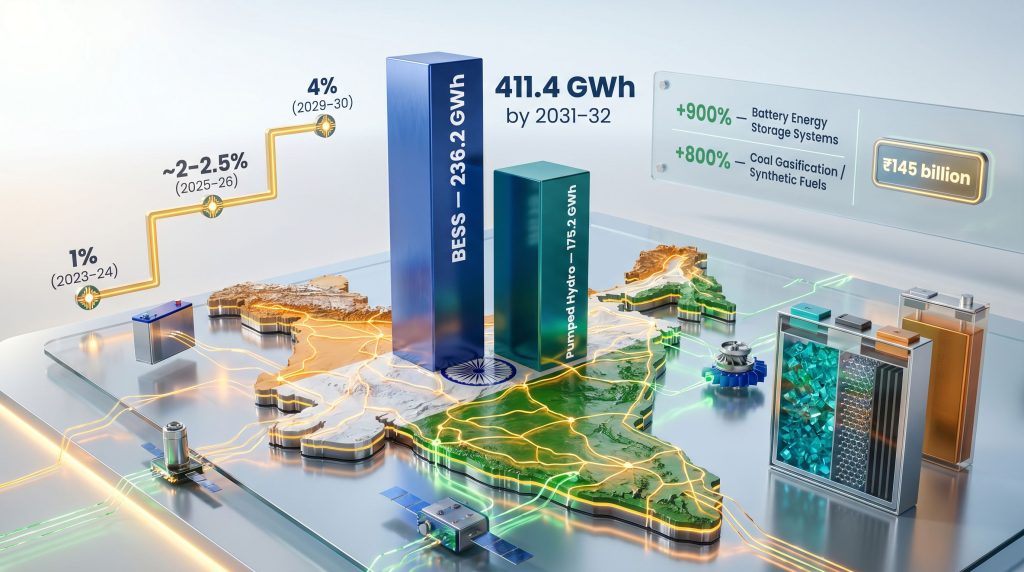
The quantitative scale of India's grid-side storage ambition is significant. The Central Electricity Authority has projected a requirement of approximately 411.4 GWh of total grid-connected storage capacity by 2031-32, broken down as follows:
| Storage Type | Estimated Requirement by 2031-32 |
|---|---|
| Battery Energy Storage Systems (BESS) | 236.2 GWh |
| Pumped Hydro Storage (PSP) | 175.2 GWh |
| Total Grid-Connected Storage | ~411.4 GWh / ~73.9 GW |
Driving this demand trajectory is the Energy Storage Obligation (ESO), a regulatory mechanism that requires distribution companies and other obligated entities to progressively increase their storage share of total electricity demand. The escalation schedule is structured as follows:
| Year | ESO Requirement (% of Demand) |
|---|---|
| 2023-24 | 1% |
| 2025-26 | ~2-2.5% |
| 2029-30 | 4% |
The ESO works through five key operational steps:
- Obligated entities such as distribution companies and open-access consumers are assigned a storage percentage relative to their total electricity demand.
- Annual ESO targets escalate progressively, creating a predictable demand signal for storage developers and investors.
- Compliance pathways include direct BESS ownership, long-term storage procurement contracts, or hybrid renewable-plus-storage power purchase agreements.
- Penalty and trading mechanisms are being developed to allow ESO certificate trading, mirroring the structure of existing Renewable Purchase Obligation certificate markets.
- State-level implementation is supported through Viability Gap Funding operational guidelines that allocate funds through state-level components.
Independent analysts from IEEFA and Berkeley IE-CEE have suggested that even these figures may understate the actual minimum required, with some estimates pointing toward 60 to 100 GW of storage capacity by the early 2030s once data centre load growth, industrial demand, and renewable curtailment risks are fully incorporated.
The Policy Architecture Behind the Build-Out
India's regulatory framework for India energy storage policy has evolved substantially over the past three years. The National Framework for Energy Storage Systems, introduced in August 2023, established three foundational principles that shaped everything that followed:
- A technology-agnostic positioning that does not privilege any single chemistry or storage mechanism across generation, transmission, and distribution applications.
- Legitimisation of multiple ownership and leasing models for energy storage systems, reducing barriers for private sector participation.
- An explicit linkage between storage deployment and India's commitment to achieving 50% non-fossil electricity capacity by 2030.
The Electricity Rules Amendment of September 2025 extended this architecture by providing legal clarity for storage operators on grid access, dispatch rights, and revenue recognition — areas where regulatory ambiguity had previously constrained investment decisions. Co-location mandates embedded in new solar tenders now require a minimum 10% BESS capacity alongside solar installations, creating a structural link between renewable capacity additions and storage deployment.
The hybrid tender share in India's renewable energy auction market grew from approximately 12% of total auctions in 2021 to over 49% by 2024, reflecting how rapidly co-location requirements have become the norm rather than the exception.
Budget Signals: The 900% BESS Allocation and What It Actually Means
The Union Budget 2026-27 delivered what may be the clearest signal yet of India's storage priorities. Jauhar highlighted that budget allocations to battery energy storage systems increased by approximately 900% year-on-year, while allocations to coal gasification for synthetic fuels rose by more than 800%. These are not incremental adjustments but category-redefining shifts that indicate these technologies have moved from pilot-phase consideration to infrastructure-scale deployment mandates.
| Technology Area | Budget Allocation Change (YoY) |
|---|---|
| Coal Gasification / Synthetic Fuels | +800% |
| Battery Energy Storage Systems | +900% |
| Hydrogen and CCUS | Significant increase |
| Nuclear R&D | Increased allocation |
The Viability Gap Funding (VGF) mechanism has been the primary financial instrument for de-risking early BESS deployment. Two tranches have been committed:
- First VGF Tranche: ₹91 billion (approximately USD 1.09 billion) supporting around 43.2 GWh of BESS capacity.
- Second VGF Tranche: ₹54 billion (approximately USD 631 million) supporting an additional ~30 GWh of BESS capacity.
- Combined commitment: Approximately ₹145 billion, structured in three disbursement stages to reduce execution risk.
This combined ₹145 billion commitment signals that BESS is being treated as core national infrastructure rather than an experimental technology class. The Production Linked Incentive (PLI) scheme for Advanced Chemistry Cells targets 50 GWh of domestic battery manufacturing capacity, and ISTS charge waivers for co-located storage projects are restructuring the transmission economics that previously made standalone storage projects commercially marginal.
Battery Manufacturing: Where the PLI Scheme Meets Supply Chain Reality
Is India's Supply Chain Ready for the Scale Required?
India's domestic battery manufacturing ambitions face a structural tension. The PLI for ACC batteries provides a clear demand-side incentive, but lithium-ion supply chains remain heavily import-dependent, with lithium carbonate, battery-grade cathode materials, and separators all sourced predominantly from China or processed through Chinese supply chains. In addition, the battery raw materials market continues to experience significant price volatility that complicates long-term project planning.
Jauhar's recommendation to explore advanced cell chemistries that draw on more domestically available raw materials points toward sodium-ion technology as a strategically important alternative. Sodium-ion cells do not require lithium, cobalt, or nickel in meaningful quantities, and India has potential access to sodium-based mineral inputs through domestic sources.
Furthermore, technologies like direct lithium extraction are emerging as viable tools to improve lithium recovery efficiency globally, though India's upstream integration into these supply chains remains limited. While sodium-ion currently carries lower energy density compared to lithium-ion, its cost trajectory and supply chain independence make it particularly relevant for stationary grid storage applications where volumetric density is less constrained than in mobile applications.
The PLI for ACC batteries provides a policy foundation for next-generation cell manufacturing, but analysts note that without complementary action on duty structures for lithium imports and upstream mineral processing, the cost competitiveness of domestically manufactured cells relative to imported Chinese packs will remain a persistent challenge.
The next major ASX story will hit our subscribers first
Solar at 22% of Peak Demand: What Integration Risk Looks Like From Here
India's 2025 renewable energy additions marked a landmark: for the first time, solar and other non-fossil capacity additions outpaced coal, gas, and other fossil-fuel based power in a single year. More operationally significant was the observation, highlighted by Jauhar, that solar contributed approximately 22% of India's peak power demand at certain intervals in 2025.
This milestone carries a double implication. On one side, it demonstrates that variable renewable energy is now large enough to meaningfully influence peak demand management, reducing reliance on expensive peaking gas plants. On the other, it signals that the grid is approaching penetration levels where storage deployment must keep pace with renewable additions or risk systemic curtailment.
When solar capacity grows faster than storage capacity, the surplus generation during midday peaks cannot be absorbed or shifted, leading to curtailment events that erode the economic case for new renewable investment and create stranded asset risk across the generation portfolio.
Data centre expansion adds a new dimension to this equation. Following government announcements of income-tax exemptions for data centres extending to 2047, the sector is projected to represent a substantial and relatively predictable incremental load. Unlike industrial demand, data centres can, if properly configured, be designed as demand-response assets that absorb surplus renewable generation during curtailment-risk periods.
The Gas Storage Gap: Why 15% Is Not Just a Volume Target
India's stated ambition to raise natural gas to 15% of the energy mix is frequently discussed in the context of upstream exploration, LNG terminal capacity, and pipeline infrastructure. Less frequently discussed is what 15% gas penetration actually demands in terms of storage infrastructure.
Gas demand in India is highly seasonal. Fertiliser production creates summer demand peaks, while space heating and industrial applications drive winter consumption in northern regions. Strategic gas reserves that can buffer import supply disruptions and inter-seasonal demand swings require a fundamentally different type of infrastructure thinking than either grid-scale batteries or liquid hydrocarbon storage.
Jauhar's framing that achieving a 15% gas share requires futuristic thinking about storage types points toward underground gas storage facilities, expanded LNG terminal regasification buffers, and potentially synthetic methane or green methanol as seasonal storage vectors. None of these are adequately addressed within the current regulatory framework for either the power sector or the upstream hydrocarbon sector.
Multi-Fuel Mobility and What It Means for Storage Planning
India's electric mobility transition is frequently discussed as a binary shift from fossil fuels to EVs. The operational reality is considerably more complex. Jauhar's characterisation of India as a country pursuing a hybrid mobility model — where CNG vehicles, multi-fuel platforms, and electric vehicles coexist across a diverse geographic and economic landscape — reflects the multi-decade timeline over which the transition will unfold.
Heavy-duty transport presents the sharpest challenge. Long-haul trucking, construction equipment, and mining vehicles remain economically dependent on diesel, and the energy density requirements for those applications make battery electrification a long-run rather than near-term proposition. This persistent diesel demand has direct implications for strategic petroleum reserve sizing and LPG buffer stock requirements that sit outside the current BESS-focused policy framework.
On ethanol, the government's trajectory from the achieved E20 blending target toward E100 ambitions introduces feedstock availability as a binding constraint. Whether sugarcane, corn, or cellulosic biomass can supply the volumes required for widespread E100 adoption without competing with food production is a question that intersects with agricultural storage capacity, not just refinery configuration.
Pumped Hydro vs. BESS: Matching Technology to Application
The 411.4 GWh storage target contains an important internal division. Of the total, 175.2 GWh is allocated to pumped storage projects (PSP) and 236.2 GWh to BESS. This split reflects a technology-neutral planning philosophy, but the operational characteristics of the two technologies serve distinctly different functions.
| Characteristic | Pumped Hydro (PSP) | BESS |
|---|---|---|
| Discharge Duration | 8-12+ hours (long-duration) | 2-4 hours (typically) |
| Response Time | Minutes | Milliseconds |
| Capital Cost | High upfront, low marginal | Declining rapidly |
| Scalability | Site-constrained | Highly flexible |
| Lifespan | 50+ years | 15-20 years |
| Best Application | Seasonal and weekly balancing | Intra-day peak shifting |
New competitive bidding guidelines introduced in February 2025 for pumped storage projects are intended to accelerate PSP deployment by reducing the approval timelines that have historically constrained project development. The technology-neutral procurement framework ensures that storage developers can optimise technology selection based on site conditions and grid service requirements rather than being directed toward a single solution.
Execution Risk: The Gap Between Target and Delivery
With approximately 35.8 GWh of BESS capacity currently under construction in India, the pathway from policy commitment to operational storage infrastructure contains several execution risks that deserve explicit acknowledgment:
- Supply chain concentration: Lithium and critical mineral import dependency from a small number of source countries creates price and availability volatility that can affect project economics at any stage of the construction cycle. Consequently, Indian lithium investment strategies are becoming increasingly important to long-term supply security.
- Grid curtailment risk: If renewable capacity additions continue to outpace storage deployment, curtailment events will create financial pressure on solar and wind project developers and may slow the pace of future auctions.
- State-level heterogeneity: Distribution companies across India's 28 states operate under significantly different financial conditions, technical capabilities, and regulatory environments, making uniform ESO compliance rates unlikely.
- The molecule-side blind spot: The absence of an integrated framework covering crude, LPG, and gas storage means that supply disruptions in hydrocarbon markets can undermine energy security even as grid storage targets are met.
- Project financing: While VGF reduces viability risk for early tranches, the commercial financing market for later-stage BESS projects will need to price in construction, offtake, and technology obsolescence risks across 15-20 year asset lifetimes.
Building a Truly Integrated Architecture: Five Structural Reforms
Moving from the current fragmented framework to a genuinely integrated national energy storage architecture would require targeted structural interventions across regulatory, financial, and institutional dimensions. Five reforms would have the most systemic impact:
- Establish a cross-ministerial storage coordination authority that integrates planning across the Ministry of Power, Ministry of Petroleum and Natural Gas, and Ministry of New and Renewable Energy, eliminating the regulatory siloes that currently separate electrons from molecules.
- Extend the ESO framework to include hydrocarbon storage obligations, creating a parallel mechanism that requires obligated entities in the oil and gas supply chain to maintain strategic buffer stocks calibrated to seasonal demand variation and import disruption scenarios.
- Accelerate sodium-ion chemistry development through targeted PLI extensions and dedicated R&D funding, reducing the strategic risk created by lithium import dependency. In addition, developing an India lithium refinery capability would further strengthen domestic processing capacity for next-generation storage technologies.
- Integrate data centre demand-response requirements into grid storage planning, requiring large data centre operators to configure a portion of their load as dispatchable demand response that can absorb renewable surplus and reduce curtailment risk.
- Develop a unified national energy storage atlas that maps BESS deployment, pumped hydro sites, LNG terminal buffers, and strategic petroleum reserves into a single operational picture, enabling coordinated response to multi-vector supply disruptions. Furthermore, battery supply chain alliances with partner nations could meaningfully strengthen India's resilience against single-source supply risks.
Furthermore, RMI's analysis on catalysing energy storage in India reinforces that financial de-risking mechanisms must be paired with institutional reforms to achieve the scale of deployment India's targets require.
Disclaimer: This article is intended for informational purposes only and does not constitute financial or investment advice. Projections and targets cited reflect publicly available regulatory and industry estimates and are subject to change. Readers should conduct independent research before making any investment or policy-related decisions.
Frequently Asked Questions: India Energy Storage Policy
What is India's total energy storage target by 2031-32?
Based on Central Electricity Authority projections, India's grid-connected storage target reaches approximately 411.4 GWh by 2031-32, comprising 236.2 GWh of BESS and 175.2 GWh of pumped hydro storage.
What is the Energy Storage Obligation and how does it escalate?
The ESO is a regulatory mandate requiring distribution companies to increase their storage share from 1% of electricity demand in 2023-24 to 4% by 2029-30, with progressive annual escalation targets in between.
What financial instruments support BESS deployment in India?
The primary instruments include approximately ₹145 billion in Viability Gap Funding across two tranches covering around 73 GWh of BESS capacity, a PLI scheme targeting 50 GWh of domestic battery manufacturing, and ISTS charge waivers for co-located renewable-storage projects.
Why is sodium-ion battery chemistry strategically relevant for India?
Sodium-ion technology does not rely on lithium, cobalt, or nickel, meaning its raw material supply chain can draw more heavily on domestically available inputs. For stationary grid storage applications where volumetric energy density is less critical than in EVs, sodium-ion presents a viable path to reducing India's import dependency for battery materials.
What percentage of India's peak power demand did solar meet in 2025?
Solar energy contributed approximately 22% of India's peak power demand at certain intervals in 2025, representing a significant milestone in the country's renewable integration trajectory.
Why does India's gas storage infrastructure require separate policy attention?
India's target of raising natural gas to 15% of the energy mix creates seasonal balancing and import security requirements that existing LNG terminal and pipeline infrastructure is not designed to address. Achieving that target requires dedicated strategic gas reserve capacity and inter-seasonal storage infrastructure that sits outside the current grid-focused India energy storage policy framework.
Want To Track The ASX Stocks Powering India's Battery Storage Revolution?
As India's energy storage ambitions drive demand for lithium, sodium, and critical minerals, Discovery Alert's proprietary Discovery IQ model delivers real-time alerts on significant ASX mineral discoveries — turning complex data across 30+ commodities into clear, actionable investment insights. Explore historic mineral discoveries and their market returns, then begin your 14-day free trial at Discovery Alert to position yourself ahead of the next major find.