July 18, 2026
India energy supply chain diversification has become a critical strategic imperative as the nation confronts mounting geopolitical tensions, supply chain vulnerabilities, and energy transition demands. Energy security vulnerabilities have become defining characteristics of the global economic landscape, with major importing nations increasingly recognising that supply chain concentration represents a strategic weakness rather than operational efficiency. Traditional procurement models that prioritise cost optimisation over resilience have proven insufficient when geopolitical disruptions threaten critical energy flows. This fundamental shift in strategic thinking has prompted large-scale reassessment of energy partnership architectures, with diversification emerging as both an immediate tactical necessity and long-term strategic imperative.
Understanding Strategic Energy Dependencies and Their Systemic Risks
India's position within global energy markets exposes multiple layers of strategic vulnerability that extend far beyond simple import statistics. As the world's third-largest crude oil importer, fourth-largest refiner, and fifth-largest exporter of petroleum products, the nation operates within complex interdependencies that amplify both opportunity and risk across its energy ecosystem.
Quantifying Critical Import Exposures Across Energy Sectors
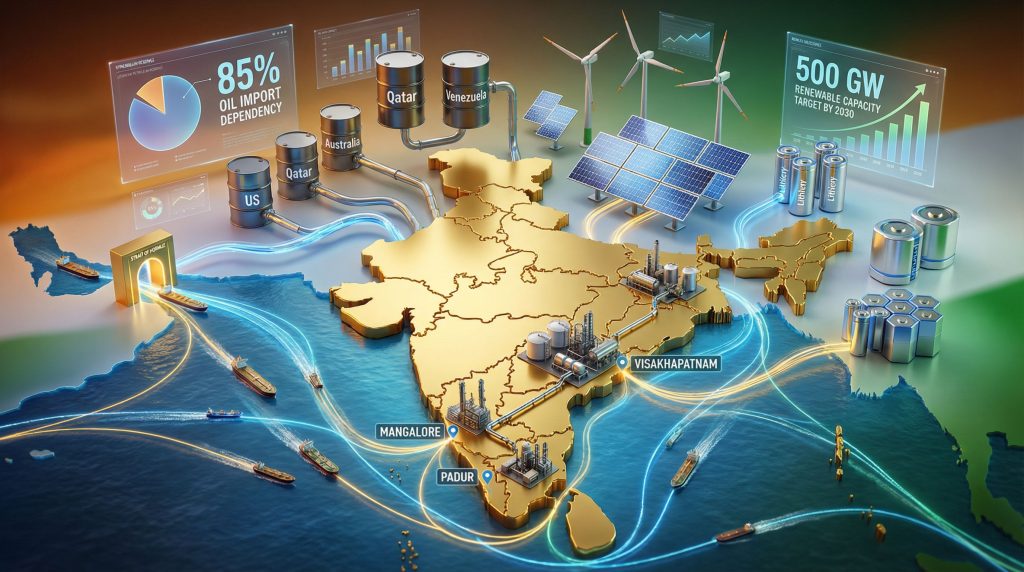
Current oil import dependency exceeding 85% creates an estimated $150+ billion annual trade exposure that fluctuates with global price volatility and currency exchange movements. This massive financial outflow represents not merely a trade balance challenge but a strategic vulnerability that affects monetary policy, fiscal planning, and economic stability during periods of supply disruption.
Liquefied Natural Gas (LNG) projections indicate import requirements reaching 90 million metric tons per annum by 2050, representing a 4.8% compound annual growth rate that will significantly expand India's exposure to international gas market dynamics. Furthermore, this growth trajectory occurs alongside domestic gas production decline, creating an expanding gap between supply and demand that must be filled through international procurement.
Coal production targets of 1.5 billion tonnes by 2030 represent attempts to reduce external reliance, though this domestic expansion strategy faces environmental constraints, technological limitations, and infrastructure development challenges that may limit its effectiveness as a complete import substitution solution.
Critical mineral dependencies present perhaps the most complex vulnerability profile, with 80% reliance on single-source suppliers for solar panel components, battery materials, and wind turbine elements essential for clean energy transition. This concentration risk extends beyond traditional fossil fuel vulnerabilities into the renewable energy sector, creating new forms of strategic dependency that require attention to critical minerals energy security.
Geopolitical Chokepoint Assessment and Regional Conflict Scenarios
The Strait of Hormuz vulnerability affects approximately 40% of global oil transit, creating a singular geographic bottleneck that can disrupt energy flows to multiple importing nations simultaneously. Indian energy companies have developed alternative supply arrangements that avoid this critical passage, representing a significant strategic achievement in supply chain diversification.
South China Sea tensions impact LNG shipment routes connecting major Pacific suppliers with Asian importing markets. These maritime security concerns extend beyond immediate disruption risks to include longer-term questions about shipping insurance costs, route reliability, and alternative transportation infrastructure development.
Supply chain concentration risks in rare earth elements and battery materials create technological vulnerabilities that compound traditional energy security concerns. Single-country dominance in critical mineral processing capabilities means that trade disputes or production disruptions can affect multiple sectors simultaneously.
Regional conflict scenarios require continuous assessment of their energy security implications. In addition, the establishment of a 24×7 control room monitoring fuel supply and stock levels across the country demonstrates institutional recognition that real-time situational awareness is essential for managing supply chain disruptions effectively.
When big ASX news breaks, our subscribers know first
Analysing India's Evolving Energy Partnership Architecture
Strategic diversification requires systematic development of alternative supply relationships that provide both volume capacity and reliability during crisis periods. This partnership matrix extends beyond simple buyer-seller transactions to include long-term supply agreements, infrastructure investments, and technological cooperation arrangements.
Crude Oil Supply Source Transformation and Geographic Spread
Multi-source procurement strategies now encompass crude supplies from 41 countries, representing a deliberate geographic diversification that reduces dependence on any single region or supplier. This expansion provides negotiating leverage, price discovery opportunities, and alternative supply activation capabilities during disruption scenarios.
US crude oil imports reaching 235,000 barrels per day represent both a commercial relationship and a strategic partnership that provides access to North American production growth. This Atlantic Basin supply source offers geographic diversification from traditional Middle Eastern suppliers while supporting broader bilateral energy cooperation initiatives.
Russian oil arrangements fluctuating from peak volumes of 1.5 million barrels per day to current levels of 436,000 barrels per day demonstrate the complex intersection of commercial opportunity, sanctions compliance, and geopolitical considerations that characterise international energy procurement in the current environment. This volatility has contributed to the broader oil price rally affecting global markets.
Venezuelan oil evaluation represents exploration of additional supply optionality, though sanctions compliance requirements and commercial viability assessments continue to influence the feasibility of expanded procurement from this source.
Natural Gas Partnership Development and Infrastructure Integration
Qatar long-term contract negotiations balanced with spot market flexibility provide both supply security and price optimisation opportunities. Long-term agreements ensure volume availability during tight market conditions, while spot market access enables cost management during periods of supply abundance.
Australian LNG partnerships support Indo-Pacific energy security cooperation and provide alternative supply sources that utilise different shipping routes and eliminate Middle Eastern chokepoint dependencies. These arrangements often include infrastructure development components and technology sharing elements that reflect current natural gas trends.
Domestic gas production decline mitigation requires coordination between import procurement strategies and upstream development investments. With 2.6% compound annual growth rate demand projections, import requirements will continue expanding regardless of domestic production optimisation efforts.
Pipeline infrastructure development for Central Asian gas access represents long-term supply diversification that would provide overland transportation alternatives to maritime LNG imports, though political stability and transit country relationships affect the viability of such arrangements.
Critical Materials Supply Chain Mapping and Partnership Development
| Resource Category | Current Dependency | Target Diversification | Key Partner Countries |
|---|---|---|---|
| Lithium | 100% imports | Domestic processing + partnerships | Australia, Chile, Canada |
| Solar Wafers/Cells | 80% China-dependent | 50% domestic by 2030 | Vietnam, Thailand, India |
| Wind Turbine Components | 60% concentrated sourcing | Multi-vendor strategy | Denmark, Germany, domestic |
| Battery Materials | 90% import-dependent | Strategic reserves + processing | Indonesia, DRC, Australia |
These partnerships require coordination between trade relationships, investment agreements, and technology transfer arrangements that enable both supply access and domestic value chain development. For instance, developments in an Indian lithium refinery represent significant progress towards reducing import dependency.
Strategic Reserve Infrastructure and Supply Chain Resilience Architecture
Physical infrastructure supporting supply chain resilience extends far beyond simple storage capacity to include transportation networks, processing facilities, and emergency response systems that enable rapid adaptation to supply disruptions.
Strategic Petroleum Reserve Capacity and Emergency Response Systems
Current strategic petroleum reserves totalling 39 million barrels across three locations (Visakhapatnam, Mangalore, and Padur facilities) provide approximately 10-day import coverage based on current consumption levels. This buffer capacity enables short-term supply disruption management while alternative procurement arrangements are activated.
Planned expansion to 132 million barrels represents a 3.4x increase in strategic reserve capacity, suggesting recognition that longer-duration disruptions require more substantial buffer inventory. This expansion timeline and additional facility locations will significantly enhance crisis response capabilities.
Regional distribution strategy minimises single-point-of-failure risks by dispersing reserves across multiple geographic locations with different transportation access points. This distribution provides operational flexibility and reduces vulnerability to localised infrastructure disruptions.
Real-time monitoring capabilities through the 24×7 control room system enable continuous assessment of supply and stock levels across the national distribution network. This operational intelligence infrastructure supports decision-making during crisis periods and enables rapid response to emerging supply challenges.
Refinery Infrastructure Flexibility and Processing Optimisation
Complex refinery configurations enable processing of diverse crude oil types, providing operational flexibility that supports supply diversification strategies. The ability to process varying crude qualities and characteristics reduces dependence on specific crude grades and enables optimisation based on available supply sources.
Capacity utilisation optimisation across 23 refineries with 5 million barrels per day total processing capacity provides substantial domestic refining capability that processes both imported crude and domestic production. This refining infrastructure supports India's position as a major petroleum products exporter.
Product export capabilities establish India as the fifth-largest global petroleum products exporter, creating revenue streams that partially offset crude oil import costs while demonstrating downstream value-added processing capabilities.
Downstream integration reduces import dependency for refined products by maximising domestic refining throughput and product yield optimisation. This integration provides both economic benefits and strategic independence from refined product imports.
Domestic Production Strategy and Energy Independence Pathways
While import diversification provides immediate supply security benefits, domestic production expansion offers long-term strategic independence that reduces overall external dependency. However, domestic production growth must be evaluated against rising energy demand to assess net import reduction potential.
Upstream Development and Production Enhancement Initiatives
Domestic crude oil production targeting reduced import dependency from current 87% levels requires substantial upstream investment, enhanced recovery technologies, and exploration expansion across both onshore and offshore basins. Production decline in mature fields necessitates both new field development and enhanced recovery implementation.
Exploration licensing rounds designed to attract international investment and technology transfer provide access to advanced exploration techniques and financial resources that domestic companies may lack independently. These licensing arrangements balance foreign investment access with domestic capability development.
Offshore drilling expansion in Krishna-Godavari and Mumbai High basins targets remaining hydrocarbon resources in established producing regions while exploring new prospects that could provide additional domestic supply sources.
Enhanced oil recovery techniques become essential for maximising productivity from existing fields as primary recovery methods experience natural decline rates. These technologies can extend field life and increase ultimate recovery factors significantly.
Renewable Energy Manufacturing and Supply Chain Localisation
Strategic Policy Framework: Production Linked Incentive (PLI) schemes allocated ₹19,500 crores for solar manufacturing, targeting 65 GW domestic capacity by 2026-27 through manufacturing incentives and domestic content requirements.
Solar module manufacturing expansion targets second-largest global capacity with vertical integration objectives that encompass polysilicon production, wafer manufacturing, cell production, and module assembly. This complete value chain development reduces import dependency across all solar manufacturing stages.
Approved List of Models and Manufacturers (ALMM) ensures quality standards while providing domestic preference in government procurement. This regulatory framework supports domestic manufacturing viability by guaranteeing market access for compliant domestic producers.
Wind turbine component manufacturing through technology transfer partnerships enables domestic production of nacelles, blades, towers, and control systems. These partnerships provide technology access while developing domestic manufacturing capabilities that contribute to mining decarbonisation benefits.
Battery cell manufacturing facilities targeting 50 GWh capacity by 2030 support electric vehicle adoption and grid-scale energy storage deployment while reducing dependence on imported battery systems.
Clean Energy Transition and Supply Chain Security Integration
Energy transition strategies must address supply chain vulnerabilities inherent in renewable energy technologies while simultaneously reducing dependence on fossil fuel imports. This dual objective requires coordination between clean energy deployment and supply chain localisation initiatives.
What Are the Renewable Energy Deployment Targets?
500 GW renewable capacity targets by 2030 requiring 50 GW annual capacity additions create massive demand for solar panels, wind turbines, and energy storage systems. This deployment scale provides market foundation for domestic manufacturing while requiring substantial supply chain coordination.
Green hydrogen production targets of 5 million tonnes annual production by 2030 enable industrial decarbonisation while creating potential export opportunities. Hydrogen production requires renewable electricity input, creating additional demand for clean energy infrastructure.
Electric vehicle adoption supporting battery demand creates domestic market foundation for battery manufacturing while reducing petroleum product consumption. Vehicle electrification affects both energy demand patterns and critical material requirements.
Biofuel blending mandates (20% ethanol, 5% biodiesel) reduce oil import requirements while supporting agricultural sector development and rural economic development objectives.
Critical Mineral Security Through Investment and Partnership Strategies
Khanij Bidesh India Ltd. (KABIL) secures mining assets across multiple continents, providing direct access to critical mineral sources essential for clean energy technology manufacturing. These overseas investments reduce supply chain vulnerabilities while providing long-term resource access.
Lithium exploration partnerships in Australia, Chile, and Argentina target direct access to lithium resources essential for battery manufacturing. These partnerships often include processing technology development and supply agreement components.
Cobalt and nickel investments in Indonesia and Democratic Republic of Congo provide access to materials essential for battery cathode production. These investments require careful evaluation of political stability, environmental standards, and operational risks.
Rare earth element supply agreements with non-Chinese producers reduce concentration risks in materials essential for wind turbine generators, solar inverters, and electric vehicle motors.
Policy Framework and Market Mechanisms Supporting Diversification
Effective supply chain diversification requires coordination between procurement policies, regulatory frameworks, and market mechanisms that incentivise alternative supplier development while maintaining cost competitiveness and reliability standards.
Procurement Strategy Implementation and Risk Management
Government procurement priorities emphasising availability, affordability, and reliability provide clear decision-making criteria that balance cost optimisation with supply security objectives. These priorities guide purchasing decisions during both normal market conditions and crisis periods.
Flexible purchasing arrangements enable refiners and importers to optimise procurement based on market conditions, supplier reliability, and geopolitical developments. This flexibility provides adaptation capability during changing market circumstances.
Long-term contracts balanced with spot market opportunities provide both supply security and cost optimisation. Long-term agreements ensure volume availability while spot purchases enable price advantage capture during favourable market conditions.
Currency hedging strategies reduce foreign exchange exposure on energy imports, providing financial risk management that complements supply diversification efforts. These hedging arrangements enable budget predictability despite currency volatility.
Regulatory Architecture Supporting Supply Chain Resilience
| Policy Instrument | Objective | Implementation Timeline | Expected Impact |
|---|---|---|---|
| Domestic Content Requirements | Solar sourcing from approved suppliers | June 2026 onwards | 30% cost reduction, supply security |
| Critical Mineral Mission | Secure overseas mining investments | 2024-2030 | 50% import dependency reduction |
| Green Energy Corridors | Transmission infrastructure for renewables | 2025-2027 | Grid stability, renewable integration |
| Hydrogen Mission | Domestic production ecosystem development | 2025-2030 | Export potential, industrial decarbonisation |
These regulatory frameworks provide market certainty for domestic manufacturers while ensuring supply security through diversified sourcing requirements and quality standards.
The next major ASX story will hit our subscribers first
Geopolitical Partnership Evolution and Strategic Cooperation
Energy partnership development occurs within broader geopolitical relationships that affect trade agreements, technology transfer arrangements, and long-term supply security cooperation. These relationships require continuous management and adaptation based on changing international circumstances.
US-India Energy Cooperation and Technology Partnership
Crude oil import expansion from the United States reaching strategic significance demonstrates commercial relationship development that provides alternative supply sources while supporting broader bilateral cooperation objectives.
LNG long-term supply agreements with US producers provide volume security while utilising different transportation routes and supply infrastructure compared to traditional suppliers. These agreements often include price mechanisms that provide both parties with market exposure and risk management.
Clean energy technology partnerships in solar manufacturing, wind energy development, and hydrogen production enable technology transfer while building domestic capabilities. These partnerships often combine commercial arrangements with research and development cooperation.
Critical mineral supply chain collaboration through Quad initiatives provides multilateral framework for resource access and supply chain resilience development across participating countries.
Traditional Partnership Recalibration and Risk Management
Middle East relationship management balances traditional supply partnerships with diversification objectives, maintaining reliable supplier relationships while reducing over-dependence on any single region or transportation route.
UAE and Saudi Arabia investments in Indian refining and petrochemical infrastructure create mutual interdependence that supports supply relationship stability while providing capital for domestic capacity expansion.
Iran oil procurement considerations remain subject to international sanctions compliance and geopolitical risk assessment, demonstrating the complex intersection between commercial opportunity and international relations.
Regional stability assessment continuously influences procurement decisions and long-term supply arrangement development, requiring ongoing evaluation of political risks and alternative supplier activation capabilities. However, these assessments must consider India's broader energy supply vulnerabilities.
Future Scenario Planning and Resilience Stress Testing
Comprehensive supply chain resilience requires systematic evaluation of potential disruption scenarios and preparation of response mechanisms that can be rapidly deployed during crisis periods. These scenario assessments inform infrastructure investment decisions and partnership development priorities.
Crisis Response Capability Assessment and Stress Testing
Regional conflict scenarios affecting 25% of crude imports within 30-day timeframes provide stress testing parameters for alternative supplier activation and reserve utilisation strategies. These scenarios evaluate the adequacy of current buffer capacity and alternative supply arrangements.
Single supplier disruption impact assessment evaluates the consequences of losing individual major suppliers and tests the availability and adequacy of alternative sources. These assessments identify supply chain vulnerabilities and guide diversification investment priorities.
Climate-related infrastructure disruption scenarios including cyclones, flooding, and extreme weather events test the physical resilience of transportation networks, storage facilities, and processing infrastructure.
Technology supply chain restriction scenarios evaluate the impact of trade restrictions, export controls, or supplier concentration disruptions affecting clean energy technology deployment and manufacturing capability development.
Adaptive Response Systems and Emergency Protocols
24×7 monitoring control room operations provide real-time supply chain oversight with decision-making authority to activate emergency procurement protocols, authorise strategic reserve releases, and coordinate supplier communications during crisis periods.
Emergency procurement protocols enable rapid supplier switching, contract modification, and alternative transportation arrangement activation without normal approval processes. These protocols balance speed of response with appropriate oversight and cost control.
Strategic partnership activation procedures provide frameworks for accessing priority supplier arrangements, government-to-government communication channels, and multilateral cooperation mechanisms during supply emergencies.
Alternative energy pathway acceleration during crisis periods includes demand management measures, fuel substitution capabilities, and emergency conservation protocols that reduce import requirements temporarily.
How Does Integration Create Strategic Advantages?
Successful India energy supply chain diversification requires integration across multiple strategic dimensions simultaneously. Geographic diversification must complement technology localisation, financial risk management must coordinate with supplier relationship development, and infrastructure investments must support multiple supply pathway options effectively.
Strategic Framework Integration and Implementation Coordination
Traditional hydrocarbon security integration with clean energy transition objectives creates complex coordination requirements that balance immediate supply needs with long-term strategic transformation. This integration requires policy frameworks that support both objectives without creating conflicting incentives or resource allocation disputes.
Technology and supply chain localisation coordination with geographic diversification provides both immediate resilience benefits and long-term strategic independence. Domestic manufacturing capabilities reduce import vulnerability while creating export opportunities that improve trade balance positions.
Financial risk management through comprehensive hedging strategies and long-term contracting arrangements complement physical supply diversification by providing cost predictability and budget planning capabilities that support sustained investment in alternative supply development.
Infrastructure development supporting multiple supply route options provides operational flexibility that enables optimisation between cost, reliability, and speed of delivery based on changing market conditions and geopolitical circumstances.
Long-term Strategic Transformation Outcomes
Reduced single-point-of-failure risks across all energy sectors provide fundamental strategic resilience that supports economic stability and development planning. This risk reduction enables long-term infrastructure investment and economic planning with greater certainty about energy availability and costs.
Enhanced negotiating leverage through supplier optionality improves procurement terms and provides alternatives during commercial disputes or relationship difficulties. Multiple supplier options create competitive dynamics that benefit cost optimisation and service quality improvement.
Domestic value chain development creating export opportunities transforms India from purely an importing nation to a value-added processing and export centre. This transformation improves trade balance positions while creating domestic employment and technology development opportunities.
Comprehensive energy security supporting broader economic objectives provides foundation for sustained economic growth, industrial development, and standard of living improvement. Energy security enables long-term planning and investment that might otherwise be constrained by supply uncertainty or cost volatility.
The successful implementation of India energy supply chain diversification requires sustained coordination across government agencies, private sector participants, and international partners. This multipolar architecture provides both immediate resilience benefits and long-term strategic positioning that supports continued economic development while managing geopolitical risks effectively.
This analysis incorporates publicly available information and policy statements as of March 2026. Energy market conditions, geopolitical relationships, and policy frameworks continue to evolve rapidly, requiring ongoing assessment and adaptation of supply chain strategies. Investment and policy decisions should consider current market conditions and consult with qualified professionals regarding specific circumstances and risk factors.
Ready to Capitalise on India's Energy Transition Opportunities?
India's massive $150+ billion energy diversification drive creates unprecedented opportunities across critical minerals, renewable infrastructure, and supply chain technologies. Discovery Alert's proprietary Discovery IQ model delivers real-time alerts on significant ASX mineral discoveries, helping investors identify actionable opportunities in lithium, rare earth elements, and battery materials essential for this transformation – begin your 14-day free trial today to position yourself ahead of this evolving market.