June 22, 2026
Understanding India's Current Energy Supply Challenge
Energy security has become a critical policy driver across developing economies, particularly when external supply disruptions threaten domestic stability. The complex interplay between geopolitical tensions, import dependencies, and infrastructure limitations creates unique challenges for energy policymakers. Furthermore, oil price stagnation and global market volatility have compounded these challenges. In March 2026, India found itself navigating precisely this scenario when regional conflicts disrupted traditional energy supply chains, forcing rapid policy adaptations to maintain household cooking fuel access.
The confluence of these factors has created an unprecedented opportunity to examine how governments restructure energy allocation during crisis periods, revealing both the flexibility and constraints inherent in centrally managed distribution systems. Understanding these dynamics provides insights into broader energy transition strategies and their implementation challenges across diverse demographic and geographic contexts.
When big ASX news breaks, our subscribers know first
Policy Framework Architecture and Implementation Mechanics
India's refined LPG connections policy India framework represents a fundamental shift in household energy allocation methodology. The regulatory amendment to the Liquefied Petroleum Gas (Regulation of Supply and Distribution) Order, 2000, implemented under the Essential Commodities Act, establishes mandatory surrender requirements for households with piped natural gas (PNG) access.
This enforcement mechanism operates through a three-tier compliance structure involving oil marketing companies as primary enforcers. IndianOil, HP, and BPCL are statutorily prohibited from issuing new domestic LPG connections to PNG-connected households, whilst existing cylinder refilling for PNG users is legally prohibited. The immediate surrender requirement upon PNG connection activation eliminates transitional overlap periods.
Key Regulatory Metrics:
• Implementation Date: March 14, 2026
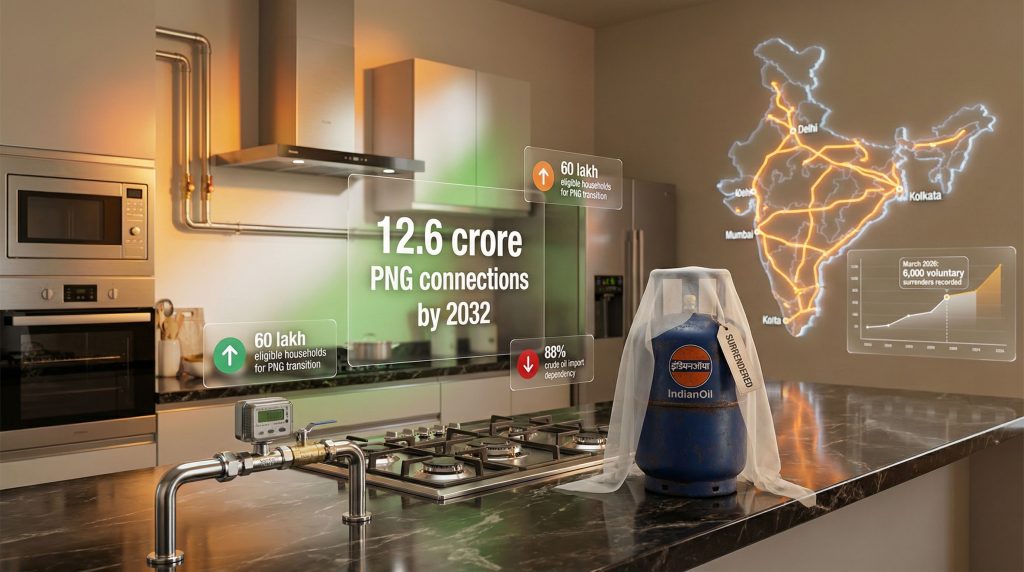
• Voluntary Surrenders Recorded: 6,000 PNG users as of March 28, 2026
• Target Eligible Households: 60 lakh (6 million) for transition
• March 2026 PNG Additions: 2.9 lakh new connections
• 2032 Strategic Target: 12.6 crore PNG connections nationwide
The 90-day transition window in PNG-ready areas provides limited flexibility for household adaptation, though the specific criteria for determining "PNG-ready" status involves infrastructure availability assessments and distribution network capacity evaluations.
Geopolitical Crisis as Policy Catalyst
The timing of this LPG connections policy India initiative directly correlates with significant geopolitical disruptions affecting energy supply chains. The ongoing Strait of Hormuz blockade, triggered by escalating US-Israel strikes on Iran and Tehran's subsequent retaliation, has created multi-vector supply constraints requiring immediate policy responses.
Current Import Dependency Profile:
| Energy Source | Import Dependency | Strategic Vulnerability |
|---|---|---|
| Crude Oil | 88% | High geopolitical exposure |
| Natural Gas | 50% | Moderate supply risk |
| LPG | 60% | Critical household dependency |
The crisis impact demonstrates the interconnected nature of energy security challenges. Industrial gas supplies have been curtailed to 80% of normal capacity, whilst fertilizer plants operate at 70-75% capacity with supplemental LNG arrangements being expedited. Commercial LPG availability has stabilised at approximately 70% of pre-crisis levels through prioritisation protocols.
Russia has emerged as a partial crude oil substitute source, though this diversification strategy proves insufficient for addressing natural gas and LPG specific shortages. Consequently, the differentiated impact across energy categories reveals the limitations of supply source diversification when transit route disruptions affect multiple commodity streams simultaneously.
Application Process and Eligibility Framework
The transition mechanism for LPG connections policy India compliance involves a structured three-stage verification process designed to ensure equitable allocation whilst maintaining supply security. Age verification requires 18+ years documentation, whilst address confirmation utilises utility bills or official records from the preceding three months.
Documentation Requirements:
• Age Verification: Government-issued identification
• Address Proof: Electricity bill, ration card, or voter ID (last 3 months)
• Rental Accommodation: Rent receipt or employer certificate
Cost Structure Analysis:
• Cylinder Deposit: ₹2,200 standard (₹2,000 in Northeast states)
• Regulator Device: ₹250
• Administrative Fees: GST applicable on transaction components
The installation protocol encompasses agency safety inspections, stove compatibility verification, and mandatory safety demonstrations for new consumers. This standardisation ensures consistent technical compliance across diverse household configurations and regional variations.
Multi-household dwelling classification presents significant administrative complexity, particularly in high-density urban environments where PNG infrastructure may serve building-level distribution whilst individual units maintain separate LPG connections. Government regulations require clarification on whether entire buildings with PNG access qualify all residents for mandatory LPG surrender.
Regional Implementation Strategies and Infrastructure Development
Urban PNG expansion has accelerated significantly under the current policy framework, with 2.9 lakh new connections added in March 2026 alone. This monthly addition rate, if sustained annually, would approach 3.48 crore connections, substantially exceeding historical deployment rates and suggesting administrative bottleneck elimination rather than technical capacity constraints.
City Gas Distribution Enhancement:
• Streamlined Approval Processes: Fast-track infrastructure authorisation
• Metropolitan Coverage Expansion: Enhanced network density in urban centres
• Installation Subsidies: Company-specific incentive programmes
Rural access optimisation continues through Ujjwala Yojana programme extensions, offering smaller cylinder options including 2kg "Munna" variants and 5kg/10kg composite alternatives. Priority allocation focuses on non-PNG accessible areas, maintaining cooking fuel access equity across geographic and infrastructure availability divides.
Company-Specific Incentive Structures:
| Company | Incentive Programme | Target Demographic |
|---|---|---|
| Indraprastha Gas | Connection fee waivers | Urban PNG adopters |
| Mahanagar Gas | Installation subsidies | Metropolitan households |
| GAIL Gas | Bulk connection discounts | Multi-unit conversions |
| BPCL | Loyalty programme benefits | Long-term subscribers |
Supply Chain Management and Crisis Response
Current supply chain optimisation has focused on distribution capacity maximisation and anti-diversion enforcement. Daily LPG refill capacity exceeds 55 lakh cylinders, with enhanced monitoring systems preventing unauthorised redistribution. Recent enforcement actions included 2,900 raids with nearly 1,000 cylinders seized, indicating significant black market activity during supply constraints.
The government has implemented comprehensive crisis management protocols including state-level daily briefing requirements, misinformation counter-campaigns, and expedited hoarding surveillance. Kerosene allocation increases provide compensatory cooking fuel options in areas experiencing LPG shortages, though this represents a temporary mitigation strategy rather than long-term solution.
Crisis Response Metrics:
• Daily Monitoring: State-level reporting protocols
• Enforcement Actions: 2,900 raids completed
• Seizure Operations: 1,000 cylinders recovered
• Alternative Fuel: Enhanced kerosene distribution
In addition, detailed information about the policy changes has been provided to help consumers understand their options. Petroleum and Natural Gas Secretary Neeraj Mittal has characterised PNG access as a basic utility comparable to electricity and water, reframing the policy from consumer choice to essential service allocation.
The next major ASX story will hit our subscribers first
Long-Term Energy Transition Implications
The 2032 strategic target of 12.6 crore PNG connections represents a fundamental restructuring of India's household cooking fuel landscape. This projection requires sustained annual additions of approximately 1.26 crore connections, demanding continued infrastructure investment acceleration and streamlined administrative processes.
Economic impact projections encompass subsidised LPG reallocation efficiency gains, reduced foreign exchange outflows for imports, and enhanced energy security resilience. The mandatory transition from dual LPG-PNG households eliminates allocation inefficiencies whilst directing resources toward underserved populations lacking gas infrastructure access.
Transition Timeline Analysis:
• Current Progress: 2.2 lakh households already transitioned
• Monthly Acceleration: 290,000 new PNG connections (March 2026)
• Annual Requirement: ~1.26 crore connections to meet 2032 target
• Infrastructure Investment: Continued expansion required
The policy establishes precedent for rapid energy allocation restructuring during crisis periods, demonstrating government capacity to implement mandatory transitions when supply security requires resource redistribution. However, global oil markets continue to influence domestic energy planning and pricing strategies.
Implementation Challenges and Regulatory Complexities
Several structural challenges emerge from the current LPG connections policy India framework implementation. Infrastructure readiness gaps in rural areas limit PNG network coverage, requiring continued LPG access maintenance until distribution expansion reaches remote communities. Installation workforce scaling presents logistical constraints as connection demand accelerates beyond historical deployment rates.
Primary Implementation Obstacles:
• Rural Coverage Limitations: PNG network gaps in remote areas
• Workforce Scaling: Installation capacity constraints
• Consumer Adaptation: Behaviour change management requirements
• Supply Continuity: Transition period fuel access
Rental property enforcement complexity requires clarification regarding landlord responsibilities and tenant compliance obligations. Cross-state migration tracking presents additional administrative burden when households relocate between PNG-available and unavailable regions during transition periods.
For instance, tariffs impact markets and energy costs, which must be considered in long-term planning. The regulatory framework must address black market prevention mechanisms as supply constraints create arbitrage opportunities.
Future Policy Evolution and Scenario Analysis
Three potential development pathways emerge from current policy trajectories, each responding to different infrastructure capacity and investment scenarios. Accelerated PNG rollout scenarios involve infrastructure investment doubling with enhanced private sector participation, potentially advancing 2030 target achievement through expedited deployment mechanisms.
Scenario A: Infrastructure Acceleration
• Investment Strategy: Double current infrastructure spending
• Timeline Advancement: 2030 target achievement potential
• Private Participation: Enhanced corporate involvement
Scenario B: Hybrid Energy Transition
• Flexible Options: Dual-fuel capabilities in transition zones
• Technology Integration: Smart grid cooking fuel distribution
• Optimisation Focus: Distribution efficiency enhancement
Scenario C: Emergency Resilience Development
• Strategic Reserves: Expanded storage capacity
• Alternative Fuels: Development programme acceleration
• Regional Independence: Self-sufficiency initiatives
Furthermore, US natural gas forecast trends may influence global pricing patterns. The long-term success of this LPG connections policy India framework depends on sustained infrastructure investment, administrative capacity enhancement, and continued geopolitical stability in energy supply regions.
This policy represents a significant precedent in energy allocation management during crisis periods, providing valuable insights for other developing economies facing similar import dependency and infrastructure transition challenges. Consequently, the outcomes will influence future energy security strategies and emergency response protocols across the region.
Additionally, Saudi exploration licenses and global energy developments continue shaping regional energy security considerations. Policy adaptability will prove crucial as global energy markets continue evolving and domestic demand patterns shift with economic development progression.
Disclaimer: This analysis is based on available information as of March 2026 and policy developments continue evolving. Energy market forecasts involve inherent uncertainties and should be considered alongside multiple scenario planning approaches. Investment decisions should incorporate comprehensive risk assessment and professional consultation.
Looking to Capitalise on Energy Market Opportunities?
Discovery Alert's proprietary Discovery IQ model delivers real-time alerts on significant mining discoveries across the ASX, including critical minerals essential for energy infrastructure development. Explore how historic mineral discoveries have delivered substantial returns to early investors, then begin your 14-day free trial to position yourself ahead of the market.