July 8, 2026
The Hidden Bottleneck Reshaping Geopolitical Power: Why Processing Capacity Is the New Oil
For most of the 20th century, raw material extraction defined resource power. Nations that sat atop hydrocarbon reserves shaped global politics, dictated industrial rhythms, and built sovereign wealth on the back of what lay beneath their soil. The 21st century is rewriting that logic entirely. Today, the critical question is not simply where minerals are found, but where they are transformed into usable industrial inputs.
The country or coalition that controls processing and refining capacity for critical minerals holds disproportionate leverage over every downstream industry that matters: electric vehicles, grid-scale energy storage, defence electronics, and advanced semiconductor manufacturing. The intersection of critical minerals and energy security has never been more strategically consequential.
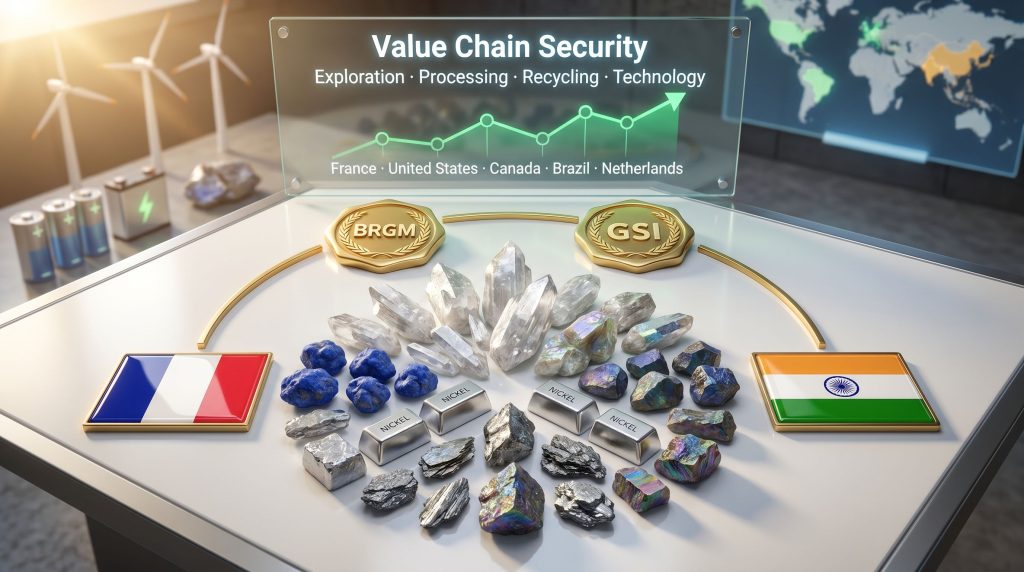
This structural reality is what has elevated the India and France critical minerals partnership from a routine diplomatic gesture into something considerably more consequential. When two major economies formalise cooperation not just on extraction but across the full value chain, including exploration, processing, recycling, technology development, and supply chain diversification, the framework signals a fundamental shift in how industrialised nations are rethinking resource security.
When big ASX news breaks, our subscribers know first
Critical Minerals and the Anatomy of Supply Chain Vulnerability
The concentration risk embedded in today's critical mineral supply chains is not a new discovery, but its strategic implications have only recently translated into urgent policy action. A handful of minerals, including lithium, cobalt, nickel, graphite, manganese, and the suite of rare earth elements, underpin virtually every technology system associated with decarbonisation and advanced manufacturing.
What makes this exposure particularly acute is the processing bottleneck. Even where mineral deposits exist across diverse geographies, the industrial capacity to refine and transform raw ore into battery-grade material, permanent magnet precursors, or semiconductor inputs remains heavily concentrated. This means that supply chain security cannot be achieved through mining agreements alone.
Nations that extract minerals without controlling or having allied access to processing infrastructure remain structurally dependent on those who do. Furthermore, rare earth supply chains represent one of the most acute examples of this vulnerability, with processing capacity concentrated in very few locations globally.
"Nations that control processing and refining hold disproportionate leverage over downstream industries including electric vehicles, defence electronics, and grid-scale energy storage. Raw material access without processing capability is an incomplete equation."
This is precisely why the emphasis on processing facilities within the India–France framework carries such strategic weight. The deliberate inclusion of processing infrastructure development, alongside geological cooperation and recycling initiatives, reflects a more sophisticated understanding of where supply chain vulnerabilities actually reside.
What the India–France Critical Minerals Partnership Actually Involves
The architecture of the India and France critical minerals partnership rests on a multi-layered framework that goes well beyond a standard bilateral trade arrangement. Its foundations were laid during French President Emmanuel Macron's India visit in February 2026, when both nations formalised their intentions through the France–India Joint Declaration of Intent on Cooperation in Critical Minerals. This document established five core areas of engagement: exploration, mining, research and innovation, value chain diversification, and circularity.
The translation of that declaration into operational structures came in July 2026, when the first India–France Joint Working Group on Critical Minerals convened over two days. Co-chaired by Benjamin Gallezot, France's Interministerial Delegate for Strategic Minerals and Metals Supplies, the working group produced substantive outcomes: identification of shared strategic priorities, initiation of corporate-level partnership frameworks between Indian and French companies, and advancement of institutional cooperation between the two nations' leading geological bodies.
The partnership's key pillars can be summarised as follows:
| Pillar | Description |
|---|---|
| Exploration Cooperation | Joint geological survey activities between BRGM and GSI |
| Processing Infrastructure | Development of aligned processing and refining facilities |
| Recycling and Circularity | Circular economy approaches to critical mineral recovery |
| Corporate Partnerships | Indian–French company-level value chain collaborations |
| Technology Development | Joint advanced materials research via DST–CNRS collaboration |
| Supply Chain Resilience | Diversification away from concentrated single-source dependencies |
What distinguishes this framework from a conventional commodity trade agreement is its deliberate focus on value chain security rather than volume-based exchange. The partnership is structured to address the full mineral lifecycle, from geological identification through to processing, advanced materials manufacturing, and eventual material recovery through recycling.
BRGM and GSI: Institutional Depth as a Strategic Asset
One of the most underappreciated dimensions of the India and France critical minerals partnership is the institutional depth it brings through the engagement of two of the world's most established geological survey organisations.
France's Bureau of Geological and Mining Research (BRGM) is the nation's primary public institution for earth sciences and mineral resource assessment. With global exploration capabilities spanning geological mapping, mineral deposit characterisation, and processing technology research, BRGM brings methodological rigour that few national agencies can match. Its involvement signals that the bilateral cooperation is designed for technical substance, not diplomatic optics.
India's Geological Survey of India (GSI) holds a comparably authoritative position. Established in 1851, making it one of the oldest geological survey organisations anywhere in the world, the GSI manages an extensive national mineral database and has conducted systematic geological mapping across the Indian subcontinent for over 170 years. Its partnership with BRGM represents a convergence of complementary capabilities.
In practical terms, the BRGM–GSI cooperation is expected to involve:
- Joint mineral exploration methodologies applicable to priority critical mineral targets
- Shared geological data frameworks to accelerate identification of economically viable deposits
- Technology transfer in advanced extraction and processing techniques
- Coordinated survey activities in India and potentially in third-country geographies where both nations hold strategic interests
This institutional layer gives the partnership a durability that political cycles alone cannot provide. Geological cooperation, once embedded at the institutional level, tends to persist across changes in government and diplomatic temperature shifts.
The Science Layer: DST, CNRS, and Advanced Materials Innovation
Beyond geology and extraction, the India–France framework includes a dedicated technology and innovation dimension that positions the partnership as a forward-looking industrial collaboration rather than simply a resource extraction agreement.
India's Department of Science and Technology (DST) and France's CNRS (National Centre for Scientific Research) are establishing a joint advanced technology development group focused on advanced materials science, processing innovation, and mineral recycling technologies. The CNRS is among Europe's largest and most internationally recognised research organisations, making this a genuinely high-calibre scientific collaboration.
Alongside this, both nations are working toward the establishment of a Centre for Advanced Materials, a proposed joint institutional initiative with long-range implications for clean energy technology, defence applications, and next-generation semiconductor materials. This is a less-reported but strategically significant element of the partnership.
"The long-term competitive advantage in critical minerals will belong not to those who mine the most, but to those who master the science of transformation. Joint research institutions create durable knowledge assets that outlast any individual project agreement."
India's Bilateral Critical Minerals Strategy in Context
India has been systematically constructing a network of bilateral mineral frameworks with a range of strategic partners. Understanding where the France agreement sits within this broader architecture helps clarify its specific significance.
| Partner Country | Agreement Type | Key Focus Areas | Status (as of 2026) |
|---|---|---|---|
| France | Joint Declaration of Intent and Working Group | Exploration, processing, recycling, technology | Active, Working Group convened July 2026 |
| United States | Bilateral Framework | Supply chain security, processing, investment | Signed May 2026 |
| Canada | Negotiations underway | Mining investment, exploration | In progress |
| Brazil | Negotiations underway | Lithium, niobium, rare earths | In progress |
| Netherlands | Negotiations underway | Technology, processing | In progress |
What the France framework offers that distinguishes it from several of these other arrangements is the combination of institutional-level geological cooperation (BRGM–GSI), a dedicated science and technology research layer (DST–CNRS), and embedding within a broader Special Global Strategic Partnership between India and France. This elevated diplomatic tier brings parallel cooperation tracks in biotechnology, advanced materials, and defence.
The India–France Economic and Financial Dialogue (EFD) held in Aix-en-Provence added ministerial-level economic security alignment to this framework, with discussions co-chaired by Finance Minister Nirmala Sitharaman and French Economy Minister Roland Lescure, further reinforcing the strategic seriousness of the bilateral engagement.
The next major ASX story will hit our subscribers first
The Circularity Dimension: Why Recycling Is a Strategic Imperative, Not a Secondary Option
A less widely discussed but critically important component of the India–France framework is its explicit emphasis on circularity and mineral recycling. This reflects a sophisticated understanding of long-term supply chain mathematics. A recent battery recycling breakthrough in China has, furthermore, demonstrated just how rapidly secondary supply technologies are advancing.
Primary mineral extraction, even from diversified sources, carries inherent geological and geopolitical risk. Deposits deplete, political environments shift, and new discoveries require long lead times to reach production. Secondary supply through recycling and material recovery, by contrast, operates on a fundamentally different risk profile.
For minerals like cobalt, lithium, and the rare earth elements used in permanent magnets, urban mining through recycling is increasingly recognised as a material supply source in its own right. The IEA has projected that recycled materials could supply a meaningful share of critical mineral demand by 2040, though the scale of this contribution depends heavily on investment in recycling infrastructure and collection systems during the current decade.
By incorporating recycling frameworks into the India–France partnership from the outset, both nations are signalling an awareness that long-term supply security requires a circular approach to material flows, not simply an expanded pipeline of primary extraction.
Strategic Implications: What This Partnership Means Beyond the Bilateral Level
For India's Industrial Policy Objectives
India's Production Linked Incentive (PLI) scheme covers sectors including electric vehicles, advanced chemistry cell batteries, electronics, and defence manufacturing. Every one of these sectors has material dependencies on critical minerals, particularly lithium, cobalt, rare earth elements, and specialty alloys. Building reliable, diversified access to these materials through bilateral frameworks directly supports India's ambition to build domestic manufacturing capability at scale.
The France partnership also reinforces India's positioning within Western-aligned supply chain networks, which matters as major economies reconfigure supply chains along geopolitical lines. Being embedded in multiple bilateral frameworks across Europe and North America gives India strategic flexibility that purely domestic or single-partner approaches cannot provide.
For Europe and the EU's Critical Raw Materials Act
France has been an active voice within the European Union's broader critical raw materials agenda. Europe's critical minerals supply chain has become a focal point for policy action, and the EU's Critical Raw Materials Act sets strategic targets for domestic processing and diversified sourcing. Bilateral partnerships that individual member states forge with resource-rich or processing-capable partners contribute to the overall resilience of the European critical mineral ecosystem.
In addition, the management of European critical raw materials supply has become increasingly urgent as the bloc seeks to reduce single-source dependencies. The India–France framework could, over time, evolve into a broader EU–India mineral cooperation mechanism, particularly given that processing infrastructure and technology development agreements of this nature generate knowledge and capacity that extends beyond individual national use.
A Note on Uncertainty and Execution Risk
It is important to note that bilateral mineral frameworks, however well-structured, carry genuine execution risk. Corporate partnership frameworks take time to mature into actual investment decisions. Joint processing infrastructure requires sustained political will, capital commitment, and resolution of complex regulatory and commercial issues across jurisdictions. Readers should interpret partnership announcements as the beginning of a process, not confirmation of achieved outcomes.
Frequently Asked Questions: India and France Critical Minerals Partnership
What was agreed at the first India–France Joint Working Group on Critical Minerals?
The July 2026 working group focused on deepening bilateral cooperation across mineral exploration, processing infrastructure, recycling, and supply chain diversification. Both sides identified shared strategic interests and initiated frameworks for Indian–French corporate partnerships, with the objective of building resilient and sustainable supply chains across France, India, and other key geographies.
Which institutions are leading the geological cooperation?
France's Bureau of Geological and Mining Research (BRGM) and India's Geological Survey of India (GSI) are the primary institutional partners for geological survey and exploration cooperation.
Why is the emphasis on processing facilities significant?
Processing and refining capacity determines which nations can convert raw mineral extraction into usable industrial inputs. Without domestic or allied processing capability, raw material access alone does not deliver supply chain security. This is why the framework explicitly prioritises processing infrastructure development alongside exploration cooperation.
How does this partnership relate to India's other mineral agreements?
It is one of several bilateral frameworks India is pursuing alongside agreements with the United States (May 2026) and ongoing negotiations with Canada, Brazil, and the Netherlands. The France partnership is distinguished by its institutional cooperation depth, technology research layer, and embedding within an elevated Special Global Strategic Partnership.
What is the DST–CNRS collaboration focused on?
India's Department of Science and Technology and France's CNRS are establishing a joint advanced technology development group and working toward a Centre for Advanced Materials, focused on next-generation materials science, processing innovation, and mineral recycling technologies.
The Bigger Signal: From Commodity Trade to Value Chain Architecture
The cumulative story told by India's expanding network of critical mineral bilateral agreements is one of deliberate strategic repositioning. India is not simply seeking to secure commodity imports. It is constructing the institutional relationships, processing partnerships, technology collaborations, and geological knowledge networks required to participate actively in the high-value segments of the global critical minerals economy.
The India and France critical minerals partnership represents one of the more structurally complete frameworks within this network, combining geological institutions, research bodies, processing infrastructure ambitions, circularity frameworks, and elevated diplomatic embedding in a single coherent architecture. Whether that architecture translates into the durable industrial outcomes both nations are seeking will depend on execution quality, sustained political commitment, and the resolution of the very real technical and commercial challenges that lie ahead.
What is already clear is that the era of treating critical minerals as a conventional trade policy matter is over. They are now a core element of energy security, industrial sovereignty, and strategic positioning in a world where the clean energy transition and technological competition are inseparable forces shaping national power.
Want to Capitalise on the Next Major Mineral Discovery Before the Broader Market Catches On?
As the global race to secure critical mineral supply chains accelerates, Discovery Alert's proprietary Discovery IQ model scans ASX announcements in real time, instantly identifying significant mineral discoveries and translating complex data into actionable investment insights — explore historic discovery returns that demonstrate just how transformative early positioning can be, and begin your 14-day free trial at Discovery Alert to secure your market-leading advantage.