August 20, 2026
When Demand Growth Becomes a Liability: India's Fuel Market at a Crossroads
For much of the past decade, the global oil industry has operated on a straightforward thesis: as Chinese transportation fuel demand plateaus, India absorbs the growth baton. A population of 1.4 billion people, a rapidly motorising middle class, and chronically underdeveloped public transit infrastructure all pointed toward one conclusion — India would be the defining demand story of the late 2020s. That thesis is now being stress-tested in real time.
A confluence of geopolitical shock, structural pricing distortions, and industrial softening has placed the India fuel demand outlook hit by price hikes narrative front and centre for analysts, traders, and policymakers tracking global oil markets. What began as a regional conflict premium in crude has cascaded into a domestic repricing event that is compressing consumer behaviour, straining the trucking sector, and forcing a meaningful downgrade to India's previously robust demand forecasts.
When big ASX news breaks, our subscribers know first
The Mechanics Behind India's Compressed Repricing Event
Understanding why India's demand response has been so sharp requires grasping how the country's retail fuel pricing system actually functions. Indian Oil, Bharat Petroleum, and Hindustan Petroleum — the three state-owned retailers that collectively dominate the market — operate under a regulated framework that has historically allowed political considerations to override market-driven price adjustments.
During the recent election cycle, these retailers held prices steady despite climbing global crude costs. The consequence was a steadily widening gap between market rates and pump prices, with the three companies collectively absorbing losses estimated at ₹5.5 billion (approximately $57 million) per day by mid-2026.
Once the electoral constraints lifted, the repricing was rapid and sequential. Four rounds of price increases were implemented in quick succession from mid-May 2026 onward, pushing:
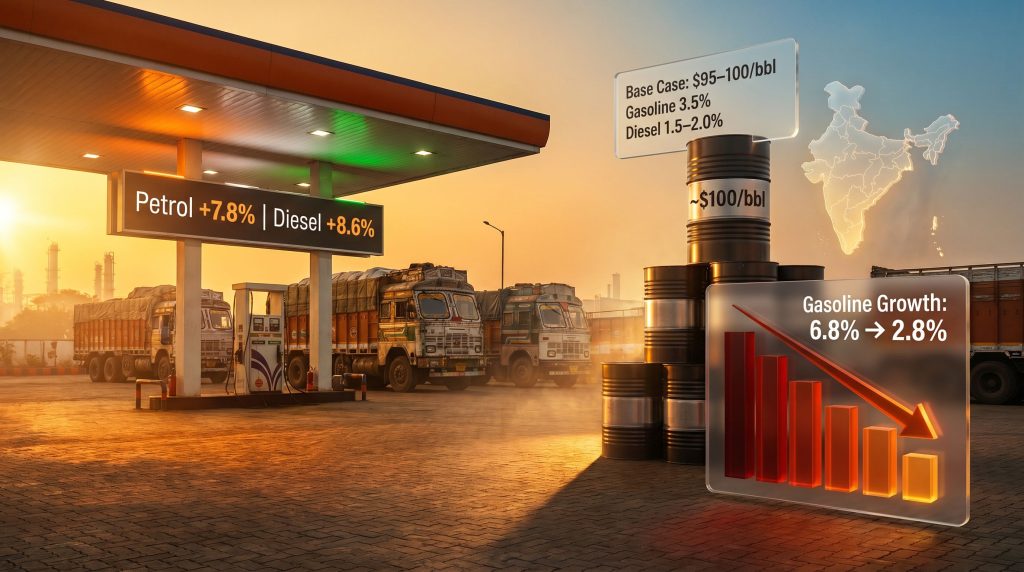
- Petrol prices up by 7.8% across the country
- Diesel prices up by 8.6%, reflecting the fuel's heavier use in commercial transport
- Both increases landing on consumers within weeks rather than being spread across months
This compression effect is critically important. Markets with real-time or frequent price pass-through mechanisms allow consumers and businesses to gradually adjust behaviour. India's election-cycle delay instead delivered a concentrated demand shock, amplifying the psychological and economic impact beyond what the underlying price levels alone would typically produce.
Furthermore, analysts tracking India's fuel price hike trajectory have noted that the structural architecture of India's regulated retail fuel market creates a built-in amplifier for demand disruption. Delayed repricing does not eliminate consumer pain; it concentrates it, producing sharper behavioural responses and more pronounced demand contractions than gradual adjustment would generate.
The Strait of Hormuz Factor and the $100 Barrel Threshold
The trigger for India's repricing cycle traces directly to the geopolitical disruption of global crude supply. Oil prices surged approximately 40% to trade near $100 per barrel following the outbreak of the Iran war, which restricted tanker traffic through the Strait of Hormuz. This waterway had historically facilitated the passage of roughly one-fifth of global oil supplies, making any sustained disruption there a near-immediate price event for every oil-importing nation.
For India, which relies on imports for approximately 85% of its crude requirements, the transmission from international price spike to domestic retail cost is direct and unavoidable. The only variable is timing, and the election-cycle freeze ensured that timing was as disruptive as possible. The oil price rally dynamics seen in prior periods offer useful context for understanding how quickly these shocks materialise.
Compounding the direct crude cost increase is a secondary effect: the West Asia conflict has simultaneously elevated shipping and logistics costs across global supply chains. For India's manufacturing sector, which depends on imported inputs and component flows, this dual pressure of higher energy costs and elevated freight rates is already translating into output contraction — a dynamic that feeds directly back into reduced diesel consumption.
Demand Forecast Revisions: How the Numbers Have Moved
The scale of analyst forecast downgrades captures the severity of the demand reassessment now underway. The table below illustrates how expectations have shifted across two leading forecasting bodies:
| Metric | Pre-Hike Forecast | Post-Hike Forecast | Change |
|---|---|---|---|
| Gasoline demand growth (FGE NexantECA) | ~4.0% | 3.5–3.7% | Down ~0.3–0.5 ppts |
| Diesel demand growth (FGE NexantECA) | ~2.5% | ~2.0% | Down ~0.5 ppts |
| Gasoline demand growth (ICRA) | 5–6% | 3–4% | Down ~2 ppts |
| Diesel demand growth (ICRA) | 2–3% | Flat to negative | Down ~2–3 ppts |
The ICRA revisions are particularly striking. A downgrade from 5–6% gasoline growth to 3–4% represents a meaningful recalibration, but the diesel outlook shift is arguably more consequential for industrial activity. Moving from a 2–3% expansion projection to a flat-to-contraction scenario effectively signals that India's freight and manufacturing engine may be stalling.
ICRA has also flagged the inflationary feedback dimension of the price hikes. Higher diesel costs are absorbed by logistics operators who pass them through to consumer goods pricing, which in turn compresses household purchasing power and reduces discretionary mobility — a self-reinforcing cycle of demand suppression that extends well beyond the fuel sector itself.
Consequently, under elevated crude scenarios, India's average inflation trajectory could approach 5.1% for the current fiscal year, according to analyst projections, adding further complexity to the Reserve Bank of India's monetary policy calculus. The India fuel demand growth projections cut by as much as 40% underscore just how significant this reassessment has become.
The Trucking Sector: A Real-Time Demand Barometer
While aggregate fuel sales data provides the macro picture, the trucking sector offers the most granular and timely evidence of what is actually happening at the operational level of India's economy.
According to SP Singh, Senior Fellow at the Indian Foundation of Transport Research and Training, freight rates on approximately three-quarters of key long-haul routes in India have fallen between 13% and 15%, even as fuel costs for operators have risen substantially. This inverse relationship between input costs and output pricing is a textbook signal of demand-side compression rather than supply-side disruption.
The mechanism is straightforward, but its implications are significant:
- Manufacturing output is declining due to elevated input costs and weak end-demand
- Fewer manufactured goods require transportation, reducing freight volumes
- With more trucks competing for less cargo, carriers are forced to accept lower rates
- Lower rates combined with higher fuel costs squeeze operator margins severely
- Financially stressed operators reduce fleet utilisation, further cutting diesel consumption
Singh has noted that drivers on major corridors are experiencing idle periods of 3 to 5 days between securing return loads. Each additional idle day represents lost revenue-generating trips per month, directly eroding the diesel consumption volumes that would otherwise flow through commercial fleet operations.
"Falling freight rates alongside rising fuel costs are not contradictory signals — they are complementary evidence of the same underlying problem: a manufacturing and logistics ecosystem under simultaneous cost and demand pressure."
Early Sales Data Confirm the Deceleration
The preliminary sales figures for May 2026 provide the most concrete early evidence that forecast revisions are tracking reality rather than theoretical modelling:
| Fuel Type | April 2026 YoY Growth | May 2026 YoY Growth | Change |
|---|---|---|---|
| Gasoline | +6.8% | +2.8% | Down 4.0 ppts |
| Gasoil (Diesel) | +0.8% | +0.9% | Marginal |
The gasoline figure is the more alarming data point. A deceleration from 6.8% year-on-year growth in April to just 2.8% in May represents an almost four percentage point collapse within a single month, coinciding directly with the onset of the price hike cycle. This is not a gradual softening; it is a demand cliff edge visible in real-time sales.
Gasoil's near-stagnation across both months tells a different story. Diesel demand had already been softening before the latest hike cycle, reflecting the industrial slowdown dynamic that predates the Iran war premium. The marginal improvement from 0.8% to 0.9% provides no comfort given the near-zero absolute growth and the risk of contraction in subsequent months.
The next major ASX story will hit our subscribers first
What India's Slowdown Means for Global Oil Markets
The global significance of India's demand deceleration cannot be overstated. As the world's third-largest oil importer and consumer, India's demand trajectory has a measurable impact on global price discovery and supply-demand balancing. Understanding the trade war impact on oil markets provides additional context for how interconnected these global pressures have become.
The broader context makes this more consequential. China's transportation fuel consumption has structurally peaked, a transition driven by the rapid electrification of its passenger vehicle fleet and a plateauing of road freight intensity relative to GDP growth. The global oil industry had been pricing in India as the replacement demand engine through the latter half of this decade.
That succession thesis now carries meaningful qualification. Simultaneous demand softening in both of the world's largest emerging market consumers creates a scenario where:
- Supply-side disruptions (via the Strait of Hormuz) push prices up
- Demand-side responses to those higher prices suppress consumption
- The net effect is a market where price spikes become self-limiting but supply security remains structurally uncertain
This supply-side paradox is particularly relevant for oil market participants. Geopolitical events that drive crude prices higher simultaneously erode the demand base that justifies those elevated prices, creating a cyclical dynamic that makes sustained $100+ pricing difficult to maintain absent continued physical supply disruption. In addition, current crude oil prices and their trajectory remain a key variable for all demand modelling going forward.
Scenario Pathways: Three Trajectories for India's Demand
The range of outcomes for India's fuel demand in 2026–2027 remains wide, contingent primarily on the trajectory of crude prices and the extent of further retail price adjustments. Three broad scenarios frame the possibility space:
| Scenario | Crude Price Assumption | Further Hikes | Gasoline Demand | Diesel Demand |
|---|---|---|---|---|
| Base Case | ~$95–100/bbl | 1–2 rounds | ~3.5% growth | 1.5–2.0% growth |
| Bearish Case | >$105/bbl | 3+ rounds | 2.0–2.5% growth | Flat to -1% |
| Recovery Case | Retreats to ~$80/bbl | No further increases | 4.5–5.0% growth | 2.5–3.0% growth |
The bearish scenario is not a tail risk. State retailers are still losing approximately $57 million per day collectively, meaning further price increases remain probable even under current crude price assumptions. The political economy of fuel pricing in India has historically constrained price adjustments pre-election, but the post-election window typically permits more aggressive normalisation.
A crude retreat toward $80 per barrel would be the most direct path to demand recovery, as it would simultaneously reduce retailer under-recovery, ease inflationary pressure, and lower logistics costs across the industrial supply chain. However, this scenario depends on geopolitical resolution that remains uncertain.
The Structural Substitution Wildcard
One dimension that purely cyclical analysis tends to underweight is the potential for price stress to accelerate structural demand substitution. India's electric two-wheeler and three-wheeler markets have been growing rapidly, and elevated petrol prices directly improve the economics of battery-powered alternatives for price-sensitive consumers in this segment.
Similarly, commercial operators exposed to diesel cost volatility have structural incentives to consider compressed natural gas (CNG) or liquefied petroleum gas (LPG) conversions, particularly for urban distribution routes where refuelling infrastructure is increasingly available. The broader implications for LNG supply markets are worth monitoring as substitution dynamics evolve.
If the current price shock proves sustained rather than transitory, it may accelerate technology adoption curves in ways that produce a more permanent reduction in India's petroleum demand growth trajectory, rather than a cyclical dip followed by recovery to prior trend growth rates.
Frequently Asked Questions: India Fuel Demand Outlook
Why Has India's Fuel Demand Growth Slowed in 2026?
A combination of sharp retail price increases, geopolitical-driven crude cost inflation, industrial sector softening, and compressed consumer purchasing power has collectively reduced both discretionary driving and commercial fuel consumption. The India fuel demand outlook hit by price hikes dynamic reflects both cyclical and structural pressures converging simultaneously.
How Much Have Petrol and Diesel Prices Increased in India in 2026?
Following four rounds of price increases from mid-May 2026, petrol prices are approximately 7.8% higher and diesel prices are approximately 8.6% higher than pre-hike levels.
What Is the Impact of the Iran War on Indian Fuel Prices?
The Iran war restricted tanker traffic through the Strait of Hormuz, triggering a roughly 40% surge in global crude prices to near $100 per barrel, which fed directly into the cost base of India's state-owned retailers and necessitated retail price increases.
How Is India's Trucking Industry Being Affected?
Long-haul freight rates have declined 13–15% on key routes despite higher fuel costs, as reduced manufacturing output limits available cargo. Truck operators face extended idle periods of 3–5 days between return loads, compressing monthly revenue per vehicle.
Will India's Fuel Demand Recover If Crude Oil Prices Fall?
A retreat in crude toward approximately $80 per barrel could support a recovery toward 4.5–5.0% gasoline growth and 2.5–3.0% diesel growth, but the pace of recovery would depend on how quickly inflationary pressures and industrial activity normalise. Furthermore, oil price movements in the context of ongoing trade tensions will influence the speed of any such recovery.
How Does India's Demand Slowdown Affect Global Oil Markets?
As the world's third-largest oil consumer, India's growth deceleration reduces the demand growth buffer that global supply planning had been pricing in, particularly given China's structural peak in transportation fuel consumption.
Key Takeaways
- Gasoline demand growth has been revised down to 3–3.7% from prior estimates of 4–6%, depending on the forecasting body
- Diesel demand faces the most severe downgrade, with scenarios ranging from flat to negative growth, a significant departure from previously anticipated 2–3% expansion
- The trucking sector is the most visible real-time barometer of demand stress, with freight rates falling 13–15% on key routes even as fuel costs rise
- India's compressed repricing mechanism created an unusually sharp demand shock rather than a gradual market adjustment
- Further price hikes remain probable given ongoing retailer under-recovery losses of approximately $57 million per day
- India's demand deceleration arrives at a critical moment for global oil markets, as the country had been widely expected to absorb demand growth vacated by China's post-peak transportation fuel consumption
- Structural substitution via electric two-wheelers and CNG conversion could convert a cyclical demand dip into a more permanent reduction in petroleum consumption growth if elevated prices persist
This article contains forward-looking forecasts and scenario analysis based on analyst projections current at time of publication. Actual outcomes may differ materially from those described. This content is provided for informational purposes only and does not constitute financial or investment advice. Readers seeking ongoing coverage of India's oil and gas sector developments can explore reporting through ET EnergyWorld at energy.economictimes.indiatimes.com.
Want to Stay Ahead of the Next Major Commodity Discovery Before the Market Moves?
While India's fuel demand slowdown reshapes global oil market dynamics, significant mineral discoveries on the ASX continue to present compelling opportunities for well-positioned investors — Discovery Alert's proprietary Discovery IQ model delivers real-time alerts the moment a major discovery hits the exchange, transforming complex geological data into actionable insights for traders and long-term investors alike. Explore why historic discoveries have generated exceptional returns on Discovery Alert's dedicated discoveries page, and begin your 14-day free trial today to secure a market-leading edge.