July 31, 2026
When Energy Markets Collide With Political Reality
Global oil markets have a long history of exposing the fragility of price-control systems. When geopolitical shocks compress supply and inflate international benchmarks faster than domestic policy can respond, the resulting gap between real costs and administered prices becomes a fiscal time bomb. India finds itself navigating exactly this situation in 2026, with the prospect of an India fuel price hike for petrol diesel and LPG becoming increasingly difficult to avoid as a conflict thousands of kilometres away reshapes the economics of every litre of fuel sold at its 83,000-plus retail outlets.
Understanding the current pressure on India's fuel pricing system requires stepping back from the immediate headlines and examining the structural mechanics at play. This is not simply a story about a war driving up crude prices. It is a story about how a nation manages the collision between international commodity markets and a domestic political economy built around consumer price protection. Furthermore, the oil price movements shaping this environment carry lessons that extend well beyond India's borders.
When big ASX news breaks, our subscribers know first
Why Are India's Fuel Prices Under Pressure Right Now?
The Global Crude Oil Shock Reshaping India's Energy Economics
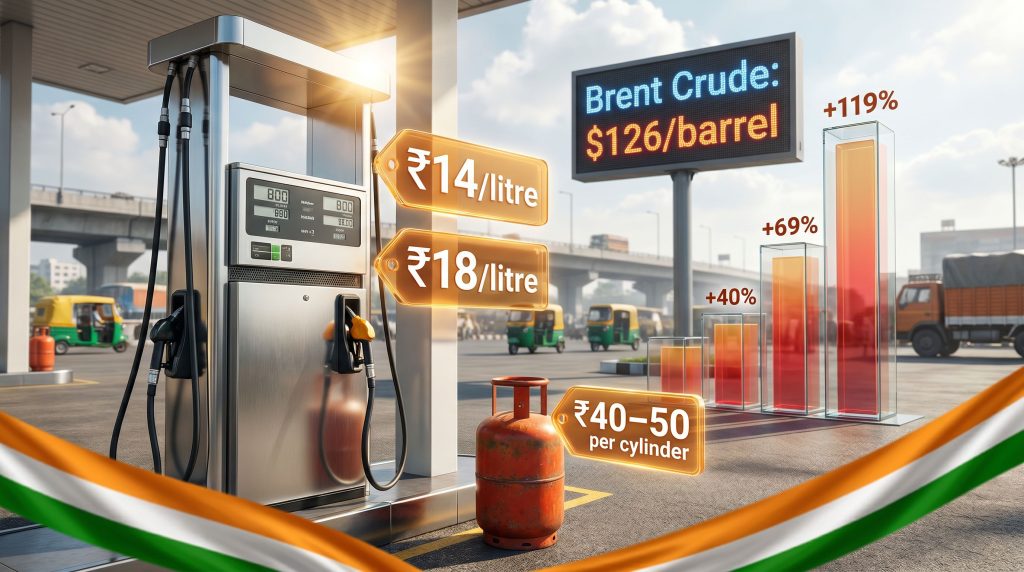
Crude oil markets reached an extraordinary threshold in late April and early May 2026. Brent crude surged above $126 per barrel following signals from US President Donald Trump that a naval blockade of Iran would continue, intensifying concerns about sustained supply disruption through the Strait of Hormuz. According to ET EnergyWorld, this level represents one of only six occasions in recorded market history when Brent's monthly average has crossed $120 per barrel, a group that includes only the most severe energy stress events of the modern era.
The magnitude of the price shift becomes clearer when measured against the pre-conflict baseline. Before hostilities escalated on February 28, 2026, Brent crude was trading near $73 per barrel. The subsequent surge to $126 represents a 72.6% price increase compressed into approximately 60 days, a pace that leaves virtually no pricing system, however well-designed, with adequate adjustment mechanisms.
June Brent futures crossed $126 before contract expiry, while July contracts stabilised near $114 per barrel, suggesting markets were already pricing in some expectation that the most acute phase of disruption might moderate, though remaining sharply elevated relative to pre-war levels. These current crude oil prices are consequently placing extraordinary stress on import-dependent economies worldwide.
The Strait of Hormuz carries an estimated 20% of global oil supply. Any credible disruption risk to this chokepoint does not merely affect Iran-linked crude flows. It reprices the entire seaborne oil market.
How Middle East Conflict Translates Into Indian Pump Price Pressure
The transmission mechanism from a geopolitical event in the Persian Gulf to an Indian petrol pump involves multiple layers of repricing across commodity categories. According to ET EnergyWorld, comparing April 2026 averages against February 2026 baseline levels reveals the following commodity-level price increases:
| Fuel Category | Price Increase vs. February 2026 Baseline |
|---|---|
| Diesel (international) | +119% |
| Petrol (international) | +69% |
| LPG | +40%+ |
| Aviation Turbine Fuel (ATF) | ~+100% (doubled) |
These are not incremental increases. A 119% rise in diesel prices means that the commodity underlying every truck, tractor, and generator in India's supply chain has more than doubled in cost at the international level. The fact that Indian consumers have not yet seen this reflected at the pump does not mean the cost has disappeared. It means it has been absorbed elsewhere in the system, primarily by state-owned Oil Marketing Companies (OMCs).
What Are the Current Losses Facing India's State-Run Oil Companies?
Understanding Under-Recovery: The Hidden Subsidy Burden
Under-recovery is one of the most consequential and least understood concepts in India's energy economics. When an OMC purchases crude oil, refines it, and delivers the resulting fuel to retail outlets, the total cost of that process has a floor. When the government-mandated retail price sits below that floor, the company absorbs the difference as an operating loss on every transaction.
India's OMCs are currently estimated to be losing approximately ₹14 per litre on petrol and ₹18 per litre on diesel at current frozen retail prices. These figures, while significant in isolation, become extraordinary when multiplied across India's daily fuel consumption volume, which runs into hundreds of millions of litres. The cumulative under-recovery liability accumulates continuously until either crude prices fall, retail prices rise, or the government intervenes with compensation.
Retail fuel prices across India have been frozen since early April 2022, a period now approaching four years. That stability was manageable during periods when crude prices remained in ranges that allowed OMC profit margins to buffer against volatility. The current environment is categorically different from anything those buffers were designed to absorb.
Why OMC Financial Buffers Are Eroding Fast
ET EnergyWorld reported that during the early phase of the war-driven price surge, there was broad expectation within government and industry circles that OMCs could manage mounting losses using the financial reserves accumulated during prior years of lower crude costs and healthy retail margins. That assumption has proven increasingly fragile.
With the Gulf crisis showing no near-term resolution pathway, those accumulated buffers are depleting at an accelerating rate. Internal deliberations have shifted from questions of short-term absorption capacity to evaluating whether government compensation transfers or direct retail price adjustments represent the more sustainable path forward.
The longer retail prices remain frozen while international benchmarks stay elevated, the larger the eventual fiscal adjustment becomes, whether borne by consumers, the government budget, or both. There is no mechanism by which the cost simply disappears.
The Centre is simultaneously managing expanding subsidy commitments on LPG and fertilisers, according to ET EnergyWorld, which constrains the fiscal space available to absorb further OMC under-recoveries through direct budget transfers. This creates a genuine bind: the government cannot easily compensate OMCs without widening its fiscal deficit at a time when food inflation is already applying pressure. The broader trade war impact on oil markets has, furthermore, added another layer of complexity to an already strained pricing environment.
What India Fuel Price Hike for Petrol, Diesel and LPG Is Being Considered?
The Proposed Calibrated Hike Structure
Government deliberations are centred on a ₹4 to ₹5 per litre increase in petrol and diesel, alongside a potential ₹40 to ₹50 per cylinder increase for domestic LPG. According to India Today, if implemented, this would mark the first retail fuel price adjustment in nearly four years and represent a deliberate policy shift away from full consumer price shielding toward a partial cost-sharing arrangement with households.
A decision window was anticipated within 5 to 7 days from early May 2026, though the timeline remains contingent on both the trajectory of Brent crude prices and the geopolitical situation in the Middle East. A sustained retreat in crude toward the $100 per barrel range could reduce the urgency of a retail adjustment, while any further escalation would compress the window for delay.
What Has Already Been Adjusted: The Two-Tier Pricing Approach
An important and underappreciated aspect of the current situation is that India's fuel pricing system has not been uniformly frozen. According to ET EnergyWorld, a deliberate two-tier pricing approach has been operating beneath the surface, where commercial and premium segments have been repriced toward market rates while regular retail grades remain shielded.
| Commercial Fuel Adjustment | Increase Amount | Timing |
|---|---|---|
| Commercial LPG (1st increase) | ₹144 per cylinder | March 2026 |
| Commercial LPG (2nd increase) | ₹200 per cylinder | April 1, 2026 |
| Commercial LPG (3rd increase) | ₹993 per cylinder | Post-April 2026 |
| XP100 Premium Petrol | Revised to ₹160/litre | Recent |
| Extra Green Diesel | Revised to ₹92.99/litre | Recent |
The cumulative commercial LPG increase across the three adjustments exceeds ₹1,300 per cylinder. Regular unbranded petrol and diesel at filling stations remain unchanged. Domestic ATF has seen only partial increases, while international aviation ATF has been fully repriced.
This selective adjustment strategy serves a dual function. It partially reduces OMC losses on higher-margin product segments while maintaining the political optics of consumer price stability. However, it also reveals the direction of travel, as the commercial pricing adjustments signal that the government understands costs must ultimately be normalised. The question is timing and sequencing, not direction.
Current Petrol and Diesel Prices Across Indian Cities
The Geography of Indian Fuel Pricing
Retail fuel prices across India reflect a complex interaction between a uniform base price set at the national level and highly variable state-level taxation structures. The resulting spread means that a consumer in Chandigarh pays significantly less per litre than a consumer in Thiruvananthapuram for an identical product sourced from the same supply chain.
As of May 1, 2026, the following city-level pricing snapshot illustrates this geographic disparity:
| City | Petrol (₹/litre) | Key Driver |
|---|---|---|
| Chandigarh | ₹94.30 | Lower state VAT structure |
| Thiruvananthapuram | ₹107.48 | Higher state tax imposition |
| Major metro cities | Mid-range variation | State VAT differentials |
The ₹13.18 per litre gap between the cheapest and most expensive cities does not reflect any difference in the cost of sourcing or delivering fuel. It reflects entirely state government tax policy decisions. This has an important implication for any proposed retail hike: a ₹4 to ₹5 per litre increase applied to the base price would be amplified in high-tax states where ad valorem components are applied, meaning consumers in those states face the largest absolute pump price increases.
Why Is the Indian Government Hesitant to Approve a Fuel Price Hike?
The Political Economy of Administered Fuel Prices
The government has publicly committed to consumer price stability as a core policy objective. Sujata Sharma, Joint Secretary in the Ministry of Petroleum and Natural Gas, stated that despite the steep and volatile rise in international prices, protecting consumers from the full impact of global energy market movements has been the government's deliberate aim, and that the financial impact on OMCs would become clearer over time. According to ET EnergyWorld, Sharma had also dismissed reports of a fuel price increase taking effect from May 1 earlier in the week.
This official position is reinforced by a broader set of political economy considerations. ET EnergyWorld reported that speculation has linked the extended retail price freeze to the recently concluded election cycle, suggesting that political calendar management played a role in the timing of any retail adjustment. While this attribution remains speculative rather than confirmed, it reflects a widely held view among market observers and policy watchers that fuel pricing decisions in India rarely occur in a political vacuum.
The Inflation Risk Calculation
Any upward revision to petrol and diesel prices carries a measurable pass-through risk to consumer price inflation. Transportation cost increases flow directly into the price of agricultural produce, manufactured goods, and logistics services. India's food inflation has already been under pressure, making any additional cost-of-living shock both economically and politically sensitive.
A ₹4 to ₹5 per litre hike is estimated to add approximately 0.2 to 0.4 percentage points to headline CPI, depending on the speed and breadth of cost transmission through supply chains. While this may appear modest in isolation, it represents a meaningful complication for monetary policy management at a time when the Reserve Bank of India has limited room to manoeuvre.
The Fiscal Dilemma: Three Policy Pathways
The government faces a genuine trilemma with no clean solution. Each available policy pathway carries distinct costs:
| Policy Option | Benefit | Risk |
|---|---|---|
| Approve retail price hike | Restores OMC balance sheets | Drives CPI inflation higher |
| Maintain price freeze, compensate OMCs | Protects consumers short-term | Expands fiscal deficit |
| Maintain price freeze without compensation | No immediate fiscal impact | Deepens OMC financial distress |
The third option, maintaining the freeze without compensation, is arguably the least sustainable. OMC financial distress at scale has downstream consequences for fuel availability, investment in refining capacity, and the creditworthiness of entities that underpin India's critical energy infrastructure.
The next major ASX story will hit our subscribers first
How Does India's Fuel Pricing Mechanism Actually Work?
Dynamic Pricing in Theory Versus Practice
India's retail fuel market is structured around a dynamic pricing framework that theoretically permits regular price revisions aligned with international benchmarks. In practice, the government exercises significant influence over the timing and magnitude of retail price changes, particularly during periods of macroeconomic stress, political sensitivity, or both.
The three dominant OMCs — Indian Oil Corporation, Bharat Petroleum, and Hindustan Petroleum — are responsible for procurement, refining, and the majority of retail distribution. While they operate as commercial entities, their pricing decisions on regular petrol and diesel are effectively subject to implicit government approval rather than purely market-driven revision cycles.
Why the Two-Tier System Creates Hidden Market Signals
The selective adjustment of premium and commercial grades while freezing regular retail prices creates a revealing market signal. When an OMC prices XP100 premium petrol at ₹160 per litre and revised Extra Green diesel at ₹92.99 per litre while leaving regular grades unchanged, it is effectively demonstrating what the market-clearing price would be if the constraint were removed.
The spread between premium and regular grades has widened substantially, creating an implied subsidy value embedded in each litre of regular fuel sold. This two-tier approach has a historical precedent in India's petroleum sector. During previous cycles of crude price volatility, differentiated adjustment strategies have been used to manage the transition from administered to market-linked pricing in ways that limit the political visibility of the adjustment.
The current selective repricing may consequently be functioning as both a fiscal management tool and a communication strategy, signalling eventual normalisation while maintaining near-term consumer price stability. Indeed, the oil price rally triggered by geopolitical tensions has only intensified the pressure on this delicate balancing act.
What Happens If Fuel Prices Are Not Raised? Scenario Analysis
Short-Term Scenario: Price Freeze Maintained (Next 30 to 60 Days)
If retail prices remain frozen through June 2026, OMC under-recoveries continue accumulating at current rates across petrol and diesel. The government faces a binary choice between compensating OMCs through direct budget transfers or allowing financial distress to deepen. Consumer inflation remains contained in the short term, but the fiscal deficit widens if compensation is provided. The eventual adjustment, when it comes, may need to be larger than the currently proposed ₹4 to ₹5 per litre to reflect accumulated under-recovery.
Medium-Term Scenario: Calibrated Hike Approved
A ₹4 to ₹5 per litre retail adjustment, if approved within the anticipated decision window, would partially restore OMC financial positions while delivering a one-time CPI impact estimated at 0.2 to 0.4 percentage points. Subsequent crude price movements would determine whether further adjustments become necessary. This scenario likely represents the base case given the trajectory of official communications and the severity of OMC losses.
Long-Term Scenario: Structural Reform of India's Fuel Pricing
Sustained geopolitical disruption of the kind currently playing out in the Middle East may ultimately accelerate India's long-running policy debate around full market-linked fuel pricing. The current episode demonstrates the fiscal and operational vulnerabilities that accumulate when retail prices are insulated from international commodity markets for extended periods. In addition, the geopolitical oil price factors driving current uncertainty suggest these pressures could persist well into the medium term.
A structural transition toward full price deregulation would improve fiscal resilience and remove the implicit cross-subsidy burden from OMC balance sheets. However, it would require a carefully managed transition framework to avoid regressive household income shocks, particularly for lower-income consumers who spend a disproportionate share of income on transportation and cooking fuel. Simultaneously, elevated and volatile fuel prices accelerate the economic case for electric vehicle adoption and alternative energy sources, a dynamic that may reshape long-term demand trajectories regardless of near-term pricing policy.
Frequently Asked Questions: India Fuel Price Hike 2026
Will petrol and diesel prices increase in India in 2026?
A retail price hike of ₹4 to ₹5 per litre for petrol and diesel is under active government consideration as of early May 2026. No final decision has been confirmed. The outcome depends on global crude price movements and geopolitical developments in the Middle East, with a decision anticipated within a 5 to 7 day window from early May.
How much will LPG prices increase?
Domestic LPG cylinder prices may rise by ₹40 to ₹50 per cylinder if the proposed retail hike is approved. Commercial LPG prices have already been raised three times since February 2026, with cumulative increases exceeding ₹1,300 per cylinder across commercial segments. Republic World reports that petrol and diesel are likely to increase by up to ₹5 per litre, further corroborating the scale of adjustment under consideration.
Why have India's fuel prices been frozen for nearly four years?
Retail petrol and diesel prices have remained unchanged since early April 2022. The extended freeze reflects a combination of government policy prioritising consumer price stability, manageable OMC losses during prior periods of lower crude prices, and political sensitivity around household energy costs.
What is the current crude oil price affecting India's fuel costs?
Brent crude surged above $126 per barrel in late April and early May 2026, driven by Middle East conflict escalation and Strait of Hormuz supply disruption concerns linked to a US naval blockade of Iran. July futures have since moderated toward $114 per barrel but remain significantly elevated relative to the pre-conflict level of approximately $73 per barrel in late February 2026.
Which Indian cities have the cheapest and most expensive petrol?
As of May 1, 2026, Chandigarh offers the lowest petrol price at approximately ₹94.30 per litre, while Thiruvananthapuram records the highest at approximately ₹107.48 per litre. Price differences across cities primarily reflect state-level tax structures rather than base price or supply cost variations.
How does a fuel price hike affect inflation in India?
Petrol and diesel price increases carry a direct pass-through effect on transportation costs, which feed into food and goods prices across the broader economy. A ₹4 to ₹5 per litre hike is estimated to add approximately 0.2 to 0.4 percentage points to headline CPI, depending on the speed and breadth of cost transmission through supply chains.
Key Takeaways: India Fuel Price Hike Outlook
-
The crude oil shock is structural, not temporary. Brent above $110 per barrel reflects sustained geopolitical supply disruption tied to a naval blockade of Iran, not a short-term market spike that will self-correct quickly.
-
OMC losses are mounting at an unsustainable rate. Under-recoveries of ₹14 per litre on petrol and ₹18 per litre on diesel represent a daily accumulating fiscal liability that no accumulated profit buffer can absorb indefinitely.
-
Commercial pricing adjustments signal the direction of travel. Three rounds of commercial LPG increases totalling over ₹1,300 per cylinder and the repricing of premium fuel grades demonstrate that normalisation is already underway, with regular retail grades the last segment to adjust.
-
A calibrated retail hike remains the most likely outcome. The government's preference for a ₹4 to ₹5 per litre adjustment balances partial OMC financial relief against the inflation management constraint.
-
The final decision remains crude-price dependent. Any sustained retreat in Brent toward $100 per barrel could delay or reduce the scale of a retail adjustment, while further escalation in the Middle East would accelerate the timeline considerably.
-
State tax structures amplify the consumer impact. In high-tax states, a base price increase of ₹4 to ₹5 per litre translates into a larger absolute pump price increase due to ad valorem tax components, creating uneven regional effects from any uniform national adjustment.
This article contains forward-looking analysis and scenario projections based on publicly available information as of early May 2026. Energy market conditions, geopolitical developments, and government policy decisions are subject to rapid change. Nothing in this article constitutes financial or investment advice. Readers should conduct independent research and consult qualified professionals before making decisions based on energy market forecasts.
Want to Stay Ahead of Commodity Market Shifts Driven by Geopolitical Shocks?
When oil price surges reshape global energy economics, the ripple effects extend across every resource sector — and Discovery Alert's proprietary Discovery IQ model instantly identifies the ASX mineral discoveries most likely to benefit, delivering real-time alerts so subscribers can act before the broader market catches on. Explore how historic discoveries have generated extraordinary returns and begin your 14-day free trial today to secure a genuine market-leading edge.