June 16, 2026
Why Gold Sits at the Fault Line of India's Currency Crisis
Few financial relationships are as misunderstood as the connection between a country's cultural habits and its currency stability. In India, this misunderstanding plays out at scale every single year, as hundreds of tonnes of gold cross its borders, quietly draining foreign exchange reserves and amplifying pressure on the rupee. India gold import duty and rupee depreciation sit at the heart of this tension, and understanding why policymakers keep returning to gold as a lever for currency management requires tracing the structural mechanics of how a consumer purchase in Mumbai or Chennai can ripple through to the US dollar exchange rate.
When big ASX news breaks, our subscribers know first
How India's Import Structure Creates Currency Pressure
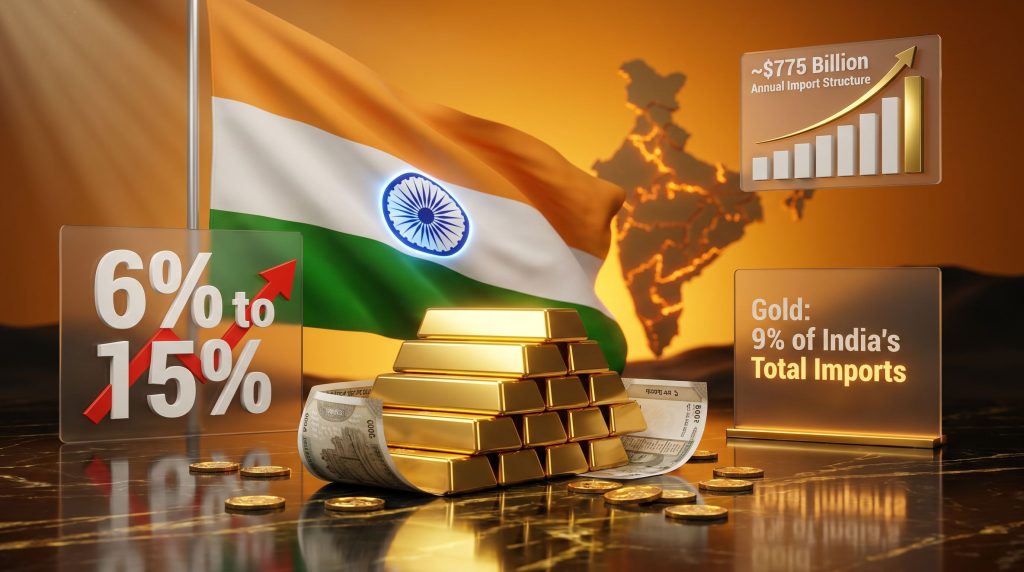
India's annual import bill sits at approximately $775 billion, and within that figure, two categories dominate the conversation: crude oil and gold.
| Import Category | Estimated Annual Value | Share of Total Imports |
|---|---|---|
| Crude Oil | ~$123 billion | ~16% |
| Gold | ~9% of total imports | 2nd largest import |
| All Other Goods and Services | Remainder | ~75% |
Crude oil is the largest single line item by value, but it is also largely non-negotiable. India's industrial economy, its transport systems, and its energy infrastructure depend on continuous oil imports. Gold, by contrast, produces no electricity, powers no factories, and adds nothing measurable to GDP once it crosses the border and settles into household storage or jewellery boxes. This distinction is precisely why gold has become the government's preferred target for demand suppression.
The current account deficit that India is navigating is not the product of any single cause. Elevated crude oil costs following geopolitical disruption in Iran have pushed India's oil basket to around $109 per barrel, up from under $70 prior to the conflict. That alone significantly widens the trade gap. When gold demand is layered on top, and foreign direct investment slows in response to currency instability, the compounding pressure on the rupee becomes acute. Furthermore, as analysts at MoneyControl have noted, the duty hike's effectiveness in curbing depreciation remains a matter of genuine debate.
The Mechanical Link Between Gold Buying and Rupee Depreciation
Step-by-Step: How a Consumer Purchase Weakens a Currency
Understanding why the Indian government appeals to its citizens to reduce gold purchases requires following a chain of transactions that most buyers never see.
- An Indian buyer purchases gold, either directly or through a financial intermediary
- Gold is priced internationally in US dollars per troy ounce
- Completing the purchase requires converting rupees into US dollars somewhere in the transaction chain
- This increases demand for dollars within India's economy
- Greater dollar demand relative to available supply depletes India's foreign exchange reserves
- Reduced reserve adequacy puts downward pressure on the rupee
- A weaker rupee makes future gold and oil imports more expensive in rupee terms
- Rising domestic gold prices, paradoxically, can increase demand for gold as a hedge against further currency deterioration
This final step is the critical one. When Indian consumers observe their currency depreciating, safe-haven gold demand intensifies precisely because it is priced globally in dollars. Buying more gold to protect against rupee weakness then deepens that very weakness, completing a feedback loop that is genuinely difficult to interrupt through policy alone.
The rupee's trajectory illustrates how long this process has been underway. In the 1950s, the exchange rate sat at roughly three to five rupees per US dollar. Today it trades at approximately 95 rupees per dollar, representing decades of cumulative depreciation driven by persistent trade imbalances, inflation differentials, and capital flow dynamics.
Gold is priced in US dollars globally. When Indian consumers or institutions purchase it, the transaction requires buying dollars, which increases dollar demand within India's economy, draws down foreign exchange reserves, and exerts downward pressure on the rupee. Currency weakness then makes gold more appealing as a hedge, which generates further gold purchases, and the cycle deepens.
India's Gold Import Duty Increase: From 6% to 15%
The Arithmetic of a 9 Percentage Point Adjustment
The most direct policy tool available to the Indian government is the import duty on gold, and it has been deployed with force. The duty was raised from 6% to 15%, a 9 percentage point increase representing the steepest single adjustment on record for this category. The arithmetic is immediate: domestic gold prices rise by approximately 9% independent of any movement in the global spot price. Consequently, India gold import duty and rupee depreciation dynamics have drawn significant international financial media attention.
The policy logic is straightforward. If gold becomes sufficiently expensive in rupee terms, demand should fall, reducing the physical import bill and easing pressure on foreign exchange reserves. In theory, this is clean. In practice, it runs into the structural reality of Indian gold demand.
Does Price Actually Suppress Indian Gold Demand?
Historical evidence suggests the answer is nuanced at best. Several dynamics undermine the effectiveness of duty-driven price increases:
- Cultural and religious jewellery demand absorbs price increases over time because the purchase is not truly discretionary
- Rupee depreciation can offset the intended suppression effect, keeping the effective dollar cost of gold stable even as the rupee price rises
- Higher official prices widen the spread between licensed import channels and informal trade, increasing the incentive for smuggling
- Investment-grade demand (bars and coins) shows moderate price sensitivity, but represents only a fraction of total imports
Prime Minister Modi's public appeal asking citizens to voluntarily reduce gold purchases for one year follows a similar logic of demand suppression, but through persuasion rather than price. The realistic assessment is that a small number of discretionary investment buyers may respond, but the vast majority of jewellery buyers, driven by weddings, cultural obligation, and inheritance practice, are largely unaffected by such appeals, regardless of how popular the political leader making them may be.
Why Indian Gold Demand Is Structurally Different
The Cultural Architecture That Resists Policy Intervention
Gold in India is not an asset class in the conventional financial sense. It is woven into the structure of family wealth, religious observance, and social identity in ways that have no direct parallel in Western markets.
A meaningful share of gold is transferred between generations as streedhan, a concept describing wealth that belongs exclusively to a woman, typically received at marriage. This gold is not expected to be liquidated during normal financial conditions. It represents security, status, and personal autonomy, and it tends to persist across generations rather than cycling back into the market.
| Demand Type | Estimated Annual Volume | Price Sensitivity | Vulnerability to Policy |
|---|---|---|---|
| Jewellery | ~500 to 700 tonnes | Low | Very Low |
| Bars and Coins | ~200 to 260 tonnes | Moderate | Moderate |
| Total Annual Imports | ~700 to 900 tonnes | Mixed | Limited |
The implication for policy is significant. The segment most responsive to price signals or government appeals, discretionary investors purchasing bars, coins, and ETFs, accounts for roughly 200 to 260 tonnes of India's annual imports. The remaining 500 to 700 tonnes sitting in jewellery demand is effectively beyond the reach of fiscal or verbal policy tools.
A useful frame for understanding why jewellery demand is so persistent: Indian women in particular hold deep emotional attachment to gold ornaments, especially pieces received as gifts or inherited from family members. The prospect of melting such pieces to participate in a government scheme represents a psychological barrier that financial incentives alone are unlikely to overcome. In addition, when comparing physical gold vs ETFs, this cultural dimension explains why physical ownership retains such dominance in India relative to paper-based alternatives.
What Went Wrong With India's Gold Monetisation Scheme
39 Tonnes in a Decade Against 25,000 to 35,000 Available
Launched in 2015, the Gold Monetisation Scheme was designed to unlock the vast stock of idle gold held in Indian households and temples, estimated at somewhere between 25,000 and 35,000 tonnes. By channelling this gold into the formal financial system, the government hoped to reduce the need for fresh imports. After a decade of operation, the scheme accumulated approximately 39 tonnes, a figure that is genuinely difficult to contextualise against the scale of the ambition.
Three structural barriers explain why the scheme fell far short of its potential:
Barrier 1: Emotional Attachment to Jewellery
The scheme was designed with jewellery as a primary target, which put it in direct conflict with the deepest form of gold ownership in Indian culture. Asking someone to melt an inherited necklace or a piece received at their wedding into an anonymous gold deposit is not a financial transaction, it is an emotionally charged decision that most people will avoid regardless of the interest rate on offer.
Barrier 2: The Hallmarking and Purity Trust Deficit
Before mandatory hallmarking became established in India, jewellery was routinely sold at stated purities, such as 91.6%, that did not reflect actual metal content. When owners brought pieces to monetisation centres and discovered they would receive significantly less value than expected due to impurity, trust in the scheme eroded rapidly. In contrast, the same owner converting old jewellery into new pieces at a jeweller could often receive better effective value through trade-in arrangements.
Barrier 3: Taxation Anxiety and Undocumented Holdings
A substantial proportion of India's household gold was accumulated over generations without formal documentation or tax records. Participating in a government scheme meant exposing the existence and origin of those holdings to official scrutiny, which deterred many potential participants regardless of the financial incentive.
The Gold Monetisation Scheme accumulated approximately 39 tonnes of gold between 2015 and 2025, against an estimated household and temple gold stock of 25,000 to 35,000 tonnes and annual imports averaging 700 to 900 tonnes. The gap between ambition and outcome illustrates how deeply structural the barriers to mobilising Indian gold actually are.
The next major ASX story will hit our subscribers first
Has Restricting Gold Imports Ever Worked?
The Informal Trade Channel Always Finds a Way
India has experimented with far more aggressive interventions than duty adjustments. Between the 1960s and the early 1990s, gold imports were subject to outright restrictions. The result was not the elimination of gold demand, but the redirection of that demand through informal trade networks.
A well-documented pattern from that era reveals that when India's official import volumes declined sharply, a neighbouring trading hub's import figures rose by a corresponding amount. When official Indian imports resumed, that hub's numbers fell back. The implication is widely understood in the industry: gold demand in India is effectively price and policy-inelastic at an aggregate level. Governments can choose whether the gold enters through official or unofficial channels, but they have limited ability to reduce the total volume entering the country.
Dubai's central role in this picture is worth noting specifically. The UAE remains one of the primary transit points for gold entering India, a relationship that becomes particularly important during periods when official import duties or restrictions increase the attractiveness of alternative sourcing arrangements.
This dynamic also means that headline import statistics during high-duty periods can create a misleading picture of policy success. Official import figures may decline, but actual consumption within India may continue largely uninterrupted through parallel channels, with an additional cost to the economy in the form of revenue foregone and reduced traceability.
India's Broader Macro Pressures: Beyond Gold
Crude Oil, FDI, and the Compounding Feedback Loop
Gold import demand is only one pressure point on the rupee. The Iran conflict's impact on oil supply has been the most acute recent catalyst, pushing India's crude oil basket to approximately $109 per barrel and dramatically increasing the dollar cost of India's $123 billion annual crude import bill. Every dollar increase in the per-barrel price of oil compounds the foreign exchange drain in a way that dwarfs the impact of gold imports.
Simultaneously, the currency instability that these pressures create tends to reduce inflows of foreign direct investment and foreign institutional investment. Investors seeking exposure to India's growth story become more cautious when currency risk is elevated, which reduces the dollar supply coming into the country and further pressures the rupee. The result is a genuinely multi-causal depreciation dynamic where each factor amplifies the others.
| Scenario | Rupee Impact | Gold Demand Impact |
|---|---|---|
| Iran conflict resolution and oil price normalisation | Significant relief | Moderate reduction in safe-haven demand |
| Sustained elevated crude prices | Continued depreciation pressure | Elevated gold demand as currency hedge |
| Strong FDI and FII inflow recovery | Partial offset to pressure | Neutral to slightly negative |
| Successful import substitution programme | Structural improvement | Reduced official import volumes |
A Two-Pronged Strategy That Could Actually Work
Targeting the Right Segment of the Market
The most actionable path to reducing India's gold import bill does not require touching jewellery demand at all. It focuses specifically on the 200 to 260 tonnes that enters the country annually in the form of bars, coins, and investment products.
Prong 1: Substituting Physical Investment Demand With Productive Digital Alternatives
India has built one of the world's most sophisticated digital payment and financial infrastructure ecosystems. Applying that capability to gold investment creates a genuine opportunity. The missing element is not the technology but the communication of outcomes.
- Present investors with concrete compounding projections, showing what a gold lease at 4% annually would produce over a 10-year horizon
- At a 4% annual gold yield, 100 grams today becomes approximately 140 to 150 grams over a decade, with no additional rupee investment required
- Make this calculus visible and standardised across retail financial platforms
- Incentivise the full value chain, including jewellers, distributors, and digital platforms, to participate in directing demand toward productive gold instruments
Prong 2: Redesigning Monetisation to Target Bars and Coins Exclusively
Bars and coins carry none of the emotional complexity of jewellery. They are standardised, documented, and typically held by buyers who are already operating in the formal financial system. A revised monetisation scheme focused on this segment would eliminate the purity verification problems that damaged the original scheme's credibility, reduce the taxation anxiety that kept holders on the sidelines, and could offer the additional feature of allowing accumulated gold to be converted into jewellery at a future date if the investor wishes.
What Is Gold Leasing and How Does It Generate a Yield?
Democratising a Product Currently Reserved for Institutions
Gold leasing is not a new concept, but retail access to it has historically been limited to institutional participants. The mechanism works as follows:
- An investor deposits gold into a leasing structure
- That gold is made available to jewellery retailers as inventory financing
- Rather than tying up large amounts of capital purchasing physical stock upfront, retailers pay a lease rate, typically in the range of 2% to 4%
- The investor receives their original gold back at the end of the lease term, plus the agreed yield paid in additional gold
- The jeweller sells the inventory during the lease period, repays the gold obligation, and retains the margin from the sale
This model already operates at scale within India's jewellery sector, with a significant proportion of gold sitting on jewellery store shelves already financed through lease arrangements from banks and institutional lenders. The innovation being explored is extending this yield opportunity to retail investors rather than keeping it exclusively within the institutional tier.
A jeweller with 6 to 7 kilograms of gold on display is carrying the equivalent of roughly 10 to 12 crore rupees in inventory at current prices. The preference to finance that inventory through leasing rather than capital allocation is already well-established. The question is whether the yield from that leasing arrangement can be routed to retail gold holders rather than to banks, creating a productive return on assets that would otherwise simply sit idle.
Silver's Place in India's Monetary Metal Ecosystem
The Accessible Alternative in a High-Price Environment
Silver operates in India as what might be described as gold's accessible substitute. It fulfils comparable functions as a monetary asset, a jewellery material, and a vehicle for wealth preservation, at a price point that remains within reach for households who find gold increasingly expensive.
Religious and festival-driven purchase cycles that traditionally motivate gold buying, such as Diwali and Dhanteras, create parallel demand for silver when gold prices are elevated. Silver ETFs have gained meaningful traction in the Indian market in recent years, mirroring the earlier adoption curve of gold ETFs. However, silver's dual nature as both a monetary metal and an industrial commodity means its price dynamics are driven by forces that have no equivalent in gold markets.
Central banks have become significant net buyers of gold, driven in part by concerns about the weaponisation of dollar-denominated reserve assets. This gold central bank demand has been a meaningful structural support for gold prices. No comparable central bank accumulation dynamic exists for silver. Silver's bullish case rests more squarely on industrial demand growth, particularly in solar energy, electric vehicles, and electronics, alongside retail investment trends.
Silver's dual nature as both a monetary metal and an industrial commodity cuts both ways. Industrial demand growth provides structural support, but it also means that price gains can trigger economisation by manufacturers. The absence of central bank buying removes one of gold's most powerful demand drivers from silver's story entirely.
One additional consideration worth noting is the digitisation dynamic. As digital gold products allow investors to hold fractional gram quantities of gold cost-effectively, one of silver's historical advantages, its accessibility at smaller purchase sizes, is partially eroded. This may apply gradual pressure to silver's monetary demand even as its industrial demand grows.
BRICS, De-Dollarisation, and the Long-Term Outlook for Gold
Structural Sovereign Demand as a Floor Under Gold Prices
The BRICS grouping represents a genuine but complex geopolitical development rather than a cohesive economic alliance. Internal competition between member states, particularly between India and China, limits the degree to which the bloc can function as a unified force in financial markets. India's own strategic positioning reflects this complexity, maintaining constructive relationships with multiple global powers while ultimately tilting toward alignment with democratic institutions and the US-led economic order.
What does have direct relevance to gold markets is the global de-dollarisation trend that BRICS membership and the freezing of Russian sovereign assets have accelerated. Central banks globally have observed what happened to Russia's dollar-denominated reserves following the Ukraine conflict and have drawn conclusions about the risks of excessive concentration in dollar assets. The result has been a sustained shift from net gold sellers to net gold buyers among central banks, representing one of the most significant structural changes to gold demand in decades.
This sovereign accumulation dynamic operates independently of retail and jewellery demand. It provides a demand floor that supports gold prices through periods of consumer weakness and amplifies price gains during periods of broader investor interest. The stagflationary economic scenario, characterised by elevated inflation alongside sluggish growth, potentially accelerated by structural job displacement from artificial intelligence adoption, would historically be among the most favourable macro environments for gold.
Key Risks Facing Gold and Silver Markets
What Could Interrupt the Bullish Thesis
| Risk Factor | Likely Market Impact | Probability Assessment |
|---|---|---|
| Sustained interest rate increases | Negative short-term pressure on gold | Moderate |
| Correlated liquidation in overheated global markets | Short-term sell-off followed by reallocation | Moderate to High |
| AI-driven structural job losses creating stagflation | Strongly positive for gold | Moderate |
| Geopolitical escalation broadening beyond current conflicts | Positive safe-haven demand | Elevated |
The correlated liquidation risk deserves particular attention. When global portfolios become overextended and systemic stop-losses are triggered, institutional managers tend to liquidate across all asset classes simultaneously to meet redemptions or margin requirements. Gold is not immune to this dynamic, and historically it has often sold off in the early phase of broad market dislocations before recovering strongly as reallocation begins. Investors should be aware that gold's safe-haven properties tend to reassert themselves in the medium term rather than functioning as an immediate hedge in a sharp liquidity event.
A practical approach that accounts for this reality involves staged accumulation rather than concentration at a single entry point. Allocating a fixed percentage of intended gold exposure each month, without attempting to time entry around price movements, has historically produced superior outcomes for the majority of investors compared to lump-sum timing strategies.
India as a One-Way Street for Gold
What This Means for Global Precious Metals Markets
India's gold market has an asymmetric character that distinguishes it from virtually every other major market. Gold enters through imports, moves into jewellery and household savings, and rarely exits. The small volume of gold jewellery that does leave India does so primarily because of the high artistic and craft value of Indian workmanship, not because domestic holders are liquidating positions.
This structural one-way flow means that India's gold stock compounds over time as each year's imports are added to a base that is never meaningfully drawn down. As India's middle class continues to expand and disposable incomes rise, the pool of potential gold buyers grows. Younger generations are showing a preference shift toward digital gold products and investment-grade formats over traditional jewellery, but this is a change in the form of demand rather than a reduction in the underlying impulse to hold gold.
The long-run implication for global gold markets is that India's aggregate demand base will grow with its economy, providing a persistent and increasingly large source of annual buying that other regions would need decades to replicate. India gold import duty and rupee depreciation pressures may shift the form in which that demand is expressed, but they are unlikely to reduce its underlying magnitude. The Indian gold market has been operating continuously for centuries, and the institutional and cultural infrastructure supporting it shows no signs of structural weakening.
Disclaimer: This article is intended for informational and educational purposes only and does not constitute financial or investment advice. All figures relating to import volumes, gold prices, and economic projections involve estimates and should be independently verified. Past performance of gold and silver as asset classes does not guarantee future results. Readers should consult qualified financial advisers before making investment decisions.
Want to Identify ASX Mineral Discoveries Before the Broader Market Does?
Discovery Alert's proprietary Discovery IQ model delivers real-time alerts on significant ASX mineral discoveries, transforming complex data across more than 30 commodities into clear, actionable insights for both short-term traders and long-term investors — start your 14-day free trial today and explore how historic discoveries have generated substantial returns for those positioned early.