
June 16, 2026
Understanding Senegal's Mining Permit Architecture: Why the ESIA Decree Is a Gateway, Not a Green Light
The global race for gold in West Africa has intensified considerably over the past decade, driven by the intersection of rising bullion prices, expanding geological understanding of the Birimian Greenstone Belt, and a quiet but meaningful redistribution of foreign mining capital toward politically stable jurisdictions. For investors tracking development-stage gold assets, the regulatory journey from exploration to production is rarely linear, and it is almost never fully understood from the outside.
Permitting sequences across West African jurisdictions differ materially from one country to the next, and the gap between a high-profile regulatory approval and actual construction authority is wider than many market participants appreciate. The Fortuna Diamba Sud gold project approval in Senegal offers a precise case study in how these regulatory mechanics operate in practice, and why the distinction between milestone types matters enormously for project timeline modelling.
When big ASX news breaks, our subscribers know first
How Senegal Structures the Path from Exploration to Mine Construction
The Two-Stage Permitting Architecture Under Senegalese Mining Law
Senegal's mining sector is governed by its Mining Code, which establishes a sequential permitting framework requiring companies to satisfy distinct regulatory obligations at each phase of a project's lifecycle. The architecture separates exploration rights from exploitation rights entirely, treating them as distinct legal instruments with different application requirements, documentation standards, and ministerial approval pathways.
At the exploration stage, companies operate under exploration permits that authorise geological work, sampling, drilling, and resource estimation but carry no authority to construct infrastructure or extract ore commercially. The transition to an exploitation permit, which is the operative instrument for mine construction and production, requires a company to demonstrate far more than resource size. It must satisfy a comprehensive environmental and social review process before the permit application can be advanced to the final approval stage.
This is where the Environmental and Social Impact Assessment (ESIA) decree sits within the system. In Senegal's regulatory framework, the ESIA is not an optional best-practice document — it is a mandatory legal prerequisite. Without a government decree confirming ESIA compliance, an exploitation permit application cannot progress. The Ministry of Energy, Petroleum and Mines serves as the central authority overseeing this process for foreign operators, and understanding the mining permitting sequence is essential for any investor evaluating project timelines.
What the ESIA Decree Actually Authorises
A common point of confusion in mining investment circles involves conflating ESIA approval with construction clearance. These are fundamentally different authorisations. The ESIA decree confirms that a project meets applicable environmental and social regulations as assessed by the relevant government authority. It is a certification of regulatory compliance at the environmental review stage, not a mandate to break ground.
The practical significance is this: receiving an ESIA decree unlocks the next stage of the permitting sequence, specifically the formal assessment and potential granting of the exploitation permit. That exploitation permit remains the operative legal instrument that authorises construction and commercial extraction.
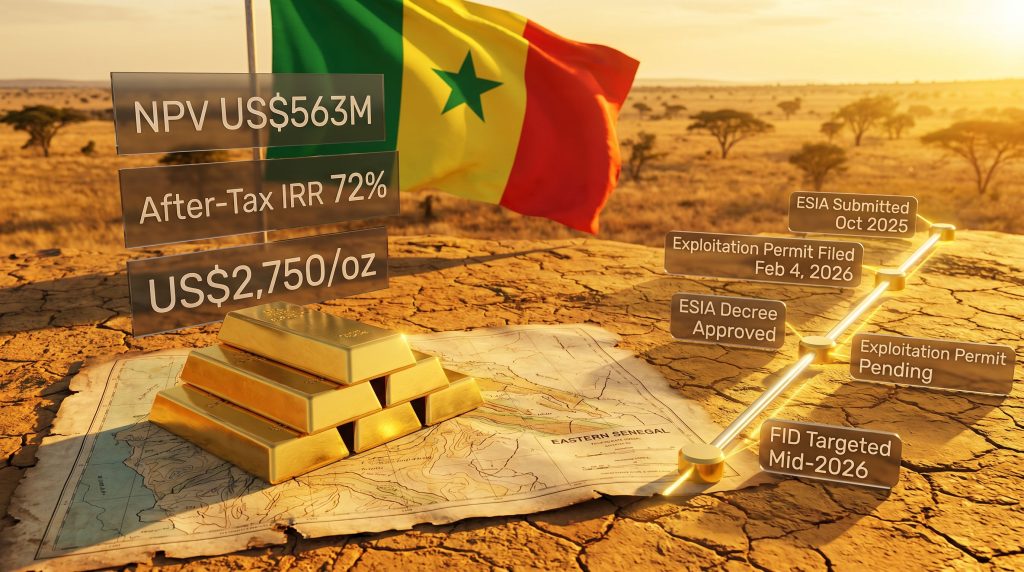
For the Fortuna Diamba Sud gold project approval in Senegal, the environmental approval permitting sequence as of mid-2026 looks as follows:
| Permitting Milestone | Status | Date |
|---|---|---|
| ESIA submission to Senegalese environmental regulator | Completed | October 6, 2025 |
| Exploitation permit application filed | Completed | February 4, 2026 |
| ESIA decree issued by Senegalese government | Completed | June 2026 |
| Exploitation permit issuance | Pending | Expected mid-2026 |
| Final Investment and Construction Decision | Pending | Targeted mid-2026 |
| Definitive Feasibility Study (DFS) | In progress | Pre-construction requirement |
The gap between the ESIA decree issuance and exploitation permit receipt is precisely the window where project timelines most frequently experience slippage in West African mining jurisdictions. Understanding this interval is critical for any investor modelling project advancement scenarios.
Where Diamba Sud Sits in the Regional Regulatory Landscape
Senegal's Mining Governance Compared to Its West African Peers
West Africa's gold mining landscape has undergone a significant reorientation since approximately 2021. Political transitions in Mali, Burkina Faso, and Niger have created substantial uncertainty for foreign mining operators, including the forced renegotiation of existing permits, elevated royalty demands, and in some cases, outright asset seizures. This shift has redirected a meaningful portion of greenfield gold development capital toward jurisdictions with more stable governance environments.
Senegal has emerged as a beneficiary of this capital migration. The country maintains democratic governance continuity that differentiates it meaningfully from its Sahelian neighbours. Its Mining Code, while not without complexity, operates within a framework that foreign operators have been able to navigate with reasonable predictability, particularly in the eastern Senegal gold belt where Diamba Sud is located.
The Fraser Institute's annual survey of mining company executives consistently evaluates West African jurisdictions on both geological attractiveness and policy perception. Senegal has generally ranked more favourably on policy perception metrics than Mali or Burkina Faso in recent years, reflecting its stable regulatory environment. However, it does not yet attract the same volume of capital as Côte d'Ivoire, which has benefited from a longer track record of successful mine commissioning under foreign operators. Furthermore, the broader mining geopolitical landscape across the Sahel region continues to reshape where development capital flows.
The Birimian Greenstone Belt: The Geological Foundation
Diamba Sud's geological setting is central to understanding why the project attracts serious capital despite being pre-construction. Eastern Senegal sits within the broader Birimian Greenstone Belt, an ancient geological formation of Paleoproterozoic age (approximately 2.1 to 2.2 billion years old) that extends across much of West Africa and hosts some of the continent's most significant gold deposits.
The Birimian is not a single geological body but rather a series of volcano-sedimentary belts interspersed with granitoid intrusions. Gold mineralisation within Birimian terranes typically occurs in structurally controlled shear zones, particularly where hydrothermal fluids have interacted with iron-rich volcanic sequences. This style of mineralisation tends to produce deposits with relatively consistent grade distribution and good metallurgical characteristics, which is critical for project economics.
Eastern Senegal's portion of the Birimian remains less explored than equivalent terranes in Ghana, Côte d'Ivoire, and Mali, meaning that Diamba Sud's discovery may represent only a fraction of the region's total resource potential. This geological underexploration is a factor that risk-tolerant investors often weigh when evaluating the optionality embedded in companies building an early-mover position in the region.
Analysing Diamba Sud's Project Economics Against the Permitting Risk Backdrop
Breaking Down the 2025 PEA Metrics
The 2025 Preliminary Economic Assessment for Diamba Sud reported economic metrics that, at face value, position the project among the more attractive development-stage gold assets globally:
- After-tax IRR: 72% at a gold price assumption of US$2,750 per ounce
- NPV at 5% discount rate: US$563 million using the same gold price assumption
- 2026 project budget: US$100 million, covering early works, feasibility advancement, and pre-construction activities
- Final investment and construction decision: targeted mid-2026, contingent on exploitation permit receipt and DFS completion
A 72% after-tax IRR is exceptionally high for a development-stage mining asset. For context, most producing gold mines targeting construction approval operate on after-tax IRRs in the 20% to 40% range at consensus gold prices, and even premium-quality assets rarely breach 50% in pre-feasibility assessments. The 72% figure at Diamba Sud reflects a combination of factors including assumed grade, mine plan configuration, capital intensity relative to projected output, and the gold price assumption used.
"Investor Consideration: PEA-stage economics are indicative estimates, not bankable figures. The 72% IRR and US$563 million NPV will be subject to material revision once the Definitive Feasibility Study is completed. DFS exercises routinely surface capital cost increases, metallurgical complexity, and infrastructure requirements that compress PEA-stage returns. The DFS, not the PEA, will be the appropriate benchmark for capital allocation decisions."
Sensitivity to Gold Price and Permitting Timeline
The PEA's gold price assumption of US$2,750 per ounce is noteworthy. The current gold price outlook suggests gold has traded at or above this level during periods of elevated macro uncertainty, but long-run consensus estimates from major investment banks have historically been more conservative. A sustained retreat toward US$2,200 to US$2,400 per ounce would compress the project's IRR and NPV materially, even if the underlying resource and cost structure remained unchanged.
Beyond gold price sensitivity, permitting timeline risk introduces a second layer of economic exposure. Extended pre-construction periods create capital cost escalation risk through contractor price inflation, equipment lead time extension, and the opportunity cost of committed capital. The US$100 million 2026 budget appears structured to advance critical path activities, including the definitive feasibility study, while avoiding full construction commitment ahead of exploitation permit receipt.
| Scenario | Exploitation Permit Outcome | Construction Decision | Project Impact |
|---|---|---|---|
| Base Case | Granted before June 2026 | Proceeds mid-2026 | Full project advancement on schedule |
| Moderate Delay | Granted Q3 2026 | Deferred to H2 2026 | 3 to 6 month schedule slippage, cost escalation risk |
| Extended Delay | Pending beyond Q3 2026 | Deferred to 2027 | Material capital reallocation risk, NPV erosion |
A particular timing pressure worth noting is the exploration permit expiry, which is expected around June 2026. If the exploitation permit has not been issued by that point, Fortuna may need to negotiate a permit extension, introducing an additional regulatory interaction and potential timeline uncertainty.
Fortuna's Portfolio Context and the Strategic Logic of West African Exposure
Asset Geography and Regional Clustering
Fortuna Mining operates and explores across a diverse set of emerging market jurisdictions: Argentina, Côte d'Ivoire, Guinea, Guyana, Peru, and Senegal. The West African component of this portfolio reflects a deliberate regional clustering strategy, concentrating exposure across three countries that share Birimian geology while maintaining distinct regulatory and political risk profiles.
Côte d'Ivoire has an established track record of producing gold mines under foreign operators and benefits from a relatively mature regulatory framework. Guinea carries higher political risk but offers significant geological upside. Senegal, through Diamba Sud, represents a potentially transformative asset in terms of NPV contribution relative to the existing producing portfolio.
The speed with which Senegalese authorities processed the ESIA application — from submission in October 2025 through to decree issuance in June 2026 — is approximately eight months, which is a credible processing timeline for a complex environmental assessment in a West African context. This pace signals a degree of pre-submission engagement between Fortuna and regulatory authorities that is consistent with high-quality project preparation.
What Rapid ESIA Processing Tells Investors About Execution Quality
In the mining industry, the speed of environmental permit processing is often used as a proxy for document quality and community engagement depth. Projects where community opposition exists, where baseline data gaps require supplementary studies, or where regulatory dialogue has been conducted inadequately tend to experience significant ESIA review delays. Consequently, requests for additional information can extend timelines by months or years.
The relatively efficient ESIA processing at Diamba Sud suggests that Fortuna's preparation was comprehensive, that community engagement in the project area reached the threshold required for regulatory acceptance, and that the pre-submission dialogue with Senegalese authorities identified and resolved potential objections before formal lodgement. For a company managing a multi-jurisdiction portfolio, this execution discipline at the permitting stage is one of the more reliable early indicators of operational competence.
Key Risks Between Now and the Construction Decision
The Critical Dependency Stack
Several non-trivial risks sit between the current permitting milestone and a legally authorised construction commencement:
- Exploitation permit timing: This remains the single most consequential near-term regulatory event. Without it, the mid-2026 construction decision cannot proceed regardless of DFS completion or gold price conditions.
- DFS completion and findings: Definitive feasibility studies regularly surface material revisions to PEA-stage capital cost estimates. A significant capital cost increase at the DFS stage would alter project economics and potentially delay the final investment decision while financing structures are renegotiated.
- Gold price volatility: The PEA's US$2,750 per ounce assumption is above many analysts' long-run forecasts. In addition, a correction toward US$2,200 to US$2,400 per ounce would meaningfully reduce the project's NPV at 5% discount rate and potentially alter financing cost assumptions.
- Exploration permit expiry: The June 2026 timeline creates genuine regulatory urgency. If the exploitation permit has not been issued, a permit extension request would introduce additional uncertainty and potential negotiation complexity.
- Local content and community obligations: Senegal's mining framework includes requirements for local content, community benefit agreements, and social licence maintenance. Any deterioration in community relations or failure to meet local employment and procurement commitments could create obstacles to permit issuance or operational disruptions post-construction.
"Analytical Note: Investors should treat the mid-2026 construction decision as a target rather than a certainty. The exploitation permit, DFS completion, and gold price environment must converge favourably within a narrow window. Scenario planning that accounts for a six to twelve month delay relative to the base case timeline is prudent risk management for anyone building a position around this catalyst."
The next major ASX story will hit our subscribers first
Frequently Asked Questions: Fortuna Diamba Sud Gold Project Approval in Senegal
What did Fortuna Mining receive approval for at Diamba Sud?
The Senegalese government issued a decree approving the Environmental and Social Impact Assessment for the Diamba Sud gold project, confirming compliance with applicable environmental and social regulations. This is a mandatory precondition for exploitation permit issuance, not a construction authorisation.
Has Fortuna Mining received a full mining permit for Diamba Sud?
Not as of mid-2026. The exploitation permit application was filed on February 4, 2026, and the ESIA decree has been issued. The exploitation permit itself, which authorises mine construction, remains pending.
What are the key economic metrics for the Diamba Sud project?
The 2025 PEA reported an after-tax IRR of 72% and an NPV of US$563 million at a 5% discount rate, using a gold price assumption of US$2,750 per ounce. The 2026 project budget is US$100 million.
When is a construction decision expected?
Fortuna has targeted a final investment and construction decision for mid-2026, subject to exploitation permit receipt and DFS completion. However, the gold market outlook and permitting timeline must converge favourably for this target to be met.
Where is Diamba Sud located geologically?
Diamba Sud is situated in eastern Senegal within the Birimian Greenstone Belt, a Paleoproterozoic geological formation hosting many of West Africa's most significant gold deposits. Eastern Senegal's portion of this belt is considered underexplored relative to equivalent terranes in Ghana and Côte d'Ivoire.
Why does the ESIA decree matter even if it is not the final permit?
Under Senegalese mining law, the ESIA decree is a non-negotiable prerequisite for exploitation permit issuance. Its receipt directly enables the final permitting stage to proceed. Without the decree, the exploitation permit application cannot advance, making this milestone genuinely decisive even though it is not the terminal approval event.
What to Watch: Near-Term Catalysts for Diamba Sud
The Milestones That Will Define Project Trajectory
Several near-term developments will determine whether the Fortuna Diamba Sud gold project approval in Senegal translates into a fully authorised construction decision or experiences the kind of permitting slippage that has historically affected development-stage gold assets in West Africa:
- Exploitation permit issuance from the Ministry of Energy, Petroleum and Mines, representing the final regulatory barrier before construction authorisation.
- DFS release, which will provide the definitive capital cost estimate, mine plan configuration, and updated mineral resource classification upon which the final investment decision will be based.
- Final Investment Decision (FID), the corporate governance event that commits construction capital and triggers mobilisation of contractors and equipment.
- Exploration permit extension or replacement, which will need to be managed around the June 2026 expiry if the exploitation permit has not been issued by that point.
Beyond the project itself, Diamba Sud's permitting experience carries signal value for the broader question of whether Senegal can position itself as a reliable destination for greenfield gold development capital in the post-Sahel-crisis realignment of West African mining investment. The efficiency and transparency of the ESIA process will be closely observed by other junior and mid-tier companies evaluating project pipelines in eastern Senegal's geologically prospective but underexplored gold corridor.
This article contains forward-looking assessments and scenario projections based on publicly available information. Preliminary Economic Assessment figures are pre-feasibility estimates and subject to material revision. Readers should not rely on this content as investment advice and should conduct independent due diligence before making any financial decisions related to companies or projects discussed herein.
For additional context on West African gold mining regulatory frameworks and emerging market project development, visit canadianminingjournal.com.
Want to Know When the Next Major ASX Mineral Discovery Hits the Market?
Discovery Alert's proprietary Discovery IQ model scans ASX announcements in real time, instantly identifying significant mineral discoveries — including gold exploration opportunities like those emerging across West Africa's Birimian Greenstone Belt — and delivering actionable insights to subscribers before the broader market responds. Explore the historic returns major discoveries have generated and begin your 14-day free trial at Discovery Alert to position yourself ahead of the next significant find.