August 23, 2026
When Price Becomes the Enemy: Understanding India's Volatile Gold Demand Cycle
Few commodity markets on earth are as structurally complex, culturally embedded, and price-reactive as India's gold market. Unlike the institutional-driven gold markets of the West, where fund managers and central bank gold demand policies dominate flow dynamics, Indian gold demand is largely shaped by tens of millions of retail consumers, small-scale jewellers, and a deeply rooted cultural relationship with the metal that spans centuries. This makes the India gold market recovery currently unfolding particularly meaningful, not just for domestic participants, but for anyone tracking global precious metals demand.
The mechanics of how Indian consumers respond to price movements are unlike almost any other market in the world. Demand does not simply slow gradually as prices rise. It can freeze abruptly, then thaw just as quickly once conditions shift. Understanding why this happens, and what the current signals suggest about where demand is heading, requires looking well beyond the headline numbers.
When big ASX news breaks, our subscribers know first
India's Weight in the Global Gold Equation
India stands as the world's second-largest gold-consuming nation, ranking behind only China. The scale of this demand makes Indian import cycles, consumption patterns, and price sensitivity enormously consequential for global gold benchmarks.
What distinguishes India from most major gold markets is its dual demand engine. On one side sits cultural and jewellery consumption, anchored by an annual calendar of weddings, religious festivals, and gifting traditions that collectively absorb enormous quantities of physical gold. On the other sits a rapidly growing financial investment demand, expressed through physical bar and coin purchases, exchange-traded funds, and futures market participation.
These two demand streams do not always move in tandem. Wedding-related jewellery purchases carry a degree of inelasticity, as families often commit to gold procurement regardless of short-term price movements. Discretionary jewellery buying and investment accumulation, however, are far more price-sensitive. It is this bifurcated demand structure that makes reading India's gold market both challenging and revealing.
The country's demand cycle is also heavily shaped by its festive calendar. Diwali and Dhanteras, typically falling in October and November, anchor the peak retail demand period of the year. The broader wedding season, which runs through multiple months, adds a secondary layer of demand that jewellers and manufacturers plan around well in advance.
The Price Shock That Froze the Market
The conditions preceding the current India gold market recovery are essential context. Surging international gold prices in prior months pushed domestic rupee-denominated prices to levels that materially compressed consumer affordability. India's gold consumers are among the most price-sensitive in the world, and when prices spike sharply, demand does not merely soften; it can collapse with unusual speed.
June 2026 brought exactly this dynamic into sharp relief. Following a sharp correction in domestic gold prices, market activity effectively stalled across jewellery retail and wholesale channels. Discretionary purchases were deferred. Foot traffic in jewellery stores declined. Import volumes fell to approximately 20 tonnes, a multi-month demand low that signalled the depth of the market's distress.
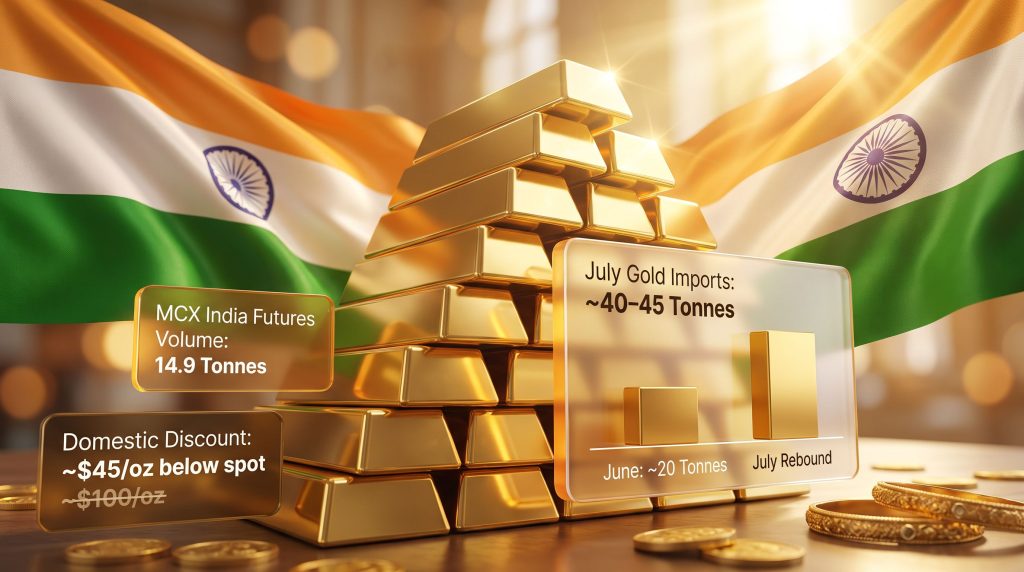
The most telling indicator of this stress was the domestic dealer discount. When demand falls short of available supply, Indian dealers reduce prices relative to international benchmarks to move inventory. By mid-May and again in early June, this discount reached approximately $100 per ounce below the international spot price. This figure matters because it quantifies the gap between what international markets were pricing gold at and what Indian buyers were actually willing to pay.
One underappreciated mechanism that sustained market liquidity during this period was the old-for-new jewellery exchange system. Indian consumers routinely trade in existing gold jewellery as partial payment toward new purchases. During periods of demand weakness, this practice effectively recycled existing gold back into the supply chain, reducing the need for fresh imports while keeping retail counters operational. It is a structural feature of India's gold market that Western analysts frequently underestimate.
Five Signals Pointing to Recovery
By July and into August 2026, several converging indicators began painting a more constructive picture for the India gold market recovery. According to the World Gold Council's India market update, each signal is worth examining individually.
Signal 1: Import Volume Rebound
July gold imports approximately doubled relative to June, rising from 20 tonnes to an estimated 40 to 45 tonnes. A doubling of import volumes in a single month is statistically significant and reflects more than just end-consumer purchases. Import volumes above 40 tonnes typically indicate active restocking activity by jewellers and wholesalers building inventory ahead of anticipated demand.
Signal 2: Domestic Price Stabilisation
International gold prices gained approximately 9% through the first two weeks of August 2026. Domestic rupee-denominated prices rose by approximately 7% over the same period. The differential is explained by rupee appreciation, which partially absorbed the global price increase by reducing the rupee cost of dollar-denominated imports. This currency offset mechanism is a critical and frequently overlooked dynamic in Indian gold pricing.
Signal 3: Narrowing Dealer Discounts
The domestic discount narrowed from approximately $100 per ounce during May and June to around $45 per ounce by mid-August. A narrowing discount signals that demand is increasingly absorbing available supply. The persistence of a discount, rather than a premium, confirms that supply remains adequate and the market is not yet in shortage territory.
| Period | Domestic Discount (per oz) | Market Condition |
|---|---|---|
| Mid-May 2026 | ~$100 below spot | Severe demand weakness |
| Early June 2026 | ~$100 below spot | Continued market stress |
| Mid-August 2026 | ~$45 below spot | Recovering, discount narrowing |
Signal 4: Futures Market Expansion
Trading volumes on the Multi Commodity Exchange of India (MCX India) rose to 14.9 tonnes in July, above the three-month prior average of 13.5 tonnes. Rising futures volumes reflect growing participation from traders, hedgers, and institutional players. In practice, increased futures activity often serves as a leading indicator of physical demand recovery, as market confidence typically builds in derivatives markets before it fully translates into cash market buying.
Signal 5: ETF Inflows and New Investor Participation
Indian gold ETF holdings increased by 1 tonne during the period, valued at approximately ₹15.6 billion (around $163 million USD). Total ETF gold holdings in India reached 120 tonnes, with assets under management of ₹1,733 billion (approximately $18.1 billion USD). Perhaps most revealing for the longer-term outlook, 57,000 new investor ETF portfolios were opened, bringing the total number of Indian ETF accounts to 12.53 million.
The simultaneous growth in both ETF assets and new account creation suggests the recovery is drawing in both existing investors adding to positions and first-time participants entering the market. Furthermore, this broadening of the investor base is a structurally positive development that extends beyond any single demand cycle.
Jewellery Demand: The Cultural Engine Restarts
The jewellery segment, which historically represents the largest share of Indian gold consumption, showed meaningful signs of reactivation as prices stabilised. Industry feedback compiled by the World Gold Council indicated that consumers who had deferred purchases during the earlier price spike began returning to retail outlets as conditions normalised.
Jewellery manufacturers reported receiving stronger order flows from retail clients. Inventory replenishment by jewellers picked up ahead of the festive season, a reliable signal of growing confidence in forward demand. This restocking behaviour matters because it typically precedes peak retail demand by six to ten weeks, meaning that August restocking activity points toward a more active October and November selling season.
The recovery in jewellery demand extended beyond the essential wedding-related category into broader discretionary purchasing. This broadening is significant because discretionary jewellery demand is the segment most sensitive to price movements. Its return signals that consumers are becoming more comfortable with current price levels, not merely making purchases they could not defer any longer.
Key structural insight: The distinction between essential wedding-related purchases and discretionary jewellery buying is central to reading Indian gold demand cycles. Essential demand provides a demand floor regardless of price. Discretionary demand is the swing factor that determines whether the broader market expands, contracts, or stagnates at a given price level.
Physical vs. Paper Gold: Where Indian Investors Are Allocating
The investment demand landscape in India is increasingly bifurcated between tangible physical accumulation and financial instrument exposure. Consequently, understanding both channels is important for assessing the overall health of investment demand. For a broader perspective, the debate around physical gold vs ETFs is relevant to investors across markets.
Physical bar and coin demand eased modestly following the June price correction but remained broadly supportive of overall market conditions. Lower prices during the correction period attracted buyers seeking long-term strategic exposure rather than short-term speculative positioning. The subsequent price rebound from July lows appeared to revive interest among investors who had been monitoring the market from the sidelines.
Gold ETFs represent the fastest-growing investment channel in India's gold market. The 12.53 million total ETF accounts figure reflects a maturing retail investor base that is increasingly comfortable using financial instruments to gain gold exposure. However, a critical distinction applies here.
Investor Consideration: Gold ETFs offer liquidity, transparency, and lower transaction costs compared to physical gold. However, ETF shares do not confer ownership of physical gold. Investors whose primary objective is wealth preservation through tangible asset ownership should understand this distinction carefully before deciding how to allocate capital across these two channels.
| Demand Channel | July 2026 Status | Key Driver | Price Sensitivity |
|---|---|---|---|
| Jewellery | Recovering | Festive season restocking | High |
| Physical bars and coins | Resilient but easing | Long-term strategic buyers | Moderate |
| Gold ETFs | Growing (+1 tonne, +57K accounts) | Retail investor participation | Low |
| MCX Futures | Rising (14.9t volume) | Trader and hedger activity | Higher (leverage exposure) |
The next major ASX story will hit our subscribers first
The Global Macro Forces Amplifying Domestic Trends
The India gold market recovery does not exist in isolation. Several global macro forces have converged to support both international gold prices and Indian domestic market conditions simultaneously.
A weakening U.S. dollar has been a primary driver. Gold is priced globally in U.S. dollars, meaning that when the dollar weakens, non-dollar currencies effectively gain purchasing power for gold imports. For India, this mechanism works through two channels: it supports the global price of gold while also improving the rupee's relative buying power for dollar-denominated imports.
According to the World Gold Council, shifting monetary policy expectations, a weaker U.S. dollar, and renewed inflows into global gold ETFs have collectively supported gold prices during the recent recovery period. Lower interest rate expectations reduce the opportunity cost of holding non-yielding assets like gold, making the metal more attractive relative to interest-bearing alternatives. Indian gold prices are doubly affected by this mechanism, through the global price channel and through exchange rate dynamics that alter the rupee cost of imports.
Global ETF inflows have added another layer of support. When institutional investors in major Western markets re-engage with gold-backed funds, it creates upward price momentum that benefits physical market participants in importing nations like India. This feedback loop between global institutional sentiment and Indian retail affordability is a dynamic that receives insufficient attention in mainstream gold market analysis. In addition, the broader gold demand trends reshaping global consumption patterns make India's evolving market all the more significant to monitor.
Key Statistics Summarising the Recovery
| Metric | Data Point | Significance |
|---|---|---|
| June gold imports | ~20 tonnes | Multi-month demand low |
| July gold imports | ~40 to 45 tonnes | Approximately 100% month-on-month rebound |
| International price gain (Aug 1-14) | ~9% | Global macro tailwinds |
| Domestic rupee price gain (Aug 1-14) | ~7% | Rupee strength absorbed some upside |
| Peak domestic discount (May-June) | ~$100/oz below spot | Severe demand weakness |
| Discount mid-August | ~$45/oz below spot | Partial recovery, supply still adequate |
| MCX futures volume (July) | 14.9 tonnes | Above 3-month average of 13.5 tonnes |
| Indian ETF gold holdings | 120 tonnes | Stable long-term accumulation |
| Indian ETF AUM | ₹1,733 billion (~$18.1B USD) | Significant scale |
| New ETF accounts (July) | +57,000 | Retail investor re-engagement |
| Total ETF accounts | 12.53 million | Broad retail participation base |
Risks That Could Derail the Recovery Narrative
A balanced reading of current conditions requires acknowledging the structural constraints that could limit or reverse the recovery.
Price sensitivity remains the primary risk. Indian gold demand has historically demonstrated sharp non-linear responses to price movements. Demand that appears to be recovering at current price levels can evaporate quickly if international gold prices surge again. Reuters data from early July noted that demand eased when prices rebounded from a three-month low, confirming that price sensitivity remains an active force in the market even during apparent recovery phases.
The recovery is measured, not exuberant. The World Gold Council's characterisation of current conditions as supportive rather than strongly expansionary is important. Investment and consumer activity are recovering from a low base, not accelerating from a position of strength. The distinction matters for setting realistic expectations about the scale of any festive season demand uplift.
Currency and import duty variables add uncertainty. Rupee volatility can materially alter the domestic gold price independently of international movements. India's government has also demonstrated a willingness to adjust gold import duty structures as a policy tool, and any such adjustment could rapidly reshape market dynamics in ways that are difficult to anticipate.
Supply adequacy remains a moderating force. The persistence of a domestic discount at approximately $45 per ounce confirms that supply continues to exceed demand. The old-for-new jewellery exchange mechanism has kept secondary supply flowing into the market, preventing the kind of supply tightness that would push prices to a premium and signal a truly tight physical market.
Outlook: Can the Festive Season Confirm What July Began?
The forward-looking indicators are cautiously constructive. Manufacturer order flows are increasing. Jeweller inventory restocking is accelerating. ETF account creation is broadening the retail investor base. Futures market participation is growing. These are the kinds of leading signals that, when they converge, tend to precede meaningful demand surges.
The festive season represents the critical test. If current restocking trends continue through August and September, October and November retail demand volumes could meaningfully exceed the levels recorded during the same period in 2025. However, the elevated gold price environment remains a ceiling on jewellery demand recovery. If international prices continue their upward trajectory, the affordability constraint will re-emerge, particularly for lower-income consumer segments who historically drive a meaningful share of India's festive gold purchases.
Investment demand is expected to provide a stabilising floor even if jewellery demand faces renewed pressure. Strategic buyers accumulating physical gold and ETF investors adding long-term exposure tend to be considerably less price-sensitive than jewellery consumers. This dual-engine structure, cultural consumption demand plus financial investment demand, gives India's gold market a resilience that single-driver markets rarely possess. For investors assessing the broader implications, the gold price outlook and gold as a safe haven narrative both remain highly relevant to understanding India's role in the global gold equation.
Furthermore, analysts tracking the festive demand trajectory may find useful context in India's demand recovery ahead of the festive season, as outlined by the World Gold Council.
What to monitor in the coming weeks:
- Monthly import data for August and September as the primary confirmation signal for the recovery trajectory
- Festive season retail sales data as the ultimate real-world demand validation
- Rupee stability and any potential import duty policy adjustments as key risk variables
- Global gold price direction and its downstream impact on domestic Indian affordability
The India gold market recovery building through July and August 2026 is real, multi-faceted, and grounded in measurable data. Whether it matures into a genuinely strong festive season, or stalls against the ceiling of elevated prices and currency volatility, will define the full-year demand picture for one of the world's most consequential gold markets.
This article is for informational purposes only and does not constitute financial or investment advice. Past market trends and demand patterns do not guarantee future outcomes. Readers considering gold-related investments should seek independent financial advice appropriate to their individual circumstances.
Want to Stay Ahead of Significant Mineral Discoveries Linked to Precious Metals Demand?
As India's gold market recovery gathers momentum and global precious metals demand signals intensify, Discovery Alert's proprietary Discovery IQ model delivers real-time alerts on significant ASX mineral discoveries — translating complex data across 30-plus commodities into clear, actionable insights. Explore how historic discoveries have generated substantial returns on Discovery Alert's dedicated discoveries page, and begin your 14-day free trial today to position yourself ahead of the broader market.