
August 22, 2026
The Processing Bottleneck That Defines Nevada's Refractory Gold Economics
Across Nevada's prolific gold districts, a structural inefficiency quietly erodes the economics of dozens of underground operations. It is not a geological problem, a permitting problem, or a price problem. It is a metallurgical infrastructure problem, and it affects every producer whose ore is chemically locked inside sulfide mineral matrices that conventional processing cannot unlock.
The scarcity of pressure oxidation autoclave capacity in Nevada is not a recent development. It has persisted for decades, consolidating meaningful processing leverage in the hands of the very few operators who control this technology. For gold producers without access to owner-operated autoclaves, the consequence is a structural revenue haircut that compounds with every tonne of ore delivered to a third-party toll milling facility.
Understanding this dynamic is essential context for evaluating the i-80 Gold Lone Tree autoclave refurbishment and the multi-year investment thesis it underpins. Furthermore, gold exploration trends across the region highlight just how critical processing infrastructure has become for unlocking economic value.
When big ASX news breaks, our subscribers know first
Why Refractory Ore Creates a Processing Hierarchy in Nevada
The Chemistry Behind Refractory Gold and Why Standard Circuits Fail
Not all gold is created equal from a metallurgical perspective. Oxide ores, where gold exists in a free-milling state, respond readily to conventional carbon-in-leach (CIL) and heap leach circuits. Cyanide dissolves the gold efficiently, and recoveries in these systems routinely exceed 85% to 90%.
Refractory sulfide ores operate under entirely different rules. In these deposits, gold is physically encapsulated within the crystalline lattice of sulfide minerals, most commonly pyrite and arsenopyrite. Cyanide solution cannot penetrate the sulfide host fast enough to achieve economic gold liberation. The gold is not absent — it is simply inaccessible without a pre-treatment step that breaks down the sulfide matrix first.
Pressure oxidation, known as POX autoclaving, is the dominant industrial pre-treatment technology for high-tonnage refractory sulfide ores. The process introduces finely ground ore into a sealed horizontal vessel under elevated temperature and oxygen pressure, typically operating at 190 to 230 degrees Celsius and 20 to 35 bar pressure. These conditions oxidise the sulfide minerals, destroying the crystalline structure that traps the gold and exposing it to subsequent cyanide leaching in a downstream CIL circuit.
The distinction matters enormously at the asset level because:
- Oxide ore can go directly to heap leach or CIL without pre-treatment
- Transitional ore contains a blend of oxide and sulfide material, requiring blending strategies or light pre-treatment
- Refractory sulfide ore requires full pressure oxidation before gold can be economically recovered at scale
Nevada's Autoclave Scarcity and the Toll-Milling Penalty
Only two companies currently operate autoclave technology capable of processing refractory sulfide ore in Nevada. This extreme concentration of processing infrastructure creates a captive market dynamic in which junior and mid-tier producers with refractory ore bodies must either ship material to one of these two operators under contractual toll arrangements or accept that their ore cannot be processed at all.
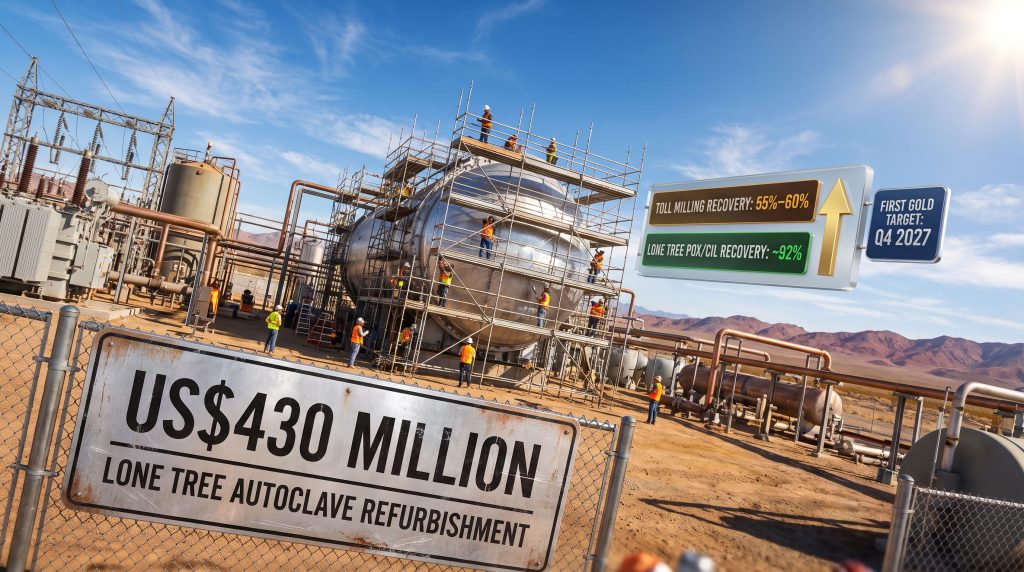
The economic penalty of external toll milling is substantial and structurally embedded. Under typical third-party toll contracts in Nevada, payability is capped at approximately 55% to 60% of contained gold value. That means for every ounce of gold contained in delivered ore, the producer receives credit for only slightly more than half an ounce at most.
The absence of owner-operated refractory processing infrastructure does not merely create an operational inconvenience. It imposes a structural margin compression of 40% to 45% on every ounce of refractory gold delivered under toll-milling terms. At current gold prices, this represents a cash leak of potentially US$1,200 to US$1,500 per contained ounce before any other cost is considered.
This is the market context that gives the i-80 Gold Lone Tree autoclave refurbishment its strategic weight. It is not simply a capital project. It is the operational mechanism through which a 40%-plus revenue discount is permanently eliminated.
What the Lone Tree Facility Is and What Is Being Rebuilt
Brownfield vs. Greenfield: Why the Distinction Matters for Capital Efficiency
Lone Tree is a brownfield pressure oxidation and carbon-in-leach processing complex situated in northern Nevada. The facility was originally constructed and operated during an earlier production cycle, meaning its civil foundations, structural footprint, and environmental permit baseline already exist. This is a material advantage.
Building a greenfield autoclave facility in Nevada, inclusive of civil works, environmental permitting, utility connections, and all structural infrastructure, would cost significantly more than refurbishing an existing permitted site. The brownfield nature of Lone Tree compresses the capital intensity of establishing owner-operated POX capability compared to a ground-up build, even at a total project cost of US$430 million.
Hatch Ltd., a globally recognised EPCM firm with deep metallurgical processing expertise, was appointed as the engineering, procurement, and construction management contractor. Hatch completed the Class 3 engineering estimate that underpins the US$430 million figure. For further context on advanced pressure oxidation systems operating across Nevada, the regional processing landscape underscores the rarity of this infrastructure.
Scope of the Refurbishment Programme
The refurbishment covers the full processing circuit from ore reception through to refined gold, not merely the autoclave vessel itself. The scope includes modernisation of electrical, mechanical, and piping systems that have aged beyond their operational lifecycle, alongside upgrades to acid plant and effluent treatment infrastructure required under contemporary environmental standards.
| Component | Scope of Work |
|---|---|
| Autoclave vessel | Refurbishment and upgrade of pressure oxidation unit |
| Carbon-in-leach circuit | Modernisation of downstream gold recovery systems |
| Mechanical, electrical, and piping | Full replacement of aged infrastructure systems |
| Environmental controls | Acid plant, effluent treatment, and emissions upgrades |
| Capital spares inventory | US$18 million allocation for critical spare components |
The total project capital estimate sits at US$430 million, broken down as:
- US$412 million for refurbishment and infrastructure works
- US$18 million for capital spares inventory
The refurbished facility is designed to process approximately 2,268 tonnes per day, equivalent to roughly 827,806 tonnes per year, targeting a gold recovery rate of approximately 92%. This compares directly against the 55% to 60% payability currently available under third-party toll arrangements.
The Hub-and-Spoke Architecture Powering the Lone Tree Strategy
How Three Underground Operations Feed One Central Autoclave
The logic of i-80 Gold's Nevada development model is built on centralising metallurgical processing rather than duplicating mill infrastructure at each mining site. Under this hub-and-spoke architecture, refractory sulfide ore is transported from geographically distributed underground operations along the Interstate 80 corridor to the central Lone Tree autoclave for treatment.
The three primary ore-source deposits currently designated to feed the Lone Tree hub are:
- Granite Creek underground, the primary near-term ore source currently in active production ramp-up
- Archimedes underground, advancing toward first gold from its Upper deposit with a target of the fourth quarter of 2026
- Cove underground, designated as Phase 3 in the revised development sequence
This model avoids the capital and operational overhead of constructing individual processing facilities at each site, channelling capital instead into a single high-capacity regional hub capable of processing ore from all three sources simultaneously once fully commissioned.
Phase 1 Production Targets and the Path to Scale
Under the Phase 1 configuration, combining ore delivery from Granite Creek and Archimedes, the company is targeting annual production of 150,000 to 200,000 ounces of gold. The longer-term ambition, contingent on full multi-asset development across all three underground sources plus the Mineral Point heap leach project, is production exceeding 600,000 ounces of gold annually by the early 2030s.
It is important to note that long-term production targets of this scale are subject to exploration outcomes, feasibility study results, financing decisions, and operational execution across multiple simultaneous development programmes. Investors should treat these figures as management targets rather than guaranteed outcomes.
Construction Progress and the Road to First Gold
Where the Refurbishment Stands as of Mid-2026
The i-80 Gold Lone Tree autoclave refurbishment is reported as on schedule and on budget as of the second quarter of 2026 reporting period. Key construction milestones and their current status are summarised below:
| Milestone | Status as of Mid-2026 |
|---|---|
| Detailed engineering completion | 30% complete |
| Procurement packages awarded by value | 50% awarded |
| Project capital committed | 40% committed (~US$110.1 million) |
| Demolition commencement | Began mid-June 2026 |
| Major construction mobilisation | Targeted Q4 2026 |
| First gold pour / commissioning | Targeted Q4 2027 |
The early commitment of 50% of procurement packages by value is a deliberate supply chain risk mitigation strategy. Equipment lead times for specialised pressure oxidation components can extend 18 to 24 months under tight market conditions. Locking in procurement commitments early reduces the risk of delivery delays that could push the commissioning timeline beyond year-end 2027.
The Cost Structure Transformation: From Toll Penalty to Owner-Operated Margin
Quantifying the AISC Impact of Eliminating Third-Party Processing
The financial case for the refurbishment is most clearly illustrated by the recovery rate differential and its direct impact on all-in sustaining costs.
| Processing Mode | Gold Recovery Rate | Effective Payability | Estimated AISC |
|---|---|---|---|
| Third-party toll milling (current) | ~55%-60% | 55%-60% of contained gold | Above US$2,000/oz |
| Owner-operated Lone Tree POX/CIL | ~92% | ~92% of contained gold | Below US$2,000/oz |
Management has indicated that commissioning the Lone Tree facility is expected to bring consolidated all-in sustaining costs below US$2,000 per ounce of gold produced. The estimated cash margin expansion from eliminating the toll-milling discount is approximately US$1,000 to US$1,500 per ounce of gold treated, based on the recovery rate differential between current toll arrangements and owner-operated processing.
The real-time cost of toll-milling dependency was visible in Q2 2026 results. Despite producing 11,098 ounces of gold in the quarter, with 8,634 ounces sourced from Granite Creek underground, quarterly revenue was constrained to US$24.3 million. More than 5,300 recoverable ounces remained sitting inside third-party processing queues at period end, representing deferred revenue that could not be recognised until external facilities completed treatment and settlement. This is precisely the operational bottleneck the i-80 Gold Lone Tree autoclave refurbishment is designed to permanently close.
The next major ASX story will hit our subscribers first
Key Execution Risks Every Investor Should Understand
Autoclave Feed Continuity and Thermal Cycling Risk
Operating a large autoclave at nameplate capacity requires an uninterrupted and consistently blended ore feed stream. Interruptions from any one of the three feeder underground operations — whether caused by geotechnical events, equipment failures, haulage bottlenecks along the Interstate 80 corridor, or stockpile mismatches — reduce feed rates below the economic threshold.
Thermal cycling is a particularly damaging consequence of unplanned autoclave shutdowns. Cooling and reheating the pressure vessel induces thermal stress on refractory brick linings and mechanical components, accelerating wear rates and increasing both maintenance costs and recommissioning time. Sustaining continuous feed from three separate underground mines simultaneously is one of the more complex operational challenges in the Lone Tree commissioning plan.
Geological Grade Reconciliation at Active Mining Zones
Early underground pre-development at certain Granite Creek stope areas encountered gold grades below the levels modelled in resource estimates. Management attributed this variance to structural geological complexity and grade distribution patterns that were not fully captured in the existing resource model. Infill drilling programmes are being executed to refine stope boundary designs and improve grade predictability before active mining advances into these areas.
Proper drill results interpretation is consequently essential in structurally complex Nevada gold systems, and grade reconciliation shortfalls of this type are common in the early stages of underground development. However, they directly affect the head grade delivered to the autoclave and, by extension, the AISC trajectory once Lone Tree is commissioned. In addition, understanding gold drilling results from infill programmes will be critical to confirming stope economics ahead of full production ramp-up.
Hydrological Management at Granite Creek
Underground decline development at Granite Creek intersects elevated groundwater inflows, requiring active dewatering infrastructure to maintain safe and productive development rates. A second expanded water treatment facility reached mechanical completion in late July 2026, lifting surface treatment capacity to approximately 3,500 gallons per minute. Sustained dewatering performance at this level is a prerequisite for maintaining ore delivery schedules to the Lone Tree autoclave once it commences operations.
Capital Cost and Schedule Execution
The US$430 million Class 3 estimate carries the contingency ranges inherent to EPCM-managed brownfield refurbishment programmes at this scale. Construction cost inflation, regional labour market tightness in Nevada, and equipment delivery timing all represent variables that could pressure the capital envelope. The proactive commitment of 40% of total project capital and the award of 50% of procurement packages by value are the primary mitigation mechanisms currently deployed against this risk.
How the Refurbishment Is Funded Without Diluting Shareholders
Balance Sheet Position Following the Q1 2026 Recapitalisation
| Financial Metric | Value |
|---|---|
| Cash on hand (June 30, 2026) | US$464.6 million |
| Cash on hand (March 31, 2026) | US$513.5 million |
| Quarterly cash reduction (Q2 2026) | ~US$49 million |
| Q2 2026 operating cash outflow | US$49.6 million |
| Q2 2026 capital expenditures | US$21.5 million |
| Legacy debt retired (Q1 2026) | US$165.0 million |
| Total recapitalisation package (Q1 2026) | US$1.1 billion |
The US$1.1 billion recapitalisation completed in Q1 2026 restructured the balance sheet, retiring legacy debt and establishing a cash position that fully funds both Phase 1 and Phase 2 development without requiring near-term equity issuance. Phase 3 development, anchored by the Cove underground deposit, is planned to be funded from operating cash flows generated by the autoclave circuit once commercial production commences.
Franco-Nevada's commitment of US$50 million to fund infill drilling and engineering at the Mineral Point heap leach project through a royalty package reduces the draw on i-80 Gold's treasury for Phase 2 study work. The participation of a major streaming and royalty company in the Nevada asset base carries implicit due diligence validation that carries weight for institutional investors evaluating the broader development thesis.
Mineral Point Resequencing and the Phase 2 Pivot
Why Heap Leach Cash Flow Has Been Elevated Ahead of Cove Underground
The decision to advance Mineral Point as Phase 2 and defer Cove underground to Phase 3 reflects a capital efficiency calculation. Heap leach projects carry substantially lower capital intensity than full underground development programmes with associated ventilation, shaft, and decline infrastructure. By prioritising Mineral Point, the development plan is designed to generate earlier cash flow that can then fund the more capital-intensive Cove build.
Mineral Point's Preliminary Economic Assessment, filed March 31, 2025, projects:
- Average annual production of approximately 282,000 gold-equivalent ounces
- Gold price assumption of US$2,175 per ounce
- Silver price assumption of US$27.25 per ounce
- After-tax NPV at a 5% discount rate of US$614 million
Investor Note: These economics are derived from a Preliminary Economic Assessment, which carries lower geological confidence and wider margin-of-error ranges than a Pre-Feasibility or Feasibility Study. The definitive feasibility study process involves considerably more rigorous resource classification, and a Pre-Feasibility Study is now targeted for mid-2027, having been delayed by slower drill penetration through sanded dolomite geological units and regional drill-rig availability constraints. Investors should apply appropriate caution to PEA-stage economics when modelling expected project returns.
As of Q2 2026, 14,836 meters of core and reverse-circulation drilling had been completed across the Mineral Point programme using five rigs, with programme completion shifted to Q1 2027.
Nevada's Jurisdiction Premium and the Autoclave Scarcity Moat
What Top-Ranked Jurisdiction Status Means for Long-Duration Capital Projects
Nevada ranked first out of 68 global mining jurisdictions in the 2025 Fraser Institute Annual Survey of Mining Companies for overall investment attractiveness. For a US$430 million infrastructure project with a multi-decade operational horizon, jurisdiction quality directly reduces the risk-adjusted discount rate an institutional investor applies to future cash flows.
Operating one of only two pressure oxidation autoclave facilities in the world's highest-ranked mining jurisdiction creates a compounding competitive moat. The combination of:
- Scarce autoclave technology in Nevada
- An existing permitted brownfield site
- A fully funded construction programme
- A regional ore network delivering feed from multiple underground operations
positions the Lone Tree facility as more than a cost-reduction project. It becomes the foundation of a potential regional processing hub that could, over time, attract third-party refractory ore volumes from other Nevada producers who lack autoclave access of their own.
Furthermore, cut-off grade economics become substantially more favourable when a producer controls its own processing infrastructure, effectively lowering the minimum economic grade threshold across the entire ore network. Whether third-party toll processing revenues become a meaningful contributor to future cash flows will depend on operational capacity utilisation and commercial negotiations that are yet to be initiated. However, the optionality itself represents incremental strategic value that is not currently priced into the core production thesis.
Frequently Asked Questions: i-80 Gold Lone Tree Autoclave Refurbishment
What is the total capital cost of the Lone Tree autoclave refurbishment?
The Class 3 engineering estimate completed by Hatch Ltd. sets the total project capital at US$430 million, comprising US$412 million for refurbishment and infrastructure works and US$18 million for capital spares inventory.
What gold recovery rate will the refurbished Lone Tree autoclave achieve?
The refurbished pressure oxidation and CIL circuit is designed to achieve approximately 92% gold recovery, compared to the 55% to 60% payability currently available under third-party toll-milling contracts.
When is the Lone Tree autoclave expected to pour first gold?
The project is targeting first gold by year-end 2027, with demolition having commenced mid-June 2026 and major construction mobilisation expected in Q4 2026.
How much of the Lone Tree project capital has been committed?
As of mid-2026, approximately 40% of total project capital has been committed, representing US$110.1 million in construction commitments, with 50% of procurement packages by value already awarded.
How is i-80 Gold funding the Lone Tree refurbishment?
The refurbishment is funded from a treasury of US$464.6 million in cash as of June 30, 2026, established through a US$1.1 billion recapitalisation completed in Q1 2026 that also retired US$165 million in legacy debt.
What throughput capacity will the refurbished Lone Tree facility have?
The refurbished plant is designed to process approximately 2,268 tonnes per day, equivalent to roughly 827,806 tonnes per year of refractory ore.
Why is the Lone Tree autoclave strategically significant for Nevada gold producers?
Lone Tree is one of only two autoclave operations in Nevada, giving its operator rare owner-operated access to pressure oxidation processing within the world's top-ranked mining jurisdiction. This infrastructure scarcity creates a durable competitive moat for refractory ore processing that extends well beyond the economics of a single project.
This article contains forward-looking statements and references to management targets and preliminary economic assessments. These involve known and unknown risks, uncertainties, and other factors that may cause actual results to differ materially from those expressed or implied. Readers should not place undue reliance on forward-looking information and are encouraged to review company filings and independent research before making any investment decisions.
Want to Know When Nevada's Next Major Gold Discovery Hits the ASX?
Discovery Alert's proprietary Discovery IQ model scans ASX announcements in real time, instantly identifying significant mineral discoveries — including high-value refractory gold opportunities — and delivering actionable alerts before the broader market has time to react. Explore Discovery Alert's dedicated discoveries page to understand how historic ASX mineral finds have generated substantial returns, and begin your 14-day free trial today to position yourself ahead of the next major discovery.