
June 24, 2026
The Geopolitical Arithmetic of Asian Energy Dependency
Across the post-war era, the dominant logic of Asian energy procurement was straightforward: source from the cheapest available origin, lock in long-term contracts, and optimise supply chains for cost efficiency. For decades, this model delivered affordable energy to the manufacturing engines of Asia. However, that logic carries an embedded assumption that geopolitical reality is now stress-testing in real time: that the maritime corridors connecting West Asian energy fields to Asian consumption centres will remain reliably open.
That assumption is no longer safe. The escalation of conflict in West Asia has reintroduced supply corridor risk as an active, not theoretical, variable in Asian energy planning. India Japan energy supply disruptions have become structural, not episodic, for two of the world's largest net energy importers. Both nations have now moved beyond monitoring the situation to actively coordinating responses, a development that signals a meaningful shift in how Asia's import-dependent economies intend to manage energy security going forward.
When big ASX news breaks, our subscribers know first
Why India and Japan Share an Uncomfortably Similar Risk Profile
The structural vulnerability connecting India and Japan is not coincidental. Both economies industrialised by importing the energy inputs their domestic resource bases could not supply. The result is an energy dependency profile that, while differing in composition, converges on the same geographic chokepoint.
Japan sources the overwhelming majority of its crude oil from Middle Eastern suppliers, with the Persian Gulf region accounting for roughly 90% of Japanese crude imports according to Japan's Agency for Natural Resources and Energy. LNG imports carry a somewhat more diversified origin mix, incorporating Australian and other Pacific sources, but spot market exposure to Asian LNG pricing still creates meaningful sensitivity to West Asian supply dynamics.
India's dependency is structured differently but is arguably more acute at the household level. West Asian sources dominate India's crude oil import mix, with Gulf Cooperation Council countries collectively supplying over 60% of India's crude imports in recent years. More critically, India's LPG import dependency, which underpins household cooking fuel for hundreds of millions of citizens under the Pradhan Mantri Ujjwala Yojana scheme, runs almost entirely through the same supply corridors. A disruption to West Asian LPG flows is not an abstraction in India — it translates directly into rural fuel scarcity within weeks.
Structural Reality: Unlike European economies that spent the post-2014 period aggressively diversifying away from concentrated import dependency, both India and Japan remain architecturally tied to West Asian supply chains. The current disruption has made the cost of this architecture visible in a way that peacetime price optimisation never could.
The Strait of Hormuz: A Shared Chokepoint With Asymmetric Consequences
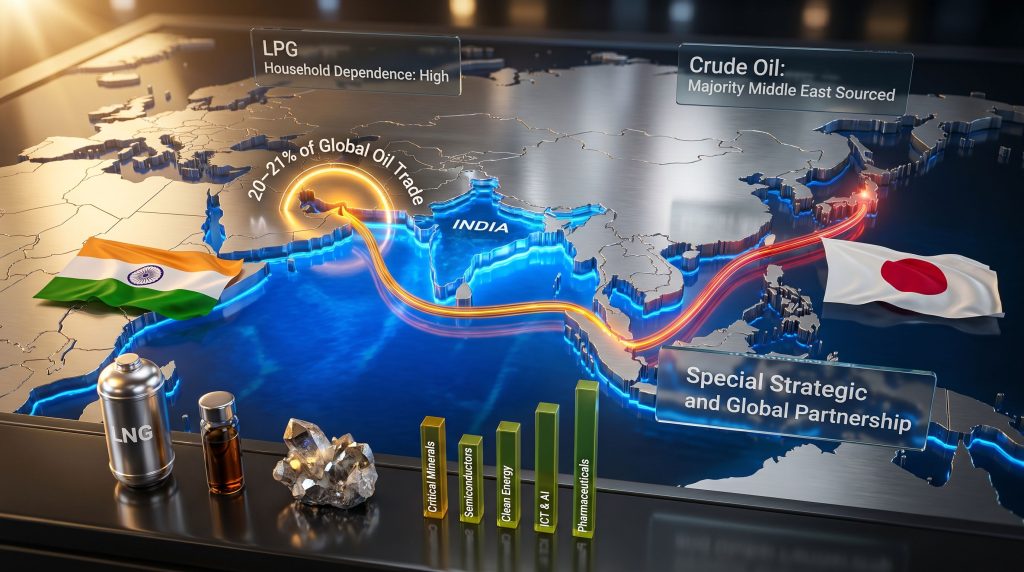
Approximately 20 to 21% of global oil trade transits the Strait of Hormuz, according to the U.S. Energy Information Administration. For most of the world, this is a data point. For Japan and India, it is an existential supply variable.
The consequences of a sustained Hormuz disruption differ in character between the two economies:
- For Japan, closure or severe constraint on Hormuz passage cascades into power generation economics, utility cost increases, and trade balance deterioration. Japan's post-Fukushima energy mix, which leaned more heavily on LNG after nuclear capacity was wound back following the 2011 disaster, amplifies this sensitivity considerably.
- For India, the same disruption compresses LPG availability, raises refinery input costs across a refining sector that processes significant volumes of Middle Eastern crude, and creates downstream shortages that travel quickly from import terminals to rural distribution networks.
- Neither country maintains a domestic production buffer sufficient to absorb a disruption measured in months rather than weeks without triggering emergency policy responses.
| Disruption Dimension | Japan's Primary Exposure | India's Primary Exposure |
|---|---|---|
| Crude Oil Supply | Very High (~90% Middle East sourced) | High (>60% Gulf-origin) |
| LNG Supply | Moderate-High (spot market pressure) | Low-Moderate (less LNG-dependent) |
| LPG / Household Fuel | Low | Very High (mass household dependence) |
| Maritime Route Risk | High (Hormuz and Indian Ocean lanes) | High (same corridor dependency) |
| Financial Market Impact | Yen pressure, trade balance stress | Fuel subsidy cost expansion |
What Active Disruption Looks Like Across Both Economies
The current West Asian conflict has moved beyond theoretical risk into operational disruption across multiple dimensions of Asian energy supply. Furthermore, the effects are not uniform, but they are mutually reinforcing across the India-Japan exposure matrix.
Japan: LNG Tightness and the Coal Substitution Dilemma
Japan's immediate challenge is a combination of rising Asian LNG spot prices and the operational complexity of its post-Fukushima energy mix. With nuclear capacity still only partially restored since the 2011 disaster reduced Japan's nuclear fleet from supplying roughly 30% of electricity to a fraction of that figure, the country's power sector carries unusually high exposure to gas price movements.
Reuters has reported that Japan risks a summer power crunch due to ongoing Middle East LNG disruptions, underscoring the urgency of the situation. In response to LNG supply tightness, Japan has deployed two primary emergency mechanisms:
- Strategic petroleum reserve releases to buffer crude oil supply shortfalls, drawing on reserves that Japan maintains at levels mandated under International Energy Agency membership obligations.
- Coal substitution in power generation, reactivating or increasing utilisation of coal-fired capacity as a short-run hedge against gas price spikes.
The second response creates a policy tension that deserves more attention than it typically receives. Japan has made significant international commitments around phasing down coal, yet the structural vulnerability of its LNG-heavy power mix creates a recurring incentive to fall back on coal precisely when supply shocks hit. This is not a failure of political will — it is a mathematical consequence of an energy mix that lacks sufficient dispatchable domestic generation to absorb external shocks.
India: From Refinery Throughput to Rural LPG Shortfalls
India's disruption manifests across a wider socioeconomic spectrum. At the industrial end, some Indian refiners have reduced throughput in response to tighter crude availability and elevated input costs. At the household end, authorities have begun encouraging shifts in consumption patterns — a demand-side signal that the supply-side pressure is operationally acute.
The LPG dimension carries particular political sensitivity. India's subsidised LPG programme reaches hundreds of millions of households, and any visible scarcity at this level generates immediate political pressure. The structural challenge is that India's LPG import infrastructure has been built around Gulf supply chains, and diversifying those supply relationships at scale requires years of terminal investment and contract renegotiation.
The Diplomatic Architecture Being Built in Response
The meeting between External Affairs Minister S. Jaishankar and his Japanese counterpart Toshimitsu Motegi was significant not simply because it addressed energy supply issues, but because of the framework within which that conversation was explicitly positioned.
Jaishankar noted directly that both nations are energy importing countries and large trading nations with shared maritime interests, framing the current disruption as a bilateral strategic concern rather than merely a commodity market problem. The meeting was held on the eve of the Quad Foreign Ministers meeting — a sequencing that was not incidental.
Motegi, for his part, articulated a broader diagnosis: that the world is navigating the most significant structural transformation of the post-war era, characterised by power balance shifts and intensifying conflicts. His remarks on the updated Free and Open Indo-Pacific (FOIP) policy positioned resilience building across economic, societal, and security domains as the organising principle of Japanese foreign policy. Consequently, energy transition security sits directly within that framework.
Strategic Positioning: The India-Japan energy conversation is being conducted inside a multilateral architecture — the Quad — combined with a bilateral framework, the Special Strategic and Global Partnership, that elevates it beyond crisis management into long-term strategic design. This is a qualitatively different response than the emergency reserve releases and diplomatic phone calls that characterised earlier supply shocks.
The Quad as an Energy Security Platform
The Quad framework, comprising India, Japan, Australia, and the United States, has historically been discussed primarily through a defence and maritime security lens. However, the current context is accelerating its evolution into an economic and energy security coordination vehicle.
Australia's relevance here is not incidental. As a major LNG exporter and supplier of critical minerals demand essential for clean energy transition, Australia represents a supply diversification option for both India and Japan that sits outside the West Asian corridor risk zone. In addition, Australian energy exports increasingly factor into the Quad's geographic logic, connecting Pacific democracies across the Indian and Pacific Oceans into an alternative energy supply architecture.
The Five-Sector Technology Collaboration Agenda: More Than Industrial Policy
India and Japan have identified five specific sectors for deepened industrial and technological collaboration. Read in isolation, these look like standard bilateral trade agenda items. Read against the backdrop of active India Japan energy supply disruptions, they reveal themselves as a structural answer to the dependency problem.
The five sectors are:
- Critical Minerals — securing upstream supply chains for battery materials and the mineral inputs essential for clean energy technology deployment. Both nations recognise that rare earth supply chains create a new dependency risk if as geographically concentrated as fossil fuel supply chains currently are.
- Semiconductors — reducing exposure to concentrated chip supply chains that are foundational to smart grid management, energy infrastructure automation, and industrial efficiency systems.
- ICT Including AI and Telecom — enabling smarter energy demand forecasting, grid resilience management, and infrastructure monitoring capabilities that reduce the operational impact of supply shocks.
- Clean Energy — joint development and deployment of renewable energy, hydrogen technologies, and next-generation nuclear capacity to structurally reduce fossil fuel import dependency over the medium term.
- Pharmaceuticals — a sector that is itself highly energy-intensive and whose supply chain resilience has direct implications for energy demand planning.
The critical minerals dimension deserves particular attention. Countries facing acute supply shocks have a demonstrated tendency to slow-walk clean energy investment in favour of emergency fossil fuel procurement, creating a perverse cycle where the disruption that should accelerate transition actually delays it. The India-Japan critical minerals collaboration agenda is designed, at least partly, to interrupt that cycle by building alternative supply chains for transition technologies before the next disruption cycle hits.
Defence Industry Cooperation: The Security-Energy Nexus
The discussion around strengthening defence industry partnerships connects to the energy security agenda in a way that is often underappreciated in mainstream analysis. Protecting maritime energy corridors is not a diplomatic abstraction — it requires physical naval capability deployed across the Indian Ocean, the Arabian Sea, and the western Pacific.
India and Japan individually lack the force projection to guarantee corridor security across the full range of their import routes. The combination of India's geographic positioning across Indian Ocean energy lanes and Japan's sophisticated naval and maritime technology, however, creates a complementary capability pairing. Defence industrial cooperation between the two nations is therefore functionally inseparable from energy supply chain security in the current environment.
The next major ASX story will hit our subscribers first
From Efficiency Optimisation to Resilience Architecture
The deeper significance of India Japan energy supply disruptions lies in what it signals about the direction of Asian energy policy. For approximately four decades following the 1973 oil shock, Asian energy policy pursued two parallel tracks: diversifying supplier geography incrementally while simultaneously optimising for cost efficiency within diversified supply chains.
The current disruption, combined with broader geopolitical fragmentation of the global trading system, is closing off the second track. Resilient supply chains are more expensive. Diversified supplier portfolios carry higher logistics and contracting costs than concentrated ones. Strategic petroleum reserves carry substantial capital carrying costs. Furthermore, domestic clean energy buildout requires upfront investment that exceeds the marginal cost of continuing fossil fuel imports in the short term.
The policy question facing both India and Japan is not whether to pay the resilience premium — the current disruption has made the cost of not paying it visible enough to settle that debate. The question is how to sequence the investment across clean energy buildout, supply diversification, strategic reserve management, and technology collaboration without creating new concentration risks in the process.
Investor and Policy Lens: The acceleration of India-Japan energy security collaboration creates identifiable medium-term investment themes across critical minerals supply chains, LNG terminal infrastructure in non-Gulf origin markets, advanced nuclear technology development, and hydrogen production and transportation infrastructure. These are multi-year structural trends, not cycle-dependent commodity plays. Note: This is an analytical observation, not financial advice. Independent professional advice should be sought before making any investment decisions.
Nuclear Policy: The Quiet Variable Gaining Momentum
Perhaps the least publicly discussed dimension of the India-Japan energy response is the nuclear policy conversation running beneath the surface of the clean energy collaboration agenda. Japan's nuclear capacity contraction post-Fukushima created a structural vulnerability in its power generation mix that has been papered over with LNG imports for over a decade. The current LNG supply pressure is adding fresh urgency to discussions about the nuclear growth outlook and restoring and potentially expanding nuclear capacity.
India's nuclear programme, while operating at a more modest scale relative to total energy mix, is gaining renewed attention as a long-duration, domestically-controlled generation source that bypasses import corridor risk entirely. Advanced reactor technologies, including small modular reactors, figure in bilateral clean energy discussions as part of the technology collaboration agenda.
The nuclear dimension matters because it represents the only currently available large-scale generation technology that combines low ongoing fuel import dependency with high capacity factors — the combination that would most directly address the structural vulnerability both countries face.
Frequently Asked Questions: India Japan Energy Supply Disruptions
What is causing the current India Japan energy supply disruption?
Escalating conflict in West Asia has introduced active uncertainty across the maritime energy corridors, particularly the Strait of Hormuz, that both India and Japan depend on for the majority of their fossil fuel imports. This has elevated Asian energy spot prices, tightened crude and LPG availability, and triggered both emergency policy responses and longer-term strategic coordination between the two nations.
How significant is Middle Eastern energy dependency for Japan?
Japan sources approximately 90% of its crude oil imports from Middle Eastern suppliers, according to Japan's Agency for Natural Resources and Energy. Its LNG imports are somewhat more diversified, incorporating Australian and other Pacific sources, but the overall energy import profile remains heavily weighted toward West Asian supply corridors.
What emergency measures has Japan deployed in response to the disruption?
Japan has released volumes from its strategic petroleum reserves to provide a near-term supply buffer and has increased coal utilisation in its power generation mix as a short-term hedge against LNG price spikes. Both responses carry limitations: reserve releases are finite, and increased coal use creates tension with Japan's longer-term decarbonisation commitments.
How does the disruption affect India differently from Japan?
India's most acute exposure runs through its LPG supply chain, which underpins household cooking fuel for a very large share of the population. Refinery throughput has also come under pressure from tighter crude availability. India's policy response has focused on demand-side consumption management and accelerating supply diversification from non-Gulf sources.
What is the Quad's role in addressing energy supply security?
The Quad, comprising India, Japan, Australia, and the United States, is increasingly being used as a multilateral coordination platform for economic and energy security in addition to its better-known defence and maritime security functions. Australia's position as a major LNG and critical minerals exporter makes it a strategically relevant partner for both India and Japan's supply diversification objectives.
Why does the five-sector collaboration agenda matter for energy security?
Each of the five sectors — critical minerals, semiconductors, ICT and AI, clean energy, and pharmaceuticals — directly or indirectly addresses a dimension of import dependency that creates energy security vulnerability. The critical minerals agenda is particularly significant because it targets the upstream supply chains for clean energy technologies, preventing the transition from simply replicating the concentration risk that fossil fuel dependency currently creates.
Want to Track the Critical Minerals Driving Asia's Energy Security Revolution?
Discovery Alert's proprietary Discovery IQ model delivers real-time alerts the moment significant ASX mineral discoveries are announced — including the critical minerals at the heart of India and Japan's supply chain diversification agenda — turning complex geological data into actionable investment insights. Explore how historic mineral discoveries have generated substantial returns and begin your 14-day free trial today to position yourself ahead of the market.