June 19, 2026
The Hidden Architecture of Energy Vulnerability: How Chokepoints Shape National Policy
Few forces reshape domestic policy faster than the sudden realisation that a single geographical bottleneck controls the fate of an entire nation's energy supply. For economies built on continuous crude import flows rather than strategic stockpiles, the Strait of Hormuz is not merely a geopolitical flashpoint. It is a structural dependency baked into the infrastructure of daily life, from household cooking gas to the fertiliser that feeds hundreds of millions of people.
Understanding why India to lift emergency fuel supply measures requires stepping back from the immediate diplomatic headlines and examining how import-dependent energy architectures create systemic fragility. Furthermore, the policy instruments governments reach for during crises reveal as much about long-term structural weaknesses as they do about short-term crisis management.
When big ASX news breaks, our subscribers know first
Why the Strait of Hormuz Remains the World's Most Consequential Energy Chokepoint
The Strait of Hormuz, the narrow passage separating Iran from Oman at its southern tip, handles roughly one-fifth of all oil consumed globally. No other single maritime corridor concentrates that volume of energy trade in such a constrained geography. The waterway serves as the mandatory export channel for Saudi Arabia, Iraq, Kuwait, the United Arab Emirates, and Qatar, collectively representing the backbone of global crude supply.
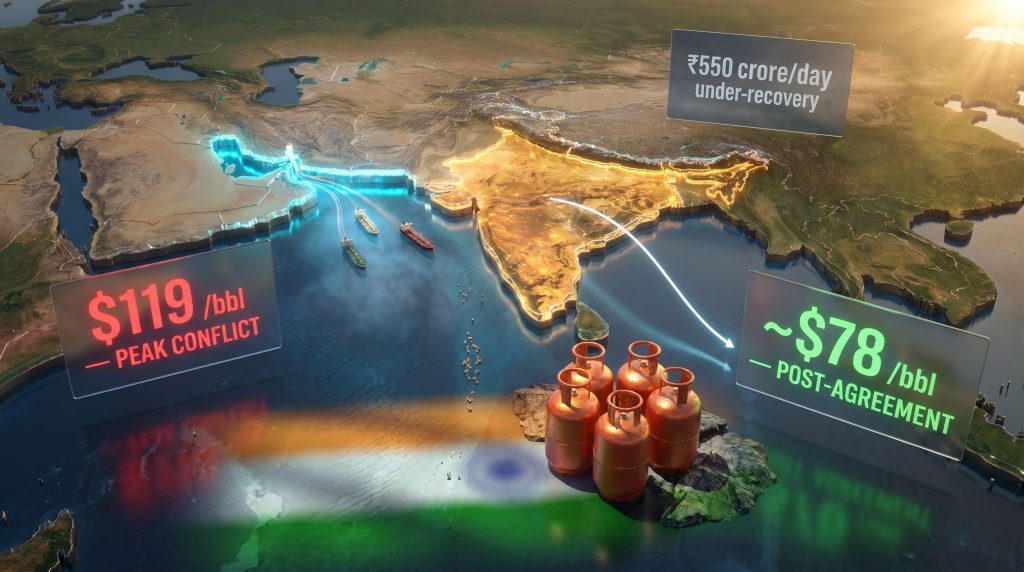
When conflict escalated in West Asia toward the end of February 2026, the consequences were not abstract. For a detailed crude oil market update, the price movements tell their own story. Crude oil prices, which had been trading in a range of $70 to $72 per barrel, surged to a peak of $119 per barrel as war-risk premiums flooded into commodity markets. Shipping insurance and freight rates climbed simultaneously, compounding the landed cost of every barrel India imported.
The arithmetic is stark: a $49 per barrel increase above pre-crisis levels, applied to the volume India imports daily, translates into a foreign exchange drain capable of meaningfully eroding current account stability within weeks.
India's Structural Position as the World's Third-Largest Crude Importer
India's exposure to Hormuz disruption is not incidental. It is the product of decades of energy infrastructure development oriented toward Gulf supply. As the world's third-largest crude oil importer and consumer, India draws a substantial proportion of its crude and LPG from nations whose only viable export route runs through the strait.
Unlike economies that have built deep strategic petroleum reserves capable of covering months of consumption, India's energy security model has historically prioritised continuous import flows. Consequently, a prolonged disruption does not simply push prices higher. At sufficient duration, it threatens the physical availability of fuel at the retail pump and the household cylinder level.
The Emergency Toolkit: What India Actually Deployed
The suite of measures India activated in response to the West Asia disruption reflects a tiered crisis management approach covering the full energy supply chain, from refinery production decisions through to consumer-end booking controls. The oil geopolitical tensions that triggered these measures had been building for some time before reaching this critical threshold.
LPG: From Distribution Monitoring to Production Redirection
The government invoked the LPG (Supply and Distribution Regulation) Order, a legal instrument that grants authorities sweeping powers over the domestic LPG supply chain. Under this framework:
- Inventories across the distribution network were subjected to heightened surveillance
- Diversion of domestic LPG cylinders to commercial or black-market channels was actively suppressed
- State governments and oil marketing companies (OMCs) were directed to maintain uninterrupted household supply
- Refiners were instructed to redirect petrochemical feedstock streams toward maximising LPG output
- Minimum intervals between cylinder refill bookings were extended to prevent per-household stockpiling
- Commercial users including hotels and restaurants faced reduced allocation to protect household supply priority
This last measure carries a nuance often overlooked in policy discussions. The decision to deprioritise commercial LPG users is not merely an administrative convenience. It reflects an explicit political hierarchy in which household cooking gas is treated as a quasi-public good, insulated from market disruption regardless of the cost to the commercial sector.
Natural Gas: A Three-Tier Prioritisation Framework
The Ministry of Petroleum and Natural Gas established a structured allocation hierarchy for domestic natural gas in constrained supply scenarios. The priority ordering was:
- City gas distribution networks serving households and CNG-powered transport
- Fertiliser sector production protecting agricultural input supply chains
- General industrial consumers deprioritised under emergency conditions
The inclusion of fertiliser manufacturing as second-tier priority is analytically significant. India's fertiliser supply dependence on gas-intensive production means any sustained curtailment of supply to urea and ammonia plants would cascade into agricultural input costs within one to two crop cycles. Policymakers clearly modelled this second-order effect when designing the prioritisation hierarchy.
| Emergency Measure Category | Specific Intervention | Primary Objective |
|---|---|---|
| LPG Supply Regulation | Invoked LPG Distribution Order | Prevent hoarding and black-market diversion |
| LPG Production | Redirected refinery petrochemical streams | Maximise domestic LPG output |
| Natural Gas Allocation | Established three-tier priority framework | Protect households, transport, fertiliser sector |
| Retail Fuel Management | Monitored outlets for abnormal demand | Suppress panic buying and stockpiling |
| Consumer Booking Controls | Extended cylinder refill booking intervals | Limit per-household LPG accumulation |
The Geopolitical Trigger for a Policy Rollback
The condition enabling India to lift emergency fuel supply measures was the signing of an interim agreement between the United States and Iran following a 111-day conflict, with the text of the agreement made publicly available. This diplomatic development carries the potential to reopen or normalise commercial shipping through the Strait of Hormuz, restoring the primary export corridor for Gulf producers.
Global oil markets responded with characteristic speed. Benchmark crude prices fell to a three-month low in the days following the agreement's announcement, with international crude trading at approximately $78 per barrel at the time Indian officials confirmed the prospective rollback.
| Period | Crude Oil Price (per barrel) | Market Condition |
|---|---|---|
| February 2026 (pre-conflict) | $70 to $72 | Stable pre-disruption baseline |
| Peak conflict disruption | $119 | Maximum war-risk premium embedded |
| Post-agreement (June 2026) | ~$78 | Declining toward normalisation |
The speed of the price unwinding from $119 to $78 per barrel illustrates a well-documented pattern in energy commodities: geopolitical risk premiums price in faster than they price out, but diplomatic resolution signals can compress months of premium into days of selling pressure.
Confidence-Gated Normalisation: The Government's Stated Approach
A senior government official confirmed that the policy rollback will be conditional on verified stabilisation in global energy markets, not governed by a fixed calendar. The withdrawal is expected to proceed in phases, with LPG supply controls likely easing first, followed by natural gas allocation adjustments, and eventually the full lifting of retail market monitoring protocols.
The phased structure reflects both operational prudence and political calculation. By framing the measures from inception as precautionary safeguards rather than crisis responses, the government preserved the optionality to roll back without acknowledging any prior supply failure.
The Political Economy of Retail Fuel Pricing During a Supply Shock
Perhaps the most analytically revealing dimension of India's crisis response was how it managed retail fuel pricing during a period of extreme international cost pressure.
Despite crude reaching $119 per barrel, the government held domestic petrol and diesel prices steady through mid-May 2026. On March 27, 2026, excise duties on both fuels were cut by ₹10 per litre each, a direct fiscal subsidy timed to coincide with assembly elections in five states including West Bengal.
This created a widening wedge between international benchmarks and domestic retail prices, with state-owned OMCs absorbing the difference. After the conclusion of the assembly election cycle, prices were adjusted:
| Fuel Type | Post-Election Price Increase | Ongoing Financial Impact |
|---|---|---|
| Petrol | +₹7.50 per litre | OMC under-recovery continues |
| Diesel | +₹7.50 per litre | OMC under-recovery continues |
| CNG | +₹6 per kg | Partial cost recovery |
| LPG (14.2 kg cylinder) | +₹89 across two instalments | Partial cost recovery |
Even after these corrections, state-owned oil marketing companies continue to lose approximately ₹550 crore per day as domestic retail prices remain below full cost-recovery levels. This is a substantial and ongoing fiscal burden that the post-election price adjustments only partially addressed.
The arithmetic of politically managed fuel pricing is rarely discussed openly: every ₹1 per litre gap between international cost and domestic retail price across India's daily fuel consumption volume generates a compounding balance sheet liability for public-sector energy companies.
Structural Lessons India Must Absorb
Concentration Risk and the Case for Import Diversification
The 2026 West Asia disruption has provided the clearest recent evidence of the systemic risk embedded in India's Gulf-centric crude import geography. The broader oil market disruption risks extend well beyond any single conflict zone, however, reinforcing the urgency of structural reform. When the single primary transit corridor for Gulf supply is disrupted, India has limited structural alternatives.
Non-Hormuz-exposed producers such as Russia, the United States, and certain West African nations become strategically valuable during such events, but redirecting supply chains of this scale takes months, not days. The crisis has consequently reinvigorated arguments among Indian energy policymakers for a deliberate diversification of crude import origins.
Strategic Reserves: The Missing Instrument
A critical observation from the emergency response is that India's toolkit relied heavily on demand suppression and distribution controls rather than strategic reserve releases. India's Strategic Petroleum Reserves capacity, while expanded in recent years, remains modest relative to consumption volumes. The emergency measures essentially rationed existing supply rather than deploying stockpiled buffers.
For a third-largest importer with growing consumption, building reserve capacity that can sustain meaningful supply continuity during a multi-month Hormuz disruption represents an unresolved infrastructure gap. The IEA's energy crisis policy tracker illustrates how peer economies have approached this challenge with considerably deeper reserve buffers.
The Fertiliser-Food Security Nexus in Energy Policy
The positioning of the fertiliser sector within the natural gas priority framework signals that Indian policymakers now explicitly model energy disruptions as food security events. Gas supply to urea plants is not merely an industrial allocation question. It is a component of agricultural supply chain integrity.
This integration of energy and food security thinking into a single crisis framework represents a meaningful policy evolution. Furthermore, the geopolitical trade reshaping underway globally makes this kind of integrated policy thinking increasingly essential for import-dependent economies.
The next major ASX story will hit our subscribers first
Key Takeaways
- India to lift emergency fuel supply measures is conditions-based, contingent on confirmed normalisation of global energy markets following the US-Iran interim agreement
- Crude oil prices have retreated from a wartime peak of $119 per barrel to approximately $78 per barrel, materially reducing import cost pressure
- The emergency framework demonstrated India possesses functioning crisis response instruments, but they are weighted toward rationing rather than reserve deployment
- State-owned OMCs face a persistent ₹550 crore per day under-recovery burden that post-election price corrections have only partially resolved
- The crisis has strengthened the structural case for import geography diversification away from Hormuz-dependent supply chains
- The fertiliser sector's second-tier priority status in gas allocation reflects an increasingly integrated approach to energy and food security policy
This article is analytical and informational in nature. It does not constitute financial or investment advice. Crude oil price forecasts, policy timelines, and market projections involve inherent uncertainty and should not be relied upon as predictive statements about future market conditions.
Want to Stay Ahead of the Next Major Commodity Disruption?
When geopolitical shocks send crude prices from $72 to $119 per barrel overnight, early intelligence is everything — Discovery Alert's proprietary Discovery IQ model scans ASX announcements in real time, delivering instant alerts on significant mineral and energy commodity discoveries so subscribers can identify actionable opportunities before the broader market reacts. Explore historic discovery returns or begin a 14-day free trial at Discovery Alert to secure a market-leading edge when the next supply shock reshapes commodity valuations.