
May 21, 2026
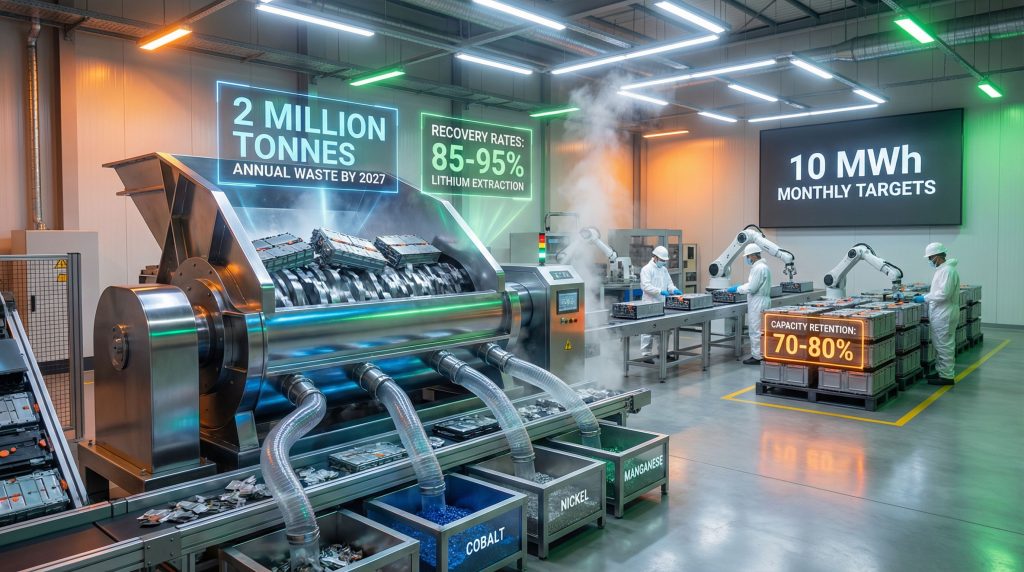
India's emerging lithium-ion battery recycling and second-life facility infrastructure represents a strategic convergence of environmental necessity, resource security, and economic opportunity within the world's fastest-growing clean energy market. This battery recycling breakthrough addresses the dual challenge of managing increasing battery waste volumes while maximizing material value through systematic recovery and repurposing processes.
Industrial facilities capable of processing lithium-ion batteries through integrated recycling and second-life applications are becoming critical components of sustainable energy supply chains. Furthermore, these operations create unprecedented demand for advanced energy storage systems, fundamentally reshaping how industries approach end-of-life battery management.
Market Dynamics Shaping India's Battery Processing Infrastructure
Economic Drivers Behind Facility Development
India's lithium-ion battery recycling and second-life facility expansion stems from several converging market forces that create compelling investment opportunities. The country's electric vehicle adoption rates are accelerating rapidly, creating substantial volumes of retired batteries that require systematic processing within the next five years.
Critical mineral security concerns drive domestic processing capabilities as India currently imports over 90% of its lithium requirements. This dependency creates strategic vulnerabilities that domestic recycling infrastructure can partially address through material recovery operations.
Government initiatives supporting circular economy development provide additional economic incentives for facility operators through policy frameworks and financial mechanisms. In addition, the Indian lithium market outlook demonstrates significant growth potential for domestic processing capabilities.
The economics of recovered materials present significant revenue opportunities:
- Lithium recovery operations typically achieve 85-95% material extraction rates
- Cobalt processing can reach 90-98% recovery efficiency
- Nickel extraction systems maintain 88-96% recovery performance
- Manganese separation processes achieve 80-90% material retention
Technical Infrastructure Requirements
Modern battery processing facilities require sophisticated technical capabilities to handle diverse battery chemistries and processing volumes. Black mass production systems must achieve minimum throughput benchmarks of 500 kilograms per hour to maintain commercial viability.
Second-life processing operations typically target 10 MWh monthly capacity for economic sustainability. Integration of shredding, sorting, and assembly systems within single facilities creates operational efficiencies that improve material recovery rates.
Technical partnerships play crucial roles in facility success, providing design expertise, engineering support, and ongoing operational optimisation. However, these collaborations typically focus on achieving operational stability while minimising power consumption and ensuring environmental safeguards throughout processing operations.
When big ASX news breaks, our subscribers know first
Industrial Processing Systems and Material Recovery
Mechanical Disassembly Operations
Battery shredding systems employ mechanical disassembly processes specifically designed for end-of-life lithium-ion batteries. These operations begin with battery pack decasing and module separation, followed by systematic dismantling of internal components including aluminium casings, copper terminals, and thermal management systems.
Material separation techniques focus on cathode recovery through controlled mechanical processing that preserves valuable materials while ensuring safe handling of potentially hazardous components. Quality control standards for black mass purity require precise particle size specifications and contamination limits.
Throughput optimisation represents a critical factor in commercial viability, with facilities needing to balance processing speed against material recovery efficiency. Consequently, modern systems integrate automated sorting capabilities with manual quality control procedures.
Critical Material Recovery Processes
| Material | Recovery Rate | Processing Method | Key Applications |
|---|---|---|---|
| Lithium | 85-95% | Hydrometallurgical extraction | New battery cathodes, industrial chemicals |
| Cobalt | 90-98% | Pyrometallurgical processing | High-performance battery applications |
| Nickel | 88-96% | Combined chemical processes | Electric vehicle batteries, grid storage |
| Manganese | 80-90% | Specialised chemical extraction | Energy storage systems, steel production |
The material recovery process involves multiple stages of chemical and mechanical treatment to achieve target purity levels. Hydrometallurgical processes use aqueous solutions to selectively extract lithium compounds, whilst pyrometallurgical methods employ high-temperature treatment for cobalt and nickel recovery.
Combined processing approaches optimise recovery rates by sequencing different extraction methods based on material properties and economic value. This closed-loop recycling solution maximises overall facility profitability while minimising waste generation and environmental impact.
Second-Life Battery Systems and Market Applications
Performance Assessment and Certification
Second-life battery assembly operations require comprehensive performance degradation assessment protocols to identify suitable candidates for repurposing. State-of-health testing methodologies evaluate retired electric vehicle batteries using electrochemical impedance spectroscopy and capacity fade quantification.
Batteries retaining 70-80% of original capacity typically qualify for stationary storage applications, extending useful service life by 5-10 years before final recycling. Internal resistance measurement protocols and safety hazard identification procedures ensure repurposed systems meet performance standards.
Standardised testing equipment and certification procedures create consistent quality benchmarks across different facility operations. Furthermore, these protocols enable systematic evaluation of battery condition and remaining useful life.
Commercial Applications for Repurposed Systems
Second-life battery systems serve multiple market segments, each with specific performance requirements and economic characteristics:
- Grid-scale energy storage integration provides backup capacity during peak demand periods
- Residential solar backup systems offer 4-8 hour discharge duration for home energy security
- Industrial uninterruptible power supply systems replace aging lead-acid installations
- Telecommunications infrastructure support enables reliable backup power for tower operations
- Off-grid renewable energy projects combine with solar systems for rural electrification
India's telecommunications expansion and rural electrification initiatives create substantial demand for reliable backup power systems. Second-life batteries provide cost-effective solutions for these applications whilst extending overall battery value before final material recovery.
The integration of second-life systems with renewable energy integration supports India's broader clean energy objectives while creating additional revenue streams for battery processing facilities.
Facility Economics and Revenue Generation
Revenue Stream Analysis
Integrated lithium-ion battery recycling and second-life facility operations generate income through multiple channels that together support sustainable business models. Primary revenue sources include material recovery sales, second-life battery system sales, processing service fees charged to original equipment manufacturers, and various government incentives.
Material Recovery Sales:
- Recovered lithium compounds sold to battery manufacturers
- Cobalt and nickel materials supplied to metal processing industries
- Manganese products distributed to steel and chemical sectors
- Refined materials exported to international markets
Second-Life System Sales:
- Residential energy storage system assembly and distribution
- Commercial backup power system integration
- Grid-scale energy storage project development
- Telecommunications infrastructure power solutions
Cost Structure and Investment Requirements
Operating costs for integrated facilities include equipment acquisition and maintenance, environmental compliance systems, skilled workforce requirements, and transportation logistics networks. Equipment costs represent significant capital expenditure, particularly for 500 kilogram per hour shredding capacity and associated material processing systems.
Working capital requirements include raw material inventory management and finished goods storage before distribution. Technology licensing agreements and strategic partnerships require ongoing financial commitments but provide essential technical expertise.
Expected return on investment timelines typically range from 3-5 years for established operations, depending on material prices, processing volumes, and operational efficiency achievements. For instance, facility economics improve significantly with scale, making geographic expansion an important growth strategy.
Strategic Partnerships and Technology Integration
Technical Collaboration Models
Successful battery processing facilities rely on comprehensive technical partnerships that provide specialised expertise across multiple operational areas. These collaborations typically encompass design and engineering services, equipment installation and commissioning, ongoing operational support, and continuous process optimisation.
Epic Energy's partnership with REFNIC through their special-purpose vehicle Swachchha Urja Nirman LLP demonstrates an integrated approach to facility development. The collaboration covers complete project lifecycle management from initial design through operational commissioning of both shredding and second-life assembly capabilities, according to Energetica India's coverage of the partnership.
Industry leader Bhalchandra Kadam notes that "systematic handling of industrial residues and recoverable materials is fundamental to developing environmentally compliant clean-energy supply chains." This perspective emphasises the integration of recycling operations with broader energy infrastructure development strategies.
Quality Systems and Environmental Management
Technical partnerships focus heavily on quality assurance protocols and environmental safeguard implementation. Testing procedures for material purity standards require sophisticated analytical equipment and trained technical personnel to ensure consistent output quality.
Sorting accuracy for different battery chemistries represents a critical technical challenge, as processing parameters must be adjusted based on specific cathode compositions and cell designs. Assembly quality control for second-life products involves comprehensive testing protocols to verify performance characteristics.
Environmental impact mitigation measures include fugitive emission capture systems, wastewater treatment infrastructure, and solid waste segregation protocols. However, these systems require ongoing technical support and regular performance monitoring to maintain regulatory compliance.
Regulatory Framework and Policy Support
Government Initiatives Driving Market Development
India's regulatory environment increasingly supports lithium-ion battery recycling and second-life facility development through targeted policy initiatives and financial incentive programmes. The Battery Waste Management Rules provide regulatory framework for systematic end-of-life battery handling, whilst the FAME scheme offers incentives for recycling infrastructure development.
The National Critical Mineral Mission establishes strategic objectives for reducing import dependency through domestic processing capabilities. State-level electric vehicle policies complement national initiatives by providing additional support for circular economy development within regional energy ecosystems.
These policy frameworks create predictable regulatory environments that support long-term facility investment decisions whilst ensuring environmental protection and worker safety standards.
Compliance Requirements and Operational Standards
Facility operators must navigate comprehensive regulatory requirements covering environmental clearance procedures, waste handling regulations, worker safety standards, and material traceability obligations. Environmental clearance processes require detailed impact assessments and mitigation planning before construction approval.
Waste handling and storage regulations specify containment requirements, transportation protocols, and disposal procedures for different material categories. Worker safety and training standards mandate specialised equipment, emergency procedures, and ongoing certification programmes for facility personnel.
Material traceability and reporting obligations require systematic documentation of material flows from battery collection through final product distribution. Consequently, these systems support regulatory compliance whilst providing operational data for process optimisation.
The next major ASX story will hit our subscribers first
Scalability and Geographic Expansion
Multi-State Development Strategies
Successful facility operators implement geographic expansion strategies that optimise transportation networks whilst accessing regional material supplies and market opportunities. Multi-state facility development requires careful analysis of local regulations, material availability, and market demand characteristics.
Epic Energy CFO Nikhil Morsawala describes their Wada facility as establishing "a scalable technical platform with expansion potential across India and potential global opportunities as market ecosystems evolve." This approach demonstrates systematic scaling from proven operational models.
Regional partnership development and local workforce training create operational foundations for expanded geographic presence. Furthermore, transportation network optimisation reduces material collection costs whilst improving distribution efficiency for recovered materials and second-life products.
Technology Evolution and Capacity Expansion
Modular facility design enables flexible expansion as market demand grows and technology capabilities improve. Automated integration opportunities include advanced material separation technologies, predictive maintenance systems, and process optimisation through data analytics.
Advanced material recovery techniques continue evolving, with new extraction methods potentially improving recovery rates and reducing processing costs. Integration with global supply chain networks creates additional market opportunities for both input materials and output products.
Technology partnerships provide access to emerging processing capabilities and operational improvements that enhance facility competitiveness over time. This advanced recycling facility development approach ensures long-term operational sustainability.
Supply Chain Integration and Material Flows
Collection Networks and Logistics Optimisation
Effective lithium-ion battery recycling and second-life facility operations require sophisticated material collection systems that efficiently gather end-of-life batteries from diverse sources. Transportation cost optimisation represents a significant operational challenge, as battery weight and safety requirements create complex logistics considerations.
Storage and inventory management systems must accommodate varying battery chemistries, sizes, and condition levels whilst maintaining safety protocols for potentially damaged or degraded units. Quality control at collection points ensures incoming materials meet processing requirements and safety standards.
Collection network development involves partnerships with electric vehicle manufacturers, fleet operators, energy storage system installers, and consumer electronics retailers. These relationships create reliable material supply streams whilst supporting systematic end-of-life battery management across multiple industry sectors.
Output Distribution and Market Access
Recovered material distribution strategies require access to domestic battery manufacturers, metal processing companies, and international export markets. Second-life battery system distribution channels include renewable energy project developers, commercial energy storage installers, and residential system integrators.
Integration with renewable energy projects creates synergistic opportunities where second-life batteries support solar and wind installations whilst facility operators access predictable demand for energy storage solutions. These partnerships strengthen overall project economics for both recycling facilities and renewable energy developers.
Domestic battery manufacturer partnerships provide guaranteed markets for recovered materials whilst supporting India's broader objectives for reduced critical mineral import dependency.
Investment Landscape and Market Opportunities
Market Scale and Growth Projections
The global second-life battery market is projected to reach $9.93 billion by 2031, with India representing a significant portion of this growth opportunity. India's electric vehicle adoption creates an estimated 49.2 GWh of retired battery potential between 2022 and 2030, providing substantial feedstock for processing facilities.
Critical mineral import reduction targets create strategic value for domestic recycling infrastructure beyond direct economic returns. Job creation potential in the green technology sector supports broader economic development objectives whilst building technical expertise in emerging energy technologies.
Market growth drivers include accelerating electric vehicle adoption, expanding renewable energy installations requiring storage, and increasing focus on circular economy principles across multiple industry sectors.
Strategic Partnership and Investment Models
Technology licensing arrangements provide access to proven processing technologies whilst managing capital requirements and operational risks. Joint venture structures enable facility development through shared investment and complementary capabilities between technology providers and local operators.
Original equipment manufacturer collaboration creates guaranteed material supply agreements that improve facility planning and investment certainty. These partnerships often include long-term processing service agreements that provide predictable revenue streams.
Financial institution support for infrastructure investment includes specialised financing programmes for clean technology projects and circular economy initiatives. However, government incentive programmes provide additional financial support through grants, tax incentives, and preferential financing terms.
Operational Considerations and Success Factors
Economic Viability Determinants
Processing capacity, material recovery rates, local demand for recycled materials, and government incentive structures collectively determine facility economic viability. Successful operations achieve optimal balance between throughput volumes and recovery efficiency whilst maintaining environmental compliance and safety standards.
REFNIC Director Mohit Gulati emphasises that "effective system design must support both efficient recycling and structured second-life assembly with focus on operational stability, low power consumption, and environmental safeguards." This integrated approach maximises facility value creation whilst minimising operational complexity.
Market positioning within established supply chains creates competitive advantages through reliable material supply and distribution relationships. Technical capabilities that enable processing of diverse battery types and chemistries increase facility utilisation and revenue potential.
Safety and Environmental Management
Fire prevention systems represent critical safety infrastructure for battery processing facilities, given the inherent thermal and electrical hazards associated with lithium-ion battery handling. Toxic material handling protocols ensure worker safety whilst maintaining environmental protection during processing operations.
Worker protection equipment requirements include specialised personal protective equipment, emergency response training, and ongoing safety certification programmes. Emergency response procedures must address potential thermal runaway events, chemical exposure, and electrical hazards specific to battery processing operations.
Environmental monitoring systems track air quality, water discharge, and waste generation to ensure regulatory compliance and community safety. Furthermore, these systems require ongoing technical support and regular calibration to maintain accurate measurement and reporting capabilities.
What Are the Future Implications for India's Energy Sector?
India's lithium-ion battery recycling and second-life facility development represents a fundamental shift toward comprehensive circular economy approaches within the clean energy sector. The integration of material recovery with value-added second-life applications creates economically sustainable models that address both environmental objectives and resource security concerns.
Technical partnerships that emphasise operational stability, environmental compliance, and scalable design principles establish foundations for long-term industry growth. These collaborations demonstrate the importance of systematic approach to facility development that balances immediate operational requirements with future expansion capabilities.
Success factors include careful market positioning, regulatory compliance, technical partnership selection, and integration with India's expanding renewable energy ecosystem. As the industry transitions from initial facility development to scaled operations, economic advantages will increasingly favour integrated processing approaches that maximise material value.
The convergence of policy support, market demand, and technical capabilities creates compelling opportunities for investors and operators willing to commit to comprehensive facility development strategies. For instance, companies like Redwood Materials are building significant battery recycling infrastructure globally, demonstrating the scalability of these approaches.
These investments support broader objectives for energy security, environmental protection, and sustainable economic development within India's evolving clean energy landscape. Consequently, the integration of recycling and second-life operations represents a critical component of India's transition toward energy independence and environmental sustainability.
Investment in battery recycling and second-life facilities involves significant technical, regulatory, and market risks. Potential investors should conduct thorough due diligence and seek professional advice before making investment decisions. Market projections and economic forecasts are subject to change based on technological developments, regulatory changes, and market conditions.
Interested in Second-Life Battery Investment Opportunities?
Discovery Alert's proprietary Discovery IQ model identifies emerging opportunities in battery recycling, critical minerals, and clean energy infrastructure across ASX-listed companies, delivering real-time alerts on discoveries that could reshape India's growing energy storage market. Explore historic examples of major discoveries and begin your 14-day free trial today to position yourself ahead of the expanding circular economy transformation.