August 24, 2026
The Fragility of a 21-Mile Bottleneck: India's Structural LPG Vulnerability
Few energy security risks are as underappreciated as the geographic concentration of a nation's cooking fuel supply through a single maritime corridor. Most analysts focus on crude price geopolitics, but the LPG dimension of Hormuz dependency carries distinct and arguably more socially acute consequences. Unlike crude, which feeds refineries with processing flexibility, LPG feeds household stoves directly. Disruptions do not merely affect balance sheets; they affect the daily act of cooking for hundreds of millions of people.
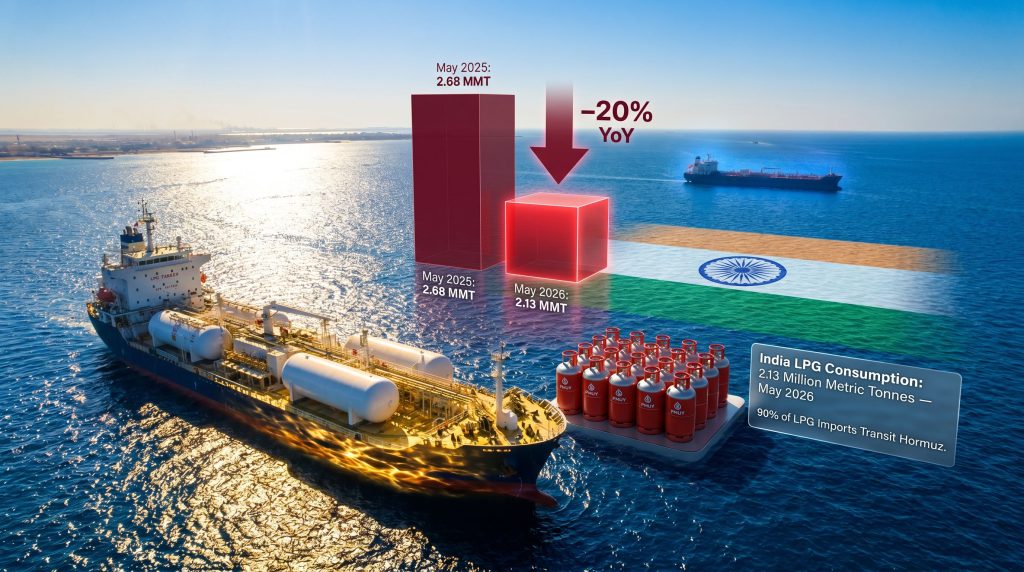
India's current predicament illustrates this vulnerability with uncomfortable precision. The country sources approximately 90% of its LPG imports from West Asia, with the overwhelming bulk transiting through the Strait of Hormuz, according to data from the Petroleum Planning and Analysis Cell (PPAC) of the oil ministry. When geopolitical tensions escalate in that region, India does not have the luxury of drawing from diversified stockpiles or redirecting supply chains within weeks. The architecture of its LPG import system was built for efficiency, not resilience.
The consequences of that design choice have become acutely visible in 2026. The India LPG supply crisis in the Strait of Hormuz has since exposed the fragility of a system that was never truly stress-tested at scale.
When big ASX news breaks, our subscribers know first
Why the Strait of Hormuz Has Become India's Most Critical Energy Chokepoint
The Geography of Dependency: How One Waterway Controls India's Cooking Gas Supply
At its narrowest point, the Strait of Hormuz measures approximately 21 nautical miles across, with navigable shipping lanes occupying only a fraction of that width. Through this passage flows an extraordinary proportion of the world's seaborne energy, including the LPG that fuels the stoves of rural and urban Indian households alike.
Unlike crude oil markets, where producers from West Africa, the Americas, and Southeast Asia can partially substitute for Gulf supply, the LPG trade is far more concentrated and logistically rigid. Specialised vessels known as Very Large Gas Carriers (VLGCs) transport LPG under pressurised or refrigerated conditions, and the global fleet of these vessels is substantially smaller than standard crude tankers. India's import terminals have been calibrated for the cargo sizes, berthing requirements, and product specifications typical of West Asian shipments, making rapid pivots to alternative origins technically constrained even when commercial will exists.
The social dimension of this dependency amplifies the stakes considerably. The Pradhan Mantri Ujjwala Yojana scheme, which has delivered LPG connections to tens of millions of rural households since 2016, dramatically expanded India's aggregate import demand. Consequently, it simultaneously concentrated millions of lower-income families into a supply chain with a single geopolitical pressure point. A policy achievement celebrated for transforming rural public health has inadvertently created structural energy security exposure.
"India's LPG import dependency is not a temporary policy gap. It is a structural feature of the country's energy architecture that amplifies the consequences of any Hormuz disruption, and the 2026 crisis has made that feature impossible to ignore."
How Dependent Is India on Imported LPG?
India's domestic LPG production capacity falls significantly short of national consumption requirements, making imports non-negotiable under any realistic near-term scenario. This structural deficit has widened over the past decade as the Ujjwala scheme progressively integrated hundreds of millions of new LPG users into the formal energy economy.
The consequence of this expansion, while profoundly positive for indoor air quality and women's health in rural communities, was a rapid escalation in import volumes that outpaced any meaningful investment in supply diversification or strategic storage. India built the pipes, cylinders, and distribution networks to serve this expanded consumer base. However, it did not build the buffer stocks or alternative supply routes to protect that base from external shocks. For a broader view of how resource export challenges play out across comparable energy-dependent economies, the structural parallels are instructive.
What Triggered the India LPG Supply Crisis in the Strait of Hormuz in 2026?
The Cascading Effect of the US-Israeli Military Campaign Against Iran
The escalation of US-Israeli military operations against Iran in early 2026 introduced a level of shipping uncertainty in Persian Gulf lanes that commercial operators had not experienced in recent decades. The threat of Iranian retaliatory measures, whether through direct interdiction of vessels or the credible threat thereof, created a chilling effect on VLGC operators facing the prospect of their assets being caught in a conflict zone.
The result was a measurable contraction in cargo movements through the Strait, with some vessel operators rerouting to longer but safer passages and others delaying departures entirely while assessing the evolving security situation. Each delay or rerouting decision compounded into a broader supply deficit that arrived at Indian import terminals as reduced cargo availability during the precise months when demand from domestic consumers was running at seasonal highs. Furthermore, the oil geopolitics and supply dynamics driving this disruption were not isolated to LPG alone, rippling across multiple energy categories simultaneously.
US Treasury Sanctions and the Iranian LPG Smuggling Network
Simultaneously, the US Treasury Department announced targeted sanctions against a network of individuals, corporate entities, and tankers that had been systematically moving Iranian-origin LPG to South and East Asian markets. The operation involved disguising these cargoes as Omani LPG through mislabelling at transshipment points, with Automatic Identification System (AIS) data on vessels reportedly manipulated to create false origin trails.
This shadow supply network had been functioning as an unofficial buffer for regional LPG markets. Its removal through sanctions enforcement tightened an already strained spot market at the worst possible moment for Indian buyers. The enforced closure of this supply channel meant that Indian importers could not access informal cargoes that had previously supplemented contracted volumes during periods of tightness. According to reporting from OilPrice.com, the sudden removal of this shadow supply layer caught Indian state importers with minimal lead time to source replacement volumes.
The Tanker Detention Episode and Diplomatic Resolution
At least two Indian LPG tankers were reportedly detained or delayed in the region during the height of the disruption. Diplomatic engagement with Iranian authorities ultimately secured the release of these vessels, including the Shivalik, which subsequently delivered approximately 40,000 metric tonnes of LPG to Gujarat. Combined with the other vessel, the two deliveries provided an estimated 92,000 metric tonnes of supply relief.
While meaningful in context, this volume represented a fraction of India's monthly requirement and illustrated the inadequacy of diplomatic crisis management as a sustainable supply security mechanism. Resolving individual vessel detentions through bilateral engagement is inherently reactive, non-scalable, and dependent on goodwill that geopolitical circumstances can withdraw at any moment.
How Deep Is the Supply Shortfall? A Data-Driven Assessment
India's LPG Consumption Collapse: May 2026 in Numbers
PPAC data published in June 2026 confirmed the scale of the crisis with statistical clarity. LPG consumption in May 2026 fell to 2.13 million metric tonnes, representing a 20% year-on-year decline from the 2.68 million metric tonnes recorded in May 2025.
| Metric | Value | Year-on-Year Change |
|---|---|---|
| LPG Consumption (May 2026) | 2.13 million metric tonnes | -20% |
| LPG Consumption (May 2025) | 2.68 million metric tonnes | Baseline |
| LPG Consumption (Apr 2026) | 2.21 million metric tonnes | Sequential decline |
| Estimated cumulative shortfall vs. prior year | ~1 million tonnes | Critical gap |
This 20% contraction represents the steepest annual decline in LPG consumption recorded in recent Indian history and is directly attributable to shipping disruptions in the Strait of Hormuz combined with the enforced removal of the Iranian LPG shadow supply chain.
Monthly LPG Trend: A Deteriorating Trajectory
The sequential monthly data reveals a pattern that extends well beyond a single anomalous month, pointing to a sustained and compounding supply chain failure rather than a temporary disruption.
| Month | LPG Volume (MMT) |
|---|---|
| March 2025 | 2.73 |
| April 2025 | 2.55 |
| May 2025 | 2.68 |
| March 2026 | 2.38 |
| April 2026 | 2.21 |
| May 2026 | 2.13 |
Every comparable month in 2026 sits materially below its 2025 equivalent, with the gap widening progressively. April 2026 was flagged by market observers as potentially critical, with available global LPG loadings reportedly covering only a few days of Indian demand, indicating an extremely thin supply buffer with minimal operational margin for further disruption.
What Are the Broader Impacts on India's Energy Consumption Landscape?
Total Fuel Consumption: A Mixed Picture Beneath the Surface
India's total fuel consumption reached 19.93 million metric tonnes in May 2026, inching up from April's 19.47 million metric tonnes but falling 6.5% below the 21.31 million metric tonnes recorded in May 2025. The aggregate figures, however, conceal a more complex and revealing pattern of stress-driven rebalancing across individual product categories.
| Product | May 2026 (MMT) | Apr 2026 (MMT) | May 2025 (MMT) | YoY Change |
|---|---|---|---|---|
| Diesel | 8.73 | 8.33 | 8.59 | +1.6% |
| Petrol | 3.91 | 3.68 | 3.78 | -3.4% |
| LPG | 2.13 | 2.21 | 2.68 | -20% |
| Jet Fuel | 0.78 | 0.77 | 0.78 | Flat |
| Fuel Oil | 0.63 | 0.49 | 0.50 | +24% |
| Naphtha | 0.67 | 0.76 | 0.95 | -29% |
| Bitumen | 0.52 | 0.58 | 0.86 | -39% |
| Total | 19.93 | 19.47 | 21.31 | -6.5% |
What the Cross-Fuel Data Reveals
Reading across the full product basket exposes dynamics that the headline LPG figure alone cannot capture.
-
Diesel resilience (+1.6% year-on-year) points to continued industrial and logistics activity, though early stress signals are emerging in the trucking sector following four consecutive retail price hikes in May 2026, with state-owned fuel retailers increasing diesel prices by ₹2.71 per litre during the month.
-
Petrol demand contraction (-3.4% year-on-year, -6.1% month-on-month) reflects consumer sensitivity to price increases. Petrol was raised by ₹2.61 per litre in May 2026, the fourth hike of the month, compressing discretionary driving activity among price-sensitive consumers.
-
Fuel oil surge (+24% year-on-year) is particularly telling. This category does not typically experience demand surges absent substitution dynamics. The most plausible explanation is that industrial users facing constrained LPG availability are pivoting to heavier fuel alternatives, creating secondary market distortions that persist beyond the immediate crisis window.
-
Bitumen collapse (-39% year-on-year) signals a substantial slowdown in road construction activity. Whether this reflects budget allocation delays, monsoon-related seasonality, or broader infrastructure investment hesitation requires closer examination, but the magnitude of the decline warrants attention.
-
Naphtha decline (-29% year-on-year) reflects softening petrochemical feedstock demand, potentially linked to both the LPG supply disruption and broader industrial output compression driven by higher energy input costs.
"The simultaneous contraction in LPG, petrol, naphtha, and bitumen against a backdrop of fuel oil expansion suggests India's energy consumption mix is undergoing a stress-driven rebalancing, not a demand-led structural shift rooted in economic growth."
Who Bears the Greatest Economic Burden of the LPG Shortfall?
Household Energy Stress: The Ujjwala Scheme's Hidden Vulnerability
The households most exposed to the LPG supply crisis are precisely those the Ujjwala scheme was designed to lift out of energy poverty. Rural and semi-urban families who depend on LPG cylinders as their sole cooking fuel source have no readily accessible alternatives when cylinder availability tightens at the distribution level.
When rationing occurs, it does not distribute pain proportionally across income levels. Wealthier households can afford black market premiums, maintain larger cylinder inventories, or supplement with electric cooking. Lower-income households have none of these options. Supply constraints therefore push the most vulnerable consumers back toward biomass fuels, firewood, and agricultural residues, reversing years of measurable public health gains in respiratory disease reduction and indoor air quality improvement. As The Guardian's reporting on India's LPG supply chain disruption highlights, this regression is already visible in affected rural districts.
Commercial Sector Disruption: Restaurants, Hospitality, and Food Services
The commercial LPG segment, encompassing restaurants, roadside eateries, catering operations, and food processing units, has experienced active rationing during peak disruption periods. Small food service operators, who typically maintain minimal inventory and rely on predictable cylinder deliveries, face existential margin pressure when supply becomes intermittent.
Menu reductions, shorter operating hours, and partial closures have been reported among small commercial operators unable to secure adequate cylinder allocations. Larger hospitality and food processing chains with diversified energy procurement strategies and greater storage capacity have demonstrated more resilience, further widening the operational gap between large and small businesses in the sector.
Industrial Feedstock Implications
LPG's role extends well beyond household cooking. It functions as a critical industrial process fuel and, in certain configurations, a petrochemical feedstock. The 29% year-on-year decline in naphtha consumption alongside the broader LPG contraction suggests downstream petrochemical production is absorbing meaningful supply-side shocks.
Industries relying on LPG for heat treatment processes, packaging line operations, glass manufacturing, and food processing are facing input cost escalation and, in some cases, production curtailment. The economic losses from these industrial disruptions are less visible than household hardship but accumulate into significant GDP-level drag if the supply disruption extends beyond several months.
The next major ASX story will hit our subscribers first
Does India Have Alternative Supply Routes? A Strategic Options Assessment
Potential Diversification Pathways
The theoretical options for supply diversification are well understood in policy circles. The practical constraints on each, however, explain why India has not already diversified away from Hormuz-transiting West Asian LPG. India's LNG tax structure offers a useful parallel for understanding how import policy frameworks can either facilitate or impede rapid supply-source switching.
| Supply Alternative | Feasibility | Timeline | Key Constraints |
|---|---|---|---|
| US LPG imports (via longer sea routes) | Moderate | Medium-term | Higher freight costs, limited VLGC availability |
| Australian LPG exports | Low-Moderate | Medium-term | Limited dedicated export infrastructure |
| African West Coast suppliers | Low | Long-term | Minimal existing trade frameworks |
| Accelerated domestic production | Low | Long-term | Requires substantial upstream investment cycles |
| Pipeline gas substitution (PNG) | Low (urban only) | Long-term | Major rural infrastructure gaps |
Why Geographic Diversification Is Structurally Difficult
The cost advantage of West Asian LPG is significant and persistent. Alternative origins carry freight premiums that would require either material consumer price increases or substantial expansion of government subsidy obligations. Neither is politically straightforward during an existing cost-of-living crisis.
Beyond cost, India's long-term supply agreements with Gulf producers contain contractual terms that limit the speed at which sourcing can be redirected. Take-or-pay provisions require India to pay for contracted volumes regardless of actual delivery, creating financial disincentives for unilateral contract restructuring even when alternatives theoretically exist.
The technical compatibility question further constrains rapid pivoting. LPG composition varies meaningfully by origin, with Middle Eastern supplies typically richer in butane while US Gulf Coast exports contain higher propane concentrations. Distribution infrastructure calibrated for one composition may require modifications to handle another, adding time and capital requirements to any rapid diversification effort.
"India cannot meaningfully diversify away from West Asian LPG within a single fiscal year. Any extended crisis requires either demand destruction, accelerated domestic gas production, or sustained diplomatic engagement to restore Hormuz transit normalcy."
What Does the Hormuz Crisis Mean for India's LPG Price Trajectory?
Price Pressure Mechanisms: From Tanker to Cylinder
The transmission mechanism from Hormuz disruption to retail LPG cylinder prices operates through several interlocking channels that compound rather than cancel each other.
-
Freight rate escalation during periods of Hormuz uncertainty adds directly to the landed cost of each cargo, as vessel operators price geopolitical risk premiums into charter rates.
-
Spot market LPG premiums rise sharply when cargo availability tightens, as buyers compete aggressively for limited supply and sellers extract scarcity rents.
-
Currency pressure compounds import costs for India if rupee depreciation accompanies the geopolitical shock, as LPG is priced in US dollars on international markets.
-
Government subsidy obligations expand as the gap between import parity pricing and administered retail prices widens, creating fiscal pressure that ultimately shapes the pace and magnitude of retail price adjustments.
The four consecutive retail price hikes implemented in May 2026 signal that India's state-owned fuel retailers have concluded they can no longer absorb the full cost burden of elevated import prices, transferring at least a portion of the financial pressure to consumers.
Downstream Price Sensitivity
Petrol and diesel price elasticity data from Indian markets suggests that each meaningful per-litre increase generates a measurable near-term reduction in consumption, as households and businesses adjust travel patterns and logistics operations. The -3.4% year-on-year decline and -6.1% month-on-month contraction in petrol demand visible in May 2026 PPAC data is consistent with this historical elasticity pattern responding to the May price increases.
For LPG specifically, the political sensitivity of cylinder pricing for lower-income households creates an asymmetric policy constraint. The government faces a narrow corridor between fiscal sustainability and social welfare protection. Raising LPG cylinder prices materially risks pushing economically vulnerable households back toward biomass fuels, undermining the public health rationale of the Ujjwala programme that justified years of policy investment.
How Does the Hormuz Disruption Fit Into India's Broader Energy Security Strategy?
The Strategic Petroleum Reserve Question
India has invested considerably in strategic petroleum reserves for crude oil, with dedicated underground cavern storage at Visakhapatnam, Mangaluru, and Padur. LPG-specific strategic storage, however, remains substantially underdeveloped relative to the country's structural import exposure.
The current crisis has illuminated this gap with particular clarity. Comparable economies with comparable LPG import dependency profiles, including South Korea and Japan, maintain dedicated emergency LPG reserves calibrated to cover meaningful durations of consumption. India's equivalent buffer capacity is considerably thinner, leaving the country with minimal cushion against import disruptions of more than a few weeks.
The investment case for dedicated LPG buffer stock facilities at major import terminals has been strengthened considerably by the 2026 experience. The capital cost of developing such infrastructure is material but finite. The economic and social cost of the current shortage, measured in industrial output losses, public health regression, and subsidy expansion, is likely to exceed those capital requirements when tallied comprehensively.
Accelerating the Domestic Gas Production Agenda
India's upstream gas assets represent a medium-term partial solution to Hormuz dependency. The KG-D6 basin and other offshore formations have demonstrated production capability, but translating upstream resource potential into LPG supply chain relief requires sustained investment over time horizons measured in years, not quarters.
Compressed natural gas and piped natural gas expansion programmes offer partial substitution pathways in urban corridors where pipeline infrastructure already exists or is under active development. These alternatives cannot, however, reach the rural households where Ujjwala-connected consumers are concentrated, limiting their relevance to the acute dimension of the current crisis. Furthermore, the geopolitical supply risks shaping global energy infrastructure investment will continue to complicate the financing environment for new domestic production capacity.
Geopolitical Hedging: Diplomatic Engagement as a Supply Tool
The diplomatic resolution of the tanker detention episode demonstrated that bilateral engagement can yield short-term supply relief. It also demonstrated the inherent limitations of this approach. Diplomatic interventions depend on the political calculations of the counterparty, require significant senior-level attention during periods when India's diplomatic bandwidth is stretched across multiple simultaneous geopolitical challenges, and produce outcomes measured in individual vessel releases rather than structural supply restoration.
India's long-term energy security architecture requires structural solutions rather than perpetual crisis diplomacy. Building genuine supply resilience involves uncomfortable trade-offs between cost efficiency and security margins, but the 2026 episode has quantified what the cost of inadequate resilience looks like in practice.
Frequently Asked Questions: India LPG Supply Crisis and the Strait of Hormuz
What percentage of India's LPG imports pass through the Strait of Hormuz?
India sources approximately 90% of its LPG imports from West Asia, according to PPAC data, with the vast majority of this volume transiting through the Strait of Hormuz, making it the single most critical maritime chokepoint for India's cooking gas supply chain.
How much did India's LPG consumption fall during the 2026 Hormuz disruption?
India's LPG consumption declined by approximately 20% year-on-year in May 2026, falling from 2.68 million metric tonnes in May 2025 to 2.13 million metric tonnes, representing the steepest annual decline recorded in recent history.
What caused the India LPG supply crisis linked to the Strait of Hormuz in 2026?
The disruption was triggered by the escalation of the US-Israeli military conflict with Iran, which created shipping uncertainty across Persian Gulf lanes. Simultaneously, US Treasury sanctions targeting a network smuggling Iranian LPG disguised as Omani LPG removed a shadow supply layer that had partially offset India's import shortfalls.
What is India doing to address the LPG supply crisis?
India has pursued diplomatic engagement to secure the release of detained LPG tankers, with at least two vessels, including the Shivalik, cleared to deliver approximately 92,000 metric tonnes of combined LPG cargo to Gujarat. Structural responses including domestic gas production acceleration and dedicated LPG reserve development remain ongoing policy priorities without confirmed completion timelines.
Which sectors are most affected by India's LPG shortage?
The most severely impacted segments include rural and lower-income households dependent on LPG cylinders for cooking, small commercial food service operators experiencing active rationing, and industrial users relying on LPG as a process fuel or petrochemical feedstock input.
Could the India LPG supply crisis worsen in the second half of 2026?
The risk of further deterioration remains elevated if Hormuz shipping disruptions persist. April 2026 data indicated that available global LPG loadings covered only a few days of Indian demand, suggesting the supply buffer is critically thin and any additional disruption could rapidly translate into deeper shortfalls across both household and commercial segments.
Key Takeaways: India's LPG Vulnerability in a Geopolitically Fractured World
The 2026 India LPG supply crisis in the Strait of Hormuz has crystallised a set of structural vulnerabilities that policymakers, investors, and energy security planners can no longer regard as theoretical risks. In summary, the key findings are as follows:
-
India's 90% dependence on West Asian LPG creates an irreducible and currently unhedged exposure to Strait of Hormuz disruption risk that cannot be resolved through short-term diplomatic interventions alone.
-
The 20% year-on-year consumption decline in May 2026 reflects both supply constraint and demand destruction simultaneously, making it difficult to assess the true depth of unmet need without granular distribution-level data.
-
Cross-fuel data reveals a stress-driven rebalancing in India's consumption mix, with fuel oil rising sharply as LPG, naphtha, and bitumen contract in parallel, signalling systemic rather than isolated pressure.
-
Four consecutive retail price hikes in May 2026 confirm that the administered pricing buffer separating import costs from retail consumers is eroding under sustained pressure from elevated crude and LPG import costs.
-
The absence of dedicated LPG strategic storage comparable to India's crude reserves represents the most immediately addressable policy gap exposed by the 2026 crisis.
-
Resolving structural vulnerability requires investment commitments spanning domestic gas production capacity, LPG terminal buffer infrastructure, contractual diversification, and the political will to accept higher short-term costs in exchange for long-term supply resilience.
This article reflects publicly available data and analysis as of June 2026. Energy market conditions, geopolitical developments, and government policy positions can change rapidly. Nothing in this article constitutes financial, investment, or policy advice. Readers should consult current primary sources and professional advisors before drawing conclusions for commercial or investment purposes.
Want to Stay Ahead of the Commodity Disruptions Reshaping Global Markets?
Supply shocks like India's LPG crisis are a reminder that energy and resource markets can shift violently and without warning — and that being positioned early is everything. Discovery Alert's proprietary Discovery IQ model scans ASX announcements in real time, delivering instant alerts on significant mineral discoveries so subscribers can identify actionable opportunities before the broader market reacts. Explore historic discoveries and their returns to see what early positioning can mean in practice, and begin a 14-day free trial at Discovery Alert to secure your market-leading edge.