July 9, 2026
The Hidden Architecture of Sovereign Oil Debt: Why Prepayment Financing Defines Frontier Fiscal Survival
Across the global commodity trade finance landscape, one of the least scrutinised yet most consequential financing mechanisms operates almost entirely outside the frameworks that govern conventional sovereign debt. Oil prepayment financing, a structure in which a state or state-owned entity pledges future crude deliveries in exchange for immediate capital, has quietly become the fiscal backbone of several sub-Saharan African governments. Understanding commodity trade volatility is essential context here, as it works seamlessly when oil flows on schedule and collapses with extraordinary speed when it does not.
The South Sudan BB Energy oil prepayment financing dispute is not merely a bilateral contract disagreement. It is a window into a broader systemic vulnerability affecting resource-dependent sovereigns that have few alternatives to commodity-backed capital raising, and it illustrates with uncomfortable clarity what happens when pipeline infrastructure, creditor competition, and English law jurisdiction clauses converge simultaneously.
When big ASX news breaks, our subscribers know first
Understanding Oil Prepayment Financing and Its Role in Frontier Economies
How the Mechanism Actually Works
Oil prepayment financing operates on a deceptively simple premise. A commodity trader or financial institution advances a lump sum to a sovereign government or its national oil company. In return, the sovereign commits to delivering a specified number of crude oil cargoes over an agreed timeline, with those physical deliveries serving as both repayment of principal and return on the trader's capital.
This arrangement differs fundamentally from conventional sovereign debt instruments in several important ways. Understanding how tariffs work in commodity markets provides useful background, but prepayment deals operate under their own distinct mechanics:
- Sovereign bonds are traded on capital markets, carry credit ratings, and are subject to multilateral restructuring frameworks when defaults occur.
- IMF facilities impose conditionality, require fiscal transparency, and involve multilateral oversight.
- Bilateral loans are negotiated between governments and typically involve diplomatic relationships as a backstop.
- Oil prepayment deals are private commercial contracts, governed by the jurisdiction specified in the agreement, with physical commodity delivery as the primary repayment mechanism.
For frontier oil producers like South Sudan that lack investment-grade credit ratings or meaningful access to international capital markets, prepayment financing is not a financing preference. It is often the only practical option available for short-term budget liquidity.
Revenue Concentration and the Amplification of Default Risk
The structural vulnerability inherent in South Sudan's position becomes stark when viewed through a comparative lens. Oil constitutes between 85% and 90% of South Sudan's total national revenue, according to African Security Analysis, a concentration ratio that is exceptional even by sub-Saharan standards.
| Country | Oil as % of Government Revenue | Primary Financing Mechanism |
|---|---|---|
| South Sudan | 85–90% | Oil prepayment / commodity-backed loans |
| Chad | ~70% | Oil-backed loans (Glencore) |
| Angola | ~65% | Chinese oil-for-infrastructure deals |
| Nigeria | ~60% | Eurobonds + multilateral lending |
When a sovereign's entire fiscal architecture rests on a single export commodity, any disruption to that commodity's delivery capability does not merely create a financing inconvenience. It triggers a cascading failure across every creditor relationship simultaneously. Furthermore, the commodity price impact on these arrangements can be profound, as declining prices reduce the real value of future cargo deliveries even when physical volumes remain intact.
The Origins and Escalation of the BB Energy Dispute
A $100 Million Advance With Undelivered Consequences
In February 2025, BB Energy advanced $100 million to the South Sudanese government under a prepayment agreement requiring the delivery of five crude oil cargoes. The arrangement was structured around South Sudan's two primary export grades: Dar Blend and Nile Blend crude.
Twelve months later, only one of the five contracted cargoes had been delivered, leaving the prepayment arrangement materially in breach. The primary structural factor contributing to the delivery failure was a significant pipeline rupture in 2024 that severely disrupted South Sudan's oil export capacity. Crucially, this infrastructure failure did not affect a single creditor relationship in isolation. It cascaded across South Sudan's entire prepayment creditor stack simultaneously, affecting obligations to multiple parties at once.
This is a characteristic of oil prepayment default risk that distinguishes it from almost every other sovereign financing mechanism. Unlike a bond coupon that can be deferred through a restructuring process involving multilateral institutions, a prepayment obligation requires a physical barrel of crude to move through an operational pipeline and onto a vessel. Infrastructure failure cannot be negotiated around.
London High Court Enforcement and the Injunction
Following South Sudan's failure to meet its delivery commitments, BB Energy pursued enforcement through the London High Court, the jurisdiction specified in the contract. This choice of venue reflects a standard feature of African commodity trade finance agreements: English law jurisdiction clauses are routinely embedded by traders and lenders as a risk management mechanism. The broader trade war impacts on global commodity flows have, however, made enforcement of such clauses increasingly complex in recent years.
"When a commodity trader secures a London High Court injunction against a sovereign government, the legal instrument operates with a precision that multilateral debt frameworks cannot replicate. The injunction does not renegotiate terms. It blocks a sovereign from accessing an entire category of financing until the court is satisfied."
In May 2026, the court issued an injunction barring the South Sudanese government from entering into any new oil prepayment agreements with third parties. According to Reuters, an offer of two additional cargoes in June 2026 failed to meet the court's threshold for lifting the restriction, and the injunction remained in place through mid-year.
The July 2026 Consent Order: Structure, Terms, and Limitations
What the Negotiated Relief Agreement Contains
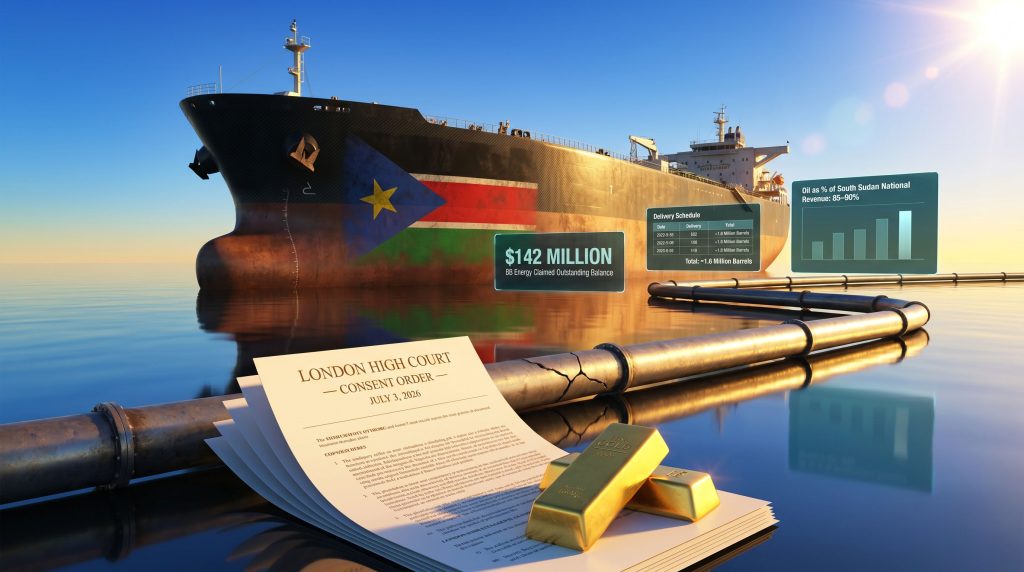
On July 3, 2026, a consent order was formalised with the London High Court, representing the first substantive easing of the injunction since the dispute began. The agreement was structured around a phased delivery commitment by South Sudan, with BB Energy agreeing to partially suspend the injunction in exchange.
| Cargo | Blend Type | Volume | Scheduled Delivery |
|---|---|---|---|
| Cargo 1 | Dar Blend | ~600,000 barrels | August 2026 |
| Cargo 2 | Nile Blend | ~600,000 barrels | September 2026 |
| Cargo 3 | Dar Blend | ~600,000 barrels | November 2026 |
| Total | Mixed | ~1.8 million barrels | Aug–Nov 2026 |
Under the consent order's terms, the partial suspension of the injunction allows South Sudan to resume accepting advance payments for Dar Blend and Nile Blend crude from new counterparties, with the explicit exclusion of the three cargoes allocated to BB Energy from any new prepayment arrangements. The relief remains operative until the end of November 2026.
BB Energy's announcement following the agreement reflected a measured assessment that the South Sudanese government had engaged constructively, while making clear that the company anticipated a full resolution of the underlying commercial relationship. Consequently, this was not a settlement. It was a structured interim arrangement.
Critical Gaps the Agreement Leaves Unresolved
The July 2026 consent order is notably limited in scope. Several material issues remain entirely unaddressed:
- BB Energy has publicly stated it is still owed $142 million, meaning the three cargoes represent partial debt service only.
- The injunction is explicitly subject to full reinstatement if no comprehensive settlement is reached before November 2026.
- The agreement contains no provisions addressing South Sudan's parallel obligations to its other prepayment creditors.
- There is no force majeure mechanism embedded in the consent order to account for further pipeline disruptions.
South Sudan's Multi-Creditor Prepayment Exposure
A Creditor Stack Competing for the Same Finite Resource
The BB Energy dispute, significant as it is, represents only one layer of South Sudan's oil-backed financing obligations. According to Global Trade Review (GTR), three additional creditors hold substantial prepayment claims against South Sudan's future crude production:
| Creditor | Type | Estimated Exposure | Current Status |
|---|---|---|---|
| BB Energy | Commodity trader | $142 million claimed outstanding | Partial injunction relief secured July 2026 |
| Qatar National Bank (QNB) | Commercial bank | Part of $2B+ collective exposure | Delivery obligations reportedly under strain |
| Afreximbank | Pan-African development finance institution | Part of $2B+ collective exposure | Delivery obligations reportedly under strain |
| Nasdec | Emirati commodity trader | Part of $2B+ collective exposure | Delivery obligations reportedly under strain |
The collective financing extended by QNB, Afreximbank, and Nasdec exceeds $2 billion, according to GTR. This creates a structural prioritisation problem that no bilateral settlement can resolve independently. Every barrel of crude committed to BB Energy under the consent order is a barrel unavailable to satisfy the claims of these three additional creditors.
"When multiple prepayment creditors compete for the same finite volume of oil exports from a country with constrained production capacity, the issuance of any new prepayment agreement effectively dilutes the security position of every existing creditor."
The Regulatory Void at the Centre of the Problem
Unlike multilateral sovereign debt instruments, oil prepayment agreements operate entirely outside IMF and World Bank transparency frameworks. There is no centralised registry of sovereign commodity prepayment obligations. There is no standardised disclosure requirement for the aggregate volume of prepayment commitments a government has outstanding at any given moment.
This information asymmetry is not a peripheral concern. It is the mechanism through which a sovereign can inadvertently over-encumber its oil production, and through which new creditors can extend financing without accurate knowledge of how much of the underlying security has already been pledged elsewhere. In addition, the geopolitical mining risks that shape broader resource extraction in frontier markets compound these transparency challenges considerably.
Three Scenarios for the Path to November 2026
Scenario Analysis: Possible Outcomes by the Consent Order Deadline
Scenario A: Full Settlement and Permanent Injunction Lift
South Sudan delivers all three cargoes on schedule and negotiates a comprehensive repayment arrangement for the remaining $142 million balance. The injunction is permanently lifted and South Sudan's access to prepayment financing is fully restored. This scenario is contingent on pipeline operational continuity and stable oil price conditions through Q4 2026.
Scenario B: Partial Delivery and Extended Negotiation
One or two cargoes are delivered but a comprehensive settlement remains out of reach before November. The parties agree to extend the consent order framework beyond the current deadline. The injunction remains partially suspended but the underlying debt overhang continues to constrain new financing relationships.
Scenario C: Delivery Failure and Full Injunction Reinstatement
South Sudan fails to deliver one or more of the three allocated cargoes. BB Energy applies to reinstate the full injunction, blocking all new prepayment financing. This outcome would deepen the fiscal crisis and increase default risk across the QNB, Afreximbank, and Nasdec exposure simultaneously.
The next major ASX story will hit our subscribers first
Structural Reforms That Could Reduce Future Prepayment Default Risk
The South Sudan BB Energy oil prepayment financing case has exposed governance gaps in sovereign commodity financing that extend well beyond South Sudan's specific circumstances. Several structural reforms could meaningfully reduce the likelihood of similar crises across resource-dependent sovereigns:
- Establish a sovereign oil delivery registry that tracks all outstanding prepayment commitments against verified available export capacity before new agreements are executed.
- Embed contractual force majeure protections in prepayment agreements that automatically trigger delivery rescheduling in the event of qualifying infrastructure disruptions, preventing cascading defaults.
- Diversify sovereign financing instruments beyond commodity prepayment mechanisms to reduce single-instrument fiscal dependency and create buffer capacity when production is disrupted.
- Engage multilateral institutions such as the African Development Bank and Afreximbank to provide structured refinancing when prepayment obligation stacks become operationally unsustainable.
- Adopt regional commodity finance transparency standards to reduce information asymmetry across creditor stacks and enable more accurate assessment of encumbrance levels before new financing is extended.
Key Metrics: South Sudan's Prepayment Financing Crisis at a Glance
| Metric | Value |
|---|---|
| Oil as share of South Sudan's national revenue | 85–90% |
| Original BB Energy prepayment advance | $100 million (February 2025) |
| Cargoes committed under original deal | 5 |
| Cargoes delivered within first year | 1 |
| BB Energy's claimed outstanding balance | $142 million |
| Cargoes committed under July 2026 consent order | 3 (~1.8 million barrels total) |
| Consent order effective period | Until end of November 2026 |
| Total oil-backed financing from QNB, Afreximbank and Nasdec | Over $2 billion |
Frequently Asked Questions: South Sudan BB Energy Oil Prepayment Financing
What is the BB Energy oil prepayment deal with South Sudan?
In February 2025, commodity trader BB Energy advanced $100 million to the South Sudanese government under a prepayment agreement requiring the delivery of five crude oil cargoes. After only one cargo was delivered in the first year, BB Energy secured a London High Court injunction blocking South Sudan from entering new prepayment agreements. A consent order reached in July 2026 requires South Sudan to deliver three additional cargoes totalling approximately 1.8 million barrels by November 2026 in exchange for partial and temporary suspension of the injunction.
How much does South Sudan still owe BB Energy?
BB Energy has publicly stated that $142 million remains outstanding under the original prepayment agreement. The three cargoes under the July 2026 consent order constitute partial debt service only, and a comprehensive settlement has not been reached.
Why did South Sudan fail to deliver oil to BB Energy?
South Sudan's delivery failures were driven by a combination of a significant pipeline rupture in 2024 that disrupted export capacity, and the structural challenge of managing simultaneous prepayment obligations to multiple creditors, including QNB, Afreximbank, and Nasdec, who collectively hold more than $2 billion in oil-backed financing claims against the country.
What happens if South Sudan fails to deliver the three cargoes by November 2026?
If South Sudan does not fulfil its delivery commitments under the consent order, BB Energy retains the right to apply to the London High Court to reinstate the full injunction, which would once again prevent South Sudan from entering into any new oil prepayment financing arrangements, severely constraining the government's access to short-term liquidity.
Who are the other creditors involved in South Sudan's oil prepayment obligations?
Beyond BB Energy, South Sudan carries outstanding prepayment obligations to Qatar National Bank (QNB), Afreximbank, and Emirati commodity trader Nasdec, who have collectively extended more than $2 billion in oil-backed financing to the country, according to Global Trade Review.
This article is intended for informational purposes only and does not constitute financial or investment advice. Forward-looking scenarios and outcome projections involve inherent uncertainty and should not be relied upon as predictions of actual events. Readers seeking further analysis of African sovereign commodity financing structures are encouraged to consult coverage from Ecofin Agency and Global Trade Review, both of which provide ongoing reporting on trade finance developments across the African continent.
Want to Track the Next Major Mineral Discovery Before the Market Reacts?
While sovereign commodity financing structures reveal how resource dependency shapes fiscal outcomes, Discovery Alert's proprietary Discovery IQ model delivers real-time alerts on significant ASX mineral discoveries — transforming complex geological data into actionable investment insights the moment announcements hit the exchange. Explore Discovery Alert's discoveries page to understand how historic finds have generated substantial returns, and begin your 14-day free trial today to position yourself ahead of the broader market.