
August 14, 2026
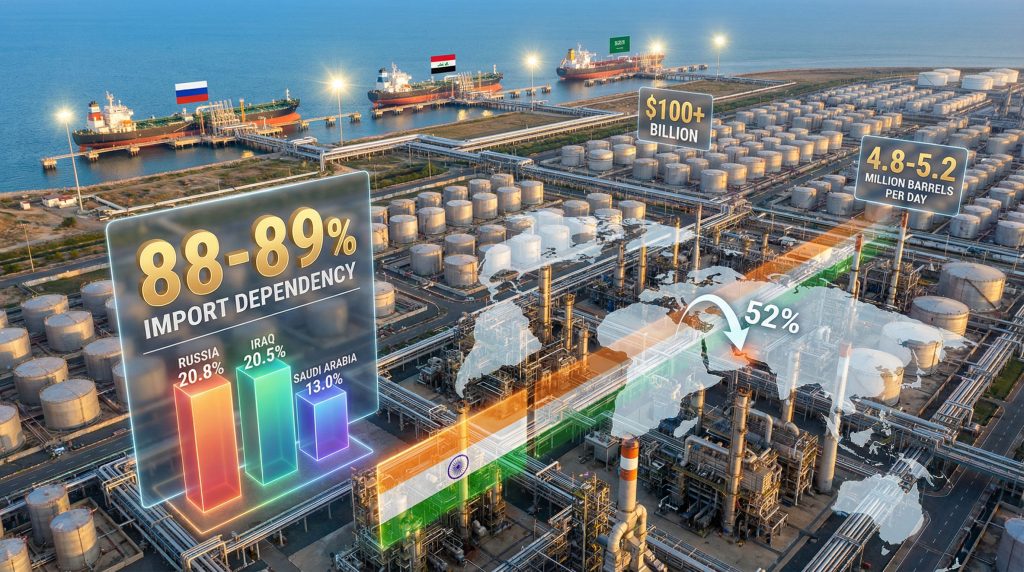
India's complex energy landscape demonstrates the intricate balance between economic growth and strategic vulnerability, particularly evident in the nation's India oil imports dependency. As the world's third-largest oil consumer, India's energy framework requires sophisticated risk management strategies that navigate both immediate supply challenges and long-term sustainability goals.
How Critical Are Oil Imports to India's Economic Framework?
India's energy dependency creates a fundamental vulnerability that permeates every sector of its economy. The nation imports approximately 85-87% of its crude oil requirements, representing one of the world's highest import dependency ratios among major economies. This reliance translates into massive foreign exchange outflows that can exceed $140-160 billion annually, depending on global price volatility and consumption patterns.
Quantifying India's Energy Import Dependency
The scale of India oil imports operates within a range of 4.9-5.3 million barrels per day, making it the third-largest consumer globally after the United States and China. Furthermore, this consumption pattern creates several economic multiplier effects that extend throughout the Indian economy:
- Foreign Exchange Impact: Oil imports account for 25-30% of India's total import bill, creating substantial pressure on the current account deficit
- Inflation Transmission: Every $10 per barrel increase in crude prices typically adds 0.2-0.4 percentage points to India's wholesale price inflation
- Fiscal Implications: Fuel subsidies and petroleum product taxes contribute significantly to both central and state government revenues
- Industrial Cost Structure: Energy-intensive industries face direct cost pressures that affect competitiveness in export markets
The dependency extends beyond simple volume metrics. India sources crude oil from over 40 countries, creating a complex logistics and risk management challenge that requires continuous diplomatic engagement and supply chain optimization.
Strategic Vulnerability Assessment
India's energy security architecture faces multiple chokepoint risks that compound the basic import dependency. The most critical vulnerability centres on the Strait of Hormuz, through which approximately 30-35% of India's crude imports transit. This narrow waterway, controlled by Iran and the UAE, represents a single point of failure that could disrupt energy supplies within weeks.
Recent geopolitical tensions have highlighted additional vulnerability factors. However, these challenges have also accelerated our understanding of oil price movements and their implications for import-dependent economies:
- Supplier Concentration: Despite sourcing from 40+ countries, the top five suppliers typically account for 75-80% of total imports
- Payment System Risks: International sanctions regimes can complicate payment mechanisms with certain suppliers
- Transportation Security: Piracy, maritime disputes, and regional conflicts create ongoing transit risks
- Price Volatility: Limited strategic reserves mean India remains exposed to sudden price spikes during supply disruptions
Economic modelling suggests that a 30-day complete closure of the Strait of Hormuz could reduce India's GDP growth by 0.8-1.2 percentage points, while a sustained 90-day disruption could trigger recession-level economic contraction.
When big ASX news breaks, our subscribers know first
Which Countries Dominate India's Crude Oil Supply Chain?
India's supplier portfolio has undergone dramatic transformation over the past five years, driven by geopolitical shifts, pricing dynamics, and strategic diversification efforts. The current supplier landscape reflects both opportunistic procurement strategies and long-term relationship building.
Current Supplier Portfolio Analysis
The composition of India's crude oil suppliers reveals a carefully balanced approach to risk management and cost optimisation. In addition, understanding these dynamics requires examining oil price rally analysis to appreciate how supplier relationships adapt to market conditions:
| Supplier | Market Share (%) | Strategic Significance | Supply Characteristics |
|---|---|---|---|
| Russia | 18-22% | Discount pricing, sanctions navigation | Price-sensitive, flexible terms |
| Iraq | 19-23% | Regional stability, infrastructure ties | Long-term contracts, quality grades |
| Saudi Arabia | 12-16% | OPEC+ coordination, strategic partnership | Premium pricing, supply reliability |
| UAE | 8-12% | Regional diversification, processing hub | Flexible contracts, multiple grades |
| United States | 3-7% | Technology partnership, strategic alliance | Higher transport costs, premium grades |
This supplier distribution reflects several underlying strategic considerations. Russian supplies surged dramatically following geopolitical developments in 2022, when India capitalised on discounted pricing opportunities while other buyers withdrew from the market. Consequently, this shift demonstrated India's pragmatic approach to energy procurement, prioritising economic benefits over geopolitical alignment.
Supplier Concentration Risk Analysis
Despite sourcing from numerous countries, India faces inherent concentration risks that require ongoing management. The top five suppliers control approximately 75-80% of total import volumes, creating potential vulnerabilities during simultaneous supply disruptions.
Geographic concentration presents additional challenges:
- Middle East Dependency: Combined supplies from Iraq, Saudi Arabia, UAE, Iran, and Kuwait typically represent 45-55% of total imports
- Single Route Risks: Multiple suppliers utilise similar transportation corridors, particularly the Strait of Hormuz
- Regional Conflict Exposure: Political instability in key supplier regions can simultaneously affect multiple supply sources
India's response involves active diversification strategies, including enhanced engagement with African suppliers (Nigeria, Angola), Latin American producers (Venezuela, Brazil), and expanded relationships with Central Asian sources through alternative routing mechanisms.
How Have Geopolitical Events Reshaped India's Import Strategy?
Recent global conflicts have accelerated India's strategic pivot toward supply chain resilience and opportunistic procurement. The most significant transformation occurred following the February 2022 Russia-Ukraine conflict, which created both challenges and opportunities for India's energy security framework.
Russian Oil Integration Post-2022
India's approach to Russian crude imports exemplifies pragmatic energy diplomacy. From minimal pre-2022 levels, Russian supplies expanded rapidly to become India's largest single supplier, reaching peak volumes of 1.6-1.8 million barrels per day. This transformation required sophisticated adaptation of payment systems, logistics networks, and refinery operations.
Key implementation mechanisms included:
- Alternative Payment Systems: Rupee-ruble trade arrangements and third-country banking mechanisms to navigate international sanctions
- Logistics Optimisation: Development of new shipping routes and insurance arrangements for Russian crude carriers
- Refinery Adaptation: Technical modifications to process different crude grades and optimise yields from Russian feedstocks
The pricing dynamics proved particularly attractive, with Russian Urals crude trading at $15-25 per barrel discounts to international benchmarks during peak periods. For instance, this pricing advantage translated into substantial cost savings for Indian refiners and downstream fuel costs.
Middle East Supply Chain Recalibration
Traditional Middle Eastern suppliers faced displacement pressure as India optimised its procurement portfolio. However, suppliers like Iraq and the UAE adapted by enhancing commercial terms and exploring new cooperation frameworks.
Iraq maintained market share through:
- Extended payment terms and credit facilities
- Investment commitments in Indian refinery expansion projects
- Enhanced crude quality specifications for Indian processing requirements
Saudi Arabia pursued strategic relationship building despite reduced volumes, focusing on downstream integration opportunities and renewable energy cooperation frameworks that extend beyond crude oil transactions.
Alternative Route Development
Recent regional tensions have accelerated India's efforts to reduce dependence on traditional chokepoint routes. According to the Petroleum Planning and Analysis Cell, non-Hormuz routing has increased to approximately 65-70% of total imports, compared to historical levels of 45-50%.
This shift involves multiple strategic initiatives:
- Cape of Good Hope Routing: Increased utilisation of African route alternatives, adding 10-15 days transit time but avoiding Middle Eastern chokepoints
- Pipeline Infrastructure: Enhanced engagement with Central Asian suppliers through overland pipeline networks
- Strategic Port Development: Expansion of receiving capacity at non-western coast ports to accommodate alternative routing
Transportation cost implications remain significant, with alternative routing adding $2-4 per barrel in logistics costs. Nevertheless, these expenses are justified by enhanced supply security during periods of regional instability.
What Economic Factors Drive India's Oil Import Decision-Making?
India's oil procurement strategy operates within a sophisticated framework that balances multiple economic variables including price optimisation, currency risk management, and strategic stockpiling requirements. This decision-making process involves coordination between government agencies, state-owned refiners, and private sector participants.
Price Sensitivity and Procurement Strategies
Indian buyers demonstrate high price sensitivity, consistently seeking opportunities to optimise procurement costs through various mechanisms. The Russian crude integration exemplifies this approach, where price differentials of $15-25 per barrel below benchmark prices justified complex logistical and payment arrangements.
Procurement optimisation strategies include:
- Opportunistic Spot Purchases: Capitalising on temporary market dislocations and supplier distress sales
- Contract Renegotiation: Continuous optimisation of long-term agreement terms based on changing market conditions
- Grade Optimisation: Matching crude quality specifications with refinery capabilities to maximise processing margins
- Seasonal Planning: Aligning procurement timing with domestic demand cycles and international price patterns
Recent market developments demonstrate this price-driven approach. When international oil releases were announced during supply disruptions, Indian refinery executives emphasised that implementation speed would determine effectiveness in preventing supply-seeking pressure and associated price increases.
Refinery Capacity Utilisation Optimisation
India's refining sector operates with approximately 5.0-5.2 million barrels per day of processing capacity, creating opportunities for strategic crude slate optimisation. Different refineries possess varying capabilities for processing different crude grades, enabling sophisticated procurement strategies.
Optimisation considerations include:
- Crude Quality Matching: Aligning heavy versus light crude purchases with specific refinery processing capabilities
- Yield Optimisation: Selecting crude grades that maximise valuable product yields (petrol, diesel, petrochemicals)
- Processing Margin Management: Coordinating crude costs with product pricing to maintain refinery profitability
- Capacity Utilisation: Managing import timing to optimise refinery run rates and inventory levels
The integration of Russian crude required significant technical adaptations, as Urals crude possesses different quality characteristics compared to traditional Middle Eastern grades. Furthermore, Indian refiners invested in processing modifications to optimise yields and maintain product quality standards.
Strategic Petroleum Reserve Development
India's strategic petroleum reserve system operates with current capacity of approximately 5.33 million tons (39.1 million barrels), representing roughly 9-10 days of consumption at current demand levels. This reserve capacity remains substantially below International Energy Agency recommendations of 90 days of import cover.
Reserve utilisation involves several strategic considerations:
- Fill Strategy: Purchasing crude during price downturns to optimise reserve acquisition costs
- Release Timing: Coordinating strategic releases with international partners during supply disruptions
- Grade Selection: Maintaining diverse crude types in storage to provide operational flexibility
- Commercial Integration: Balancing strategic reserves with commercial inventory management
Reserve expansion plans target 87.48 million barrels of total capacity by 2030, requiring substantial investment in underground storage facilities and surface infrastructure. This expansion would provide approximately 18-20 days of consumption cover, enhancing but not eliminating import dependency vulnerabilities.
How Do Global Supply Disruptions Impact India's Energy Security?
Supply disruption scenarios create cascading effects throughout India's energy system, affecting everything from immediate procurement costs to long-term strategic planning. Recent experiences with regional conflicts and international coordination mechanisms provide valuable insights into disruption management strategies.
Strait of Hormuz Dependency Analysis
Despite diversification efforts, approximately 30-35% of India oil imports continue transiting the Strait of Hormuz, creating persistent vulnerability to regional disruptions. Recent conflict scenarios demonstrated both the risks and potential mitigation strategies available to Indian energy planners.
During the February 2026 regional tensions, India achieved several adaptive measures. Moreover, these developments have highlighted the importance of understanding trade war oil impact on global supply chains:
- Route Diversification: Non-Hormuz routing increased from 55% to 70% of total imports within two weeks
- Alternative Suppliers: Enhanced procurement from non-Gulf sources to reduce chokepoint exposure
- Emergency Protocols: Implementation of expedited customs and port handling procedures for alternative routing
However, alternative routing involves significant cost and time penalties. Cape of Good Hope routes add 12-16 days transit time and $3-5 per barrel in additional transportation costs, while pipeline routes from Central Asia involve limited capacity and higher per-unit costs.
International Emergency Response Mechanisms
India's non-membership in the International Energy Agency creates both challenges and opportunities during global supply disruptions. While excluded from coordinated strategic reserve releases, India maintains operational flexibility to source crude from any available supplier without political restrictions.
Recent emergency coordination mechanisms demonstrated several key dynamics:
- Market Impact Timing: Large-scale strategic releases (400 million barrels announced by IEA members) require rapid implementation to prevent supply-seeking behaviour
- Price Transmission: Even substantial releases may not immediately stabilise pricing if market participants anticipate continued disruptions
- Non-Member Benefits: Countries outside formal coordination mechanisms can benefit from market stabilisation without contributing to reserve drawdowns
Indian energy officials recognise that release timing proves crucial for effectiveness. Rapid, large-volume releases can prevent supply competition and associated price spikes. Conversely, gradual releases may prove insufficient to stabilise market psychology during acute disruptions.
Domestic Production vs. Import Balance
India's domestic crude production contributes approximately 11-14% of total consumption, providing limited buffer capacity during import disruptions. According to the International Energy Agency's India profile, current production levels of 0.7-0.8 million barrels per day face natural decline pressures that require continuous investment to maintain output levels.
Production enhancement strategies include:
- Enhanced Recovery: Implementation of advanced extraction technologies in mature fields to improve recovery rates
- Exploration Investment: Commitment of $60-80 billion over the next decade for offshore and unconventional resource development
- Technology Partnership: Collaboration with international oil companies for technical expertise and capital investment
- Regulatory Reform: Streamlined permitting and fiscal frameworks to encourage private sector participation
However, geological constraints and investment requirements suggest that domestic production will likely remain below 15% of total consumption through 2030, maintaining India's fundamental import dependency regardless of production enhancement efforts.
What Alternative Energy Transitions Are Reducing Oil Import Dependence?
India's approach to reducing oil import dependence operates across multiple sectors through fuel substitution programmes, renewable energy expansion, and efficiency improvements. These initiatives represent both immediate tactical responses to supply disruptions and longer-term strategic transitions toward energy independence.
Fuel Substitution Policy Implementation
Government-led fuel switching programmes target multiple consumption sectors to reduce crude oil demand. Recent policy announcements emphasise practical substitution opportunities that can be implemented rapidly during supply constraints.
Key substitution initiatives include:
- LPG Alternatives: Encouraging switching from LPG to kerosene, biomass, and coal for residential and commercial applications
- Transportation Fuels: Expanding ethanol blending in petrol from current 10% levels toward 20% targets
- Industrial Applications: Promoting coal and biomass utilisation in energy-intensive industries traditionally dependent on fuel oil
- Agricultural Sector: Transitioning irrigation systems from diesel to electric and solar-powered alternatives
These programmes face implementation challenges including infrastructure requirements, consumer acceptance, and cost competitiveness. However, they provide tactical flexibility during supply disruptions while contributing to longer-term demand reduction objectives.
Renewable Energy Integration Effects
India's renewable energy expansion significantly reduces oil consumption in power generation while creating opportunities for electrification across transportation and industrial sectors. Current renewable capacity exceeds 180 GW, with targeted expansion to 500 GW by 2030.
Sectoral displacement opportunities include:
- Power Generation: Virtual elimination of oil-fired power plants through solar and wind expansion
- Electric Vehicle Adoption: Transportation sector oil displacement through battery electric and hydrogen fuel cell vehicles
- Green Hydrogen Production: Industrial fuel replacement for steel, fertiliser, and chemical manufacturing processes
- Distributed Energy: Rooftop solar and small-scale renewables reducing grid demand and associated fuel requirements
Economic analysis suggests that renewable energy investments can displace 200,000-300,000 barrels per day of oil equivalent consumption by 2030, representing 5-7% of current import requirements. While significant, this displacement occurs gradually and requires substantial capital investment in generation, transmission, and end-use infrastructure.
Energy Efficiency Investment Returns
Efficiency improvements across transportation, industrial, and residential sectors provide cost-effective oil demand reduction with rapid implementation potential. Government programmes target both regulatory standards and financial incentives to accelerate adoption.
Priority efficiency areas include:
- Vehicle Standards: Implementing stricter fuel economy requirements for passenger and commercial vehicles
- Industrial Optimisation: Energy audits and equipment upgrades in energy-intensive manufacturing sectors
- Building Codes: Enhanced insulation and efficiency requirements for residential and commercial construction
- Appliance Standards: Improved efficiency ratings for heating, cooling, and industrial equipment
Investment requirements for comprehensive efficiency programmes range from $15-25 billion over the next decade, with payback periods of 3-7 years depending on specific applications. These investments provide immediate economic returns while contributing to long-term energy security objectives.
The next major ASX story will hit our subscribers first
How Will India's Oil Import Profile Evolve Through 2030?
India's energy trajectory through 2030 reflects competing forces of economic growth driving increased consumption against efficiency improvements and alternative fuel substitution. Understanding this evolution requires analysis of demographic trends, economic development patterns, and policy implementation effectiveness.
Demand Growth Trajectory Analysis
India's oil demand growth operates within the context of rapid economic expansion, urbanisation, and industrial development. GDP growth projections of 6-7% annually create upward pressure on energy consumption across multiple sectors.
Demand drivers through 2030 include:
- Transportation Expansion: Vehicle ownership growth in middle-class households and commercial fleet expansion
- Industrial Development: Manufacturing sector growth requiring both energy and petrochemical feedstocks
- Urbanisation Effects: City development creating demand for transportation fuels, heating, and commercial energy
- Demographic Dividend: Working-age population growth increasing economic activity and associated energy consumption
Baseline projections suggest oil consumption could reach 6.5-7.2 million barrels per day by 2030, representing 25-35% growth from current levels. However, this growth trajectory remains highly sensitive to policy effectiveness in promoting alternatives and efficiency improvements.
Supply Diversification Roadmap
India oil imports supplier portfolio will continue evolving based on geopolitical developments, pricing dynamics, and infrastructure capabilities. Strategic planning emphasises reducing concentration risk while maintaining cost competitiveness. Additionally, understanding oil price stagnation factors helps inform long-term procurement strategies.
Diversification priorities include:
- African Suppliers: Enhanced engagement with Nigeria, Angola, and emerging producers in East Africa
- Latin American Sources: Expanded relationships with Brazil, Guyana, and potentially Venezuela depending on sanctions developments
- North American Integration: Increased U.S. and Canadian imports balanced against transportation cost considerations
- Central Asian Connectivity: Pipeline infrastructure development for Kazakhstan and other regional suppliers
Infrastructure investments supporting diversification include port capacity expansion, pipeline connectivity, and strategic storage facilities positioned to accommodate diverse supply sources. These investments require $25-35 billion in capital expenditure over the next decade.
Strategic Reserve and Emergency Preparedness
India's strategic petroleum reserve expansion represents critical infrastructure for managing supply disruptions and price volatility. Current expansion plans target 87.48 million barrels of capacity by 2030, providing approximately 18-20 days of consumption cover.
Reserve system development involves:
- Underground Storage: Construction of additional underground facilities in strategic locations across the country
- Grade Diversification: Maintaining reserves of different crude types to provide operational flexibility during disruptions
- Release Mechanisms: Development of rapid deployment capabilities for emergency market intervention
- Commercial Integration: Coordination with private sector storage to maximise effective reserve capacity
Emergency preparedness extends beyond storage to include diplomatic arrangements, alternative payment systems, and logistics capabilities for crisis scenarios. Furthermore, comprehensive understanding of oil price crash insights enables better preparation for various market scenarios. These comprehensive preparations position India to manage supply disruptions while maintaining economic stability and energy security.
Disclaimer: This analysis contains forward-looking statements regarding India's energy sector evolution, policy implementation effectiveness, and market dynamics. Actual developments may differ significantly from projections due to geopolitical changes, technological developments, economic conditions, and policy modifications. Readers should conduct independent research and consider multiple perspectives when making investment or strategic decisions related to India's energy sector.
Ready to Capitalise on India's Energy Transition Investment Opportunities?
India's massive energy transformation creates significant opportunities across exploration, renewable technologies, and infrastructure development, particularly within the Australian mining sector supporting this transition. Discovery Alert's proprietary Discovery IQ model delivers instant alerts on ASX mineral discoveries essential to India's energy security, from battery metals to strategic commodities, ensuring subscribers identify actionable opportunities ahead of the broader market.