
July 9, 2026
The Electricity Grid Is Being Rewired From the Top Down
For most of the twentieth century, electricity demand grew in a relatively predictable pattern, expanding alongside population, urbanisation, and industrial output. Grid planners could rely on decade-long lead times, building generation and transmission assets ahead of steady, foreseeable load growth. That model has broken down. The emergence of hyperscale computing, artificial intelligence workloads, and mass transport electrification has introduced demand curves that compress what once took thirty years into fewer than ten. Nowhere is this compression more visible than in India, where India peak power demand 300 GW driven by data centres AI and EVs is reshaping the structural foundations of electricity consumption in real time.
When big ASX news breaks, our subscribers know first
Why India's Power Demand Is No Longer Business as Usual
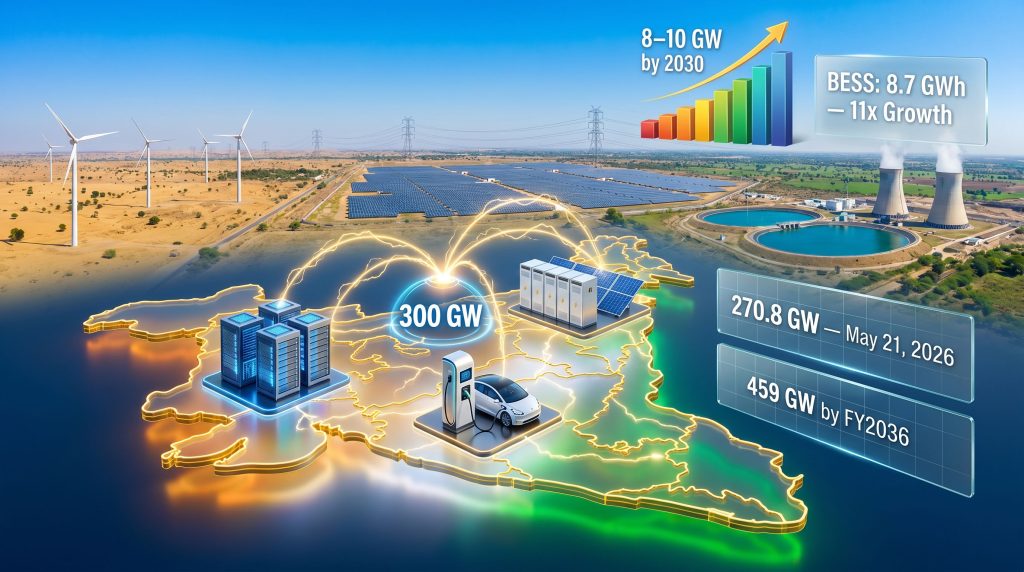
On May 21, 2026, India recorded a peak power demand of 270.8 GW, a figure driven partly by intense heatwave conditions across northern and central states but also reflecting the unmistakable signature of structural, technology-led load growth. Heatwaves are cyclical events that amplify peak readings temporarily. What distinguishes India's current demand trajectory is that even after seasonal effects are stripped out, the underlying baseline continues to climb at an accelerating pace.
India's Union Power Minister Manohar Lal, speaking at the India Energy Storage Week in July 2026, confirmed that peak demand projections point toward 300 GW within the following year, with data centres, artificial intelligence infrastructure, and electric vehicle adoption identified as the primary incremental load drivers. These are not cyclical pressures. They are structural forces that compound year upon year, making the 300 GW threshold not a ceiling but a waypoint.
The longer-term arc is even more significant. Government estimates project India's peak power demand could reach 459 GW by FY2036, which would require total installed generation capacity of approximately 1,121 GW, more than double current levels. To put this in perspective, doubling an electricity system of India's current scale within a decade represents one of the most ambitious infrastructure mobilisation challenges in modern energy history.
India's power demand is no longer driven primarily by population growth or industrial expansion alone. Technology adoption curves are now compressing decades of demand growth into a few years, creating a fundamentally different planning environment for grid operators and policymakers alike.
The Three Technology Megatrends Driving India's 300 GW Demand Milestone
Data Centres: From Niche Infrastructure to Grid-Scale Power Consumers
India's data centre sector has moved decisively from a supporting role in the economy to a primary driver of electricity demand growth. Currently accounting for approximately 0.8% of India's total electricity consumption, the sector's footprint is set to expand dramatically as hyperscaler investment, domestic cloud migration, and digital public infrastructure rollout converge simultaneously.
By 2030, data centres are projected to represent between 2.5% and 3% of India's total national electricity demand, with installed capacity growing nearly six-fold to between 8 and 10 GW. The annual electricity requirement of the sector is expected to reach 40 to 45 TWh per year by 2030, a consumption figure comparable to the total annual electricity usage of a mid-sized nation.
| Metric | Current (2026 Est.) | Projected (2030) |
|---|---|---|
| Data Centre Share of India's Power Demand | ~0.8% | 2.5% to 3% |
| Installed Data Centre Capacity | ~1.5 to 2 GW | 8 to 10 GW |
| Annual Electricity Consumption | ~10 to 12 TWh | 40 to 45 TWh |
What makes this trajectory particularly challenging for grid planners is the compounding effect. Each individual hyperscaler campus that comes online adds a concentrated, continuous load to the grid rather than the distributed residential load that planners have historically managed with flexible supply tools. Data centres operate at high utilisation rates around the clock, creating flat, persistent demand profiles that interact poorly with the variable output of India's expanding solar and wind capacity.
Artificial Intelligence Workloads: The Hidden Power Multiplier
Within the data centre sector, artificial intelligence represents a demand multiplier rather than a simple additive load. AI inference and model training workloads are significantly more energy-intensive per unit of compute than conventional cloud or enterprise computing tasks. A GPU cluster running large language model training can consume several times the power of an equivalent footprint of standard server infrastructure.
India's ambition to develop sovereign AI capabilities, including domestic GPU clusters and large language model training facilities, amplifies this dynamic considerably. AI-optimised data centres typically deploy power densities measured in tens of kilowatts per server rack, compared to conventional data centres operating at five to ten kilowatts per rack. As India's AI infrastructure buildout accelerates, the average power intensity of the national data centre fleet will increase even if the physical footprint grows at a moderate pace.
Furthermore, this is a dimension of India's demand trajectory that is frequently underestimated in aggregate forecasting models, which tend to project data centre power demand based on capacity additions rather than workload intensity shifts. According to IEA research on energy demand from AI, the practical implication is that the 40 to 45 TWh demand estimate for 2030 could prove conservative if AI adoption within Indian enterprises accelerates faster than current forecasts assume.
Electric Vehicles: Distributed Load With Grid Management Complexity
Electric vehicle adoption introduces a qualitatively different type of demand challenge compared to the concentrated, predictable loads of data centres. EV charging is geographically dispersed, time-sensitive, and strongly correlated with human behavioural patterns. When millions of vehicles return home in the early evening and connect to chargers simultaneously, the resulting demand spike can coincide precisely with the period when solar generation has ceased and grid operators are already managing their most constrained supply window.
EV adoption is expected to contribute meaningfully to the projected 30 GW of incremental demand over the next five to six years, alongside data centres and AI infrastructure. Managing this load will require a combination of smart charging infrastructure, time-of-use tariff structures that incentivise off-peak charging behaviour, and ultimately vehicle-to-grid technology that allows EV batteries to discharge back into the grid during peak stress periods.
The vehicle-to-grid concept remains nascent in India but carries significant long-term potential. A national EV fleet of tens of millions of vehicles represents a distributed storage asset of considerable scale, one that could partially offset the need for centralised grid-scale storage if the enabling infrastructure and regulatory frameworks develop appropriately.
What 300 GW Peak Demand Means for India's Grid Infrastructure
The Energy Storage Imperative: Numbers That Define a National Challenge
As India's renewable energy capacity scales toward its 500 GW target, the mismatch between generation profiles and demand patterns becomes increasingly acute. Solar generation peaks in the middle of the day when industrial and commercial demand is elevated but not at its highest. Peak demand typically occurs in the late afternoon and early evening, precisely when solar output is declining. Bridging this structural mismatch at scale requires energy storage, and India's storage requirements are substantial.
The Central Electricity Authority has set a target of approximately 160 GW of total storage capacity by 2035, encompassing both battery and pumped hydro systems. A joint report released by the India Energy Storage Alliance and Customized Energy Solutions at India Energy Storage Week quantified the longer-term capacity requirement at 888 GWh of energy storage system capacity by FY2035-36. The near-term requirement to maintain grid stability as peak demand approaches 300 GW is estimated at approximately 230 GWh by 2030.
| Milestone Year | Required Storage Capacity | Technology Mix |
|---|---|---|
| 2030 | ~230 GWh | Battery + Pumped Hydro |
| 2035 to 36 | 888 GWh | Battery + Pumped Hydro |
| 2035 (installed capacity target) | ~160 GW | Battery + Pumped Hydro |
These figures establish energy storage not as an optional grid enhancement but as a structural prerequisite for managing the India peak power demand 300 GW driven by data centres AI and EVs scenario that is now unfolding.
Battery Energy Storage: India's Fastest-Growing Grid Asset
India's battery energy storage system sector has demonstrated remarkable deployment momentum. In the first half of 2026 alone, installed BESS capacity grew eleven-fold, reaching 8.7 GWh, with the country on track to surpass 10 GWh of total installed capacity by the end of the calendar year. This rate of expansion positions India among the fastest-deploying BESS markets among major emerging economies globally.
Several factors are driving this acceleration:
- Production-linked incentive schemes encouraging domestic battery cell manufacturing
- Grid-scale procurement tenders creating predictable demand signals for storage developers
- Regulatory frameworks enabling storage-as-a-service business models
- Declining lithium-ion battery costs improving project economics across bid rounds
Despite this momentum, India's current installed BESS capacity of under 10 GWh represents a small fraction of the 230 GWh required by 2030 and an even smaller fraction of the 888 GWh needed by FY2035-36. The gap between current deployment rates and the scale required highlights both the urgency of continued policy support and the enormous investment opportunity embedded in India's storage transition. Those tracking the broader battery metals investment landscape will recognise the strategic importance of India's accelerating BESS buildout.
Pumped Hydro Storage: The Long-Duration Complement
Battery storage systems excel at providing grid services over periods of one to four hours, making them ideal for managing the daily solar generation trough that occurs each evening. However, multi-hour and seasonal storage requirements that extend beyond four hours are served more cost-effectively by pumped hydro energy storage, where topography permits.
India has a substantial pumped hydro pipeline under development, but new projects face lead times measured in years rather than months due to the geological surveys, environmental clearances, and civil construction timescales involved. This long development horizon means that pumped hydro projects that will be operational by 2030 must already be in advanced planning stages today, creating urgency in the project development pipeline that does not yet appear fully reflected in publicly available capacity announcements.
A less commonly understood constraint on India's pumped hydro ambitions relates to geography. The most favourable sites for closed-loop pumped hydro, which avoid the environmental and hydrological complexities of river-based systems, are concentrated in specific geological terrains, primarily the Deccan plateau margins and Himalayan foothills. Distance from these sites to major demand centres in Maharashtra, Delhi, and Karnataka introduces significant transmission infrastructure requirements that add materially to project costs and timelines.
The Infrastructure Bottlenecks Nobody Is Talking About
Transmission: The Invisible Constraint on India's Energy Transition
Generation capacity announcements tend to dominate the headlines, but India's most binding near-term constraint on peak demand management may be its inter-state transmission system. India's solar resources are concentrated in Rajasthan and Gujarat, its wind resources in Tamil Nadu, Gujarat, and the coastlines of Andhra Pradesh, while its largest demand centres are in Maharashtra, Uttar Pradesh, Delhi, and Karnataka. Moving electrons from generation-rich states to demand-rich states at 300 GW scale requires a transmission network of considerably greater capacity and flexibility than currently exists.
Inter-state transmission system expansion is a critical enabler of India's 300 GW peak readiness, but transmission projects face their own lengthy approval and construction cycles. Transmission bottlenecks can strand renewable generation assets, forcing grid operators to curtail clean power while simultaneously running fossil fuel plants in demand centres, a paradox that undermines both the economics and the environmental logic of the energy transition.
Supply Chain Vulnerabilities in Battery Manufacturing
India's BESS deployment ambitions intersect with a concentrated global supply chain that presents strategic risk. Lithium-ion cell manufacturing remains heavily concentrated in China, which controls the majority of global refining capacity for the four critical minerals at the heart of battery chemistry: lithium, cobalt, nickel, and manganese. The broader relationship between critical minerals and energy security is therefore central to India's ability to execute its storage buildout at the pace required.
India is actively developing its domestic battery manufacturing ecosystem through a combination of production-linked incentives and strategic mineral sourcing initiatives, including bilateral agreements with resource-rich nations in South America and Africa. However, meaningful domestic cell manufacturing self-sufficiency is unlikely before the late 2020s at the earliest, meaning India's near-term BESS deployment will remain substantially dependent on imported cells, introducing both cost and supply security considerations into the storage buildout timeline. In addition, India's lithium investment push reflects the government's recognition that securing upstream mineral supply is as important as downstream manufacturing capacity.
Innovations in direct lithium extraction technology could, furthermore, accelerate India's access to economically viable lithium resources, potentially reducing its dependence on conventional hard-rock mining supply chains over the medium term.
Scenarios for India's Power Demand Trajectory to 2030
Long-range demand forecasting carries inherent uncertainty, particularly when the primary demand drivers are technology adoption curves that are themselves subject to policy, capital availability, and geopolitical variables. Three scenarios bracket the plausible range of outcomes:
-
Base Case: Peak demand reaches 300 GW by 2027, driven by moderate AI infrastructure buildout, steady EV adoption, and continued industrial growth. Storage procurement accelerates but faces execution constraints.
-
Accelerated Case: Rapid hyperscaler investment and aggressive EV policy push demand toward 320 to 330 GW by 2027, stressing grid infrastructure and significantly accelerating storage and transmission procurement timelines.
-
Moderated Case: Demand management programmes, energy efficiency mandates, and slower-than-expected AI infrastructure deployment moderate growth to 285 to 290 GW by 2027, providing additional runway for storage and transmission planning.
It is worth noting that the Central Electricity Authority's FY2026-27 peak forecast of 270 GW was validated by the actual May 2026 recorded peak of 270.8 GW, lending meaningful credibility to the near-term projections underpinning the base case scenario.
The next major ASX story will hit our subscribers first
Frequently Asked Questions: India Peak Power Demand 300 GW
What is India's current peak power demand?
India recorded a peak demand of 270.8 GW on May 21, 2026, a figure shaped by extreme heat conditions combined with rising industrial, commercial, and data infrastructure loads. This reading confirmed the structural upward trajectory in India's electricity consumption and validated near-term forecasting models.
When will India's peak power demand reach 300 GW?
Government projections indicate that peak demand is expected to reach 300 GW within the next one to two years, with data centres, AI infrastructure, and EV adoption collectively contributing approximately 30 GW of incremental load over the next five to six years.
What is India's long-term peak power demand forecast?
Government estimates project peak demand reaching 459 GW by FY2036, requiring installed generation capacity of approximately 1,121 GW, representing more than double current installed levels.
How much energy storage does India need to support 300 GW peak demand?
Approximately 230 GWh of energy storage capacity is required by 2030 to maintain grid stability at near-300 GW peak demand levels. The longer-term requirement rises to 888 GWh by FY2035-36, with a total installed storage capacity target of 160 GW by 2035.
How fast is India's battery energy storage sector growing?
India's installed BESS capacity grew eleven-fold in the first half of 2026, reaching 8.7 GWh, with the country on track to exceed 10 GWh by the end of 2026.
How much electricity will Indian data centres consume by 2030?
Indian data centres are projected to consume 40 to 45 TWh of electricity annually by 2030, with installed capacity growing nearly six-fold to 8 to 10 GW, representing between 2.5% and 3% of India's total electricity demand.
The Global Significance of India's 300 GW Milestone
India's journey toward India peak power demand 300 GW driven by data centres AI and EVs and beyond carries implications that extend well beyond its own borders. As the world's most populous nation and one of its fastest-digitalising economies, India is navigating a demand inflection point that other emerging economies will face within the next decade. The degree to which India can successfully integrate very high renewable penetration with rapidly growing technology-driven loads, while building out storage, transmission, and demand management infrastructure at scale, will serve as a reference point for energy planners across Asia, Africa, and Latin America.
The 300 GW peak demand milestone is not simply a national energy statistic. It is a leading indicator of how digital transformation, artificial intelligence, and transport electrification will fundamentally reshape electricity systems across the developing world over the next decade.
The investment capital required to achieve this transition is substantial, spanning generation, storage, and transmission assets, and will need to be mobilised through a combination of domestic financing, foreign direct investment, green bonds, and multilateral development bank facilities. The scale of private sector participation required in grid-scale storage procurement alone represents one of the largest infrastructure investment opportunities in the Asian energy sector over the coming decade.
Readers seeking additional context on India's evolving energy landscape and power sector policy developments may find related reporting from ET EnergyWorld at energy.economictimes.indiatimes.com a useful reference for ongoing coverage of India's electricity sector.
Disclaimer: This article contains forward-looking projections and scenario analysis based on publicly available government estimates and industry research. Actual outcomes will depend on policy execution, technology adoption rates, capital availability, and macroeconomic conditions. Nothing in this article constitutes financial advice.
Want to Invest in the Minerals Powering India's Energy Transformation?
India's race to 300 GW and beyond is driving unprecedented demand for lithium, cobalt, nickel, and manganese — and Discovery Alert's proprietary Discovery IQ model delivers real-time notifications the moment significant ASX mineral discoveries are announced, turning complex data across 30+ commodities into clear, actionable investment insights. Explore how historic discoveries have generated substantial returns on Discovery Alert's dedicated discoveries page, then begin your 14-day free trial to position yourself ahead of the market.