June 9, 2026
When Supply Chains Become Fault Lines: Understanding the Fertilizer Price Shock Hitting Indian Agriculture
Global commodity markets have a way of transmitting geopolitical shocks far beyond the immediate theatre of conflict. The mechanism is rarely direct. It works through feedstock dependencies, shipping route vulnerabilities, and the compounding urgency of seasonal demand cycles. Nowhere is this more visible right now than in the market for India phosphate fertilizer prices, where a convergence of upstream input constraints, Middle East conflict risk, and pre-monsoon procurement pressure has driven import costs to levels not seen in the modern pricing era.
Understanding why this is happening, and what it means for Indian agriculture, requires looking past the headline numbers and into the structural plumbing of the fertilizer supply chain itself. Furthermore, commodity market volatility of this magnitude rarely resolves quickly, making it essential to understand the underlying drivers.
When big ASX news breaks, our subscribers know first
The Price Reality: What India Just Paid for DAP
India is the world's largest buyer of diammonium phosphate (DAP), the dominant phosphate fertilizer used across its agricultural regions. The scale of its procurement decisions means that when India buys, markets pay close attention.
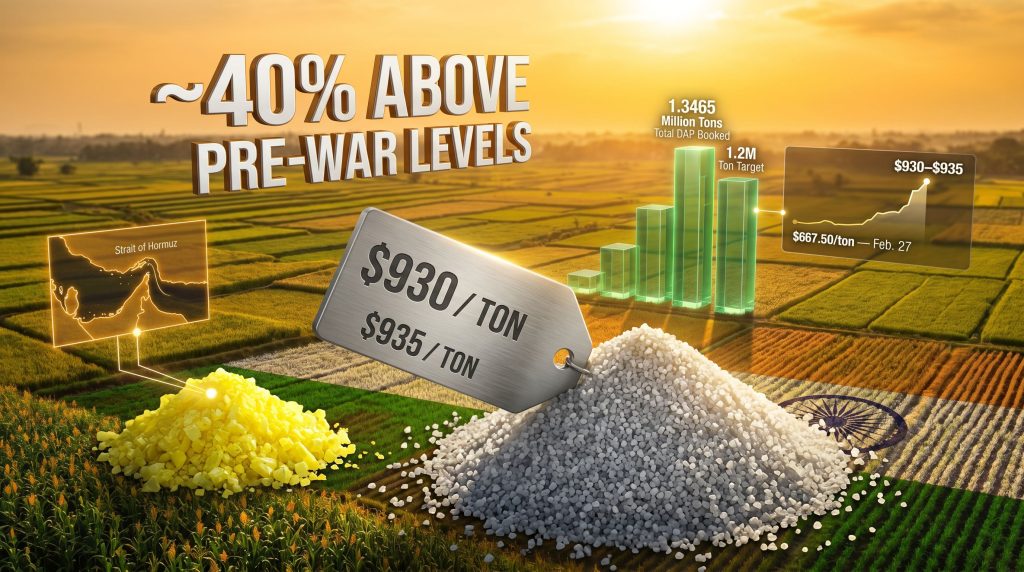
In May 2026, Indian Potash Ltd., the entity responsible for importing fertilizer on behalf of the government and other companies, contracted 1,346,500 tons of DAP across two coastal delivery corridors. The breakdown was as follows:
| Metric | Value | Significance |
|---|---|---|
| West coast DAP volume | 705,000 tons | Primary import gateway for northern crop regions |
| West coast DAP price | $930/ton CFR | Delivered cost including freight |
| East coast DAP volume | 641,500 tons | Serves eastern and southern agricultural zones |
| East coast DAP price | $935/ton CFR | Slight regional premium on delivered cost |
| Total DAP contracted | 1,346,500 tons | Full procurement outcome |
| Initial tender target | 1,200,000 tons | Volume originally sought |
| Volume above target | Oversubscription relative to tender intent | |
| Prior spot quote (Feb 27, 2026) | $667.50/ton | Pre-escalation baseline reference |
| Price increase vs. pre-war levels | ~39% to 40% including freight | Scale of import cost inflation |
Source: Bloomberg News, May 12, 2026, citing Green Markets data and people familiar with the procurement.
The $267.50 per ton gap between the February 27 spot reference and the May tender clearing price is not a minor market fluctuation. It represents a structural repricing of India's phosphate import cost baseline, with real consequences for subsidy budgets and farmer economics.
The 12% oversubscription of the tender is equally telling. When a buyer of India's scale accepts prices well above recent norms and buys more than it originally planned, the market interprets that behaviour as a strong urgency signal — one that reinforces rather than softens seller pricing power.
The Sulfur Factor: A Hidden Chokepoint in Phosphate Economics
A common misconception about phosphate fertilizer pricing is that it moves primarily with phosphate rock availability. In reality, the production economics of DAP are shaped by multiple input costs, and one of the most critical is sulfur.
DAP is manufactured through a chemical process that combines phosphate rock with both ammonia and sulfuric acid. Sulfur is therefore not a peripheral commodity in this context. It sits at the centre of the production chain. Tightening sulfur availability raises manufacturing costs even when phosphate rock supply remains adequate, compressing producer margins and forcing price increases in finished fertilizer products.
This is where the geographic concentration of global sulfur supply becomes strategically significant. According to Bloomberg News reporting, the Middle East accounts for nearly half of global sulfur supply. A large portion of this output originates from oil and gas processing operations in the Persian Gulf region, where sulfur is recovered as a byproduct of hydrocarbon production and desulfurisation processes.
The Middle East's dominance in sulfur supply means that conflict-related disruptions in the region create upstream input risk for fertilizer manufacturers globally, even when the region is not a primary exporter of finished phosphate products.
When geopolitical tension raises uncertainty around the Strait of Hormuz, the effect on fertilizer markets is not limited to direct export disruptions. It triggers a cascading risk-repricing across:
- Sulfur feedstock availability expectations
- Shipping insurance and war-risk premium assessments
- Vessel routing decisions and transit time projections
- Forward cargo pricing by fertilizer traders and producers
This chain reaction can lift DAP benchmarks significantly before physical supply shortages fully materialise. The market prices risk in advance, and buyers absorb that risk premium through higher delivered costs.
How the Conflict Transmitted into India's Import Costs
The mechanism connecting Middle East conflict to India phosphate fertilizer prices follows a logical but non-linear sequence. Understanding this transmission pathway helps analysts distinguish between temporary risk premiums and structural price shifts.
- Geopolitical escalation raises uncertainty around supply corridors, particularly the Strait of Hormuz.
- Sulfur logistics and availability expectations tighten as market participants price in disruption risk.
- Fertilizer producers and traders adjust forward cargo pricing to reflect elevated input and freight costs.
- Importers conducting large-scale tenders face a market where sellers are unwilling to offer below revised benchmarks.
- Tender clearing prices establish new reference levels, reinforcing the price reset for subsequent procurement rounds.
- Higher import costs feed into domestic subsidy calculations and distribution economics.
What makes this sequence particularly impactful for India is the timing. Pre-monsoon procurement for the kharif sowing season compresses the buying window, reducing negotiating flexibility. Importers cannot defer purchases without risking supply shortfalls during the critical planting period for rice, corn, and soybeans. Seasonal urgency structurally weakens buyer leverage.
Consequently, geopolitical shipping disruptions of this kind tend to have an outsized effect on agricultural economies that operate within fixed seasonal procurement windows.
Tender Outcomes as Market Signals: What the Numbers Reveal
Large Indian fertilizer tenders do not just reflect market conditions. They actively shape them. When Indian Potash Ltd. clears a tender at $930 to $935 per ton, that outcome immediately becomes a reference point for:
- Suppliers pricing subsequent cargo offers to other buyers
- Distributors recalculating inventory replacement economics
- Competing import-dependent economies benchmarking their own procurement
- Subsidy administrators estimating the per-ton cost of maintaining below-market retail prices
The oversubscription dynamic adds another layer of interpretation. The fact that total contracted volume reached approximately 1.35 million tons against an initial target of 1.2 million tons suggests that procurement decision-makers assessed supply security as the primary objective, accepting elevated prices rather than risk an undersupplied pre-monsoon period. This behaviour is consistent with the demand characteristics of an agricultural economy where monsoon crop planting follows a fixed seasonal calendar.
Investors and market analysts tracking India phosphate fertilizer prices should note that tender oversubscription at elevated price points historically reinforces seller confidence and tends to support firm benchmark pricing in subsequent procurement rounds.
Phosphate vs. Urea: A Broader Nutrient Cost Shock
Contextualising India phosphate fertilizer prices alongside nitrogen fertilizer costs reveals that the current market stress is not confined to a single nutrient category. India's concurrent procurement of 2.5 million tons of urea at prices described as nearly double pre-war levels indicates a broader agricultural input inflation event.
| Fertilizer | Procurement Volume | Price Movement vs. Pre-War | Supply Chain Pressure |
|---|---|---|---|
| DAP (phosphate) | 1.35 million tons | ~39% to 40% higher | Sulfur input constraint, freight risk |
| Urea (nitrogen) | 2.5 million tons | ~100% higher | Nitrogen feedstock and supply chain stress |
Source: Bloomberg News, May 12, 2026
While the relative price escalation for urea is more severe on a percentage basis, the cumulative effect on farm economics is additive. Indian agriculture requires both phosphate and nitrogen applications across major crop cycles. A farmer or distributor absorbing simultaneous cost increases across both nutrient categories faces a materially different budget environment than one facing stress in only a single input category.
This cross-nutrient inflation context also matters for public finance. India's government subsidises DAP sales to farmers at below-market rates. When import costs rise by 39% to 40%, the gap between subsidised retail prices and actual landed costs widens, creating fiscal pressure on subsidy budgets. The broader the nutrient cost shock, the greater the aggregate subsidy burden.
In addition, the India import tax structure adds another layer of complexity to how landed costs ultimately translate into domestic market pricing and subsidy calculations.
How Does the Subsidy Gap Affect Farmers?
This widening fiscal gap is not merely an accounting concern. When government subsidy mechanisms struggle to keep pace with rapidly rising import costs, the risk of delayed disbursements or distribution bottlenecks increases. Farmers in remote agricultural regions are often the last to receive adequate supply — and the first to face the consequences of any shortfall.
Furthermore, US fertilizer import reliance offers a useful parallel, as it similarly illustrates how import-dependent agricultural economies face compounding pressure when global supply chains tighten simultaneously.
The next major ASX story will hit our subscribers first
Farm-Level Implications for the Kharif Season
The practical consequences of elevated India phosphate fertilizer prices play out most directly at the farm level during the kharif (monsoon) agricultural season. Three scenarios capture the plausible range of outcomes:
Base case: Supply arrives on schedule, subsidy mechanisms cushion the gap between import costs and retail prices, and application rates hold relatively steady across major monsoon crops.
Stress case: Elevated landed prices strain subsidy budgets, causing distribution delays or reduced availability at the farm level, potentially resulting in lower or deferred phosphate application.
Easing case: Freight markets and sulfur supply stabilise faster than expected, improving the economics of replacement cargoes and creating room for price relief in later procurement rounds.
Which scenario materialises will depend heavily on:
- The trajectory of the Iran conflict and associated shipping route disruption
- The speed and magnitude of subsidy budget adjustments by the fertilizer ministry
- Dealer inventory positions across different states heading into the sowing window
- Regional distribution efficiency, which varies considerably across India's agricultural geography
Five Variables That Determine Where Prices Go Next
For analysts, agribusiness participants, and policymakers monitoring the trajectory of India phosphate fertilizer prices, five indicators capture the most decision-relevant information:
| Variable | Short-Term Price Effect | What to Monitor |
|---|---|---|
| Conflict escalation or de-escalation | Higher or lower delivered costs | Strait of Hormuz vessel traffic and war-risk premiums |
| Sulfur supply conditions | Raises or lowers production economics | Sulfur benchmark pricing trends |
| Tender demand intensity | Supports or softens offer levels | Oversubscription rates and procurement urgency signals |
| Subsidy policy and reimbursement speed | Affects distribution economics | Ministry budget announcements |
| Seasonal demand calendar | Reduces or increases buyer flexibility | Kharif procurement and sowing timelines |
Scenario modelling for the next three to six months suggests three primary pathways:
- De-escalation scenario: Freight premiums cool, sulfur flows stabilise, and DAP delivered prices moderate from current highs, though likely remaining above the pre-war $667.50 baseline.
- Prolonged disruption scenario: Supply-chain caution persists across shipping lanes and sulfur markets, keeping import offers elevated and compounding subsidy pressure.
- Compounding stress scenario: Energy, freight, and sulfur markets remain simultaneously tight, sustaining fertilizer import cost volatility across both phosphate and nitrogen products through the kharif season and into rabi planning.
Reading the Numbers Correctly: A Methodology Note
Interpreting India phosphate fertilizer prices requires precision about what different price points actually represent. The $930 to $935 per ton range reported from India's latest DAP procurement reflects CFR delivered import costs, incorporating freight. These figures do not represent:
- The domestic maximum retail price (MRP) paid by farmers
- The subsidy-adjusted effective cost at the farm gate
- A universal national average price applicable to all distribution channels
- A spot market indication available to smaller buyers
Methodology note: In fertilizer market analysis, separating international import costs, tender clearing prices, subsidy-adjusted economics, and end-user prices is essential. Blending these categories can produce misleading conclusions about affordability and market stress.
The February 27, 2026 spot reference of $667.50 per ton provides a useful baseline for measuring escalation, but analysts should confirm whether that figure and the May tender prices share identical delivery basis, product specification, and freight assumptions before calculating percentage changes. Global commodity market impacts from tariff and trade policy shifts can further complicate price comparisons across different procurement periods.
FAQ: India Phosphate Fertilizer Prices in 2026
Why Are India Phosphate Fertilizer Prices Rising Sharply in 2026?
Import costs for DAP have increased due to supply-chain disruption linked to Middle East conflict, tighter sulfur input availability, elevated freight and insurance risk, and seasonal procurement urgency ahead of monsoon sowing.
What Are the Current DAP Import Prices for India?
Recent contracted deliveries cleared at approximately $930 per ton for west coast delivery and $935 per ton for east coast delivery, both on a CFR delivered basis.
How Much Higher Are Prices Than Before the Conflict Began?
Delivered prices are approximately 39% to 40% above pre-war levels, based on Green Markets data comparing current tender outcomes with the $667.50 per ton reference quoted on February 27, 2026.
Why Does Sulfur Matter for Phosphate Fertilizer Pricing?
Sulfur is a core manufacturing input for DAP production. Because the Middle East supplies nearly half of global sulfur output, regional geopolitical disruptions can tighten fertilizer manufacturing economics even without direct phosphate export restrictions.
Will High Prices Affect Indian Farmers This Kharif Season?
The ultimate impact depends on how quickly subsidy support is adjusted to reflect elevated import costs, how efficiently supply reaches distribution networks, and whether procurement volumes secured in recent tenders prove sufficient to meet seasonal demand.
What to Watch in the Coming Months
The current episode of elevated India phosphate fertilizer prices is best understood as a convergence event rather than a single-cause disruption. Geopolitical risk in a critical supply corridor, feedstock concentration risk in the sulfur market, seasonal procurement urgency, and a broader nutrient-cost inflation environment across both phosphate and nitrogen categories are all acting simultaneously.
Near-term monitoring priorities include:
- New DAP tender results and whether clearing prices hold near current levels
- Any narrowing or widening of the east-west coast delivered price spread
- Sulfur benchmark direction as a leading indicator of production economics
- Freight and war-risk insurance conditions through Hormuz-adjacent shipping routes
- Fertilizer ministry communications on subsidy allocation for the kharif period
The headline price move of 39% to 40% above pre-war levels matters not only to fertilizer traders or importers. It matters for food production costs in one of the world's most populous agricultural economies, for public finance through its effect on subsidy obligations, and for the monsoon crop cycle that underpins rural income across hundreds of millions of farm households.
Further Exploration: Readers seeking broader market context can access reporting from India's Ministry of Chemicals and Fertilizers, international commodity news services covering agricultural inputs, and agricultural policy research institutions for additional perspective on subsidy frameworks and procurement systems.
Disclaimer: This article is intended for informational purposes only and does not constitute financial, investment, or agricultural policy advice. Price data, procurement figures, and scenario projections are sourced from Bloomberg News (May 12, 2026) and Green Markets. Forward-looking scenarios involve inherent uncertainty and should not be relied upon as forecasts. Readers should verify all figures against primary sources before making procurement, investment, or policy decisions.
Want to Identify the Next Major Mineral Discovery Before the Broader Market Does?
While fertiliser price shocks reshape agricultural economics globally, commodity supply chain disruptions simultaneously create significant opportunities in the mining and exploration sector — and Discovery Alert's proprietary Discovery IQ model delivers real-time ASX mineral discovery alerts, turning complex commodity data into actionable investment insights. Explore historic discoveries and their returns or start your 14-day free trial today to position yourself ahead of the market.