May 13, 2026
India's Gulf Energy Lifeline: What the Modi-MBZ Summit Reveals About a Shifting Global Order
Few diplomatic encounters in 2026 carry as much structural weight as the bilateral meeting between Prime Minister Narendra Modi and UAE President Sheikh Mohamed bin Zayed. On the surface, it reads as a routine high-level engagement between two longstanding partners. Look closer, and a more complex picture emerges: a world's third-largest oil importer navigating simultaneous OPEC restructuring, regional military instability, and an accelerating clean energy transition — all whilst maintaining productive relationships with rival Gulf powers.
The Modi UAE energy talks are not simply about securing barrels. They represent a live stress test of India's entire energy security doctrine, touching on everything from household LPG affordability to upstream equity stakes worth over a billion dollars.
When big ASX news breaks, our subscribers know first
Why the UAE Holds a Structurally Irreplaceable Position in India's Energy Matrix
Understanding the urgency behind Modi's May 16, 2026 visit requires understanding just how deeply the two economies are intertwined at an energy infrastructure level. India does not import UAE crude and LNG as a matter of preference — it does so because decades of supply chain architecture, refinery configurations, and long-term contractual commitments have made the UAE an integrated component of India's domestic energy system.
India imports the majority of its energy requirements from Gulf nations, with the UAE functioning as a key node across multiple commodity categories simultaneously. This multi-commodity dependency is what distinguishes the UAE relationship from other bilateral energy partnerships:
| Energy Commodity | UAE's Estimated Role in India's Supply | Strategic Significance |
|---|---|---|
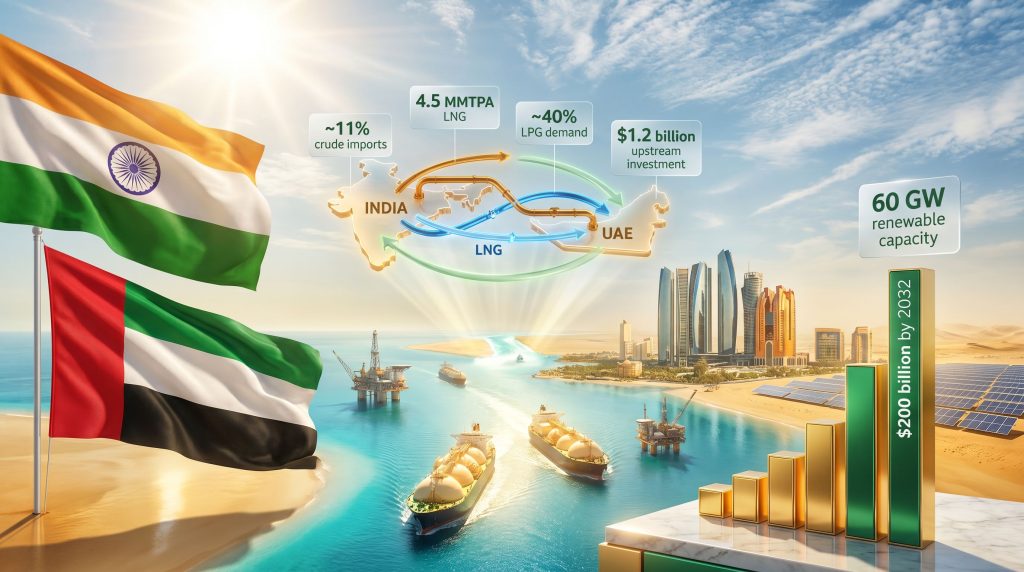
| Crude Oil | Approximately 11% of total imports (4th largest source) | Refinery feedstock compatibility |
| LNG | Among top three suppliers; ~4.5 MMTPA via ADNOC Gas | Long-term contract price insulation |
| LPG | Largest single source; ~40% of total national demand | Direct household energy affordability |
Note: The above figures represent industry estimates based on publicly available trade data. Readers should verify current volumes against official Indian Ministry of Petroleum & Natural Gas statistics, as bilateral energy flows fluctuate quarterly.
The LPG dependency figure deserves particular attention. Unlike crude oil — which enters complex refinery and distribution chains before reaching end consumers — LPG reaches Indian households relatively directly. When UAE LPG supply faces disruption or pricing pressure, the downstream effect on India's domestic energy affordability is near-immediate.
For a government managing the cost-of-living expectations of 1.4 billion people, that is not an abstract risk — it is a politically live vulnerability. Furthermore, questions around global LNG supply add another layer of complexity to India's procurement strategy.
India's Upstream Footprint Inside UAE Energy Assets
The bilateral energy relationship extends beyond the buyer-seller dynamic. Indian state-owned energy firms hold equity stakes in UAE upstream production blocks, including the Lower Zakum offshore block and Abu Dhabi Onshore Block-1, acquired in 2018 and 2019 respectively. Total Indian upstream investment in UAE assets is estimated to exceed $1.2 billion, though precise current figures require verification against official disclosures from the relevant Indian upstream entities.
This reciprocal investment architecture matters strategically. When India holds equity in the production assets supplying its own import volumes, the relationship transforms from transactional procurement into integrated supply chain ownership. Disruption to those assets becomes a direct financial loss, not merely a market pricing problem — which fundamentally changes the diplomatic incentive structure on both sides.
The OPEC Exit: Why Abu Dhabi's Production Independence Changes India's Negotiating Environment
Modi's visit occurs just weeks after the UAE formally departed from OPEC, a development that represents a major shift in global oil politics that could eventually allow the Gulf nation to raise production outside quotas. For India — which has consistently and publicly advocated for stable and affordable global oil prices — this structural change carries significant implications.
OPEC's market influence has long constrained UAE output regardless of Abu Dhabi's actual capacity or willingness to produce more. Those constraints served cartel price management objectives that did not always align with the interests of large price-sensitive importers like India. The UAE's departure from that framework removes a ceiling on bilateral supply agreements that was never of India's making.
The strategic timing of Modi's visit — occurring in the weeks immediately following the UAE's OPEC exit — is unlikely to be coincidental. Diplomatic calendars at this level are constructed with precision, and the window between an OPEC departure and the establishment of new bilateral supply frameworks represents exactly the kind of moment New Delhi would want to occupy.
From India's perspective, several potential supply-side benefits emerge from the UAE's new production independence:
- Greater volume flexibility in bilateral long-term supply contracts without OPEC quota interference
- Potential for Abu Dhabi to offer more competitive pricing structures as it competes for market share outside the cartel
- Reduced exposure to OPEC collective production decisions that have historically driven price volatility unfavourable to Indian import budgets
- Enhanced scope for India to negotiate supply volume guarantees that would have been constrained under the previous quota regime
Regional Instability as a Compounding Supply Risk
India's advocacy for affordable oil prices gains additional urgency in the context of ongoing geopolitical tensions across West Asia. The region has experienced persistent instability through conflicts that affect maritime supply corridors critical to Indian energy logistics. India imports the vast majority of its crude through Gulf sea lanes, meaning any sustained disruption to key transit routes — including the Strait of Hormuz — carries immediate consequences.
The broader geopolitical risk landscape across the region creates what analysts characterise as a multi-front disruption environment. Iran-UAE tensions, Yemen-related shipping disruptions, and regional military activity combine to produce a cumulative probability of supply chain disruption that is meaningfully higher than any single-incident analysis would suggest.
Risk Framework: India imports the majority of its crude oil requirements from Gulf nations. Any sustained disruption to key maritime transit routes could trigger immediate supply shocks, price surges, and downstream inflationary pressure across the Indian economy — with LPG households among the first to feel the impact.
Beyond Hydrocarbons: The Clean Energy and Strategic Technology Agenda
The Modi UAE energy talks in May 2026 extend well beyond crude procurement. A parallel agenda spanning renewable energy, green hydrogen, nuclear technology cooperation, and strategic sector investment has been building momentum through a series of bilateral frameworks established over the preceding two years. Consequently, this summit carries particular weight for India's long-term energy transition security.
The 60 GW Renewable Energy Framework: What Does It Signal?
UAE-based clean energy developer MASDAR entered into an agreement with the Indian state of Rajasthan in late 2024, establishing a framework for up to 60 gigawatts of renewable energy capacity. To contextualise the scale: 60 GW represents a substantial share of India's entire current renewable installed base, making this a generational infrastructure commitment rather than an incremental partnership agreement.
Note: The specific terms, timelines, and confirmed investment commitments under this framework require verification against official Rajasthan State Government and MASDAR press releases, as project frameworks of this scale typically evolve significantly between announcement and implementation.
Beyond solar and wind capacity, the bilateral clean energy agenda includes:
- Grid interconnection feasibility studies exploring physical energy transmission links between the two nations
- UAE participation in India's Global Biofuels Alliance, launched in 2023, with potential for expanded cooperation on sustainable aviation fuel and industrial bioenergy
- Green hydrogen as an emerging frontier — the UAE's substantial solar irradiance and India's growing industrial hydrogen demand create a natural production-consumption complementarity
- Small modular reactor (SMR) nuclear technology cooperation as a longer-term strategic possibility
The $200 Billion Trade Vision: Structural Enablers and Gaps
The India-UAE Comprehensive Economic Partnership Agreement (CEPA), signed in 2022, provides the institutional architecture for a bilateral trade relationship targeting $200 billion by 2032. The UAE is already India's third-largest trade partner and one of its most significant sources of foreign direct investment, as reported by Arabian Business amid growing pressure on India's economy from elevated oil prices.
The Indian diaspora in the UAE — estimated at between 4.4 and 4.5 million residents — functions as a parallel economic bridge, sustaining remittance flows, bilateral business networks, and cultural commerce that formal trade statistics only partially capture.
Key sectors expected to drive trade growth toward the $200 billion target include:
- Energy and petrochemicals (the existing foundation)
- Renewable energy technology, equipment, and services
- Financial services and fintech integration
- Logistics and port infrastructure cooperation
- Defence manufacturing and dual-use technology transfer
- AI, semiconductors, and digital infrastructure
India's Multi-Vector Gulf Diplomacy: Balancing the UAE and Iran Simultaneously
Perhaps the most strategically revealing dimension of the May 2026 diplomatic calendar is what is happening in New Delhi whilst Modi is in Abu Dhabi. Iranian Foreign Minister Seyed Abbas Araghchi travelled to India for the BRICS foreign ministers' summit starting May 14 — just as Modi departed for the UAE. This is not scheduling coincidence. It reflects a deliberate diplomatic architecture.
According to Business Standard's coverage of the visit, the summit agenda is focused specifically on energy security and Fujairah cooperation — confirming that the hydrocarbon dimension remains central even as clean energy gains prominence. This parallelism highlights India's sustained effort to maintain productive relationships with competing Gulf powers as regional tensions reshape global energy and trade flows.
The UAE and Iran occupy structurally opposed positions across several dimensions of Gulf geopolitics: territorial disputes, proxy conflict alignments, competing visions for regional order, and divergent positions on nuclear non-proliferation. India has commercial and strategic interests on both sides of this divide:
| Dimension | UAE Relationship | Iran Relationship |
|---|---|---|
| Energy Trade | Crude, LNG, LPG imports; upstream equity stakes | Historically constrained by sanctions; Chabahar port access |
| Strategic Alignment | Defence cooperation; technology partnership | BRICS membership; South Asian connectivity |
| Diplomatic Risk | UAE tensions with Iran affect regional stability | Sanctions exposure limits financial transaction depth |
| Economic Depth | Third-largest trade partner; major FDI source | Significantly constrained by US sanctions architecture |
BRICS as a Parallel Energy Diplomacy Framework
India's BRICS membership adds a layer of complexity — and leverage — to its Gulf energy diplomacy. The BRICS grouping increasingly functions as a platform for exploring alternatives to dollar-denominated energy settlement, with implications for how India manages the financial dimensions of sanctioned-energy relationships.
Iran's inclusion within the BRICS expansion framework creates a scenario where India's energy procurement calculus from Tehran operates within a multilateral diplomatic context that is partially insulated from bilateral US pressure. This does not eliminate sanctions risk, however it does create structural cover for maintaining engagement channels that purely bilateral diplomacy would find more exposed.
India's capacity to simultaneously host Iran's foreign minister and dispatch its Prime Minister to the UAE — without either visit undermining the other — is a demonstration of what New Delhi's foreign policy establishment calls strategic autonomy: the maintenance of functional relationships across geopolitical fault lines in service of defined national economic interests.
The Five-Nation Tour Architecture: Reading India's Integrated Energy Strategy
The UAE stopover anchors a broader five-nation circuit that also includes the Netherlands, Sweden, Norway, and Italy. Each leg of this tour serves a distinct function within India's integrated energy security framework, and the sequencing is analytically instructive.
The UAE visit secures the hydrocarbon foundation — supply continuity, upstream equity, and clean energy investment from the Gulf's most commercially sophisticated energy partner. The European legs then layer in complementary capabilities:
- Norway: North Sea expertise in offshore production technology, LNG infrastructure, and deepwater engineering — capabilities India needs for its own upstream development
- Netherlands: European energy trading hub with Rotterdam as a critical LNG and crude transit point; relevant to India's diversification of supply routing
- Sweden and Italy: Technology, industrial manufacturing, and potential renewable energy supply chain partnerships
Read as a single strategic document, the five-nation tour communicates something specific to global energy markets: India is actively constructing a multi-polar supply and technology network that is resilient to single-region disruption. No single country — not even the UAE — should interpret Indian energy demand as captive.
Scenario Analysis: Measuring the Success of the UAE Summit
| Outcome Category | Minimum Success Indicator | Optimal Outcome |
|---|---|---|
| Hydrocarbon Supply | Reaffirmation of existing LNG contract terms | New long-term crude supply agreements post-OPEC exit |
| Renewable Energy | Progress update on MASDAR-Rajasthan 60 GW framework | Green hydrogen MOU with defined investment timeline |
| Trade Architecture | Bilateral trade roadmap reaffirmation | Sectoral CEPA expansion into new technology categories |
| Strategic Defence | Joint statement on maritime security cooperation | Formal defence manufacturing partnership signed |
| Diplomatic Signalling | Neutral communique language on Gulf tensions | Coordinated bilateral position on regional stability mechanisms |
The next major ASX story will hit our subscribers first
Frequently Asked Questions: Modi UAE Energy Talks 2026
Why is Modi visiting the UAE in May 2026?
Prime Minister Modi's May 16, 2026 UAE visit is focused on reinforcing energy supply continuity, deepening the bilateral strategic partnership, and advancing the $200 billion trade target by 2032 under the CEPA framework. The visit takes on additional significance given the UAE's recent OPEC exit and ongoing West Asian geopolitical tensions that directly affect India's energy import security.
What makes this visit different from previous Modi-MBZ meetings?
This is the second one-on-one meeting between Modi and Sheikh Mohamed bin Zayed within a five-month window, signalling unusual diplomatic intensity. The meeting follows a session in Delhi earlier in 2026 that reportedly generated more than a dozen formal bilateral agreements across defence, energy, and trade — suggesting institutional momentum in the relationship rather than episodic engagement.
How does the UAE's OPEC exit affect India's supply outlook?
The UAE's departure from OPEC removes production quota constraints that previously limited Abu Dhabi's ability to independently scale output or offer volume guarantees beyond cartel-sanctioned levels. For India — which imports approximately 11% of its crude from the UAE and relies on it for a substantial share of LNG and LPG demand — this creates an opening to negotiate more flexible long-term supply frameworks than were previously structurally possible.
Why is India hosting Iran's foreign minister at the same time Modi visits the UAE?
The concurrent BRICS foreign ministers' summit in New Delhi (May 14–15, 2026), which includes Iranian Foreign Minister Seyed Abbas Araghchi, reflects India's multi-vector diplomacy in practice. Engaging competing Gulf powers simultaneously — without formal alignment with either — preserves India's strategic flexibility and demonstrates New Delhi's capacity to operate across geopolitical fault lines in pursuit of defined national interests.
What clean energy outcomes could emerge from the Modi-MBZ summit?
Potential outcomes include progress on the MASDAR-Rajasthan 60 GW renewable energy framework, green hydrogen cooperation agreements, grid interconnection feasibility studies, and expanded UAE participation in India's Global Biofuels Alliance. Longer-term cooperation on small modular reactor technology and semiconductor supply chains has also been identified as a possible agenda item.
Disclaimer: This article contains forward-looking assessments, diplomatic projections, and energy market analysis based on publicly available information and industry reporting as of May 2026. Statistics relating to bilateral energy trade volumes, investment figures, and renewable energy targets should be independently verified against official government and industry sources. Nothing in this article constitutes financial or investment advice.
Want to Track the Commodity Shifts Driving India's Energy Pivot?
As India's multi-billion-dollar energy strategy reshapes demand across crude oil, LNG, and critical minerals, Discovery Alert's proprietary Discovery IQ model delivers real-time ASX alerts the moment significant mineral discoveries are announced — explore historic discoveries and their market returns to see why early positioning matters, then begin your 14-day free trial at Discovery Alert to stay ahead of the opportunities these global energy shifts are creating.