
May 13, 2026
The Hidden Fragility in Every Tonne of Aluminium Ever Made
Long before geopolitical tensions resurface in headlines, industrial supply chains quietly accumulate fragility. The aluminium sector offers a textbook example of this dynamic: a material that forms the backbone of modern packaging, transport, construction, and aerospace depends on a refinery byproduct that most people have never heard of. Calcined petroleum coke sits at the intersection of crude oil processing and primary metal production, functioning as the consumable carbon heart of every electrolytic smelting cell on the planet. When its supply is disrupted, the consequences travel far beyond the facilities that produce it.
The petroleum coke shortage and aluminium smelters crisis now unfolding across global markets in 2026 illustrates precisely how a second-tier raw material can generate first-order economic disruptions when supply chains tighten under simultaneous pressure from geopolitics, structural refining shifts, and demand growth from new industries. Furthermore, these aluminium market pressures compound existing vulnerabilities that were already building well before the current conflict emerged.
When big ASX news breaks, our subscribers know first
What Petroleum Coke Actually Does Inside an Aluminium Smelter
Understanding why the current supply crisis carries such serious consequences requires a brief detour into electrochemistry. Primary aluminium is produced almost exclusively through the Hall-Héroult process, in which alumina dissolved in molten cryolite is reduced to metallic aluminium by passing a powerful electrical current through large electrolytic cells, commonly called pots. Carbon anodes, submerged in the molten bath, are consumed during this electrochemical reaction, oxidising progressively as aluminium metal deposits at the cathode.
Those carbon anodes are manufactured almost entirely from calcined petroleum coke. For every tonne of aluminium produced, a smelter consumes approximately 0.4 to 0.5 tonnes of CPC in anode form. This consumption ratio is not a variable that technology has significantly altered in decades; it is rooted in the fundamental thermochemistry of aluminium electrolysis. Anode carbon participates directly in the reduction reaction, meaning there is no process-level substitute and no way to run the smelter without it.
Green Petroleum Coke vs. Calcined Petroleum Coke: A Critical Supply Chain Distinction
Not all petroleum coke is ready for smelter use. Green petroleum coke (GPC) is the raw residue that emerges from petroleum refining's coking units, typically produced in delayed cokers or fluid cokers. It contains high levels of moisture, volatile matter, and sulphur that disqualify it from direct use in anode production. To become usable, GPC must be calcined, a process involving sustained heating to approximately 1,300 to 1,500 degrees Celsius inside large rotary kilns, which drives off volatiles and transforms the carbon structure into a dense, electrically conductive material.
This calcination step adds a layer of supply chain vulnerability that is rarely appreciated outside the industry. Calcining capacity is geographically concentrated, capital-intensive, and slow to expand. Disruptions to GPC supply do not immediately translate into CPC shortages, but if GPC tightness persists, downstream calcining output inevitably contracts within weeks to months.
The Forces Converging on Petroleum Coke Supply in 2026
Reporting from AL Circle, citing analysis by JPMorgan Chase and Co., confirms that around 20 percent of global petroleum coke supply is currently affected by disruptions linked to the Strait of Hormuz, where ongoing Persian Gulf tensions have interrupted shipping and refinery operations. Because petroleum coke is a direct byproduct of crude oil refining, any refinery located in or dependent on shipping through the Hormuz corridor contributes to the affected supply pool.
The Strait of Hormuz is widely understood as a chokepoint for crude oil exports, but its role as a pathway for refined petroleum products and industrial feedstocks receives far less attention. Petroleum coke, alumina, and other bulk industrial materials transiting this waterway serve facilities spread across Asia, Europe, and beyond. When tanker traffic is disrupted, the consequences ripple through industrial supply chains that are not immediately associated with energy markets in public discourse. These energy supply pressures further tighten the overall cost environment for energy-intensive industries like primary aluminium production.
Structural Vulnerabilities That Predate the Conflict
What makes the current situation particularly acute is that the petroleum coke market was already under structural pressure before the 2026 escalation. Two long-running trends had been quietly tightening the supply outlook for years.
The first is the global refining industry's shift toward lighter crude grades. Petroleum coke yield from crude processing varies substantially depending on crude density and composition. Heavier crude grades, such as Venezuelan Merey or certain Middle Eastern blends, typically yield 4 to 8 percent petroleum coke by crude volume. Lighter, high-API shale crudes from North America yield considerably less, often in the 1 to 3 percent range.
As global refiners have progressively processed a higher proportion of light crudes — driven by both regulatory pressure on heavy fuel oil and the abundance of North American shale production — the volume of GPC generated per unit of crude refined has declined structurally.
The second structural factor involves Venezuelan crude sanctions and their effects on Chinese refiners. Chinese refining facilities, particularly in Guangdong and Shandong provinces, historically processed significant volumes of Venezuelan heavy crude, generating substantial petroleum coke as a byproduct. As sanctions limited Venezuelan crude availability to Chinese buyers, refiners shifted toward alternative feedstocks with lower coke yields, compressing Chinese CPC output growth at precisely the time when demand from both aluminium smelting and battery anode manufacturing was accelerating.
US Gulf Refinery Closures Add Further Supply Pressure
A third pre-existing pressure deserves attention. The US Gulf Coast has historically been one of the world's largest concentrated petroleum coke production zones. Several refinery consolidations and closures over the past decade have reduced the absolute number of coking units in operation, and early 2026 production data suggest US Gulf petroleum coke output is tracking approximately 4 percent below the prior year on a volume basis. Against a backdrop of rising global demand, even modest supply-side erosion carries disproportionate market consequences.
Current Market Metrics: Pricing and Structural Cost Shifts
The following data, derived from JPMorgan Commodities Research analysis as reported by AL Circle, captures the scale of market disruption as of May 2026.
| Metric | Pre-Crisis Level | May 2026 Level | Change |
|---|---|---|---|
| US Gulf Green Petroleum Coke Price | ~USD 120/tonne | USD 145/tonne | ~+21% |
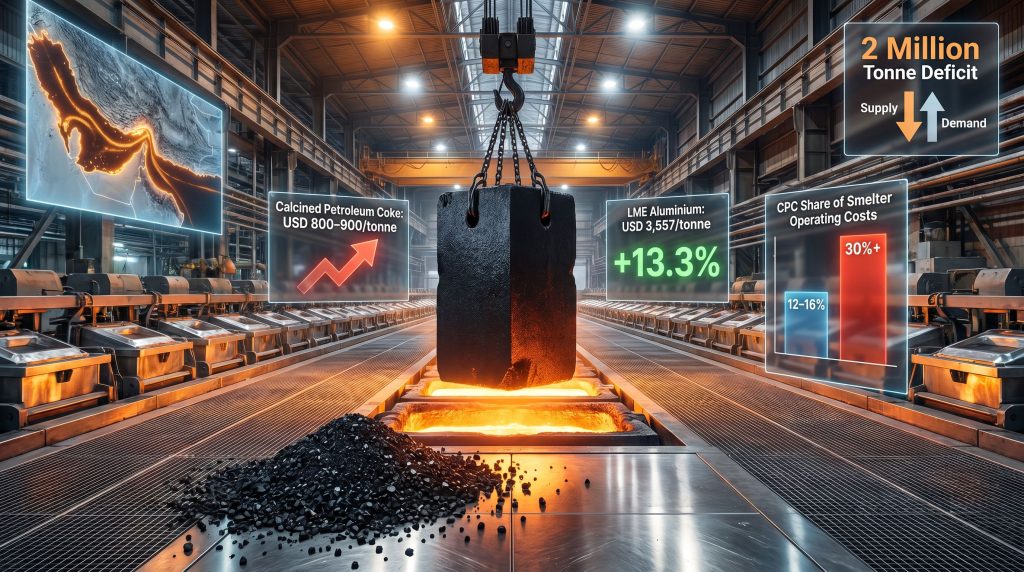
| Calcined Petroleum Coke Price Range | USD 400-500/tonne | USD 800-900/tonne | ~+80 to 100% |
| CPC Share of Smelter Operating Costs | 12-16% | 30%+ | Significant increase |
| Global CPC Supply at Risk (Hormuz) | Baseline | ~20% | Structural disruption |
| LME Aluminium Price | USD 3,140/tonne | USD 3,557/tonne | +13.3% |
One of the more counterintuitive signals in these figures is that the 21 percent increase in US Gulf green petroleum coke prices appears modest relative to the scale of the supply disruption being described. JPMorgan's commodities research team has flagged this apparent gap, suggesting the coke market may be materially underpricing the supply risk embedded in current conditions.
Several mechanisms could explain this lag. Long-term CPC supply contracts between smelters and calciners insulate a significant portion of physical volume from spot market pricing, meaning headline spot prices understate the true scarcity being experienced in unhedged segments of the market. Additionally, if aluminium smelters reduce output in response to coke constraints, demand for CPC itself declines, creating a mechanical self-limiting dynamic on prices. The risk, however, is that once these contractual buffers are exhausted or renegotiated, price adjustments could be sudden and severe rather than gradual.
Which Smelting Regions Face the Greatest Exposure
West Asia accounts for approximately 10 percent of global primary aluminium smelting capacity, representing a substantial concentration of output in a geographically compact region. Facilities across the UAE, Bahrain, and Qatar are directly exposed to the current disruption through both the physical proximity of operations to the conflict zone and the dependence of those facilities on petroleum coke and alumina supplied through Hormuz-adjacent shipping corridors.
The compounding problem for Gulf smelters is that petroleum coke disruption has arrived simultaneously with alumina supply interruptions. Alumina is the other principal raw material input for aluminium smelting, and shipping route disruptions in the Persian Gulf have created parallel constraints on both critical inputs at the same time. A smelter running short of alumina faces operational suspension; a smelter running short of carbon anodes faces the same outcome through a different pathway.
Why the Risk Extends Beyond the Conflict Zone
JPMorgan's analysis, as cited by AL Circle, specifically raises the scenario that aluminium producers operating entirely outside the Gulf region could face their own operational constraints if petroleum coke shortages intensify. This second-order risk arises because global CPC supply is interconnected: tightness in one major supply region raises prices and reduces availability across all markets.
A smelter in Europe or Southeast Asia sourcing CPC from global spot markets will eventually encounter the same tightness that is already pressuring Gulf facilities, even if the first-order physical disruption is geographically remote. Indeed, Argus Media has reported that the structural coke shortage is expected to keep smelter costs elevated well beyond the immediate conflict period.
The Smelter Restart Problem: Why Recovery Is Structurally Slow
Even if petroleum coke supply normalises relatively quickly once geopolitical conditions stabilise, the aluminium market faces a structural recovery lag that JPMorgan estimates at 12 to 18 months per smelter. This asymmetry between how fast raw material production can resume versus how slowly aluminium smelting capacity can return to operation is one of the least appreciated dynamics in commodity supply analysis.
Restarting a primary aluminium smelter is not comparable to restarting a refinery or a manufacturing facility. The challenges are numerous and sequential:
- Electrolytic cells (pots) must be relined with new cathode materials, a process that requires specialised refractory installation and extended curing periods.
- Carbon anode inventories must be rebuilt from scratch, requiring functioning CPC supply chains and sufficient calcining output.
- High-voltage power supply infrastructure must be recommissioned and validated, often requiring extensive electrical testing and regulatory sign-off.
- Workforce re-establishment is complex given the highly specialised nature of smelter operations; experienced potroom operators and process engineers cannot be rapidly redeployed from other industries.
- Long-term raw material agreements, including alumina and petroleum coke supply contracts, must be re-established before lenders and equity holders will approve restart expenditure.
Consequently, even in an optimistic scenario where the Strait of Hormuz reopens and petroleum coke production resumes promptly, the aluminium market could remain structurally undersupplied for an extended period after the raw material constraint is resolved.
The next major ASX story will hit our subscribers first
A 2 Million Tonne Deficit: What the Numbers Mean for End Users
JPMorgan Commodities Research projects a global aluminium supply deficit of approximately 2 million tonnes for 2026. To contextualise that figure, global primary aluminium production runs at roughly 70 million tonnes per year; a 2 million tonne deficit represents approximately 2.8 percent of global annual output. While this may appear modest in percentage terms, commodity markets do not require large absolute deficits to generate significant price dislocations, particularly when inventory buffers are thin and smelter restart timelines stretch well into the following year.
The downstream consequences of this supply gap are distributed unevenly across end-use sectors.
| End-Use Sector | Primary Impact | Secondary Risk |
|---|---|---|
| Beverage Packaging | Can sheet shortages; volume rationing | Consumer price increases |
| Automotive Manufacturing | Higher alloy input costs; supply delays | EV and ICE production slowdowns |
| Construction | Elevated structural aluminium costs | Project timeline extensions |
| Aerospace | Tight sheet and plate availability | Longer procurement lead times |
| Consumer Electronics | Component cost inflation | Device pricing pressure |
LME aluminium prices have already moved from USD 3,140 per tonne to USD 3,557 per tonne, a gain of 13.3 percent. If the 2 million tonne deficit materialises in full and smelter restarts remain slow, market analysts have flagged the possibility of prices approaching USD 4,000 per tonne under a prolonged disruption scenario.
The Battery Anode Wildcard: A Demand Complication Few Are Discussing
A dimension of the petroleum coke market that receives limited coverage in aluminium-focused analysis is the growing competition for CPC from the lithium-ion battery anode sector. The rise of battery raw materials demand has introduced a significant new competitor for the same upstream carbon feedstock that smelters depend upon. Battery-grade petroleum coke, processed into needle coke or graphitised carbon materials, is an increasingly significant demand source as electric vehicle penetration accelerates globally.
This means that even if geopolitical conditions stabilise and Gulf refinery operations recover, the petroleum coke market faces a structural demand growth trajectory from the battery sector that could sustain tightness for three to five years beyond any conflict-driven supply normalisation. The aluminium industry and the battery industry are, in effect, competing for the same upstream carbon feedstock — a competitive dynamic that has rarely been considered in mainstream aluminium supply analysis.
Policy and Industry Responses Taking Shape
India's aluminium producers and policymakers have responded to the emerging supply stress by advocating for duty-free imports of aluminium scrap, aiming to reduce dependency on primary aluminium and thereby ease pressure on smelting operations. This approach reflects a broader industry recognition that secondary aluminium, produced through scrap melting at a fraction of the energy and carbon inputs of primary smelting, can partially bridge supply gaps, though it cannot fully substitute for primary production in high-purity applications.
Secondary aluminium production requires no petroleum coke and dramatically less energy than primary smelting, making it an attractive buffer during primary supply crises. However, scrap availability is itself constrained by collection infrastructure, sorting technology, and the long end-of-life cycles of aluminium products in buildings, vehicles, and infrastructure.
Within the industry, operators have increasingly argued that carbon input costs, particularly CPC, should be indexed to LME aluminium prices to create a natural hedge against input cost volatility. Notably, the aluminium sector restructuring already underway across major producers adds further complexity to how cost indexing arrangements might be negotiated and implemented. While this structural reform would benefit producers' cost management, it has not gained significant traction among market participants given the complexity of implementing pricing linkages across fragmented global coke markets.
Three Scenarios for How This Crisis Could Evolve
Scenario 1: Rapid Conflict Resolution (Optimistic)
The Hormuz corridor reopens within months, and CPC supply progressively normalises through late 2026. Smelter restart timelines still impose a 12 to 18 month lag on output recovery, meaning the aluminium market remains in deficit through at least mid-2027. LME prices stabilise at elevated levels but the risk of further upside diminishes as supply certainty improves.
Scenario 2: Prolonged Disruption (Base Case)
Conflict continues through mid to late 2026, keeping supply chains fractured. CPC spot prices sustain above USD 800 per tonne, and smelter operating cost structures remain under severe stress. The 2 million tonne deficit materialises in full, driving LME aluminium prices toward USD 4,000 per tonne. End-use industries face procurement cost increases and supply chain restructuring requirements.
Scenario 3: Escalation and Structural Realignment (Bearish for Supply)
An extended Hormuz closure triggers permanent rerouting of petroleum coke supply chains, imposing lasting logistical cost premiums. CPC tightness intersects with accelerating battery anode demand, creating a multi-year supply deficit dynamic. Investment in secondary aluminium infrastructure and alternative carbon technologies accelerates, but these solutions operate on five to ten year deployment timelines, leaving the near term materially undersupplied.
Key Indicators to Monitor Through the Rest of 2026
Investors, procurement teams, and industrial strategists tracking this situation should focus on the following signal points:
- Strait of Hormuz tanker traffic volumes and shipping insurance premium movements, which provide real-time indicators of route accessibility
- US Gulf petroleum coke production data released on a monthly basis by refinery operators and the US Energy Information Administration
- LME aluminium warehouse stock levels, which will confirm or challenge the 2 million tonne deficit projection as the year progresses
- CPC spot price movements in key trading hubs including Rotterdam, Singapore, and Houston
- Smelter restart announcements from Gulf-based operators, which will signal whether the 12 to 18 month recovery timeline assumption holds in practice
Among the top aluminium companies globally, those with vertically integrated carbon supply chains or long-term contracted CPC volumes are expected to demonstrate greater resilience than spot-market-dependent operators as the year progresses.
Frequently Asked Questions: Petroleum Coke Shortage and Aluminium Smelters
What is petroleum coke and why is it essential for aluminium production?
Petroleum coke is a carbon-rich solid byproduct generated during crude oil refining. When calcined at high temperatures, it is used to produce the carbon anodes that are consumed during the electrolytic reduction of alumina to aluminium metal. Without a continuous supply of calcined petroleum coke, smelters cannot manufacture anodes and cannot produce primary aluminium.
How much of global petroleum coke supply is affected by the Strait of Hormuz disruption?
According to JPMorgan Commodities Research, as reported by AL Circle in May 2026, approximately 20 percent of global petroleum coke supply is exposed to disruptions connected to the Strait of Hormuz, given the concentration of petroleum refining capacity in and around the Persian Gulf region.
How long does it take to restart an aluminium smelter after a shutdown?
JPMorgan estimates the restart timeline at 12 to 18 months per facility. This extended period reflects the need for electrolytic cell relining, anode inventory rebuilding, power infrastructure recommissioning, workforce re-establishment, and raw material contract re-negotiation, all of which must proceed sequentially.
Will the petroleum coke shortage cause aluminium prices to rise further in 2026?
This section contains forward-looking analysis and should not be interpreted as financial advice. LME aluminium prices have already risen approximately 13.3 percent since the onset of the conflict. If the projected 2 million tonne supply deficit materialises and smelter restarts remain slow, further price increases are possible. The trajectory will depend heavily on conflict duration, smelter restart progress, and the extent to which secondary aluminium production can offset primary supply constraints.
Which countries are most affected by the current aluminium supply disruption?
Gulf Cooperation Council countries including the UAE, Bahrain, and Qatar face the most direct exposure given the proximity of their smelting facilities to the conflict zone. However, aluminium producers across Asia, Europe, and the Americas face indirect exposure through higher CPC prices and tighter global supply, as JPMorgan's analysis specifically flags the potential for operational challenges beyond the Gulf region.
Can recycled aluminium replace primary aluminium during a supply shortage?
Secondary aluminium, produced by melting scrap, requires no petroleum coke and uses significantly less energy than primary smelting. It can partially offset primary supply shortfalls in many applications, but it cannot fully substitute for primary aluminium in high-purity metallurgical uses such as aerospace alloys or certain beverage-grade sheet specifications. Scrap availability is also constrained by collection and sorting infrastructure capacity.
Disclaimer: This article contains forward-looking statements, market forecasts, and scenario projections based on publicly available reporting and established industry analysis. These should not be construed as financial or investment advice. Commodity markets involve substantial uncertainty, and outcomes may differ materially from projections cited. Readers should conduct independent due diligence before making investment or procurement decisions.
Want to Stay Ahead of ASX Mineral Discoveries Linked to Critical Industrial Commodities?
Discovery Alert's proprietary Discovery IQ model delivers real-time alerts on significant ASX mineral discoveries — including those tied to aluminium, battery materials, and the broader critical minerals supply chain — instantly transforming complex market data into actionable investment insights for both short-term traders and long-term investors. Explore Discovery Alert's dedicated discoveries page to understand how historic mineral discoveries have generated substantial returns, and begin your 14-day free trial today to position yourself ahead of the next major market move.