May 13, 2026
The Hidden Architecture Behind the World's Next Mineral Superpower
Long before any mine is dug or any refinery commissioned, the true determinant of a nation's mineral future is geological luck combined with strategic will. Most resource-rich countries possess one or the other. Very few possess both. Across centuries of economic history, the nations that successfully leveraged underground wealth into industrial sovereignty did so not by exporting raw ore, but by controlling what happened to that ore after extraction. This distinction, between being a resource supplier and being a resource processor, separates commodity dependence from industrial power.
Saudi Arabia is now engineering that transition at a scale and speed that warrants serious attention from investors, policymakers, and anyone tracking the global critical minerals landscape. The Saudi minerals sector driving industrial clusters and downstream growth is no longer a forward-looking aspiration inside a policy document. It is a measurable economic reality, validated by data, underpinned by geology, and accelerating through regulatory reform.
When big ASX news breaks, our subscribers know first
Why the $2.5 Trillion Figure Understates the Real Opportunity
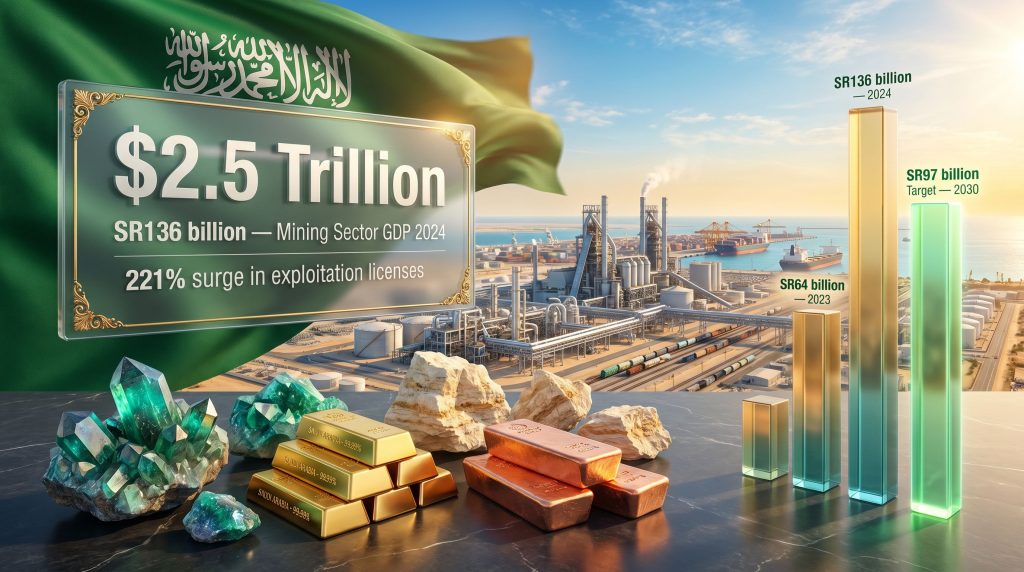
The number most commonly cited in discussions of Saudi Arabia's mineral future is $2.5 trillion in estimated untapped mineral resources. That figure, sourced from geological surveys across the Arabian Shield, represents 45 or more identified minerals spanning precious metals, base metals, rare earth elements, and industrial minerals. However, the headline valuation tells only part of the story.
What makes Saudi Arabia's position structurally unusual is the combination of resource scale, geographic positioning, and institutional timing. The Kingdom sits geographically between the Red Sea and the Arabian Gulf, providing direct maritime access to Asian, African, and European markets simultaneously. No other major mineral-endowed nation occupies this precise intersection of geological richness and logistical centrality.
The economic numbers confirm that transformation is underway rather than merely planned. Mining sector GDP contribution reached SR136 billion ($36.7 billion) in 2024, more than double the SR64 billion recorded in 2023, according to Arab News reporting drawing on expert analysis by Saurabh Priyadarshi, a geologist and mining adviser at Geoxplorers Consulting Services. The Vision 2030 target for the sector was originally set at SR97 billion by 2030, a figure that the 2024 data has already surpassed, indicating that the sector is outpacing its own official projections.
The Saudi mineral sector is not simply catching up to global benchmarks. In several measurable dimensions, it is already ahead of its own timetable.
Yaseen Ghulam, Associate Professor of Economics and Director of Research at Al-Yamamah University in Riyadh, has characterised the $2.5 trillion in undeveloped resources as a strategic instrument for expanding the Kingdom's geopolitical standing and deepening integration into international supply chains. This framing positions minerals not merely as a revenue source but as a tool of economic diplomacy and industrial sovereignty. Furthermore, Saudi Arabia exploration licences are playing a central role in unlocking this geological potential at pace.
The Arabian Shield: Understanding the Geological Foundation
The Arabian Shield is among the most geologically significant Precambrian rock formations on Earth. Spanning the western and northwestern portions of the Arabian Peninsula, it is a basement complex of ancient crystalline rock that has preserved mineral concentrations across billions of years. This geological context matters because it determines both the diversity and the depth of Saudi Arabia's resource base.
The Shield hosts a remarkable range of mineral types:
- Precious metals: Gold with an estimated 40-year production life at current extraction rates, generating over 500,000 ounces annually
- Base metals: Copper with approximately 15 years of identified reserve life; aluminium supported by a production base exceeding 900,000 metric tonnes per year
- Heavy rare earth elements (HREEs): An estimated 552,000 tonnes at Jabal Sayid, including dysprosium and terbium, materials central to permanent magnets used in electric vehicle motors and wind turbine generators
- Industrial minerals: Phosphate deposits at Ras Al-Khair and Hazm Al-Jalamid positioning Saudi Arabia as a major global fertiliser supplier
- Strategic battery minerals: Lithium and nickel deposits under active prioritisation within Vision 2030 planning frameworks
The classification of dysprosium and terbium as heavy rare earth elements is worth understanding in detail. HREEs are significantly rarer than light rare earth elements such as lanthanum or cerium, and they command substantially higher market prices. Dysprosium is irreplaceable in high-performance permanent magnets that must retain magnetism at elevated operating temperatures, precisely the conditions found inside EV motors. Consequently, Saudi Arabia's confirmed HREE deposits represent exposure to one of the highest-value segments of rare earth supply chains.
| Mineral | Strategic Application | Saudi Reserve Position |
|---|---|---|
| Rare Earth Elements (Heavy) | EV motors, wind turbines, defence electronics | ~552,000 tonnes at Jabal Sayid |
| Phosphate | Fertilisers, global food security | Major exporter via Ras Al-Khair |
| Gold | Monetary reserves, industrial use | 500,000+ oz annual output; ~40-year reserve life |
| Aluminium | Aerospace, packaging, EVs | 900,000+ metric tonnes annual production |
| Copper | Energy infrastructure, EV wiring | ~15-year identified reserve life |
| Lithium and Nickel | Battery technology, energy storage | Active prioritisation under Vision 2030 |
The 15-year reserve life for copper deserves particular attention from an investment perspective. It is a relatively short horizon compared to gold's 40-year profile. This could indicate either a rapid extraction pace relative to identified reserves, or that significant unexplored copper potential remains within the Shield. Given that copper is foundational to energy transition infrastructure, this gap represents both a risk and an exploration opportunity.
The Licensing Surge: When Regulatory Reform Produces Measurable Results
One of the clearest indicators that Saudi Arabia's mining transformation is accelerating is the dramatic shift in exploitation licence issuance. In 2024, Saudi Arabia issued 19 mining exploitation licences. In 2025, that number reached 61 permits, representing a 221% year-on-year increase. The Saudi mining licence expansion signals not just regulatory momentum but a fundamental shift in how the Kingdom is opening its subsurface to commercial development.
More telling than the volume is the capital attached to these licences. Total investment committed to projects covered by the 2025 licensing round exceeded SR44 billion, equivalent to approximately $11.7 billion. At an average of roughly SR721 million per licence, these are not exploratory permits issued to speculative ventures. They represent substantive capital commitments to commercial-scale extraction and processing operations.
Foreign companies accounted for approximately two-thirds of all participants in the 2025 licensing round, a proportion that reflects international investor confidence in Saudi Arabia's regulatory environment. The regulatory architecture enabling this acceleration includes:
- The Mining Investment Law, which created the foundational legal certainty that long-term mining investments require
- Streamlined permitting processes designed to reduce administrative time-to-licence for both exploration and exploitation activities
- Local content requirements integrated into licensing frameworks to ensure economic benefits flow into domestic employment and supply chains
| Year | Licences Issued | Mining GDP Contribution | Notes |
|---|---|---|---|
| 2023 | Data not published | SR64 billion | Baseline period |
| 2024 | 19 permits | SR136 billion ($36.7bn) | GDP doubles year-on-year |
| 2025 | 61 permits | Data pending | 221% increase in licences; SR44bn committed |
| 2030 Target | Ongoing | SR97 billion (original) | Already exceeded in 2024 |
Industrial Clusters: The Architecture That Converts Resources Into Industrial Power
The cluster model is perhaps the most strategically sophisticated element of Saudi Arabia's minerals approach. Rather than exporting raw ore for processing elsewhere, the Kingdom is building geographically concentrated industrial zones that integrate extraction, beneficiation, refining, and downstream manufacturing under a single logistical framework. In addition, this model directly supports critical minerals and energy security objectives that are increasingly central to Western industrial policy.
Saurabh Priyadarshi has described the cluster approach at Ras Al-Khair and Wa'ad Al-Shamal as having redefined industrial synergy, attracting SR250 billion in planned investments and generating over 1,300 new industrial licences. Critically, co-locating extraction and processing has produced double-digit reductions in logistics costs compared to geographically fragmented supply chains. This cost reduction is a structural competitive advantage that improves margins across the entire value chain.
Ras Al-Khair: Phosphate, Aluminium, and Base Metals Integration
Ras Al-Khair is the flagship industrial cluster, housing phosphate mining and processing operations via the Ma'aden-SABIC joint venture. A new integrated phosphate complex is scheduled to commence operations in 2026. Aluminium smelting and refining infrastructure at the site supports export-grade production at a scale that positions the Kingdom as a significant global aluminium supplier.
Wa'ad Al-Shamal: Northern Industrial Frontier
Located in the Kingdom's north, Wa'ad Al-Shamal focuses on phosphate extraction and processing for fertiliser export markets. The site's infrastructure is designed to support long-haul mineral logistics connecting to Red Sea port facilities, and it is emerging as a model for how remote-region industrial development can be made commercially viable through integrated cluster planning.
Oxagon and Yanbu: Advanced Materials and Downstream Processing
These sites are where Saudi Arabia's ambitions in higher-value materials are taking shape. Rare earth element refining capacity is under development at Oxagon, alongside titanium sponge production through a partnership with Toho Titanium at a planned annual capacity of 15,600 tonnes. The Ma'aden-Alcoa aluminium joint venture, valued at $10.8 billion, anchors Yanbu as one of the world's most significant integrated aluminium complexes.
The value chain architecture Saudi Arabia is constructing follows a deliberate progression:
Raw Extraction → Beneficiation → Refining → Downstream Manufacturing → Export of High-Value Products
Each stage retained domestically multiplies the economic return per tonne of ore extracted, capturing value that purely extractive economies surrender to foreign processors and manufacturers.
International Partnerships: The Network That De-Risks Ambition
Saudi Arabia's minerals strategy is being built through a network of joint ventures and bilateral partnerships that bring technology, capital, and market access. The partnership portfolio includes:
- Alcoa (USA): The $10.8 billion aluminium smelter and refinery at Ma'aden, one of the world's largest integrated aluminium facilities
- Toho Titanium (Japan): Titanium sponge manufacturing partnership targeting 15,600 tonnes of annual production capacity at Oxagon
- MP Materials (USA): Collaboration targeting rare earth processing and supply chain development
- Barrick Gold: Technical expertise and operational collaboration supporting gold extraction
- Critical Metals Corp (USA): A 50-50 joint venture structured around rare earth element refinery development
- Cove Capital: A multibillion-dollar investment fund targeting African mineral asset acquisition to feed Saudi processing infrastructure
The bilateral minerals agreement formalised between Saudi Arabia and the United States adds a geopolitical dimension to these commercial relationships. It targets a position among the world's top-7 mineral processors by 2030, and it positions the Kingdom as a Western-aligned alternative to supply chains that are heavily concentrated in a single jurisdiction.
This last point carries significant weight. Understanding China's rare earth strategy helps contextualise why Saudi Arabia's emergence matters so much to Western manufacturers. China currently controls an estimated 60 to 85 percent of global rare earth processing capacity, and Western manufacturers in automotive, defence, and clean energy industries have spent years actively seeking geopolitically diversified sourcing options.
A nation that can supply both raw minerals and refined intermediate materials to multiple markets simultaneously holds structural leverage that raw material exporters never achieve. This is the distinction Saudi Arabia is working to claim.
The next major ASX story will hit our subscribers first
Comparing the Blueprint: What Indonesia, Morocco, and Australia Teach
Saudi Arabia is not operating in a strategic vacuum. Three international case studies offer instructive parallels and cautionary lessons, as highlighted by Oxford Business Group's analysis of the Kingdom's industrial ecosystem shift:
| Country | Mineral Focus | Key Lesson for Saudi Arabia |
|---|---|---|
| Indonesia | Nickel and EV battery materials | Downstream processing mandates drove domestic value capture; foreign capital followed domestic policy enforcement |
| Morocco | Phosphates and supply chain logistics | Positioned as a midstream processing hub for European markets by investing in proximity and logistics infrastructure |
| Australia | Critical minerals and innovation ecosystems | Combined extraction with R&D, technology commercialisation, and innovation clusters to sustain long-term competitiveness |
Yaseen Ghulam specifically cited these three economies as instructive models for how Saudi Arabia might balance upstream production strength with downstream processing ambition and innovation ecosystem development. The Australian model is particularly relevant for addressing what both Ghulam and Priyadarshi identified as the Kingdom's most significant remaining structural gap.
The Innovation Gap: Saudi Arabia's Most Significant Remaining Risk
Both experts drew attention to the same structural weakness: innovation ecosystem deficiencies that could constrain long-term competitiveness if not systematically addressed. The Saudi minerals sector driving industrial clusters and downstream growth will ultimately depend on whether this gap can be closed at pace.
The specific gaps identified include:
- A relative scarcity of dedicated mining research laboratories
- Limited platforms for industry-academia collaboration in materials science and extraction technology
- Insufficient density of innovation incubators focused on mining and advanced materials
- A shortage of proprietary process development capability in high-end refining technology
On the technology adoption side, however, the Kingdom has made meaningful progress. Autonomous hauling systems are reducing operational costs and improving safety metrics at active mining sites. AI-driven exploration tools are accelerating resource identification. The Mining Skills Framework, launched in 2026, establishes sector-wide benchmarks for technical competency that integrate digital mining, autonomous systems, and ESG compliance into training curricula.
Ghulam emphasised that global mining technology benchmarks are advancing rapidly, particularly in green mineral production and battery-grade processing, and that the window for closing innovation gaps is narrowing.
Environmental and Operational Challenges That Cannot Be Ignored
The scale of Saudi Arabia's mineral ambitions generates proportionate operational and environmental challenges. Physical constraints include remote locations of many mineral deposits, which require substantial infrastructure investment before extraction becomes economically viable. Water scarcity is an acute challenge in arid mining regions, as processing operations for phosphate, aluminium, and certain rare earth extraction methods are water-intensive.
Environmental pressures include land degradation risks from large-scale open-pit extraction and pollution management requirements for processing operations. International offtake partners in European and North American markets are increasingly imposing green mineral production benchmarks as conditions of purchase agreements. Meeting these standards is not optional for a Kingdom seeking premium market access.
Three Scenarios for Saudi Arabia's Mineral Future
Note: The following scenario analysis involves forward-looking projections based on available data and expert assessments. These scenarios are inherently speculative and should not be treated as investment advice or forecasts of specific outcomes.
Scenario 1: Full Downstream Integration by 2030
If cluster investments, international partnerships, and skills development programmes execute on schedule, Saudi Arabia could achieve top-7 global processor status across multiple mineral categories, fundamentally repositioning the Kingdom's economic identity.
Scenario 2: Strong Midstream Competitiveness With Ongoing Upstream Gaps
A more probable near-term outcome sees the Kingdom establishing robust refining and processing capabilities while continuing to rely on foreign expertise for advanced R&D. This is a competitive but not fully sovereign industrial position that still delivers substantial economic diversification benefits.
Scenario 3: Structural Bottlenecks Limit Scale
If innovation ecosystem gaps, water constraints, and logistics fragmentation in remote mineral provinces are not systematically resolved, downstream processing ambitions could be constrained by upstream and midstream inefficiencies.
What determines which scenario prevails comes down to four variables: the speed of local skills development and technology transfer absorption, the depth and durability of international partnership structures, the effectiveness of ESG integration in securing premium offtake agreements, and the pace of infrastructure investment in remote mineral provinces.
Frequently Asked Questions
What minerals does Saudi Arabia have the most significant reserves of?
Saudi Arabia's most strategically significant mineral resources include phosphate, gold producing over 500,000 ounces annually with a roughly 40-year reserve life, aluminium via established production exceeding 900,000 metric tonnes annually, heavy rare earth elements including dysprosium and terbium at Jabal Sayid, copper, and lithium and nickel deposits being prioritised under Vision 2030.
How much is Saudi Arabia's untapped mineral wealth estimated to be worth?
Estimates place the total value of undeveloped mineral resources at approximately $2.5 trillion, spanning 45 or more identified minerals across the Arabian Shield geological formation.
What is the significance of heavy rare earth elements in Saudi Arabia's mineral strategy?
Heavy REEs such as dysprosium and terbium are among the highest-value segments of the rare earth market because of their essential role in high-performance permanent magnets used in EV motors and wind turbine generators. Saudi Arabia's estimated 552,000 tonnes of heavy REE deposits at Jabal Sayid represent direct exposure to the materials most critical to clean energy hardware manufacturing.
How has Saudi Arabia's mining sector GDP contribution changed recently?
Mining sector GDP contribution reached SR136 billion ($36.7 billion) in 2024, more than doubling from SR64 billion in 2023. This growth has already exceeded the Vision 2030 target of SR97 billion by 2030, suggesting the Saudi minerals sector driving industrial clusters and downstream growth is tracking well ahead of official projections.
Is Saudi Arabia positioning itself to compete with China in mineral processing?
The Kingdom is explicitly developing domestic rare earth refining and processing capacity as an alternative supply node to China-dominated networks, which currently account for an estimated 60 to 85 percent of global rare earth processing. Joint ventures including a 50-50 REE refinery partnership and the formalised U.S.-Saudi minerals agreement both reflect this strategic positioning.
Want to Track the Next Major Mineral Discovery Before the Broader Market Does?
Saudi Arabia's minerals surge is reshaping global critical mineral supply chains, and similar transformational discoveries are emerging across the ASX every day — Discovery Alert's proprietary Discovery IQ model delivers real-time alerts the moment significant mineral discoveries are announced, turning complex geological data into actionable investment insights. Explore how historic ASX mineral discoveries have generated substantial returns by visiting Discovery Alert's dedicated discoveries page, and begin your 14-day free trial today to position yourself ahead of the market.