July 25, 2026
When Diplomacy Becomes a Price Signal: The New Physics of Oil Markets
The relationship between crude oil pricing and physical supply fundamentals has fundamentally shifted over the past decade. What once moved markets were inventory reports, rig counts, and refinery utilisation data. Today, a single presidential statement can reprice the global energy complex within hours. This transformation in market mechanics is nowhere more visible than in the current US-Iran standoff, where diplomatic language itself has become a tradeable variable, with Brent crude responding to press conferences the way it once responded to OPEC output decisions.
Understanding this dynamic is essential context for anyone attempting to make sense of where oil prices go next, and what the trajectory of Trump Iran ceasefire oil prices means for the global economy.
When big ASX news breaks, our subscribers know first
What Does a Ceasefire on Life Support Actually Mean for Energy Markets?
As of mid-May 2026, ICE Brent futures are trading at approximately $107.50 per barrel, posting daily gains of around 3.18%, while WTI crude has climbed to $101.40 per barrel with a daily advance of 3.39%. These moves follow President Trump's characterisation of the current ceasefire framework as being in critical condition, paired with his outright rejection of Iran's most recent peace proposal.
Iran's offer centred on a conditional reopening of the Strait of Hormuz for a defined 30-day period in exchange for a commitment to longer-term diplomatic negotiations. The White House dismissed this framework, eliminating what had briefly appeared to be the most plausible near-term pathway to supply normalisation. Within hours of that rejection becoming public, Brent surged roughly 2.9% in a single session, illustrating with precision how tightly energy markets are now coupled to political rhetoric.
Furthermore, the oil price rally observed in recent months has amplified the sensitivity of crude benchmarks to diplomatic signals, making each presidential statement a potential market-moving event.
Key Market Mechanism: A geopolitical risk premium is the component of the oil price that exceeds what supply and demand fundamentals alone would justify. When the probability of prolonged conflict rises, traders embed a forward-looking buffer into prices. When de-escalation signals emerge, that premium deflates rapidly. The Trump-Iran dynamic has made this premium unusually large and unusually reactive to individual statements.
The risk premium mechanism is not new, but its current volatility is extraordinary. Oil prices are seesawing week to week based on whether ceasefire talks appear to be advancing or collapsing, decoupling price discovery from physical market realities in ways that create both risk and opportunity for market participants.
Key Oil Market Stress Indicators as of May 12, 2026:
| Benchmark | Price Level | Change Since Conflict Began | Primary Driver |
|---|---|---|---|
| Brent Crude | ~$107.50/barrel | +40-50% | Hormuz blockade and ceasefire uncertainty |
| WTI Crude | ~$101.40/barrel | +35-45% | Supply disruption and US export ban fears |
| US Gasoline | $3.69/gallon (current) | Significant increase | Downstream supply squeeze |
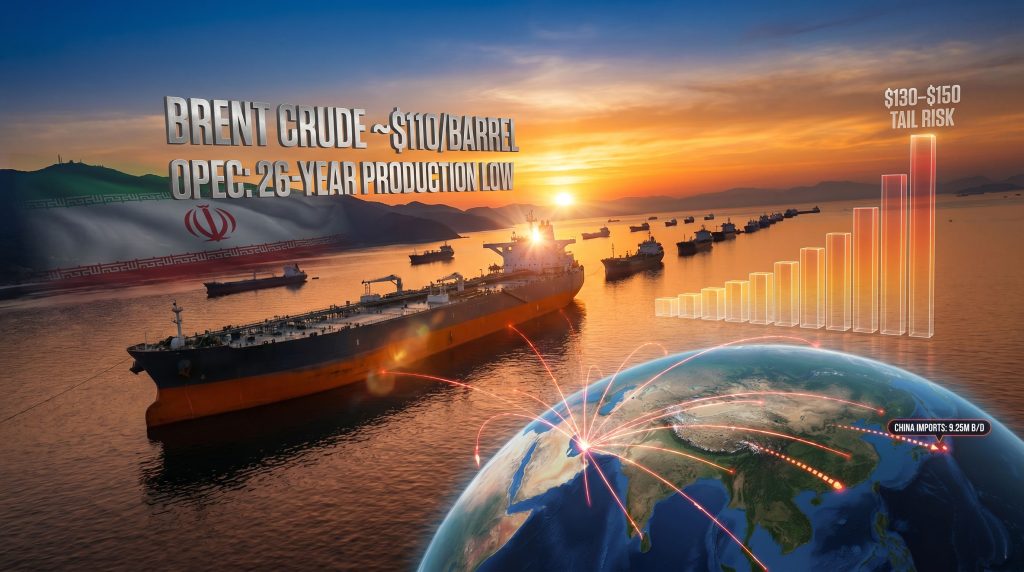
| OPEC Output | 26-year low | -830,000 b/d in April alone | Gulf infrastructure damage |
| China Crude Imports | 9.25 million b/d (April) | -2.4 million b/d month-on-month | Hormuz routing collapse |
Morgan Stanley has issued an assessment that global oil buffers, encompassing both strategic petroleum reserves and OPEC spare capacity, could be depleted before the Strait of Hormuz returns to normal commercial operations. This removes the traditional shock absorber that markets have historically relied upon to cap price spikes during supply disruptions, representing a qualitatively different risk environment from previous Gulf crises.
One of the lesser-appreciated dimensions of the current crisis is the insurance and financing dimension. When vessels attempt to transit contested waters, war risk insurance premiums become prohibitive, and many major carriers simply refuse to take on the exposure regardless of the nominal availability of routing. This creates a de facto closure effect that extends well beyond Iran's formal military blockade perimeter.
The Strait of Hormuz: A 33-Kilometre Bottleneck Holding the World to Ransom
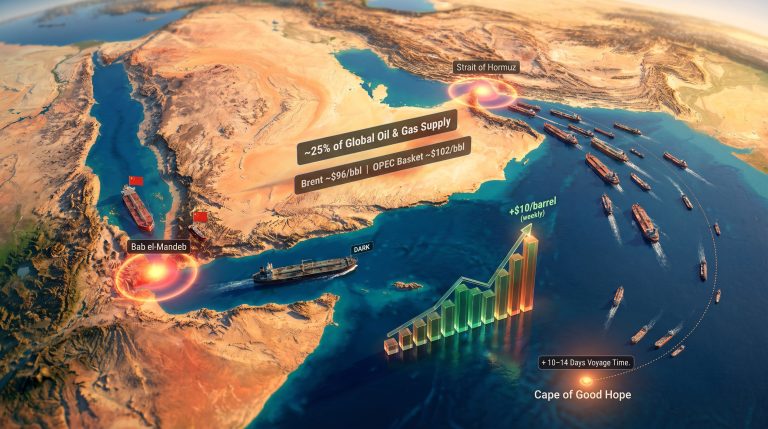
Under normal operating conditions, the Strait of Hormuz handles approximately 20% of global oil supply daily, with roughly 100 commercial vessels transiting the narrow passage. The strait is not merely a crude oil corridor. It also carries a substantial share of the world's liquefied natural gas exports, primarily from Qatar, making it a dual chokepoint for both oil and gas markets simultaneously. The broader LNG supply outlook has consequently deteriorated sharply since hostilities commenced.
Since the conflict commenced in late February 2026, Iran's near-total blockade has removed an extraordinary volume of supply from accessible global markets. The Islamic Revolutionary Guard Corps has now declared what it describes as a vastly expanded operational area around the strait, stretching the zone of claimed maritime control approximately 250 kilometres from the Hormuz chokepoint itself, reaching as far as Sirri Island. This represents a tenfold expansion from pre-war operational parameters.
Sirri Island is not incidental geography. It sits within the broader Persian Gulf production zone and has historically served as a staging point for Iranian offshore oil and gas infrastructure. Iranian command over the waters surrounding it effectively enables maritime interception operations across a far wider area than the strait's narrow geography might suggest, creating a zone of commercial shipping paralysis that extends deep into what were previously considered open international waters.
The operational evidence of this paralysis is concrete. More than 40 India-bound vessels remain trapped in the region unable to proceed. Oil tankers have been documented using AIS transponder shutdowns — essentially going dark — to attempt Hormuz transits without detection. The only documented successful commercial energy cargo transit since hostilities began was the Qatari LNG carrier Al Kharaitiyat, which exited the strait bound for Pakistan following a bilateral arrangement between Islamabad and the IRGC. This single transit, achieved only through a government-to-government side arrangement with Iranian military forces, illustrates how thoroughly normal commercial passage has broken down.
Hormuz Scenario Matrix: Supply and Price Implications
| Scenario | Shipping Impact | Oil Price Implication |
|---|---|---|
| Hormuz fully closed (current trajectory) | ~20 million b/d removed from accessible supply | Brent sustains $100-$115+ range |
| Partial reopening via negotiated corridor | Spot supply relief, reduced war premium | Brent retreats to $85-$95 range |
| Full ceasefire and phased demilitarisation | Supply normalisation over 3-6 months | Brent correction toward $70-$80 range |
| Conflict re-escalation with nuclear dimension activated | Catastrophic supply shock | Brent could breach $130-$150 |
Strategic Warning: Iran's parliament is actively reviewing the option of enriching uranium to 90% purity, the weapons-grade threshold, in response to further military strikes. This nuclear escalation pathway represents the single most severe tail risk currently embedded in global energy markets, though analysts broadly categorise it as a low-probability but non-zero scenario.
How the Conflict Has Rewired Global Crude Oil Trade Flows
Supply disruptions of this magnitude do not simply reduce the total volume of oil reaching markets. They restructure the entire architecture of who buys from whom, via which routes, at what quality specifications, and under what pricing terms. The changes now underway represent a structural rewiring of Asian energy supply chains that carries implications extending well beyond any ceasefire timeline. Indeed, the trade war impact on oil has compounded these disruptions by adding further layers of sanctions complexity to an already fractured supply landscape.
Key Trade Flow Shifts Since February 2026:
- China's crude imports collapsed to 9.25 million barrels per day in April, their lowest level since July 2022, representing a month-on-month decline of 2.4 million b/d
- Brazil's crude oil exports to China have doubled as refiners in Beijing scramble to source Atlantic Basin barrels capable of bypassing Hormuz routing entirely
- Japan received its first Central Asian crude cargo since the conflict began, marking a geographic diversification that would have been economically suboptimal under pre-war conditions
- Chinese refiner nominations for June-loading Saudi crude barrels collapsed to just 10 million barrels (~333,000 b/d), the lowest level on record, compared with 2025 export averages of 1.4 million b/d to China
- Iraq's state oil marketer SOMO cut its official selling price to Asian buyers by $13 per barrel for June-loading cargoes, compared with Saudi Aramco's more measured reduction of $4 per barrel
The pricing gap between Iraq and Saudi Arabia reveals a critical competitive dynamic. Iraq, with fewer alternative markets and greater fiscal dependence on oil revenue, is prioritising volume retention over margin. Saudi Aramco, as the world's largest integrated producer with significant financial reserves, is maintaining pricing discipline rather than engaging in a race to the bottom. This divergence creates a two-tier Middle Eastern pricing structure that buyers are actively exploiting.
China's Refining Sector Under Structural Stress
The pressure on China's refining industry is compounding from multiple directions simultaneously, creating a policy trap with no clean exit.
Independent refiners concentrated in Shandong province, commonly referred to as teapot refiners and representing China's largest cluster of private-sector refining capacity, have cut utilisation rates to just 50% of capacity as of May 2026. This compression reflects the combined effect of elevated crude input costs and Beijing's imposed export ban on refined products, which prevents refiners from accessing more profitable export markets to offset their higher feedstock costs.
China's state planning authority, the NDRC, has simultaneously issued a directive warning independent refiners that they risk permanent quota reductions if they cut run rates below their 2024-2025 historical averages. This creates a direct conflict between commercial rationality and regulatory compliance, forcing refiners to choose between losing money on every barrel they process or losing their import licence entitlements permanently.
Chinese crude inventories tracked by Kayrros have remained flat throughout May at approximately 1.34 billion barrels, suggesting that refiners are absorbing the import shortfall by reducing throughput rather than drawing down storage. This inventory behaviour has important implications: it means the supply shock is currently being absorbed through production cuts rather than destocking, and that visible inventory levels are not providing an accurate signal of underlying supply tightness.
A less widely noted development is the record-breaking surge in Chinese ethane imports, which reached an all-time high of 1 million tonnes in April. Petrochemical producers are substituting ethane for naphtha and LPG as primary feedstocks, as severe regional shortages of these conventional feedstocks have made ethane the only economically viable alternative. This substitution behaviour represents an adaptive response to supply chain disruption but also signals the depth of the petrochemical feedstock crisis spreading across Asia.
Three Scenarios for Oil Prices if the Ceasefire Collapses
The current market is pricing in sustained uncertainty rather than a specific outcome. Understanding the distinct probability-weighted scenarios is essential for any informed assessment of where Trump Iran ceasefire oil prices are likely to move.
Scenario 1: Fragile Ceasefire Holds (Low Probability, Base Case)
- Back-channel negotiations continue while Trump pauses active military operations
- A limited humanitarian or commercial shipping corridor through Hormuz is negotiated
- Brent trades in the $95-$105 range with elevated but slowly declining risk premium
- Gulf infrastructure repair timelines, currently flagged by Saudi Arabia and the UAE as extending into 2027, are revised modestly forward
Scenario 2: Ceasefire Collapses Without Nuclear Escalation (Moderate Probability)
- Diplomatic frameworks break down entirely; US naval operations resume under existing operational mandates
- The IRGC activates its expanded Hormuz operational zone, targeting additional commercial vessels
- OPEC production, already at a 26-year low after losing 830,000 b/d in April alone with Kuwait posting a single-month drop of 640,000 b/d, declines further
- Brent breaches $115-$120 per barrel; US gasoline approaches $5.50-$6.00 per gallon
- Morgan Stanley's buffer exhaustion warning becomes an active market reality
Scenario 3: Nuclear Escalation Pathway Activated (Tail Risk, Low but Non-Zero Probability)
- Iran moves toward 90% uranium enrichment following further military strikes
- Global energy markets enter a structural shock phase that coordinated strategic reserve releases from 30+ nations cannot adequately offset
- Brent potentially exceeds $130-$150 per barrel; global recession risk rises sharply
- The IEA's pre-conflict projection of tight global gas markets persisting through 2030 becomes dramatically understated
An underappreciated wildcard within Scenario 2 is the behaviour of US shale producers. Diamondback Energy (NYSE: FANG) has already purchased options worth approximately $70 million to sell the WTI-Brent spread at a negative $42 per barrel differential. This sophisticated hedging position reflects a specific bet that the Trump administration will impose a US crude oil export ban to suppress domestic gasoline prices, which would dramatically widen the WTI-Brent discount by trapping American barrels inside the domestic market. The sheer size of this options position signals that at least some major producers regard a US export ban as a plausible near-term policy outcome.
US Policy Responses to the Domestic Gasoline Price Crisis
With US gasoline prices having risen sharply since the conflict began, reaching a peak of approximately $4.52 per gallon, the political pressure on the Trump administration to demonstrate domestic relief has become acute. California has recorded the worst regional outcomes, as it typically does given its unique fuel formulation requirements and refinery concentration challenges.
Active and Proposed US Policy Responses:
- Federal gas tax suspension: Temporary elimination of the 18-cent per gallon federal fuel tax, estimated to cost the US Treasury approximately $500 million per week in forgone revenue
- Strategic Petroleum Reserve coordination: The US is executing drawdowns in coordination with approximately 30 allied nations, representing the largest coordinated strategic reserve deployment since the 2022 Ukraine-era releases
- EPA summer blend rule relaxation: Easing fuel formulation standards to allow simpler, cheaper gasoline blends to reach retail markets faster
- Iranian oil trader sanctions: The Treasury Department has announced sanctions targeting Chinese and UAE-based intermediaries facilitating Iran's crude exports, with the State Department offering rewards of up to $15 million for intelligence on IRGC oil trade networks
Policy Tension: The Trump administration is simultaneously attempting to suppress domestic gasoline prices through supply-side relief while maintaining maximum economic pressure on Iran through expanded sanctions. These objectives partially conflict, since Iranian crude reaching global markets through any channel, even sanctioned ones, would marginally ease the supply deficit driving prices higher. This internal policy contradiction may limit the effectiveness of both strategies.
However, there is also an important and underexplored dynamic around the $7 billion in oil bets currently under investigation for potential insider trading. The scale and timing of these positions have raised serious concerns among regulators about whether advance knowledge of diplomatic or military developments is being exploited in commodity markets. This adds a layer of market integrity risk entirely separate from the fundamental supply-demand picture.
The next major ASX story will hit our subscribers first
The OPEC Production Crisis and Long-Term Gulf Capacity Damage
The conflict has not simply disrupted oil shipments. It has inflicted physical damage on producing infrastructure that will constrain Gulf output regardless of when Hormuz reopens, creating a long-duration supply problem that markets are only beginning to price accurately.
OPEC Production Collapse: April 2026 Data
| Producer | Output Change | Context |
|---|---|---|
| OPEC 12 members combined | -830,000 b/d month-on-month | 26-year production low |
| Kuwait | -640,000 b/d (largest single-nation decline) | Largest monthly drop in the survey |
| Iran | Infrastructure repair: up to 2 years | South Pars gas field severely damaged |
| Saudi Arabia and UAE | Full repairs flagged for 2027 | Drone strike damage to production sites |
Iran's Organisation for Energy Optimisation and Strategic Management has publicly acknowledged that restoring the country's energy infrastructure will require substantial investment and potentially two years of repair work, with particular damage identified at the critically important South Pars gas field — the largest natural gas field in the world by recoverable reserves.
Saudi Arabia and the UAE have each signalled that comprehensive restoration of drone-damaged production facilities is unlikely before 2027. Notably, ADNOC Gas has separately confirmed it is targeting approximately 80% recovery of its Habshan facility by the end of 2026, suggesting that even partial restoration will be a phased, multi-year process rather than a rapid rebound.
The practical implication is that even a successful ceasefire would not translate into rapid supply normalisation. Physical production capacity has been degraded, and rebuilding it requires not just cessation of hostilities but active investment, equipment procurement, engineering work, and commissioning periods that cannot be compressed regardless of political will.
Cascading Effects: LNG, Refining, Coal, and Petrochemicals
The oil price shock is the headline symptom of a broader energy system operating under acute stress. Secondary and tertiary disruptions are now propagating across multiple commodity markets simultaneously.
LNG and Gas Markets
- Japan and South Korea are pivoting toward coal as a substitute fuel source, reversing years of decarbonisation investment in a matter of weeks
- Qatar has separately asked vessels at its key LNG port facilities to disable their AIS transponders for safety reasons, creating additional uncertainty around LNG supply reliability
- Pakistan's state energy company has ceased all spot market LNG tendering, having rejected all submitted bids including BP's lowest offer at $17.28 per MMBtu, opting instead for pre-arranged Qatari supply agreements
- Norway's Hammerfest LNG terminal, with 4.2 million tonnes per annum of capacity operated by Equinor, has been taken offline for unplanned maintenance due to process problems, further tightening European gas supply at a critical juncture
- The IEA's projection that tight global gas markets will persist through 2030, issued before the current conflict, now appears to underestimate the structural supply challenge
Downstream and Refining
- Mexico's 330,000 b/d Oaxaca refinery operated by Pemex was taken offline following a fire in its hydrotreater unit that injured six workers, the second incident at the facility within five months
- Libya's National Oil Corporation has assumed full operational control of the 220,000 b/d Ras Lanuf refinery following a decade-long legal dispute, potentially adding downstream capacity at a moment of acute global need
- Global jet fuel exports reached a 10-year seasonal low in April, compressing airline margins and creating questions about summer travel season capacity and pricing
Commodity Spillover
- Copper reached a three-month peak of $14,025 per tonne on the London Metal Exchange, up approximately $1,000 per tonne within a single week, driven by supply disruptions and significant hedge fund positioning
- Global coal demand has surged as utilities across Asia and Europe reactivate mothballed coal-fired generation capacity as a bridge fuel to replace disrupted gas and oil supplies
- India's inflation has accelerated as high energy costs spread through the economy, with Prime Minister Modi urging citizens to conserve fuel while state fuel retailers absorb mounting losses from a politically motivated fuel price freeze
The Xi-Trump Summit: The Geopolitical Variable That Could Move Everything
The upcoming summit between US President Trump and Chinese President Xi Jinping introduces a macro-level variable that could shift the entire trajectory of Trump Iran ceasefire oil prices in either direction within a very short timeframe. In addition, the broader US-China trade war tensions have complicated energy diplomacy significantly, as sanctions enforcement and supply chain decoupling intersect in ways that constrain both nations' room for manoeuvre.
The timing is further complicated by the Trump administration's simultaneous announcement of new sanctions targeting Chinese companies facilitating Iranian crude shipments to China. This creates immediate tension around the prospects for any substantive breakthrough at the summit table.
China's refiners are experiencing acute supply stress, with crude import volumes at multi-year lows and independent refining margins compressed to unsustainable levels. This economic pressure gives Beijing a genuine incentive to seek resolution. However, China's structural role as a primary buyer of sanctioned Iranian crude creates a direct conflict of interest with US demands, making any agreement on energy trade flows a prerequisite for broader diplomatic normalisation rather than a secondary concern.
From a market psychology perspective, the summit represents the single most important near-term binary for oil prices. A visible breakthrough in US-China relations could compress the geopolitical market risks premium rapidly even without a formal Iran ceasefire, as reduced economic warfare between the two largest economies would ease the sanctions enforcement environment currently amplifying the supply disruption. Conversely, a visible deterioration at the summit would likely push Brent toward the upper end of current scenario projections.
As Reuters reports, oil prices surged sharply when US-Iran peace proposal talks broke down, reinforcing how directly diplomatic failure translates into immediate crude price escalation. Furthermore, CNBC's analysis of the Brent and WTI price movements confirms that market participants are treating each diplomatic development as a live pricing input, with volatility remaining structurally elevated until a durable resolution emerges.
Disclaimer: This article is for informational purposes only and does not constitute financial, investment, or trading advice. All price projections and scenario analyses reflect forward-looking estimates subject to significant uncertainty. Readers should conduct their own independent research before making any investment decisions. The scenarios described involve speculative assumptions about geopolitical and market outcomes that cannot be predicted with certainty. Past price behaviour during previous Middle Eastern conflicts may not be indicative of future outcomes given the unique structural features of the current crisis.
Want to Stay Ahead of the Next Major Resource Discovery Triggered by Energy Market Shifts?
When geopolitical shocks reshape commodity markets at this speed, early positioning in significant mineral discoveries can be equally transformative — Discovery Alert's proprietary Discovery IQ model delivers real-time ASX mineral discovery alerts, turning complex market data into actionable opportunities the moment they're announced. Explore why historic discoveries have generated substantial returns on Discovery Alert's dedicated discoveries page, and begin your 14-day free trial today to secure your edge ahead of the broader market.