August 5, 2026
The Geography Behind the World's Most Consequential Maritime Chokepoint
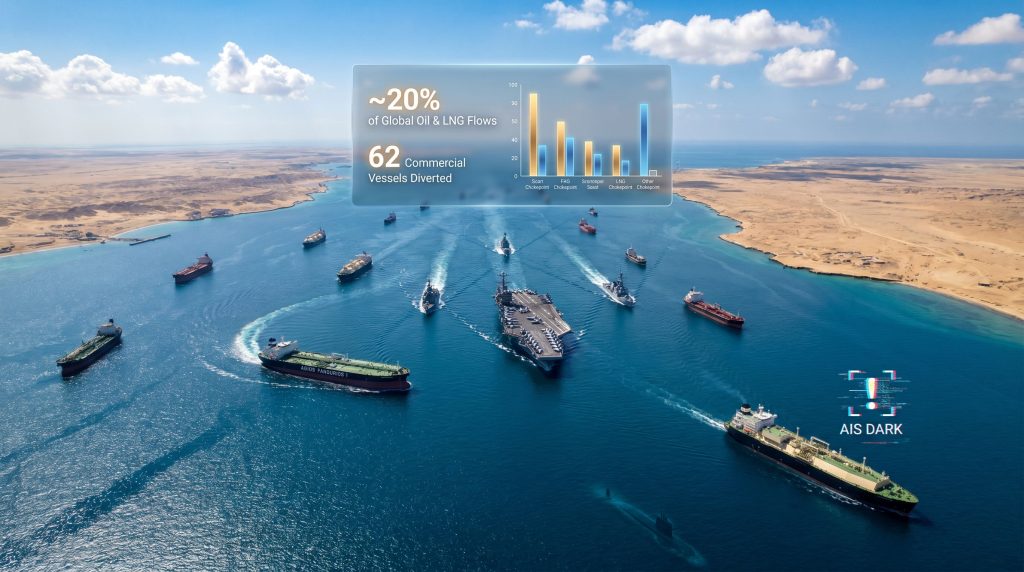
Not all waterways are equal. Some carry regional significance, others affect continental trade flows, but only one corridor on Earth holds the entire architecture of global energy supply in a kind of permanent tension. The U.S. blockade in the Strait of Hormuz has placed this narrow passage — barely 33 kilometres wide at its most constrained navigable point — under acute operational stress. Under normal conditions, this corridor connects the Persian Gulf to the Gulf of Oman and handles roughly one-fifth of all global oil and LNG flows every day.
What makes Hormuz uniquely dangerous from an energy security standpoint is not simply its traffic volume, but the near-total absence of viable alternatives. Saudi Arabia's East-West Pipeline and the UAE's Abu Dhabi Crude Oil Pipeline (ADCOP) offer limited bypass capacity, but neither comes close to replicating the throughput of the strait itself. Consequently, when something goes wrong at Hormuz, the market cannot simply reroute.
How Hormuz Compares to Other Critical Maritime Energy Corridors
The table below illustrates why the U.S. blockade in the Strait of Hormuz represents a qualitatively different category of supply disruption compared to friction at other chokepoints:
| Chokepoint | Est. Share of Global Oil Flow | Key Dependent Regions | Practical Alternative Routes |
|---|---|---|---|
| Strait of Hormuz | ~20% | Asia, Europe, South Asia | Limited / Cost-prohibitive |
| Strait of Malacca | ~16% | East Asia | Partial (Lombok, Sunda Straits) |
| Suez Canal | ~12% | Europe, North America | Cape of Good Hope |
| Bab el-Mandeb | ~9% | Europe, Asia | Cape of Good Hope |
| Turkish Straits | ~3% | Southern Europe | Limited |
The Strait of Hormuz stands apart from every other global energy chokepoint because no large-scale alternative routing exists for Persian Gulf exports. Any sustained disruption carries structurally distinct market consequences compared to closures elsewhere on the map.
The downstream dependency chain runs deep. China, Japan, South Korea, and India collectively draw enormous shares of their crude oil and LNG supplies through this corridor. European LNG buyers reliant on Qatari cargoes face the same exposure. This geography is not a recent development — it is a decades-old structural reality that has now been placed under acute operational stress, contributing significantly to commodity market volatility across global energy benchmarks.
When big ASX news breaks, our subscribers know first
What the U.S. Naval Blockade in the Strait of Hormuz Actually Involves
The U.S. blockade in the Strait of Hormuz, enforced by U.S. Central Command (CENTCOM), is a maritime interdiction operation targeting vessels entering or exiting Iranian waters through the strait. The naval architecture deployed is substantial, involving a flotilla of at least 10 U.S. destroyers positioned south of the Strait alongside the USS Abraham Lincoln carrier strike group. CENTCOM has confirmed publicly that U.S. forces in the Middle East remain committed to full enforcement of the blockade.
It is important to distinguish between the primary and secondary layers of enforcement. Iranian-flagged vessels are the principal targets of interdiction. However, third-party commercial shipping is subject to diversion and inspection protocols, and this secondary layer of enforcement has proven increasingly consequential for non-Iranian operators seeking to transit the strait with legitimate cargo.
How the Blockade Escalated: A Chronological Framework
Understanding the current state of the strait requires tracking how enforcement evolved from policy to kinetic action over a matter of weeks:
-
April 13, 2026: The blockade formally takes effect. CENTCOM begins redirecting commercial vessels approaching the enforcement zone.
-
May 6, 2026: The USS Abraham Lincoln uses 20mm cannon fire to disable the tanker M/T Hasna by targeting its rudder, marking the first reported physical incapacitation of a vessel during blockade enforcement.
-
May 8, 2026: U.S. Navy F/A-18 Super Hornets disable Iranian tankers M/T Sea Star III and M/T Sevda using precision munitions fired into vessel smokestacks, escalating from ship-boarding and diversion to active aerial engagement.
-
May 11, 2026: The Iraqi supertanker Agios Fanourios I, loaded with crude oil bound for Vietnam, reverses course as it approaches the U.S. blockade line, despite having already cleared the strait over the preceding weekend.
-
May 12, 2026: Commercial transit through Hormuz remains severely restricted. Observable traffic consists predominantly of Iranian-linked carriers, including LPG tankers, small fuel carriers, and bulk cargo vessels.
The escalation pattern here is notable. What began as vessel redirection in April has progressively moved toward disabling operations, aerial engagement, and a deterrent effect that is now influencing the commercial decisions of non-Iranian operators.
The Agios Fanourios I Incident and the Scope of Commercial Disruption
As of mid-May 2026, CENTCOM has confirmed via its official social media channels that 62 commercial vessels have been diverted since the blockade took effect. Four Iranian-flagged tankers have been physically disabled during active enforcement operations. According to ship-tracking data compiled by Bloomberg, observable commercial transits on May 12 consisted primarily of Iranian-linked carriers.
The case of the Agios Fanourios I deserves particular attention because it illustrates a dimension of the blockade that extends well beyond its stated Iranian focus.
Case Study: The Agios Fanourios I — The Iraqi supertanker successfully transited the Strait of Hormuz over the weekend of May 10–11, 2026, carrying crude oil destined for Vietnam. Despite having already cleared the strait, the vessel reversed course on May 11 as it approached the U.S. naval enforcement position. The turnaround was not compelled by direct U.S. military action, but by the deterrent weight of the enforcement architecture itself.
The implications reach beyond a single vessel:
-
Iraq's export exposure: Iraqi crude bound for Asian end-markets is experiencing collateral disruption despite Baghdad having no direct role in the U.S.-Iran dispute. This represents an economic cost being imposed on a sovereign OPEC+ producer outside the primary conflict.
-
Asian buyer vulnerability: Vietnamese and other Asian refiners expecting contracted Iraqi crude face delivery timeline uncertainty, potentially triggering force majeure assessments and spot market procurement at elevated prices.
-
Deterrence spillover: The blockade is now influencing the commercial navigation decisions of third-party operators without requiring direct physical intervention, suggesting the deterrent effect has extended further than the immediate enforcement perimeter.
Qatar's LNG Corridor: Navigating the Enforcement Zone
Qatar occupies a particularly complex position in the current crisis. As one of the world's leading LNG exporters, Qatar's primary export corridor runs directly through the Strait of Hormuz, and Doha must balance its relationships across multiple competing interests while maintaining uninterrupted deliveries to contracted buyers. The broader global LNG supply picture makes Qatar's continued access to the strait especially consequential for importing nations across Asia and Europe.
The Qatari LNG carrier Mihzem provides a concrete illustration of the operational pressures now facing Qatari shipping. The vessel appeared to transit the strait successfully on May 12, 2026, en route to Pakistan, but only after briefly reversing course and disabling its AIS tracking transponder on May 11. A second Qatari LNG shipment also cleared the chokepoint over the preceding weekend. Qatari port authorities have reportedly instructed vessels near the country's primary LNG export terminal to deactivate tracking systems as a precautionary security measure.
The LNG Supply Chain Vulnerability Matrix
| Risk Factor | Impact Level | Affected Markets | Mitigation Options |
|---|---|---|---|
| Vessel diversion by CENTCOM | High | All Hormuz-dependent importers | Cape of Good Hope rerouting (cost-intensive) |
| AIS transponder blackouts | Medium-High | Insurers, commodity traders | Satellite AIS, alternative verification |
| Iranian naval interdiction threat | High | Non-Iranian commercial shipping | Naval escorts, convoy protocols |
| GPS jamming and AIS spoofing | Medium | All regional maritime operators | Multi-source positioning systems |
| Qatar LNG terminal access restrictions | Medium | South Asia, East Asia, Europe | Spot market reallocation |
The financial arithmetic of rerouting via the Cape of Good Hope is not trivial. A Qatari LNG carrier diverting around the southern tip of Africa adds approximately 7,000 to 8,000 nautical miles to a typical voyage to East Asian markets, translating to additional voyage costs measured in hundreds of thousands of dollars per shipment, and delivery timeline extensions of roughly two to three weeks. For contracted buyers operating on tight inventory margins, this is not an abstract concern.
The Dark Shipping Problem: AIS Spoofing and the Collapse of Maritime Visibility
One of the most underappreciated dimensions of the current crisis is the degree to which electronic interference is degrading the quality of information available to market participants. Widespread AIS (Automatic Identification System) signal spoofing and deliberate transponder shutdowns are making independent verification of vessel movements across Hormuz shipping lanes increasingly unreliable.
AIS is the maritime equivalent of a flight transponder. Every commercial vessel above a certain tonnage threshold is legally required to broadcast its identity, position, speed, and heading. When that signal is disabled or manipulated, the vessel effectively disappears from commercial tracking systems. It continues to move, it continues to carry cargo, but the market cannot see it.
According to reporting from Bloomberg, Iranian-linked vessels have historically followed a pattern of disabling tracking systems while transiting high-risk waters near Hormuz, often remaining electronically invisible until reaching the Strait of Malacca days later. This practice is now being replicated, at least under security instructions, by operators with no direct Iranian connection.
Why Dark Shipping Creates Cascading Market Risks
The consequences of widespread AIS blackouts extend across multiple market layers simultaneously:
-
Insurance pricing distortions: War-risk underwriters cannot accurately assess vessel exposure without verified location data, forcing them to price risk conservatively and broadly, raising premiums across the entire region.
-
Commodity price volatility amplification: Crude and LNG spot markets respond to perceived supply disruption. When tracking data is unreliable, market participants cannot distinguish between genuine supply loss and vessels that are simply electronically invisible, amplifying uncertainty premiums beyond what physical disruption alone would generate.
-
Sanctions compliance blind spots: Financial institutions, trading houses, and commodity merchants subject to U.S. secondary sanctions frameworks lose the ability to verify the provenance and routing of cargoes, creating compliance exposure that many will manage by avoiding the region entirely.
-
Cargo delivery uncertainty for end-buyers: Asian and South Asian importers face heightened ambiguity around whether contracted cargoes are in transit, diverted, or disrupted, forcing reactive spot market procurement at elevated prices.
The Diplomatic Deadlock Driving the Crisis
The blockade did not emerge in a vacuum. It was implemented following the breakdown of diplomatic negotiations between Washington and Tehran, and understanding why those talks failed is essential to assessing how the current disruption resolves. According to recent reports, the two parties have reached a pronounced stalemate, with neither side willing to offer the concessions needed to break the impasse.
Iran's negotiating position included two conditions that Tehran characterised as non-negotiable: relief from the naval blockade and a phased reopening of the strait as preconditions for any broader agreement. Washington rejected these terms, viewing them as incompatible with the leverage architecture the blockade was designed to create. President Donald Trump publicly dismissed Tehran's most recent proposals and signalled that any ceasefire arrangement remains highly conditional.
Iran's response has been to escalate its own naval posture. Reports indicate that Iran has deployed small submarines to reinforce security operations around the strait, introducing asymmetric threat vectors that did not previously exist at this intensity. Furthermore, Iran continues to issue threats against commercial vessels, regional military installations, and nations operating within the U.S.-led enforcement framework.
The structural impasse is straightforward to diagnose but difficult to resolve. Iran cannot accept a blockade that systematically strangles its primary export revenue stream. The United States views that same blockade as its primary coercive instrument. Neither party has yet demonstrated the willingness to offer the concessions that would be required to break the deadlock.
This dynamic reflects a broader pattern in coercive diplomacy where the instrument of pressure becomes simultaneously the obstacle to resolution. Lifting the blockade is what Iran needs to negotiate; maintaining the blockade is what Washington believes makes Iran negotiate. The geopolitical risk landscape surrounding this dispute is, consequently, affecting commodity markets well beyond the energy sector.
The next major ASX story will hit our subscribers first
Global Energy Market Stress Scenarios Under a Prolonged Blockade
The oil market impact of a sustained U.S. blockade in the Strait of Hormuz is not uniform across time. Disruption evolves as it extends, and each phase carries distinct pricing and supply dynamics.
Short, Medium, and Long-Term Market Impact Framework
| Time Horizon | Primary Market Dynamics | Key Risk Indicators |
|---|---|---|
| 0–30 days | Geopolitical risk premium absorbed into spot crude prices; Asian refiners activate SPR drawdowns | Brent/WTI spread widening; LNG spot price spike in JKM benchmark |
| 30–90 days | Measurable supply tightness in Asian import markets; freight rates surge on alternative routing | Tanker day rates on VLCC Atlantic Basin routes; Pacific LNG spot premiums |
| 90+ days | Structural rerouting pressure via Saudi East-West Pipeline and UAE ADCOP gains strategic urgency | Energy security policy acceleration in Japan, South Korea, India; SPR depletion rates |
Regional Energy Security Exposure by Import Dependency
| Region | Hormuz-Dependent Import Share | Primary Commodities | Est. Strategic Reserve Coverage |
|---|---|---|---|
| Japan | ~85% of crude imports | Crude oil, LNG | ~90–100 days |
| South Korea | ~70% of crude imports | Crude oil, LNG | ~90 days |
| India | ~60% of crude imports | Crude oil | ~60–65 days |
| China | ~40% of crude imports | Crude oil | ~90+ days (SPR) |
| European LNG buyers | Variable | LNG (Qatar-sourced) | Seasonal dependency |
Japan and South Korea face the most acute structural exposure, with the vast majority of their crude import supply routed through the strait. While both countries maintain meaningful strategic petroleum reserves, a disruption extending beyond 90 days would begin to create genuine supply adequacy questions, particularly if concurrent geopolitical events constrain Atlantic Basin alternatives.
Maximum Pressure at Sea: The Coercive Logic of the Blockade
The U.S. blockade in the Strait of Hormuz represents a meaningful escalation in the toolkit of coercive diplomacy applied to Iran. Financial sanctions operate on economic flows through banking and payment systems. A naval blockade, however, operates on physical commodity flows, intercepting actual cargo rather than funds. This shift from financial to kinetic coercive instruments reflects both the perceived limits of sanctions pressure and the availability of U.S. naval power in the region. The oil price shock dynamics that energy executives were already navigating in early 2025 have, consequently, been amplified significantly by this escalation.
Historical precedents for naval blockades as diplomatic instruments offer mixed lessons. The Cuban Missile Crisis quarantine of 1962 is frequently cited as a successful coercive blockade, but that case involved a defined and finite demand. Blockades that fail to produce negotiated outcomes within weeks tend to generate escalation cycles, collateral economic harm to third parties, and hardened domestic political positions on both sides.
Third-Party Nation Exposure: Iraq, Qatar, and the Collateral Dimension
The Agios Fanourios I incident crystallises a dimension of the blockade that extends well beyond the Iran-U.S. bilateral. Iraq, a sovereign OPEC+ member, is facing operational disruption to its ability to fulfil export contracts. Qatar is being forced to modify its operational procedures, disable tracking systems, and absorb additional voyage risk across every LNG shipment it clears through the strait.
These nations are not parties to the dispute. They are bearing an asymmetric economic burden because of their geographic dependency on a waterway that has become a theatre of enforcement. The longer the blockade persists, the greater the pressure these third-party producers will face to find alternative routing or seek diplomatic mediation through multilateral channels.
Escalation Pathways and Resolution Scenarios
Three scenarios capture the plausible range of outcomes over the coming weeks and months, each carrying distinct market and geopolitical implications.
Scenario 1: Negotiated De-escalation
A partial blockade relief agreement is reached in exchange for Iranian concessions on nuclear or proxy activity. Given the Trump administration's explicit rejection of Tehran's preconditions, the probability of this outcome in the near term is low. However, if achieved, the market impact would be rapid normalisation of Hormuz transit and a downward correction in crude prices as the risk premium deflates.
Scenario 2: Sustained Enforcement Stalemate
Neither party makes meaningful concessions. The blockade remains in place for 60 to 120 or more days, producing persistent supply tightness in Asian markets, elevated LNG spot prices, accelerated strategic reserve drawdowns, and growing pressure on third-party exporters. The current trajectory suggests this is the most probable near-term outcome.
Scenario 3: Kinetic Escalation
An Iranian submarine or proxy attack on U.S. naval assets or commercial shipping triggers retaliatory U.S. strikes on Iranian naval infrastructure. Iran's confirmed submarine deployments signal this capability exists. If this scenario materialises, the crude price response would be severe, and the possibility of a temporary full closure of the strait would activate global energy security emergency protocols across importing nations.
Disclaimer: All scenario assessments and market projections contained in this article are analytical frameworks based on available information as of the date of publication. They do not constitute financial, investment, or trading advice. Commodity markets are subject to rapid and unpredictable change, and readers should conduct their own independent assessment before making any commercial or investment decisions.
Frequently Asked Questions: U.S. Blockade in the Strait of Hormuz
What is the U.S. blockade in the Strait of Hormuz?
The U.S. naval blockade in the Strait of Hormuz is a CENTCOM-enforced maritime interdiction operation targeting vessels entering or exiting Iranian waters through the strait. Implemented in April 2026 following the collapse of U.S.-Iran diplomatic negotiations, it involves a significant U.S. naval deployment including destroyer flotillas and the USS Abraham Lincoln carrier strike group.
How many ships have been affected by the Hormuz blockade?
As of mid-May 2026, CENTCOM has confirmed the diversion of 62 commercial vessels since the blockade took effect. Four Iranian-flagged tankers have been physically disabled during enforcement operations.
Is the Strait of Hormuz completely closed?
No. The strait is not fully closed, but commercial transit is severely restricted. Observable traffic has been limited primarily to Iranian-linked carriers, with select third-party operators — including a Qatari LNG tanker — successfully transiting under conditions of heightened operational complexity and risk.
What percentage of global oil flows through the Strait of Hormuz?
Approximately 20% of global oil and LNG flows transit the Strait of Hormuz under normal operating conditions, a share large enough to make any sustained disruption a systemic event for global energy markets rather than a regional supply issue.
Why did the Iraqi supertanker turn back at Hormuz?
The Agios Fanourios I, an Iraqi supertanker carrying crude oil bound for Vietnam, reversed course on May 11, 2026, after approaching U.S. naval blockade enforcement positions. The vessel had already cleared the strait over the preceding weekend before halting its voyage, illustrating the growing deterrent effect the blockade is exerting on non-Iranian commercial operators, as documented by Bloomberg ship-tracking data.
What is AIS spoofing and why does it matter at Hormuz?
AIS (Automatic Identification System) is the mandatory vessel identification and tracking technology used across commercial shipping. Spoofing involves the manipulation or deliberate deactivation of AIS transponders, making vessels invisible to commercial tracking systems. At Hormuz, widespread spoofing and transponder shutdowns by both Iranian-linked vessels and Qatari operators acting under security instructions are severely degrading the accuracy of real-time cargo flow intelligence, amplifying uncertainty for insurers, commodity traders, and end-buyers across Asia and South Asia.
Key Takeaways: What the Hormuz Blockade Means for the Future of Energy Geopolitics
The U.S. blockade in the Strait of Hormuz has moved well past symbolic deterrence into active kinetic interdiction, with 62 vessels diverted and four tankers disabled in the space of weeks. The enforcement architecture is now exerting deterrent pressure on non-Iranian operators, as the Agios Fanourios I incident confirms, extending collateral commercial disruption to sovereign producers like Iraq who have no direct role in the underlying geopolitical dispute.
AIS spoofing and electronic warfare are adding an informational dimension to the physical disruption, creating a dark shipping environment that amplifies commodity market uncertainty beyond what cargo loss alone would generate. The absence of viable alternative routing for Persian Gulf exports means the market cannot simply absorb this disruption through rerouting the way it might if a different chokepoint were affected.
The diplomatic path to resolution requires concessions that neither Washington nor Tehran has yet shown willingness to offer. As analysts have noted, neither side can sustain this standoff indefinitely without significant economic and strategic cost. Until that calculus changes, the Strait of Hormuz will remain the focal point of global energy security risk, and the approximately one-fifth of world oil and LNG flows that normally transit this 33-kilometre passage will continue to move under conditions of exceptional uncertainty.
Readers seeking ongoing upstream industry coverage of the Middle East energy corridor and broader global commodity developments can explore reporting from World Oil at worldoil.com.
Want to Track the Commodity Market Fallout From Global Energy Disruptions in Real Time?
Sustained supply shocks like the Strait of Hormuz blockade send ripple effects across mineral and energy commodity markets, creating both volatility and opportunity for informed investors. Discovery Alert's proprietary Discovery IQ model scans ASX announcements in real time, delivering instant alerts on significant mineral discoveries so subscribers can act on emerging opportunities ahead of the broader market — start your 14-day free trial today or explore how historic discoveries have generated extraordinary returns for those positioned early.