May 12, 2026
The Chokepoint That Moves Markets: Understanding the Hormuz Price Mechanism
Few geographic features on Earth carry the same weight in global energy pricing as a waterway barely 33 kilometres wide at its narrowest point. The Strait of Hormuz has long functioned as the world's most consequential energy corridor, and when political forces converge to threaten its operability, oil futures markets respond with extraordinary sensitivity. That sensitivity is not irrational. It reflects a deep structural reality: energy supply chains built around Hormuz transit have few viable alternatives, and disruption costs are asymmetric, falling heavily on importing nations while creating windfall conditions for alternative suppliers.
The conflict that erupted between the United States, Iran, and Israel on February 28, 2026 has placed that chokepoint under simultaneous pressure from two directions, a situation without modern precedent. Understanding why oil gains on US-Iran talks failure and Hormuz shipping disruption requires moving beyond headline price figures and examining the underlying mechanics of how diplomatic deadlock translates into market repricing.
When big ASX news breaks, our subscribers know first
The Diplomatic Impasse at the Heart of the Oil Price Surge
How a 24-Hour Negotiation Collapse Is Reshaping Energy Futures
The structure of the current deadlock is arguably more consequential for energy markets than any single supply disruption event. When diplomatic resolution appears genuinely possible, futures markets price in a partial recovery premium, anticipating the easing of restrictions and the restoration of Hormuz transit. When negotiations collapse, that premium evaporates rapidly, and a new risk premium takes its place — one that accounts not merely for current supply loss, but for the sustained uncertainty of an unresolved conflict.
Pakistani mediators facilitated weekend peace talks that disintegrated within roughly 24 hours. The core obstacle, according to the US position, was Iran's continued refusal to relinquish its nuclear programme. A prior two-week ceasefire, announced on April 7, 2026, had already lapsed without producing a binding successor agreement. When President Trump extended the ceasefire unilaterally on April 22, White House press secretary Karoline Leavitt confirmed that no defined end date had been established, leaving the market to price a conflict with an open-ended timeline.
The oil market is repricing expectations with little sign of progress in finding a resolution in the Persian Gulf, with hopes for a diplomatic settlement fading as peace talks stall. — ING analysts, April 23, 2026
This analysis from ING, one of the most closely followed institutional voices in energy markets, captures precisely why sustained diplomatic stagnation is structurally more bullish for crude oil price trends than any single supply incident. A one-time disruption can be modelled, hedged, and partially absorbed through reserve drawdowns. An unresolved geopolitical standoff with no visible resolution pathway cannot be efficiently hedged, and markets respond by maintaining elevated pricing until a credible de-escalation signal emerges.
The Circular Deadlock That Prevents Resolution
The diplomatic impasse has a particularly intractable quality because the preconditions each side has set for progress are mutually contradictory. Iranian parliament speaker and chief negotiator Mohammad Baqer Qalibaf stated that a full ceasefire only made sense if the US naval blockade of Iran's maritime trade was lifted. The United States, in contrast, has indicated that blockade relief is contingent on demonstrable progress on Iran's nuclear programme.
This circular structure means that neither side can take the first step without conceding its primary leverage point. Furthermore, for energy markets, this circular deadlock functions as a persistent price floor, preventing the resolution-driven price compression that would otherwise occur. Consequently, the oil price impact of this stalemate continues to compound with each passing week.
What the Strait of Hormuz Disruption Actually Means in Practice
Volume, Vulnerability, and the Dual-Blockade Structure
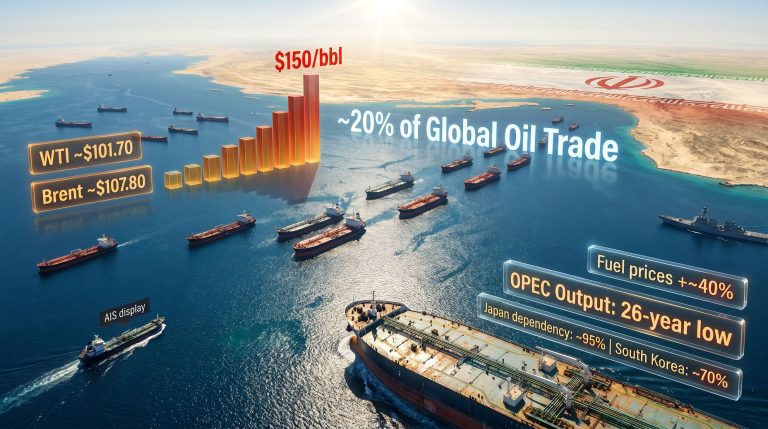
Before the conflict began on February 28, 2026, the Strait of Hormuz facilitated approximately 20% of daily global oil supplies, according to reporting by Arab News, citing Reuters. The strait also serves as a critical transit corridor for a significant portion of global LNG supply shipments, making any sustained restriction an energy security event with consequences that extend well beyond crude oil pricing.
What makes the current disruption structurally unusual is that restrictions are being applied simultaneously from both sides of the conflict. This dual-blockade mechanism has no straightforward precedent in modern energy market history.
| Actor | Action Taken | Geographic Scope |
|---|---|---|
| United States | US Navy blockade of Iranian maritime trade | Asian waters including positions near India, Malaysia, and Sri Lanka |
| Iran | Seizure of two vessels transiting the strait on April 23, 2026 | Within the Strait of Hormuz |
| Combined Effect | Dual-party interdiction of the world's primary oil corridor | Global shipping rerouting and insurance premium escalation |
The US military intercepted at least three Iranian-flagged tankers in Asian waters, redirecting them away from positions near India, Malaysia, and Sri Lanka, according to shipping and security sources cited by Reuters on April 23, 2026. Iran's seizure of two additional vessels transiting the strait on the same day compounded the bottleneck effect. French shipping firm CMA CGM separately reported a direct attack on one of its vessels transiting the waterway, adding a further dimension of commercial risk to the disruption picture.
The Insurance Premium Spiral and Its Downstream Effects
One underappreciated mechanism through which Hormuz disruptions transmit into broader economic pain is the war-risk insurance market. When vessels transiting a contested waterway face credible interception or attack risk, insurers reprice coverage dramatically. These elevated premiums are not absorbed by shipping operators; they are passed directly into freight costs, which in turn flow into the landed cost of every product that travels by sea through the affected corridor.
The practical consequence is that energy price inflation from a Hormuz disruption is not limited to crude oil futures. Refined product costs, LNG import prices, and the broader cost of goods transported via affected supply chains all rise in concert. Nations that are heavily dependent on Hormuz transit for both energy imports and exports face compounding economic pressure from multiple directions simultaneously.
By contrast, Gulf states with export infrastructure located outside the strait — such as the UAE's Fujairah terminal on the Gulf of Oman coast — are positioned to capture meaningful revenue and market share advantages from rerouted supply flows, a structural benefit that persists as long as the disruption continues.
Oil Price Data: The Numbers Behind the Oil Gains
Benchmark Performance as Diplomatic Hopes Fade
The price movements recorded as oil gains on US-Iran talks failure and Hormuz shipping disruption accelerated have been substantial. Both major benchmarks registered significant moves as the diplomatic picture darkened, reflecting oil geopolitics analysis that points to a structurally elevated risk environment.
| Benchmark | Price (April 23, 2026) | Session Change | Percentage Move |
|---|---|---|---|
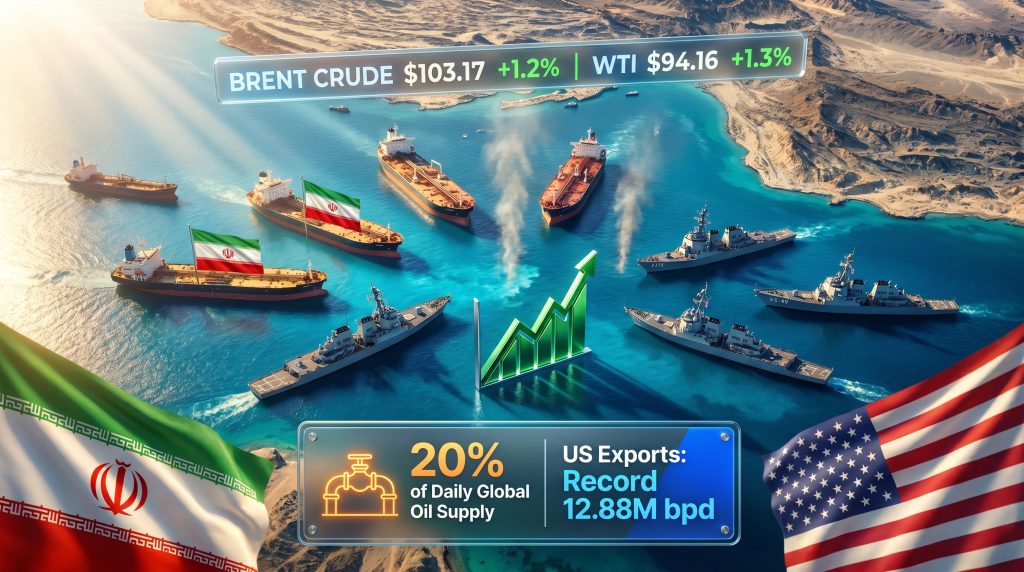
| Brent Crude Futures | $103.17 per barrel | +$1.26 | +1.2% |
| West Texas Intermediate (WTI) | $94.16 per barrel | +$1.20 | +1.3% |
| Brent (prior session close) | Above $100 per barrel | First time in over two weeks | Milestone threshold |
Source: Arab News / Reuters, April 23, 2026, as of 09:30 a.m. Saudi time.
Both benchmarks closed more than $3 higher in the Wednesday session, April 22, driven by a combination of diplomatic stagnation and strongly divergent US energy inventory data. Brent crossing back above the psychologically significant $100 per barrel threshold — for the first time in over two weeks — marked a clear signal that markets were reassessing their probability weighting for a near-term resolution. According to reporting from the Wall Street Journal, markets are increasingly weighing the consequences of a prolonged Hormuz strait closure.
Investor Note: Oil price movements of this magnitude within a single session reflect acute market sensitivity to Hormuz developments. Investors should treat these figures as indicative of current conditions only. Commodity prices are inherently volatile, and this article does not constitute financial advice. Forward-looking price scenarios discussed here involve significant uncertainty.
EIA Inventory Data: Reading the Supply Signal Correctly
Why Divergent Stock Movements Are Telling Two Different Stories Simultaneously
The Energy Information Administration's inventory release on April 22, 2026 produced a set of figures that initially appear contradictory but, when read together, reveal the complex supply dynamics created by Hormuz disruption. Understanding the divergence between crude stock builds and refined product draws is essential for interpreting the current price environment accurately.
| Commodity | Actual Change | Analyst Expectation | Variance from Forecast |
|---|---|---|---|
| US Crude Stocks | +1.9 million barrels | -1.2 million barrels (draw) | +3.1 million barrel upside surprise |
| Gasoline Stocks | -4.6 million barrels | -1.5 million barrels (draw) | 3.1 million barrel larger draw |
| Distillate Stockpiles | -3.4 million barrels | -2.5 million barrels (draw) | 0.9 million barrel larger draw |
Source: US Energy Information Administration, reported by Arab News / Reuters, April 23, 2026.
The crude stock build, despite analyst expectations of a draw, reflects a structural shift in global purchasing patterns. As Hormuz-dependent supply chains face interdiction risk, Asian and European buyers are actively redirecting procurement toward US-origin crude, treating American supply as a safe-harbour alternative to Persian Gulf sources. This purchasing redirection is physically increasing domestic US crude inventories even as demand for refined products remains robust.
The gasoline and distillate draws tell the complementary story: domestic consumption is strong, and supply chain disruptions are limiting the refined product volumes available to meet that demand. The result is a genuinely bifurcated inventory picture — crude accumulating at the source while finished products tighten at the consumer end — a dynamic that supports price pressure across the barrel.
US Export Records and America's Emerging Role as Swing Supplier
The inventory data sits alongside a separate but related development: the United States is now exporting crude oil and petroleum products at record volumes. Total exports of crude oil and petroleum products climbed by 137,000 barrels per day to a record 12.88 million barrels per day, as Asian and European buyers accelerated purchases of US-origin supplies in response to Hormuz-related supply chain disruption.
This export surge represents a structural repositioning of the United States within global energy trade flows. As Persian Gulf supply chains face sustained uncertainty, the US is being elevated into the role of the world's supplier of last resort — a function historically performed by Saudi Arabia within the OPEC market influence framework. President Trump noted the influx of empty tankers heading toward US export terminals, publicly framing American energy exports as a primary economic beneficiary of the displacement of Hormuz-dependent supply.
Scenario Analysis: What Could Move Prices Sharply in Either Direction
Conditions That Would Push Oil Significantly Higher
Several specific triggers, if they materialise, would likely produce rapid upward repricing beyond current levels:
- Additional Iranian vessel seizures beyond the two confirmed on April 23, 2026, particularly involving vessels flagged to nations with significant political leverage
- Any US military action against Iranian infrastructure, including the power plant and bridge strikes that Trump referenced before stepping back from that position
- Expansion of US interdiction operations into deeper Asian waters, more directly threatening supply chains serving India, China, Malaysia, and Sri Lanka
- A breakdown in the existing ceasefire framework with no successor arrangement, eliminating even the nominal diplomatic structure currently in place
Conditions That Would Compress Prices
Equally specific triggers exist on the de-escalation side of the ledger:
- A third-party mediated framework — potentially through Pakistan or another neutral party — that decouples the blockade question from the nuclear programme debate by sequencing their resolution rather than treating them as simultaneous preconditions
- A formal ceasefire extension with defined terms, monitoring mechanisms, and specified timelines, as opposed to the open-ended extension currently in place
- An emergency OPEC+ production increase specifically designed to compensate for Hormuz-related supply shortfalls, which would demonstrate the cartel's capacity to buffer geopolitical disruptions
- Any credible signal that the US or Iran is willing to modify its preconditions for comprehensive talks
Speculative Scenario: If dual restrictions on Hormuz transit persist beyond 60 days without a credible diplomatic resolution pathway, some energy market analysts have suggested that Brent crude could test ranges above $110 per barrel, with potential further escalation contingent on the intensity and geographic scope of interdiction operations. These projections involve substantial uncertainty and should not be treated as forecasts.
The next major ASX story will hit our subscribers first
Frequently Asked Questions: Oil Prices, Hormuz, and the US-Iran Standoff
Why are oil prices rising if a ceasefire technically exists?
The current ceasefire is partial, unilaterally extended by the United States without defined terms or end date. Critically, both the US naval blockade and Iranian vessel seizures remained active through April 23, 2026, meaning the physical supply disruption at the Strait of Hormuz continued regardless of the nominal ceasefire label. Oil markets price physical supply availability and the probability of future disruption, not diplomatic terminology.
How much of global oil supply transits the Strait of Hormuz?
Prior to the conflict beginning February 28, 2026, the Strait of Hormuz facilitated approximately 20% of daily global oil supplies, according to Arab News. It also serves as a critical corridor for global LNG shipments, making it the single most consequential energy chokepoint in terms of volume and concentration of supply dependency. However, as reported by the BBC, the broader consequences of sustained disruption are increasingly felt across global energy import markets.
Why did crude stocks rise while gasoline and distillate stocks fell?
The divergence reflects two simultaneous dynamics. Global buyers are redirecting crude procurement toward US-origin supplies, building domestic crude inventories. At the same time, domestic refined product consumption remains strong while supply chain disruptions limit refined product availability, drawing down gasoline and distillate inventories. Both trends are direct consequences of the Hormuz disruption.
What would a comprehensive ceasefire require?
Iranian negotiator Mohammad Baqer Qalibaf indicated that a full ceasefire is only viable if the US lifts its naval blockade of Iran's maritime trade. The United States has not indicated willingness to do so absent meaningful progress on Iran's nuclear programme. This circular structure of preconditions represents the core obstacle to resolution.
Structural Shifts That Will Outlast the Current Crisis
How the Hormuz Disruption Is Redrawing Long-Term Energy Trade Patterns
Beyond the immediate price movements, the conflict is accelerating structural shifts in global energy trade that are unlikely to fully reverse once diplomatic resolution eventually occurs. Nations that have been forced to diversify procurement away from Hormuz-dependent supply chains are building new commercial relationships and logistical infrastructure that will persist beyond any ceasefire.
Several trends deserve particular attention from those monitoring long-term energy market dynamics:
- The United States is consolidating its position as a swing supplier with genuine scale, a role that carries strategic influence well beyond simple export revenue
- Gulf states with alternative export infrastructure outside the strait are gaining durable competitive advantages over those wholly dependent on Hormuz transit
- Nations implementing demand-side conservation measures, including shortened working arrangements and fuel rationing, are discovering that demand elasticity is real at sustained elevated price levels, a dynamic that modifies long-term consumption forecasts
- The conflict is accelerating strategic reserve adequacy discussions in energy-importing nations across Europe and Asia, with potential long-term implications for reserve acquisition and infrastructure investment
The Strait of Hormuz has been a strategic vulnerability in global energy architecture for decades. What the current conflict has demonstrated is that the vulnerability is not merely theoretical. When both sides of a conflict have both the motivation and the capability to restrict transit simultaneously, oil gains on US-Iran talks stagnation and Hormuz shipping disruption become self-reinforcing, producing market impacts that are immediate, substantial, and structurally persistent in ways that single-actor disruptions are not.
Disclaimer: This article is intended for informational purposes only and does not constitute financial, investment, or trading advice. Oil price data and geopolitical assessments reflect conditions as reported on or around April 23, 2026. Energy markets are highly volatile and subject to rapid change. Readers should consult qualified financial advisers before making investment decisions. Forward-looking scenarios and price projections discussed herein involve material uncertainty and should not be relied upon as forecasts.
Want to Capitalise on the Market Opportunities Created by Global Energy Disruptions?
Discovery Alert's proprietary Discovery IQ model delivers real-time alerts on significant ASX mineral discoveries — including commodities directly impacted by geopolitical supply shocks like the Hormuz crisis — instantly transforming complex market data into actionable investment insights for both short-term traders and long-term investors; explore historic discovery returns on Discovery Alert's dedicated discoveries page and begin your 14-day free trial today to position yourself ahead of the market.