May 12, 2026
The Geopolitics of Mineral Dependency: Why Non-Aligned Supply Chains Are Reshaping the Global Energy Transition
For decades, the architecture of global critical mineral supply chains has been shaped by geography, colonial-era extraction patterns, and the industrial ambitions of a handful of dominant processing nations. The energy transition has not simplified this picture. If anything, it has intensified the strategic competition over minerals like lithium and rare earth elements, transforming what were once niche industrial inputs into contested geopolitical assets. Against this backdrop, the reported progress on the India Russia critical minerals pact represents one of the most strategically significant bilateral negotiations currently underway in the global resources sector.
Understanding why this agreement matters requires stepping back from the headline and examining the deeper structural forces at play.
When big ASX news breaks, our subscribers know first
Why India Cannot Afford to Stand Still on Critical Minerals
India's exposure to mineral supply chain concentration is not a theoretical concern. In 2023, New Delhi formally designated more than 20 minerals, including lithium, as critical to its energy transition and industrial development agenda, according to Reuters. This designation was not merely symbolic. It reflected an acknowledgment that India's ambitions across electric vehicles, electronics manufacturing, renewable energy infrastructure, and grid storage are directly contingent on securing reliable access to materials it does not yet produce or process at scale domestically.
The core strategic anxiety driving India's outreach is China's commanding position across critical mineral supply chains. China does not merely mine significant quantities of rare earth elements and lithium precursors. It has built formidable downstream processing and refining infrastructure that gives it structural leverage over the global battery and magnet supply chains. For any nation seeking to build an independent industrial base in clean technology, understanding China's rare earth strategy helps explain why dependence on Chinese processing capacity represents a vulnerability that grows more acute as geopolitical tensions rise.
India's response to this structural problem has been an increasingly ambitious programme of bilateral minerals diplomacy. The country has signed critical minerals agreements with Argentina, Australia, and Japan, and has engaged in negotiations with Peru and Chile on broader bilateral frameworks that include mineral provisions, as Reuters reported in May 2026. More recently, agreements were finalised with Germany, Brazil, and Canada within the same year, reflecting accelerating urgency in New Delhi's strategic minerals agenda.
Yet urgency alone does not translate into results.
The Gap Between Agreements and Assets
India's track record of converting minerals diplomacy into operational assets reveals a significant execution challenge. As of mid-2026, the country had secured only a single confirmed overseas lithium project: five exploration and mining blocks in Argentina, signed in 2024. That represents one concrete upstream asset from a diplomatic network spanning multiple continents and numerous partner governments.
India's lithium strategy illustrates both the ambition and the risks embedded in its overseas minerals approach. India had been involved in discussions around a lithium exploration initiative in Mali with ties to Russian state nuclear corporation Rosatom. That participation was ultimately abandoned due to security concerns arising from political instability in the West African nation. Reuters reported that re-engagement with the Mali project remains possible, but only if conditions on the ground stabilise sufficiently to make operations viable.
This pattern, where agreements are signed but operational delivery lags, reflects a challenge that extends well beyond India's diplomacy. Translating geological access into processed mineral output requires not just exploration rights, but capital deployment, processing infrastructure, technical expertise, and stable operating environments. Signed memoranda of understanding are the first step in a long value chain, not the destination.
The structural gap between signed agreements and functioning mineral supply chains is perhaps the most underappreciated challenge in critical minerals diplomacy. Geology is only one variable in a much more complex equation.
What the India Russia Critical Minerals Pact Actually Involves
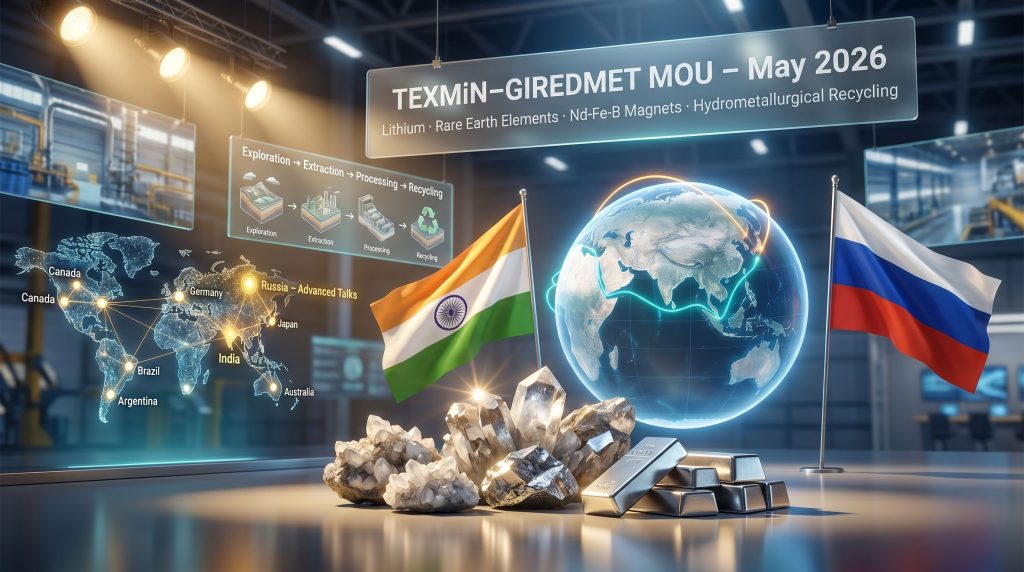
According to two sources familiar with the negotiations cited by Reuters, India and Russia are in advanced discussions to formalise a preliminary agreement on critical minerals, with a focus on lithium and rare earth elements. The proposed framework covers exploration, processing, and technological collaboration. Both governments are also expected to facilitate corporate investment flows between the two countries as part of the arrangement.
A draft agreement had been shared with Russian counterparts as of May 2026, with a signing expected within approximately two months of that date. India's Ministry of Mines is leading the negotiations on the Indian side. Russia's Ministry of Industry and Trade and the office of First Deputy Prime Minister Denis Manturov did not respond to requests for comment from Reuters.
The scope of the proposed agreement is notable not just for what it includes, but for what it signals. Moving beyond raw material procurement into joint processing and technology collaboration suggests that India is attempting to address its downstream capability deficit, not just its upstream supply exposure.
India's Bilateral Minerals Network: Where Russia Fits
To appreciate Russia's strategic position within India's minerals partnership architecture, it is worth mapping the full network of agreements against what each relationship is known to deliver.
| Partner | Agreement Status | Primary Focus | Known Concrete Outcome |
|---|---|---|---|
| Argentina | Signed (2024) | Lithium | 5 exploration/mining blocks secured |
| Australia | Signed | Critical minerals | Supply chain alignment |
| Japan | Signed | Rare earths | Industrial collaboration |
| Germany | Signed (2026) | Technology and processing | Clean energy supply chains |
| Brazil | Signed (2026) | Mining partnerships | Bilateral trade development |
| Canada | Signed (2026) | Technology access | Upstream partnerships |
| Peru | In negotiations | Broader bilateral | Pending |
| Chile | In negotiations | Broader bilateral | Pending |
| Russia | Advanced talks | Lithium, rare earths | Draft agreement shared |
Source: Reuters, May 2026. Partnership details reflect publicly available information as of that date.
Russia occupies a distinct position within this network for several reasons. Unlike most of India's Western-aligned partners, Russia brings geological reserves, established mining and metallurgical infrastructure, and a willingness to engage in deeper technology transfer. Furthermore, Russia operates outside the Western sanctions and export control frameworks that increasingly constrain technology sharing between allied nations, though this same characteristic introduces its own set of complications for Indian entities engaging with Russian state-linked institutions.
The Processing Technology Question
One dimension of the India Russia critical minerals pact that deserves particular analytical attention is the emphasis on processing and technological collaboration, not just exploration rights. This framing reflects a more sophisticated understanding of where India's critical minerals and energy security vulnerability actually lies.
Access to ore deposits is the easier problem to solve. Many countries have minerals in the ground. The harder problem is building the industrial capability to convert those deposits into battery-grade lithium carbonate, permanent magnet alloys, or refined rare earth oxides at competitive cost and scale. This is precisely the capability where China has established the most durable competitive advantages, and where India remains most exposed.
A collaboration framework that includes processing technology therefore has the potential to deliver strategic value well beyond what a simple supply agreement could achieve. Whether that potential translates into actual capability transfer, joint facility development, or co-investment in refining infrastructure will depend heavily on the terms finalised when the agreement is formally signed.
The next major ASX story will hit our subscribers first
Navigating the Geopolitical Complexity
The India Russia critical minerals pact cannot be evaluated in isolation from its broader geopolitical context. India's engagement with Russia on minerals overlaps with existing Western-facing partnerships and raises legitimate questions about how Indian entities will manage exposure to Russian state-linked institutions, particularly given the sanctions architecture that has been in place since 2022.
India has demonstrated a consistent strategic preference for what might be described as multi-vector engagement, maintaining economic relationships with both Western-aligned partners and non-aligned or adversarial states. India's continued energy imports from Russia following 2022 established a precedent for this approach in the resource sector. The minerals pact appears to extend this logic into a new domain.
Several risk dimensions are worth monitoring:
-
Sanctions exposure: Indian companies engaging with Russian state-linked entities may face secondary sanctions risks from Western regulators, particularly if the institutions involved have direct links to sanctioned entities.
-
Processing dependency substitution: There is a genuine strategic risk that deepening minerals cooperation with Russia could substitute one form of external processing dependency for another, rather than building genuine Indian industrial autonomy.
-
Security and geopolitical volatility: The Mali project withdrawal demonstrated that geopolitical conditions can rapidly undermine overseas mineral investments. Russia's own operating environment carries strategic risks that must be factored into long-term planning.
-
Technology transfer limitations: Even within a formally agreed collaboration framework, there is no guarantee that sensitive processing technologies will be transferred on terms that materially advance India's domestic capabilities.
Disclaimer: The risk assessments and scenario analyses in this section represent analytical perspectives based on publicly available information and should not be construed as investment advice or definitive forecasting. Geopolitical dynamics are inherently uncertain and outcomes may differ materially from projections.
What to Watch as the Pact Moves Toward Signing
With a formal signing expected by approximately mid-July 2026, several developments will indicate whether this agreement is progressing toward genuine strategic depth or remains a framework-level commitment.
Key indicators to monitor include:
-
Whether the final signed agreement includes specific provisions for processing technology collaboration or remains limited to exploration frameworks
-
Which Indian public sector undertakings or private entities are identified as lead participants in Russian mineral projects under the corporate investment facilitation component
-
Whether the Mali lithium project discussion progresses as a parallel track, potentially creating a multi-node Russia-linked minerals strategy for India
-
How Western partner governments respond to the formalisation of the pact, and whether any compliance or sanctions-related constraints emerge for participating Indian entities
-
The pace at which earlier 2026 agreements with Germany, Brazil, and Canada begin generating operational outcomes, which will set the benchmark against which the Russia partnership is assessed
A New Architecture for Non-Western Minerals Supply Chains
The India Russia critical minerals pact is one piece of a much larger reconfiguration of global mineral supply chain architecture. The energy transition has created enormous demand for lithium, rare earth elements, cobalt, nickel, and other critical materials. However, it has done so in a geopolitical environment where the existing supply chain concentration, predominantly in Chinese hands at the processing stage, is increasingly viewed as a systemic vulnerability by a growing number of governments.
Consequently, Indian lithium investment has become a focal point of this wider reconfiguration, with New Delhi constructing a multi-partner network that spans Western allies and non-aligned partners. This reflects a pragmatic recognition that no single bilateral relationship can solve the depth and complexity of its minerals exposure. The Russia dimension adds processing capability and geological access that Western-aligned partners have been slower to offer.
In addition, the broader challenge of securing rare earth supply chains sits at the heart of why the Western-aligned partnerships remain essential, offering technology standards, financing mechanisms, and geopolitical predictability that Russia cannot provide. As analysts at the Economic Times note, the depth of any minerals framework ultimately depends on the operational assets secured and the processing capabilities built.
Whether this multi-vector strategy produces the operational mineral security India requires will ultimately be determined not by the agreements signed, but by the assets secured, the processing capabilities built, and the supply chains made genuinely resilient. The pact with Russia is a potentially important building block. But it is the beginning of a structural transformation, not its completion.
Want to Stay Ahead of the Next Major Mineral Discovery on the ASX?
As critical mineral supply chains are reshaped by geopolitical forces, Discovery Alert's proprietary Discovery IQ model delivers real-time alerts on significant ASX mineral discoveries — turning complex mineral data into actionable investment insights for traders and long-term investors alike. Explore historic examples of major mineral discoveries and their returns, then begin your 14-day free trial to position yourself ahead of the market.