
June 12, 2026
When Industrial Accidents Expose the Hidden Fragility of Metal Supply Chains
Commodity markets have a long history of underestimating single-site concentration risk until an incident forces a reassessment. Zinc, despite its industrial ubiquity in galvanising steel, manufacturing batteries, and producing alloys, rarely commands the same investor attention as copper or lithium. Yet the infrastructure underpinning refined zinc supply is far more concentrated than most market participants appreciate. A small number of large integrated smelting complexes account for a disproportionate share of global refined output, meaning that any sustained disruption at one facility can ripple through downstream supply chains with surprising speed.
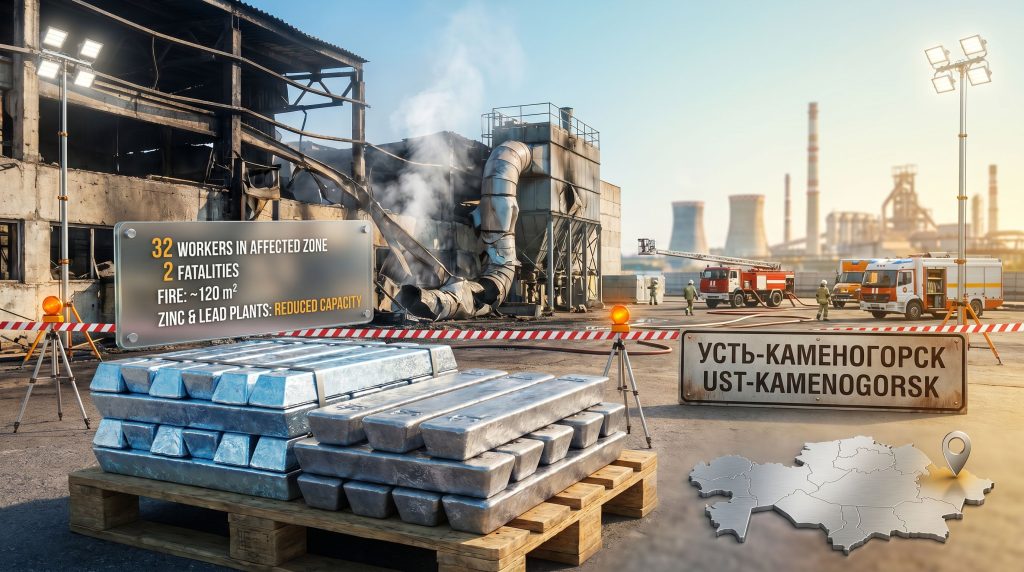
That reality came into sharp focus on 5 May 2026, when an explosion at the Kazzinc metallurgical complex in Ust-Kamenogorsk, eastern Kazakhstan, resulted in confirmed fatalities, injuries, and a formal disclosure of Kazzinc reduced capacity after blast across the facility's zinc and lead processing plants.
When big ASX news breaks, our subscribers know first
What Happened at the Ust-Kamenogorsk Complex
The Incident: Verified Facts and Confirmed Data
According to a Reuters dispatch published on Mining.com on 12 May 2026, Kazzinc confirmed that its zinc and lead plants at the Ust-Kamenogorsk metallurgical complex were operating at reduced capacity following an explosion the previous week. The same report, authored by Maiya Gordeyeva and Maxim Rodionov, confirmed that three people were killed and five others were injured in the blast.
Important note on casualty figures: The Reuters report of 12 May 2026 is the most current verified source and confirms three fatalities. Some earlier or secondary sources have cited two deaths. The Reuters figure of three should be treated as authoritative until official investigation findings are released.
Key confirmed details of the incident include:
- Date: 5 May 2026
- Location: Kazzinc zinc-gold metallurgical complex, Ust-Kamenogorsk, eastern Kazakhstan
- Trigger point: A dust-collection unit during active cleaning operations
- Physical damage: Fire covering approximately 120 square metres, with partial structural collapse of an affected workshop
- Workers in affected zone: 32 at the time of the explosion
- Fatalities: 3 (as confirmed by Reuters, 12 May 2026)
- Injuries: 5
- Environmental impact: None detected via air quality monitoring
Kazzinc confirmed that both site clean-up and a formal investigation were ongoing as of mid-May 2026. The company did not disclose the specific magnitude of the output reduction affecting either plant.
Kazzinc's Ownership Structure and Market Position
Kazzinc is majority-owned by Glencore, one of the world's largest diversified commodity trading and mining groups. The company holds the position of Kazakhstan's largest producer of zinc, lead, and precious metals, according to Reuters. The Ust-Kamenogorsk complex functions as the operational core of Kazzinc's integrated processing output, combining smelting and refining across multiple metals streams under one roof.
Furthermore, Glencore smelting challenges have been a recurring theme in recent years, and the Ust-Kamenogorsk incident adds yet another layer of operational complexity for the group's base metals division.
| Metal | Kazzinc's Role |
|---|---|
| Zinc | Kazakhstan's largest domestic producer |
| Lead | Kazakhstan's largest domestic producer |
| Gold | Significant integrated refinery operations on-site |
| Silver | Co-produced through the refining process |
| Precious metals | Dedicated refinery at Ust-Kamenogorsk |
The integrated nature of the complex is a critical factor in understanding the blast's potential downstream impact. Unlike facilities that process a single metal, the Ust-Kamenogorsk complex handles multiple metal streams simultaneously, meaning any disruption to shared infrastructure, power, or dust management systems can affect several production lines at once.
The Combustible Dust Problem: An Underappreciated Industrial Hazard
Why Zinc Dust Processing Environments Carry Inherent Explosion Risk
The explosion's origin in a dust-collection unit during a cleaning cycle points to one of the most systematically underestimated hazard categories in metallurgical processing: combustible dust. Zinc dust is formally classified as a combustible dust, meaning it can ignite and propagate a deflagration or explosion when suspended in air at sufficient concentrations above the minimum explosive concentration threshold.
What makes this class of incident particularly dangerous is that it frequently occurs not during peak production, but during maintenance windows such as cleaning operations, when standard safeguards may be partially suspended and workers may be working in closer proximity to hazard zones than during normal operations. Indeed, considerations around mining safety and sustainability highlight that maintenance-phase risks often receive insufficient attention relative to active production hazards.
The key combustible dust risk factors in this type of environment include:
- Particle size: Finer zinc particles have greater surface area, lowering the ignition energy required to trigger a deflagration.
- Suspension dynamics: Dust disturbed during cleaning operations becomes momentarily airborne, creating explosive concentration conditions that may not exist during normal steady-state processing.
- Ignition source proximity: Cleaning equipment, static electricity, or residual heat from nearby processing can act as an ignition source during maintenance.
- Confined geometry: Dust collection ducting and collection units create confined volumes where pressure waves from initial ignition can propagate secondary explosions along the duct network.
The partial structural collapse documented at the Ust-Kamenogorsk workshop suggests the initial deflagration generated sufficient overpressure to compromise structural elements, a characteristic of confined dust explosions where pressure relief pathways are inadequate.
This category of industrial incident has global precedent across zinc smelting, grain handling, wood processing, and chemical manufacturing. The common thread is that routine operational activities, not extraordinary process upsets, create the conditions for ignition.
Industrial Safety Benchmarks for Zinc Smelting Facilities
| Risk Category | Relevance to Ust-Kamenogorsk Incident |
|---|---|
| Combustible dust management protocols | Primary explosion trigger (dust-collection unit during cleaning) |
| Hot work and maintenance permit systems | Elevated risk during cleaning operations near ignition sources |
| Emergency evacuation systems | 32 workers present in affected zone at time of blast |
| Structural integrity of older workshop buildings | Partial collapse indicates structural vulnerability |
| Environmental monitoring systems | Air quality monitoring confirmed no external contamination |
Production Disruption: What Reduced Capacity Actually Means for Zinc Markets
The Data Gap at the Centre of the Market Impact Assessment
Kazzinc's statement confirming reduced capacity at both its zinc and lead plants is, on its surface, a relatively contained corporate disclosure. However, the critical detail is not what was said, but what was omitted: no quantified output reduction figure has been publicly disclosed.
This matters considerably for commodity analysts and market participants. In integrated metallurgical facilities, the relationship between physical damage and throughput reduction is not linear. A damaged dust-collection system servicing a single workshop may require the partial curtailment of an entire production circuit if the affected infrastructure cannot be safely bypassed.
Conversely, if the damage is isolated, partial output restoration may be achievable quickly while full restoration takes weeks or months. Broader commodity price impacts from facility-level disruptions of this kind have historically proven difficult to forecast without confirmed throughput data.
Without confirmed throughput data, the possible range of outcomes includes:
- A modest 10–20% temporary reduction managed through operational workarounds
- A sustained 30–50% output curtailment pending equipment replacement and structural repairs
- A more severe disruption if the investigation identifies systemic safety failures requiring broader facility modifications before resumption of full operations
The absence of specific capacity data from Kazzinc is itself analytically meaningful. In major industrial incidents at facilities owned by listed companies, the timing and granularity of production disclosures often provide signals about the severity of the underlying disruption. Delayed or vague disclosure frequently precedes more significant operational updates.
Kazakhstan's Role in Global Refined Zinc Supply
Kazakhstan consistently ranks among the top zinc-producing nations globally, with Kazzinc representing the country's dominant domestic processing capacity. The Ust-Kamenogorsk complex is not a mine-to-concentrate operation; it is an integrated smelting and refining hub, which means it converts zinc concentrates into refined zinc metal suitable for direct industrial use.
This distinction is commercially important. Refined zinc metal, not zinc concentrate, is the product that galvanising operations, alloy manufacturers, and zinc oxide producers purchase. Any sustained reduction in refined zinc output from this facility cannot be immediately offset by increased concentrate production elsewhere; it requires alternative smelting and refining capacity, which operates on longer lead times.
Key monitoring indicators for commodity analysts tracking the downstream impact:
- Official Kazzinc production updates: Any quantified output reduction figure will be the primary market signal.
- LME zinc warehouse inventory movements: Unexpected drawdowns in exchange-held zinc stocks can indicate downstream supply tightness beginning to manifest.
- Government investigation commission findings: Regulatory outcomes will determine whether operational restrictions are imposed beyond what Kazzinc voluntarily implements.
- Glencore quarterly reporting: The next earnings cycle will likely include material disclosure of any production impact, given Glencore's reporting obligations as a publicly listed company.
- Zinc spot and forward curve behaviour: A steepening of zinc backwardation on the LME would signal that physical traders are pricing in near-term tightness.
Government Response and Regulatory Implications
State-Level Oversight of an Industrial Incident
The Kazakhstani government's response to the Ust-Kamenogorsk explosion has been notably direct. Prime Minister Olzhas Bektenov assumed personal oversight of the incident response, an unusual level of political engagement for an industrial accident, reflecting both the severity of the casualties and the strategic significance of the Kazzinc complex to Kazakhstan's industrial economy.
A dedicated government commission was established to investigate the root causes of the explosion, and nationwide safety inspections were ordered across comparable industrial facilities. The breadth of that response suggests the government is treating the incident as a systemic industrial safety matter rather than an isolated operational failure.
Key elements of the governmental response include:
- Establishment of a special commission to investigate explosion causes and assign accountability
- Ordered inspections across comparable metallurgical and industrial facilities nationwide
- Direct engagement at Prime Minister level, indicating high-priority classification of the incident
- Oversight of clean-up and site investigation processes
Compensation Framework and Corporate Accountability
Kazakhstan's long-term compensation commitment following the blast is significant. Kazzinc has pledged to compensate the families of the deceased workers with an amount equivalent to 10 years of salary per individual, which is notably above standard industrial compensation norms in many jurisdictions.
This commitment likely reflects both genuine corporate responsibility and the reputational context of operating under the Glencore umbrella in a country where the government is closely monitoring the response. For Glencore, which manages ESG-sensitive assets across multiple high-scrutiny jurisdictions, how the Kazzinc incident is handled from a worker welfare, transparency, and operational recovery perspective carries implications well beyond the immediate commercial impact of reduced zinc output.
Glencore's Planned Kazzinc Stake Sale: A Complicating Factor
The Divestment Context
Prior to the explosion, Glencore had been reported to be exploring the potential sale of its approximately 70% stake in Kazzinc, with Kazakhstani entrepreneur Shakhmurat Mutalip among the reported prospective acquirers. Industrial incidents of this nature introduce a specific category of transaction complexity that goes beyond simple valuation adjustments.
The scenarios facing any prospective transaction now span a wide range of outcomes:
Scenario A: Rapid Containment. If investigations conclude within weeks and production returns to full capacity on a short timeline, the sale process may proceed with minimal structural disruption, though buyers would likely seek price adjustments reflecting short-term production losses and incremental safety upgrade costs.
Scenario B: Extended Curtailment. If reduced capacity persists for several months, or if structural workshop damage proves more extensive than preliminary assessments suggest, prospective buyers may request enhanced representations and warranties, revised valuations, or deferred transaction timelines pending clearer visibility on the asset's earnings trajectory.
Scenario C: Regulatory Escalation. If the government commission identifies systemic safety management failures, Kazzinc could face mandatory capital expenditure requirements or operational restrictions that materially alter the near-term financial profile of the asset, creating meaningful complications for deal pricing and structure.
The due diligence implications are layered. Any prospective buyer would need to assess not only the physical repair costs but also the liability exposure from the incident, the adequacy of the existing safety management systems, and the risk of future regulatory scrutiny following the nationwide inspection programme.
The next major ASX story will hit our subscribers first
What Commodity Analysts and Investors Should Watch
Positioning in the Context of Incomplete Information
One of the structurally challenging aspects of the Kazzinc reduced capacity situation after the blast is that markets are being asked to price an event whose magnitude remains unquantified. The absence of a confirmed output reduction figure creates a wide distribution of possible outcomes, from commercially negligible to materially significant for regional zinc supply balances.
The initial absence of a notable zinc price response, as of mid-May 2026, suggests market participants are currently treating the disruption as localised and likely temporary. However, this interpretation carries its own risks. Market volatility can amplify quickly once supply tightness becomes quantifiable, and zinc markets have historically experienced periods of acute tightness driven by relatively modest disruptions, particularly when combined with low LME inventory buffers.
Analysts monitoring the situation should track the following data points in sequence:
- First official quantification of output reduction from Kazzinc or Glencore
- LME zinc inventory trend over the following four to eight weeks
- Government commission preliminary findings on the root cause and any required remediation
- Glencore's next quarterly production report and any associated guidance revisions
- Any disclosed updates on the stake sale process and buyer engagement status
Furthermore, a broader review of metals and mining analysis underscores that integrated metallurgical processing hubs represent concentrated, single-point supply risks that are structurally different from mine-level disruptions. Mines can often continue operating at reduced throughput while maintaining some market presence. Integrated smelting complexes that go offline or operate at significantly reduced capacity remove refined metal from availability on a one-to-one basis, creating a more direct transmission mechanism between facility disruption and market tightness.
Disclaimer: This article is intended for informational purposes only and does not constitute financial or investment advice. Forward-looking statements regarding production recovery timelines, zinc market impacts, and transaction outcomes are speculative in nature and subject to material change as new information becomes available. Readers should conduct their own due diligence before making investment decisions related to zinc markets, Glencore, or associated commodity exposures.
Want to Stay Ahead of Supply Disruptions Affecting ASX-Listed Commodity Stocks?
Discovery Alert's proprietary Discovery IQ model delivers real-time alerts on significant ASX mineral discoveries, instantly translating complex commodity and exploration data into actionable investment insights — so subscribers can identify opportunities before the broader market reacts. Explore how major discoveries have historically generated substantial returns on Discovery Alert's dedicated discoveries page, and begin your 14-day free trial today to position yourself ahead of the next market-moving event.