
May 13, 2026
When the World's Most Critical Chokepoint Closes, Africa's Oil Map Gets Redrawn
The Strait of Hormuz closure impact on African oil exporters is becoming one of the defining energy stories of 2026. Global markets have long assumed that the narrow stretch of water between Oman and Iran would remain open. However, once that assumption failed, the fallout spread far beyond crude pricing into freight, food security, trade routes, and geopolitical leverage.
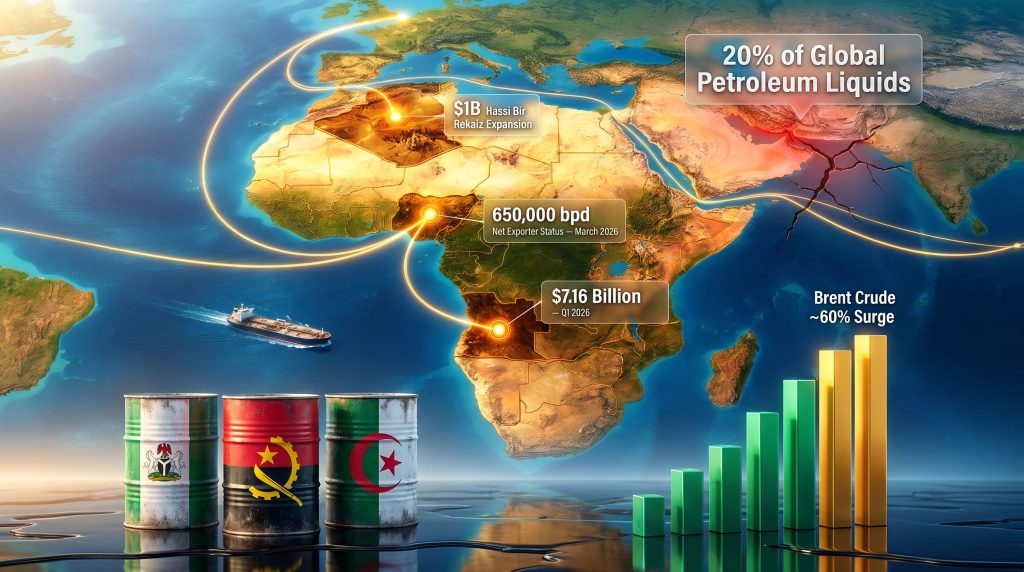
Global energy markets rely on this passage for roughly 20% of global petroleum liquids and more than 25% of seaborne oil trade, according to the U.S. Energy Information Administration. Consequently, a closure does not simply interrupt shipments from the Gulf. It also reshapes opportunities and risks for producers across Africa’s Atlantic and Mediterranean coasts.
The Scale of the Disruption: Numbers That Reframe the Crisis
To understand the current shock, it helps to begin with scale. Saudi Aramco CEO Amin Nasser has warned that the oil market loses 100 million barrels of supply for every week the strait stays shut. That means the cumulative deficit has already exceeded 1 billion barrels.
At the same time, around 880 million barrels have been partially rerouted via Aramco’s east-west pipeline system, while strategic reserves have offered a temporary buffer. Yet these measures are limited. As a result, Brent crude has risen about 60% from pre-closure levels, reinforcing broader concern over crude oil price trends.
The shock reaches further than oil alone. Key trade corridors have seen severe declines, while shipping costs have exploded.
- Fertiliser volumes on key routes: down about 92%
- Dry bulk shipping: down around 83%
- Steel and iron ore flows: down between 65% and 93%
- Tanker day rates: above $400,000 per day
- War-risk insurance premiums: as high as 3% of vessel value per voyage
In addition, the International Energy Agency’s Strait of Hormuz overview notes that this waterway remains one of the world’s most sensitive oil security points. Likewise, UNCTAD’s analysis of Hormuz disruptions highlights the impact on wider trade and development, not merely on energy markets.
For many African economies, the fertiliser collapse is especially alarming. East and West African states that depend on imported agricultural inputs now face higher transport costs and fewer cargoes. Therefore, the energy shock also becomes a food security threat.
Why Rerouting via the Cape of Good Hope Cuts Both Ways
As Gulf routes become unusable, vessels are turning around the Cape of Good Hope. This adds roughly 6,000 to 7,000 nautical miles and extends journeys by 10 to 14 days. Freight bills rise sharply, and so do delays across global shipping networks.
South Africa has seen more vessel traffic as a result. Nevertheless, that traffic has not yet translated into the full infrastructure revenue many expected. For African exporters, this means stronger oil prices are partly offset by heavier logistics costs and broader supply chain impacts.
The key distinction, however, remains clear: African producers are benefiting from price elevation, not suffering from route paralysis. Their cargoes do not depend on Hormuz. In other words, they gain from scarcity without being physically trapped by it.
Nigeria: A Downstream Revolution Meets an Upstream Moment
From chronic importer to net exporter
Nigeria’s changing energy position makes it especially significant in the current crisis. The 650,000 barrel-per-day Dangote Refinery has transformed the country from a major fuel importer into a net petrol exporter.
By March 2026, Nigeria had officially become a net exporter of petrol. Daily petrol production reached 57 million litres, or roughly 360,000 barrels per day, indicating utilisation of about 55% of nameplate capacity.
Its downstream footprint is already substantial:
- Supplies 95% of domestic Jet A1 aviation fuel
- Exported about 876,000 metric tonnes of aviation fuel to Europe between March and April 2026
- Shipped 456,000 tonnes of petroleum products to Togo, Niger, Ghana, and the UK across 12 cargoes
Nigeria’s crude export footprint
Alongside refining strength, Nigeria remains Africa’s largest crude exporter by volume at about 1.4 million barrels per day. The EU imported $14.23 billion of Nigerian crude in 2025, while Singapore, China, and Turkey remain major buyers.
This broad buyer base matters as importers seek alternatives to Gulf producers. Furthermore, the country’s position reflects wider debates around resource export challenges in volatile global commodity markets.
Nigeria’s advantage lies in dual exposure. When crude rises, export earnings improve. When refined products rise too, Dangote captures margin across the chain. That creates a structural edge few African producers can match.
Angola: Revenue Resilience Through Inventory Management
Fewer barrels, more revenue
Angola’s Q1 2026 performance shows how higher prices can outweigh lower volumes. The country exported 86.18 million barrels, worth $7.16 billion, despite a 9.14% quarter-on-quarter decline in volume.
Brent averaged $81.13 per barrel, helping sustain revenue. More strikingly, March exports hit 1,152,930 barrels per day, above production of 1,021,633 barrels per day. That gap suggests Angola drew down inventories to maximise returns while prices were elevated.
This is a sophisticated move. Rather than storing barrels, Angola sold into a favourable market. Consequently, it has shown a level of commercial maturity that strengthens its standing with major buyers.
Angola’s global buyer network
Trade intelligence shows Angola supplied crude to 28 verified buyers globally between July 2024 and June 2025. India’s Indian Oil Corporation accounted for 41% of global imports of Angolan crude during that period.
That matters because India has been actively diversifying supply. Angola’s Atlantic position gives it a strategic advantage in a time of oil market disruption. It offers crude with no Hormuz exposure and reduced geopolitical complication.
Angola’s refining expansion
Angola is also moving to build domestic refining capacity:
- Luanda Refinery expansion from 65,000 BPSD
- Cabinda Refinery newly completed at 30,000 BPSD
- Lobito Refinery planned at 200,000 BPD
At AOG 2026, Angola targeted $70 billion in investment and a rise in local content to 20% by 2027. If achieved, that would deepen resilience beyond the current crisis.
Algeria: Europe’s Most Reliable Alternative to Middle Eastern Supply
Sonatrach’s infrastructure scale
Algeria’s state company, Sonatrach, operates five refineries with combined capacity of roughly 30 million tonnes per year. This established footprint has made Algeria one of Europe’s most dependable nearby crude suppliers.
A recent $1 billion expansion at the Hassi Bir Rekaiz oilfield aims to lift output by 31,500 barrels per day. Therefore, Algeria is not only benefiting from current demand. It is also investing to meet future demand.
A remarkably broad buyer base
Algeria’s export network is strikingly diverse. Volza data shows 26,751 verified buyers worldwide, with 12,634 active buyers during the latest tracked period. That diversity reduces vulnerability to any one disrupted market.
Top import patterns are also geopolitically significant:
- Ukraine: 109,984 shipments
- European Union: 71,144 shipments
- Lithuania: 42,815 shipments
This reflects Europe’s long-running shift away from Russian energy and increased attention to OPEC’s market influence. Algeria has become a practical alternative that is close, established, and free from Hormuz exposure.
Structural immunity to Hormuz risk
Algerian exports move through the Mediterranean and Atlantic-linked routes. They do not need the Strait of Hormuz, the Red Sea, or the Suez Canal under current configurations. In effect, Algeria enjoys what could be called a structurally hedged position.
It captures the upside of a chokepoint shock without carrying the chokepoint risk itself.
The Dual-Impact Framework: Winners, Losers, and the Complexity in Between
The Strait of Hormuz closure impact on African oil exporters is not wholly positive. For Nigeria, Angola, and Algeria, higher Brent prices mean stronger revenue and potentially deeper buyer relationships. Yet, for many other African economies, the picture is much darker.
Import-dependent states face several simultaneous pressures:
- Rising fuel import costs
- Fertiliser shortages
- Surging freight charges
- Higher insurance costs
- Greater fiscal stress from a stronger US dollar
Moreover, planting seasons do not wait. Missed fertiliser deliveries now can turn into harvest shortfalls 90 to 120 days later.
Structural Vulnerabilities Beneath the Revenue Headlines
Even for exporters, there are limits to the upside. A stronger dollar raises the burden of servicing sovereign debt. In addition, instability in the Gulf may delay investment from UAE and Saudi funds that have supported African energy projects.
Africa also still suffers from a refining gap. Nigeria is the standout exception, while Angola is building capacity. However, most of the continent still exports crude and imports expensive fuel. That imbalance magnifies vulnerability whenever global shipping is disrupted.
The Strait of Hormuz closure impact on African oil exporters therefore sits within a much broader economic story. Windfall revenues can help, but they do not erase structural weaknesses in debt, refining, logistics, or food systems.
Frequently Asked Questions
What percentage of global oil trade passes through the Strait of Hormuz?
About 20% of global petroleum liquids and over 25% of seaborne oil trade normally passes through it.
Do African oil exporters send crude through Hormuz?
No. Nigeria, Angola, and Algeria export through Atlantic or Mediterranean routes, so they avoid direct Hormuz exposure.
Which country is best placed to benefit?
Nigeria appears best placed because it combines crude exports with refined product exports, allowing it to earn across multiple parts of the value chain.
Why is food security part of this story?
Because fertiliser shipments on key routes are down by roughly 92%, and that threatens future crop yields across import-dependent African economies.
Converting a Crisis Into Structural Advantage
The Strait of Hormuz closure impact on African oil exporters ultimately reveals a continent split between opportunity and vulnerability. Nigeria, Angola, and Algeria have a rare chance to strengthen their long-term market positions. However, many neighbouring economies are facing severe import-side pain.
To turn this moment into lasting advantage, exporters should focus on:
- Expanding refining capacity
- Diversifying buyers across regions
- Using windfalls to reduce debt and build buffers
The current disruption is accelerating changes that were already underway. If buyers keep some of their newly diversified supply relationships after the strait reopens, Africa’s top exporters could emerge with stronger and more durable roles in the global energy system.
Want To Stay Ahead of the Next Major Resource Discovery?
While Africa's oil exporters are capitalising on structural shifts in global energy markets, Discovery Alert's proprietary Discovery IQ model is scanning the ASX daily to identify the next significant mineral discovery — instantly alerting subscribers to actionable opportunities before the broader market catches on. Explore historic discoveries and the returns they generated, then begin your 14-day free trial to ensure you're positioned ahead of the market.