June 18, 2026
How India's Procurement Strategy Responds to Global Supply Chain Disruptions
India's energy import portfolio underwent dramatic transformation during early 2026, reflecting sophisticated crisis management rather than opportunistic market timing. The nation's position as the world's third-largest oil consumer, with approximately 80% import dependency according to the International Energy Agency, magnifies the impact of any supply chain adjustments on global commodity markets.
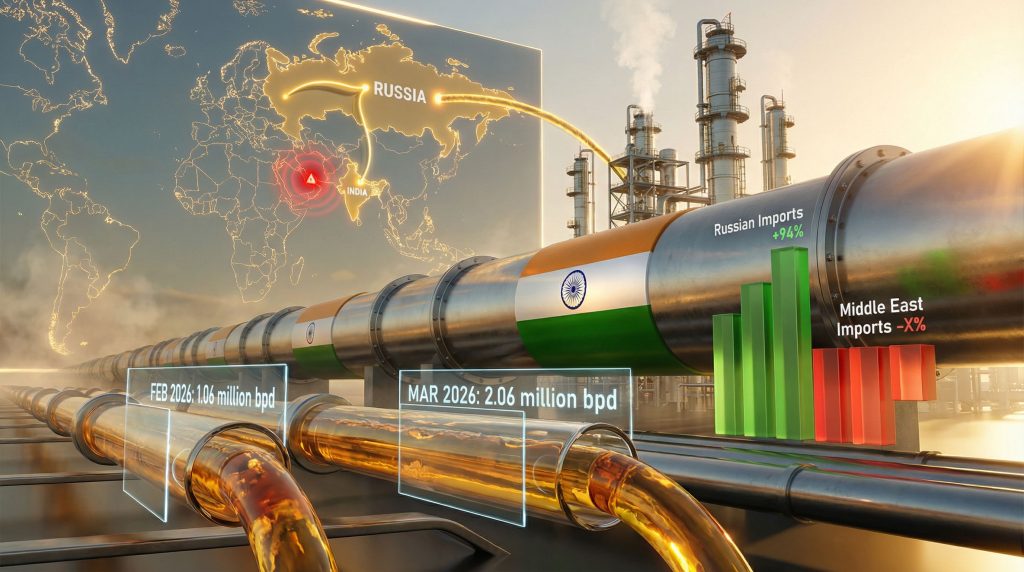
The scale of India's strategic response became evident through rapid procurement acceleration that defied seasonal trends. While total crude imports typically peak between October and April before declining during monsoon maintenance periods, March 2026 volumes reached 2.06 million barrels per day (bpd) from Russian sources, representing a 94% month-on-month increase from February's 1.06 million bpd.
Furthermore, this transformation demonstrates how India increases Russian oil imports in response to regional supply disruptions. The oil price crash analysis reveals broader market dynamics affecting procurement decisions.
Table: India's March 2026 Import Portfolio Transformation
| Source Country | February 2026 (Million bpd) | March 2026 (Million bpd) | Monthly Change |
|---|---|---|---|
| Russia | 1.06 | 2.06 | +94% |
| Saudi Arabia | 1.00 | 0.50 | -50% |
| Iraq | 1.00 | 0.00 | -100% |
| UAE | 0.40 | 0.20 | -50% |
| Total Portfolio | 5.20 | 4.40 | -15% |
Source: OilPrice.com analysis, April 2026
This procurement acceleration occurred despite overall import volumes declining 15% month-on-month, indicating deliberate substitution rather than increased consumption. Russian crude's share of total imports surged from 20.4% in February to 46.8% in March, approaching the May 2023 peak of 2.15 million bpd when India previously maximized Russian purchases.
Refinery Configuration Advantages Drive Technical Compatibility
Indian refineries possess technical specifications optimised for medium-sour crude processing, creating natural advantages for certain crude grades regardless of pricing dynamics. Russian Urals blend, with its API gravity of approximately 32° and sulphur content around 1.4%, matches the processing requirements of India's refining infrastructure.
This technical compatibility reduces switching costs and processing adjustments compared to alternative light sweet crude substitutes. When combined with Venezuelan heavy crude purchases totaling 1.6 million tonnes for April delivery, India's refining strategy demonstrates sophisticated grade optimisation that maintains operational efficiency during supply transitions.
Refiner-Specific Response Patterns:
• Indian Oil Corporation (IOC): Doubled intake to 660,000 bpd, establishing consistent state-sector buying
• Reliance Industries: Rebounded to 360,000 bpd after minimal February volumes of 150,000 bpd
• HMEL/MRPL/HPCL: Resumed purchases after December halt, accounting for 15% of March volumes
• Nayara Energy: Maintained active procurement despite April maintenance scheduling
When big ASX news breaks, our subscribers know first
Regional Supply Disruption Creates Market Reconfiguration Opportunities
The February 28, 2026 Strait of Hormuz disruption eliminated approximately 2.5-2.7 million bpd of traditional Middle Eastern supply flows to India. This geographic chokepoint historically channelled supplies from multiple Gulf producers through a single vulnerability point, exposing the concentration risks inherent in India's energy import architecture.
Iraqi supply cessation represented the most significant single-source disruption, removing 1.0 million bpd of previously reliable volumes. The complete loss of Kuwaiti supplies, combined with substantial reductions from Saudi Arabia and the UAE, created an immediate 1.7-2.0 million bpd supply gap requiring urgent substitution.
Regional Supply Impact Analysis:
The Strait of Hormuz crisis transformed what would normally constitute a supply emergency into a structural market opportunity by creating urgent demand for alternative suppliers at premium pricing levels.
This disruption pattern demonstrates how geographic concentration creates systemic vulnerabilities in energy security planning. Countries historically dependent on Gulf crude for 60-99% of supply requirements, including Thailand, Vietnam, and Sri Lanka, faced similar substitution challenges, intensifying competition for available alternatives.
Infrastructure Vulnerability Cascades Through Asian Markets
Supply substitution requirements extended beyond India as regional buyers competed for limited alternative sources. The Philippines resumed Russian crude imports after a five-year hiatus, purchasing two ESPO cargoes totaling 200,000 tonnes in March. Brunei received ARCO and Varandey shipments through its majority Chinese-owned Hengyi refinery, while government-level negotiations proceeded with multiple Southeast Asian nations.
These procurement patterns reveal how individual supply disruptions create region-wide market distortions. As traditional supplier relationships face geographic constraints, buyers must rapidly develop alternative partnerships, creating new competitive dynamics across Asian energy markets. The OPEC production impact further influences these regional adjustments.
Sanctions Policy Creates Finite Trading Windows and Market Distortions
The March 12, 2026 U.S. sanctions waiver fundamentally altered global oil flow dynamics by creating temporal constraints on Russian crude trading. The waiver specifically applied to cargoes already loaded onto tankers, creating artificial scarcity for previously stranded inventory whilst maintaining restrictions on new production loading.
Floating Storage Depletion Timeline:
- January 2026: 19 million barrels in floating storage
- Late April 2026: 8 million barrels remaining
- Monthly depletion rate: Approximately 3.7 million barrels
Source: OilPrice.com analysis, April 2026
This rapid inventory absorption occurred primarily through Chinese and Indian purchases, with most volumes already positioned in Asian waters. The temporal constraint created by the waiver's scope intensified buyer competition whilst reducing negotiating leverage for smaller regional purchasers.
Russian Urals Premium Signals Market Tightness
The emergence of an $8 per barrel premium for Russian Urals over Brent represents a fundamental market inversion indicating acute medium-sour crude scarcity. This premium structure, described as a rare market occurrence, reflects several converging factors:
Market Tightening Mechanisms:
• Limited availability of previously constrained Russian volumes
• Urgent substitution demand following Middle Eastern supply losses
• Technical compatibility advantages for medium-sour processing refineries
• Competitive intensity between major Asian buyers
The premium's sustainability depends on floating storage depletion rates and infrastructure restoration timelines. As available volumes diminish, pricing pressure may intensify further, potentially creating additional arbitrage opportunities for alternative suppliers.
Infrastructure Risks Compound Supply Constraints
Ukrainian attacks on Russian Baltic ports during March 2026 highlighted infrastructure vulnerabilities affecting export capacity. The Ust-Luga facility, which shipped 480,000 bpd in March with 33% destined for India, ceased operations following March 23 strikes. Primorsk, exporting 910,000 bpd with 32% to India, resumed operations within days but faces ongoing disruption risks.
These infrastructure constraints create potential supply bottlenecks for May 2026 deliveries, depending on restoration capabilities. The combination of sanctions-limited inventory and infrastructure vulnerabilities may further intensify competition for available Russian volumes among Asian buyers. Additionally, tariffs impact markets through complex trade mechanisms.
Economic Optimisation Through Diversified Energy Partnerships
India increases Russian oil imports as part of broader trade balance optimisation strategies that extend beyond simple cost arbitrage. Discounted Russian crude pricing provides estimated annual savings compared to traditional Middle Eastern suppliers, though specific figures require verification through official trade statistics.
Currency Flow Diversification Benefits:
• Rupee-ruble settlement mechanisms reduce dollar dependency
• Bilateral trade expansion enhances monetary policy autonomy
• Alternative payment systems support broader de-dollarisation trends
• Reduced exposure to dollar-denominated energy transaction volatility
The development of alternative payment mechanisms aligns with broader emerging market strategies for reducing dependence on Western-dominated financial systems. These arrangements may persist beyond current geopolitical tensions, creating permanent structural changes in international energy trade settlement.
Strategic Petroleum Reserve Management
India's approach to strategic petroleum reserves during supply disruptions reflects sophisticated inventory management that balances immediate procurement needs with longer-term security considerations. The decision to accelerate Russian purchases whilst maintaining reserve levels demonstrates coordinated energy security planning across multiple timeframes.
Refining capacity expansion plans targeting 450 million tonnes annually by 2030 require diversified sourcing strategies that extend beyond crisis response. Current supply relationships established during market disruptions may influence long-term procurement frameworks as refiners optimise for operational flexibility and cost efficiency.
Future Market Structure Implications and Competitive Dynamics
The current period represents more than temporary crisis response, signalling potential permanent shifts in global energy trade architecture. As traditional supplier relationships face ongoing geopolitical constraints, alternative trading networks gain structural importance in regional energy security planning.
Emerging Market Dynamics:
• Accelerated development of non-Western energy trading systems
• Enhanced importance of technical compatibility in supplier selection
• Growing significance of payment mechanism flexibility
• Increased emphasis on supply chain diversification strategies
These developments suggest that multipolar energy trading systems may become permanent features of global commodity markets. Countries establishing alternative relationships during crisis periods often maintain these connections as insurance against future disruptions, creating lasting market share shifts.
Regional Integration Acceleration Prospects
Enhanced Russia-India energy cooperation may catalyse broader Eurasian economic integration extending beyond crude oil transactions. Potential developments include expanded pipeline infrastructure, joint refining ventures, and technology transfer agreements that deepen bilateral economic relationships.
The sustainability of elevated Russian import levels depends on multiple factors including sanctions policy evolution, alternative supply development, and infrastructure capacity constraints. However, the technical advantages, cost benefits, and payment flexibility demonstrated during current crisis conditions suggest these relationships may persist beyond immediate geopolitical tensions.
Investment Implications and Market Psychology Shifts
Energy market pricing signals reflect broader shifts in investor psychology regarding supply security and relationship diversification. The Russian Urals premium over Brent indicates fundamental changes in medium-sour crude market dynamics that may influence refining margin calculations across Asia.
Investor Sentiment Indicators:
• Energy companies with diversified supply relationships commanding valuation premiums
• Increased investor focus on supply chain resilience metrics
• Growing importance of technical processing capability in asset valuation
• Enhanced attention to alternative payment mechanism development
Indian energy companies demonstrating supply diversification capabilities and established alternative trading relationships attract particular investor interest. This valuation pattern reflects market recognition that supply flexibility provides competitive advantages during disruption periods.
Long-Term Strategic Positioning Considerations
The current transformation demonstrates how crisis-driven procurement decisions can evolve into permanent strategic advantages. Companies and countries that successfully navigate supply disruptions whilst maintaining operational efficiency often emerge with enhanced market positions and improved risk management capabilities.
For global energy markets, India's strategic response exemplifies how emerging economies increasingly prioritise relationship diversification over traditional Western-aligned supplier preferences. This trend accelerates the formation of alternative commodity trading networks operating outside established frameworks. The tariff policy implications also influence these strategic choices.
The next major ASX story will hit our subscribers first
Navigating Multipolar Energy Architecture Development
The dramatic expansion of India's Russian oil imports reflects sophisticated energy security planning that extends far beyond opportunistic crisis response. As global energy markets continue fragmenting along geopolitical lines, successful navigation requires understanding both technical compatibility and relationship flexibility.
India's procurement strategy demonstrates how emerging economies balance cost optimisation with supply security through diversified partnerships. The technical advantages of Russian crude for Indian refineries, combined with alternative payment mechanisms and competitive pricing, create sustainable foundations for continued cooperation regardless of broader geopolitical developments.
Key Strategic Elements:
• Technical refinery compatibility reduces operational switching costs
• Payment mechanism diversification enhances monetary policy independence
• Supply relationship diversification provides crisis response flexibility
• Geographic sourcing spread reduces concentration risk exposure
The permanence of these elevated import levels will ultimately depend on infrastructure capacity development, sanctions policy evolution, and alternative supply availability. However, the demonstrated benefits of diversified energy partnerships suggest these relationships may persist as insurance against future supply disruptions.
For investors and policymakers, India's Russian oil strategy illustrates the acceleration of multipolar trading systems and declining dominance of traditional energy relationships. This transformation requires adaptation strategies for an increasingly fragmented and competitive global energy landscape where relationship flexibility and technical compatibility often matter more than historical partnerships.
The broader implications extend beyond bilateral trade relationships, signalling fundamental changes in how emerging economies conceptualise energy security in an interconnected yet geopolitically fragmented world. Furthermore, as countries navigate the OPEC global influence alongside diversification strategies, Russia's energy strategy becomes increasingly significant for regional stability. As these trends continue developing, understanding both technical and strategic factors becomes essential for navigating the evolving energy landscape successfully.
Are You Positioning Your Portfolio for Global Energy Market Shifts?
India's dramatic pivot to Russian oil demonstrates how geopolitical supply disruptions create immediate opportunities for informed investors. Discovery Alert's proprietary Discovery IQ model delivers real-time alerts on significant ASX mineral and energy discoveries, helping subscribers identify actionable opportunities as global commodity dynamics reshape markets. Begin your 14-day free trial today to position yourself ahead of these transformative market shifts.