August 2, 2026
What Makes India's Rare Earth Element Partnerships Critical for Global Supply Chain Resilience?
The global transition toward clean energy technologies has fundamentally altered the strategic importance of critical minerals, positioning rare earth elements as the backbone of modern technological infrastructure. As nations grapple with supply chain vulnerabilities exposed by geopolitical tensions and market concentration, India's emerging approach to rare earth elements collaboration represents a calculated response to decades of import dependency. The convergence of domestic resource potential, international partnerships, and integrated value chain development creates a unique framework that could reshape regional supply dynamics within the next decade.
The Strategic Imperative Behind India's REE Collaboration Framework
India's critical minerals strategy extends beyond simple resource extraction, encompassing a comprehensive approach that integrates exploration, processing, and downstream manufacturing capabilities. The nation's positioning as a potential alternative to concentrated global supply chains reflects growing recognition that technological sovereignty requires mineral security. This strategic shift becomes particularly evident when examining the collaboration between Gujarat Mineral Development Corporation and NMDC Limited, which represents a blueprint for public sector coordination in critical minerals development.
The partnership framework emphasizes knowledge exchange and technical evaluation, moving beyond traditional mining agreements toward comprehensive technology transfer initiatives. This approach addresses fundamental gaps in India's rare earth processing capabilities while building institutional capacity for future resource development. The focus on indigenous processing capabilities reflects broader national priorities around reducing import dependency and establishing domestic value chains in strategic sectors.
Quantifying India's Domestic Rare Earth Resource Potential
India's rare earth reserves present significant opportunities for supply chain diversification, with geological surveys identifying substantial deposits across multiple states. The Ambadungar deposit in Gujarat, which forms the centerpiece of the GMDC-NMDC collaboration, represents one component of a broader national resource base that includes monazite deposits along coastal regions and inland rare earth formations.
Key Resource Indicators:
- Total identified reserves: Multiple geological formations across seven states
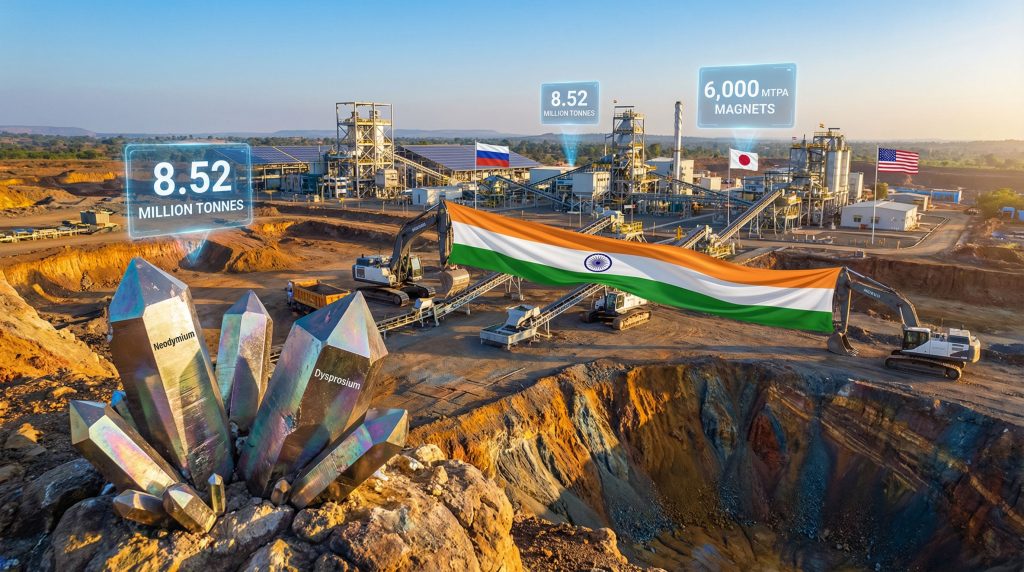
- Processing capacity targets: Focus on developing 6,000 metric tons per annum magnet production capability
- Technology validation: Pilot-stage processing initiatives currently underway
- Value chain integration: End-to-end capabilities from exploration through downstream applications
The technical evaluation of these resources requires sophisticated processing technologies that current domestic capabilities cannot fully support, highlighting the strategic importance of international partnerships in technology transfer and capacity building initiatives.
When big ASX news breaks, our subscribers know first
How Do Public Sector Mining Partnerships Transform India's Critical Minerals Strategy?
The collaboration between public sector mining entities represents a fundamental shift in how India approaches critical minerals development. Unlike traditional single-company extraction models, these partnerships leverage complementary institutional strengths to address complex technical and commercial challenges inherent in rare earth processing.
GMDC-NMDC Alliance: A Blueprint for Integrated Value Chain Development
The memorandum of understanding between Gujarat Mineral Development Corporation and NMDC Limited establishes a framework for comprehensive rare earth development that extends from resource characterization through downstream applications. This partnership model addresses several critical challenges that individual companies struggle to overcome independently.
Partnership Structure Benefits:
- Risk distribution: Shared technical and financial risks across institutional partners
- Knowledge pooling: Combined expertise in exploration, extraction, and processing methodologies
- Resource optimization: Efficient allocation of technical capabilities and infrastructure investments
- Market positioning: Enhanced competitive positioning against established global producers
The alliance focuses particularly on developing sustainable processing capabilities that can support India's growing demand for rare earth elements across clean energy technologies, advanced manufacturing, and strategic industries. This integrated approach contrasts sharply with import-dependent supply chains that expose domestic manufacturers to price volatility and supply disruptions.
Technical Collaboration Models in the Indian Mining Sector
Public sector mining partnerships in India increasingly emphasize technical collaboration over traditional resource-sharing agreements. These models prioritize knowledge transfer, technology validation, and capability development as foundation elements for long-term competitive advantage in global markets.
| Metric | Current Status | 2030 Target | Strategic Impact |
|---|---|---|---|
| Domestic REO Reserves | 8.52 million tonnes | Full characterisation | Supply security |
| Processing Capacity | Limited | 6,000 MTPA magnets | Manufacturing base |
| International Partnerships | 12+ bilateral agreements | Technology localisation | Knowledge transfer |
| Value Chain Integration | Fragmented | End-to-end capability | Market competitiveness |
Which International Collaborations Are Reshaping India's Rare Earth Supply Security?
India's approach to rare earth elements collaboration extends beyond domestic partnerships to encompass strategic international relationships that provide access to advanced processing technologies and market expertise. These collaborations address critical gaps in technical capabilities while supporting broader geopolitical objectives around supply chain diversification.
Russia-India REE Processing Technology Transfer Initiative
The Russia-India partnership in rare earth processing represents one of the most significant technology transfer agreements in the critical minerals sector. This collaboration provides India with access to advanced separation and purification technologies that are essential for producing high-grade rare earth oxides suitable for downstream applications.
Russian expertise in rare earth processing, developed through decades of domestic production, offers India proven methodologies for handling complex mineral compositions found in deposits like Ambadungar. Furthermore, the technology transfer includes separation techniques, purification processes, and quality control systems that meet international specifications for rare earth products.
Japan's Role in Gujarat-Rajasthan Deposit Development
Japan's involvement in India's rare earth development focuses on the technical challenges associated with processing mixed rare earth deposits found across Gujarat and Rajasthan regions. Japanese companies bring specialised knowledge in magnet manufacturing and precision processing that complements India's resource base.
The collaboration with Japan addresses specific technical requirements for producing rare earth magnets used in electric vehicles, wind turbines, and advanced manufacturing applications. Moreover, Japanese expertise in quality control and specifications ensures that Indian-produced materials meet international standards for high-performance applications.
US-India TRUST Framework for Advanced Materials Research
The United States-India collaboration under various strategic frameworks focuses on research and development of advanced materials applications for rare earth elements. This partnership emphasises innovation in processing technologies and development of new applications for rare earth materials in emerging technologies.
The Japan-India collaboration on Rajasthan's 1.29 million metric ton REO deposits represents a strategic model where technology transfer meets resource access, potentially reducing India's import dependency by 40% within the next decade.
What Are the Economic Implications of India's Integrated Rare Earth Value Chain Strategy?
The development of integrated rare earth value chains in India carries significant economic implications that extend beyond the mining sector into broader industrial and technological capabilities. The economic impact encompasses direct investment requirements, job creation potential, and downstream industry development opportunities.
Investment Requirements for End-to-End REE Processing
Establishing comprehensive rare earth processing capabilities requires substantial capital investment across multiple stages of the value chain. Initial estimates suggest that developing integrated facilities capable of processing India's identified reserves requires coordinated investment in exploration, extraction, processing, and manufacturing infrastructure.
Investment Categories:
- Exploration and characterisation: Advanced geological surveys and resource validation
- Processing infrastructure: Separation plants, purification facilities, and quality control systems
- Manufacturing capabilities: Magnet production, alloy processing, and specialised applications
- Research and development: Technology validation, process optimisation, and product development
Job Creation Potential in Critical Minerals Manufacturing
The rare earth value chain development creates employment opportunities across multiple skill levels and technical specialisations. From geological exploration through advanced manufacturing, the sector requires diverse expertise that supports both direct employment and broader economic development in resource-rich regions.
High-skill positions in chemical engineering, materials science, and process optimisation represent the most significant value-added employment opportunities. These positions require specialised training and technical education that positions India's workforce for participation in global critical minerals markets.
Export Revenue Projections from Downstream Industries
India's integrated rare earth strategy positions the nation to capture value-added revenue streams from processed materials and finished products rather than raw material exports. This approach maximises economic returns while building domestic capabilities in strategic technologies.
Export potential extends beyond rare earth oxides to include finished products such as permanent magnets, specialised alloys, and advanced materials for electronics applications. In addition, these higher-value products generate substantially greater export revenues than raw materials while supporting domestic manufacturing capabilities.
How Does the Ambadungar Deposit Fit Into India's Long-Term Mineral Security Vision?
The Ambadungar rare earth deposit represents a cornerstone of India's critical minerals strategy, combining domestic resource development with international technology partnerships to create an integrated value chain spanning exploration, processing, and manufacturing applications. This deposit serves as a testing ground for technical approaches and partnership models that can be replicated across other rare earth resources.
Resource Characterisation and Extraction Feasibility
The Ambadungar deposit presents unique technical challenges that require specialised processing approaches developed through the GMDC-NMDC collaboration. Initial characterisation studies indicate complex mineralogy that demands advanced separation techniques to produce high-grade rare earth concentrates suitable for downstream processing.
Extraction feasibility depends on several factors including ore grade distribution, processing complexity, and infrastructure requirements. The deposit's location in Gujarat provides advantages in terms of transportation access and proximity to industrial infrastructure, supporting cost-effective development of processing facilities.
Processing Technology Requirements and Pilot Programmes
Successful development of the Ambadungar deposit requires proven processing technologies that can handle the specific mineral composition and grade characteristics found in Gujarat's geological formations. Current pilot-stage technology validation programmes focus on optimising separation and purification processes for local ore characteristics.
The partnership between GMDC and NMDC facilitates technology testing and process optimisation through shared expertise and infrastructure investments. These pilot programmes provide critical data for scaling processing capabilities to commercial production levels while maintaining product quality standards.
Market Positioning Against Global REE Producers
India's rare earth development strategy positions domestic production as a strategic alternative to concentrated global supply chains while meeting quality and cost requirements for international markets. The Ambadungar deposit development serves as a foundation for broader market positioning that emphasises reliability, sustainability, and strategic partnership opportunities.
Competitive positioning requires demonstrating technical capabilities, production consistency, and market responsiveness that match or exceed established global producers. Success in developing the Ambadungar deposit provides proof-of-concept for India's broader rare earth capabilities and market credibility.
What Challenges Must India Overcome to Achieve REE Self-Sufficiency?
India's path toward rare earth self-sufficiency faces several critical challenges that require coordinated solutions across technical, regulatory, and market dimensions. These challenges reflect the complexity of establishing integrated value chains in a sector dominated by established global producers with decades of operational experience.
Technology Gaps in Advanced Processing Methods
The most significant challenge facing India's rare earth development involves bridging technology gaps in advanced processing methods. Current domestic capabilities focus primarily on initial concentration and basic separation, while high-value applications require sophisticated purification and finishing processes.
Critical Technology Areas:
- Separation chemistry: Advanced solvent extraction and ion exchange systems
- Purification processes: High-purity oxide production for specialised applications
- Quality control: Analytical capabilities and specifications management
- Process optimisation: Efficiency improvements and waste minimisation
International partnerships provide pathways for technology transfer, but successful implementation requires developing domestic expertise and operational capabilities that can support long-term competitive advantage in global markets.
Environmental and Regulatory Compliance Requirements
Rare earth processing presents complex environmental challenges that require sophisticated management systems and regulatory compliance frameworks. India's environmental regulations continue evolving to address specific challenges associated with rare earth extraction and processing operations.
Processing rare earth ores typically generates radioactive waste streams and chemical byproducts that demand specialised handling and disposal methods. Developing appropriate regulatory frameworks and operational protocols ensures environmental compliance while supporting commercial viability of domestic operations.
Competition with Established Global Suppliers
India's emerging rare earth capabilities face direct competition from established global suppliers with significant cost advantages, technical expertise, and market relationships. Competing effectively requires differentiated value propositions that address specific market needs and customer requirements.
Strategic positioning emphasises supply chain reliability, partnership opportunities, and technical innovation rather than competing solely on cost metrics. Consequently, this approach leverages India's strengths in technical expertise, strategic location, and commitment to sustainable development practices.
The next major ASX story will hit our subscribers first
How Will India's REE Partnerships Impact Clean Energy Technology Manufacturing?
India's rare earth elements collaboration directly impacts the nation's capacity to manufacture critical components for clean energy technologies, positioning domestic industries to participate in global energy transition markets while reducing dependence on imported materials. The energy transition in minerals creates significant opportunities for India's emerging capabilities.
Permanent Magnet Production for Electric Vehicle Motors
The development of domestic rare earth processing capabilities enables India to establish permanent magnet manufacturing for electric vehicle applications. These magnets require high-performance neodymium and dysprosium that must meet strict specifications for automotive applications.
Electric vehicle motor magnets represent one of the fastest-growing applications for rare earth materials, with demand projections indicating substantial market opportunities for domestic producers. Establishing this capability supports India's electric vehicle manufacturing objectives while creating export opportunities in regional markets.
Wind Turbine Component Manufacturing Capabilities
Wind turbine generators utilise rare earth permanent magnets that offer superior performance characteristics compared to conventional alternatives. India's wind energy expansion creates domestic demand for these components while positioning the nation to serve broader regional markets.
Manufacturing wind turbine magnets requires consistent supply of high-grade rare earth materials and specialised production techniques. The GMDC-NMDC collaboration provides foundation capabilities for developing this manufacturing capacity through integrated supply chain development.
Defence and Aerospace Applications Development
Rare earth materials play critical roles in defence and aerospace applications where performance requirements exceed those found in commercial markets. India's strategic industries require reliable access to specialised rare earth materials that meet stringent specifications for advanced systems.
| Application Sector | REE Requirements | Domestic Potential | Partnership Benefits |
|---|---|---|---|
| Electric Vehicles | Neodymium, Dysprosium | High demand growth | Technology access |
| Renewable Energy | Rare earth magnets | Manufacturing scale | Cost optimisation |
| Defence Systems | Specialised alloys | Strategic autonomy | Quality assurance |
| Electronics Manufacturing | High-purity oxides | Technical capability | Market diversification |
What Role Do State-Level Initiatives Play in India's REE Development Strategy?
State-level mineral development corporations play crucial roles in implementing India's rare earth strategy through resource development, infrastructure investment, and partnership facilitation. These entities provide regional expertise and operational capabilities that complement national policy frameworks.
Gujarat's Mineral Development Corporation Leadership
Gujarat Mineral Development Corporation's leadership in rare earth development reflects the state's broader industrial capabilities and strategic positioning in critical minerals. The corporation's approach emphasises integrated development that connects resource extraction with downstream manufacturing opportunities.
GMDC's partnership with NMDC demonstrates how state-level entities can leverage institutional relationships to address technical and commercial challenges that individual organisations struggle to overcome independently. This collaborative model provides a template for other states with rare earth resources.
Tamil Nadu and Kerala Monazite Processing Potential
Coastal states like Tamil Nadu and Kerala possess significant monazite deposits that represent alternative sources of rare earth materials with different processing requirements than inland deposits. These resources offer opportunities for diversified production that reduces concentration risk in national supply chains.
Monazite processing requires specialised techniques due to thorium content and complex mineralogy. State-level development initiatives focus on establishing appropriate processing capabilities while addressing regulatory requirements for radioactive material handling.
Cross-State Coordination for Integrated Development
Successful development of India's rare earth resources requires coordination across multiple states with different geological formations, processing requirements, and infrastructure capabilities. Cross-state partnerships enable resource optimisation and integrated value chain development.
Coordination Benefits:
- Resource complementarity: Different deposit types support diversified production
- Infrastructure sharing: Efficient utilisation of processing and transportation facilities
- Technical expertise: Knowledge sharing across regional development programmes
- Market access: Coordinated approach to domestic and export market development
How Do India's REE Collaborations Compare to Global Best Practices?
India's approach to rare earth elements collaboration incorporates lessons learned from successful international models while adapting to domestic conditions and strategic objectives. Comparative analysis reveals both opportunities and challenges in India's emerging framework.
Australia's Critical Minerals Partnership Model
Australia's critical minerals strategy emphasises international partnerships and technology sharing to develop domestic processing capabilities beyond raw material exports. The Australian model provides insights into effective partnership structures and technology transfer mechanisms.
Australian success in developing downstream processing capabilities demonstrates the importance of sustained investment, technical expertise development, and market positioning strategies. However, India's lithium strategy with Australian companies provides access to proven methodologies and operational experience.
European Union's Strategic Materials Alliance
The European Union's approach to critical materials emphasises supply chain diversification, strategic stockpiling, and partnership development with reliable suppliers. This model demonstrates how regional cooperation can address supply security concerns while supporting technological development.
EU partnerships with India focus on technology sharing, market development, and regulatory alignment that supports long-term strategic relationships. These collaborations provide India with access to advanced European markets while offering European companies reliable alternative suppliers and European raw materials supply diversification.
Lessons from China's Vertical Integration Approach
China's dominance in rare earth markets resulted from integrated development that spans exploration, processing, and manufacturing across the entire value chain. This model provides insights into the importance of coordinated development and long-term strategic planning.
India's partnership approach differs from China's predominantly domestic focus by emphasising international collaboration and technology transfer. This approach provides access to global expertise while building domestic capabilities that support competitive positioning in international markets.
What Investment Opportunities Emerge from India's REE Partnership Strategy?
India's rare earth elements collaboration creates diverse investment opportunities across the value chain, from resource development through advanced manufacturing applications. These opportunities reflect growing market demand and India's strategic positioning as an alternative supplier.
Public Sector Mining Company Growth Prospects
Public sector mining companies involved in rare earth development offer investment exposure to India's critical minerals strategy while providing operational stability and strategic support. Companies like GMDC and NMDC benefit from government backing and access to strategic resources.
Investment in these entities provides exposure to resource development upside while supporting broader economic development objectives. Partnership structures reduce individual company risks while leveraging collective expertise and infrastructure investments.
Technology Transfer Joint Venture Potential
International technology transfer partnerships create opportunities for joint ventures that combine Indian resources with global expertise in processing and manufacturing technologies. These partnerships address critical capability gaps while providing market access for international partners.
Joint venture structures enable risk sharing and technology validation while building domestic capabilities that support long-term competitive advantage. Successful partnerships provide pathways for technology localisation and operational expertise development.
Downstream Manufacturing Investment Requirements
The development of domestic rare earth processing capabilities creates investment opportunities in downstream manufacturing applications including permanent magnets, specialised alloys, and advanced materials. These higher-value applications offer superior margins compared to raw material production.
Manufacturing investments require coordination with upstream processing capabilities to ensure reliable supply of high-quality feedstock materials. For instance, integrated development approaches provide operational synergies while reducing supply chain risks for manufacturing operations, particularly in mining industry innovation sectors.
While India's REE partnerships offer significant long-term potential, investors should consider technology transfer timelines, environmental compliance costs, and market competition from established producers when evaluating opportunities in this sector.
The convergence of domestic resource development, international partnerships, and integrated value chain strategies positions India's rare earth elements collaboration as a critical component of global supply chain diversification efforts. Success in implementing these partnerships requires sustained commitment to technology development, regulatory compliance, and market positioning that addresses evolving demands for critical minerals across strategic industries. The outcomes of current initiatives will determine India's role in reshaping global rare earth supply dynamics and supporting broader technological sovereignty objectives in an increasingly complex geopolitical environment.
Looking to capitalise on critical minerals opportunities?
Discovery Alert's proprietary Discovery IQ model delivers instant notifications on significant ASX mineral discoveries, including critical minerals and rare earth elements that are reshaping global supply chains. Stay ahead of market movements with real-time insights that turn complex exploration announcements into actionable investment opportunities. Begin your 14-day free trial today to position yourself at the forefront of the critical minerals revolution.