August 2, 2026
The Rare Earth Bottleneck That No Clean Energy Transition Can Avoid
The global pivot toward electrification has quietly transformed a handful of obscure metallic elements into the most strategically contested resources on earth. Among them, heavy rare earth elements sit at the apex of supply chain anxiety. Unlike lithium or cobalt, which have attracted billions in exploration capital and diversified supply pipelines, heavy rare earths remain almost entirely captive to a single country's processing infrastructure. That country is China. The deposit geology that could meaningfully change this equation is concentrated in a conflict-affected corner of Southeast Asia: Myanmar's northern highland states.
Understanding why India is now actively pursuing India rare earths from Myanmar requires unpacking both the technical realities of heavy rare earth chemistry and the geopolitical forces reshaping Asia's mineral diplomacy. Furthermore, the broader context of rare earth supply chains makes this pursuit one of the most consequential resource plays of the decade.
When big ASX news breaks, our subscribers know first
Why Heavy Rare Earths Are Not Like Other Critical Minerals
The term "rare earths" is itself somewhat misleading. Most rare earth elements are not particularly scarce in the earth's crust. What makes them rare, in practical terms, is the extreme difficulty and cost of separating, refining, and processing them into forms usable by industry. This challenge is compounded for heavy rare earth elements (HREEs), a subset that includes dysprosium (Dy) and terbium (Tb), which require more complex hydrometallurgical separation processes than their light rare earth counterparts.
Dysprosium and terbium are indispensable additives in the neodymium-iron-boron (NdFeB) permanent magnets that power electric vehicle motors, offshore wind turbine generators, and advanced military guidance systems. Without dysprosium, NdFeB magnets lose their coercivity at elevated operating temperatures, making them unsuitable for high-performance EV drivetrains. Without terbium, the efficiency of these magnets degrades under the thermal stress common in industrial applications.
There is no commercially viable substitute for these elements in high-performance permanent magnet applications at present, which is precisely why nations with clean energy ambitions are scrambling to secure reliable access. The rare earth processing challenges involved only deepen this urgency.
Myanmar's Kachin State: A Geological Anomaly in the Global HREE Map
Myanmar's rare earth deposits, concentrated primarily in Kachin State and parts of Shan State, are geologically distinct from most other known HREE sources. They occur as ion-adsorption clay deposits, a deposit type first identified extensively in southern China's Jiangxi Province. In these formations, rare earth ions are loosely adsorbed onto clay mineral surfaces rather than locked within hard-rock crystal lattices, making extraction relatively simple using in-situ leaching with ammonium sulfate or ammonium bicarbonate solutions.
The practical implication is significant: ion-adsorption clay deposits can be brought into production faster and at lower capital intensity than conventional hard-rock rare earth mines. This is part of why Kachin State's rare earth output scaled rapidly once Chinese operators began systematic extraction in the late 2010s, with Myanmar emerging as a critical node supplying a substantial share of global HREE feedstock.
Analysts have estimated that Myanmar's Kachin State contributes a disproportionately large share of the world's heavy rare earth supply relative to the size of the country's formal mining sector, making it one of the most consequential HREE-producing regions outside China's own domestic deposits.
The flip side of the low-barrier extraction model is environmental fragility. Ion-adsorption clay mining, when conducted without adequate controls, generates significant acid drainage, heavy metal contamination, and soil erosion. According to research on the human cost of rare earth extraction in Myanmar, this environmental legacy is highly relevant to any new operator, including Indian entities, who would face scrutiny over operational standards.
The Supply Chain Architecture That Locks China In
It would be an oversimplification to describe China merely as a buyer of Myanmar's rare earths. The reality is more structurally entrenched. Chinese capital built much of the extraction infrastructure in Kachin State. Chinese chemical reagents, particularly ammonium compounds, are the operational inputs for the leaching process. Chinese logistics networks move ore concentrates across the border, and Chinese separation facilities in Yunnan Province transform Kachin feedstock into separated rare earth oxides sold to manufacturers globally.
This means that even if raw ore were theoretically redirected toward Indian processing, the upstream extraction operations themselves remain financially and technically dependent on Chinese supply chains. Displacing this embedded presence is not a matter of signing a bilateral agreement; it requires building parallel infrastructure across every link in the value chain simultaneously. Consequently, China's export restrictions have only accelerated the urgency with which India is seeking alternatives.
| Factor | Current Reality | India's Strategic Goal |
|---|---|---|
| Primary rare earth supplier | China (processing and refining) | Diversified, direct sourcing |
| Myanmar ore destination | Chinese refineries via Kachin corridor | Indian processing facilities |
| India's refining capacity | Limited for heavy rare earths | Scale-up under development |
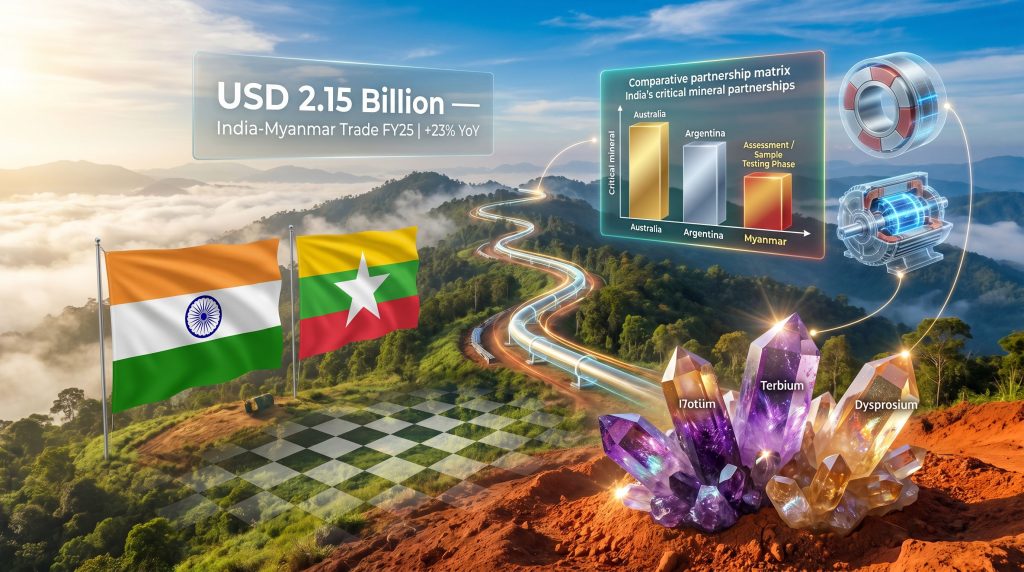
| Bilateral trade (FY25) | USD 2.15 billion (+23% YoY) | Expanded via rupee-kyat mechanism |
India's Rare Earth Vulnerability and the Myanmar Opening
India's clean energy ambitions are substantial. The country has committed to significant renewable energy capacity expansion, including large-scale wind power deployment, and its domestic electric vehicle market is projected to grow sharply through the 2030s. Both sectors require permanent magnets containing dysprosium and terbium, elements that India currently has almost no domestic supply of. The growing critical minerals demand for these inputs places India in an increasingly exposed position.
This structural gap creates what analysts describe as a compound vulnerability: India is dependent on China not just for refined rare earth products, but for every stage of the value chain from separation chemistry to magnet alloy manufacturing. Any supply disruption or export restriction from Beijing could simultaneously affect Indian EV production, wind turbine deployment, and defence procurement.
The diplomatic opening created by Myanmar's President Min Aung Hlaing's visit to New Delhi in mid-2026 placed rare earth access prominently on the bilateral agenda. According to reporting by ET Bureau, the question of India rare earths from Myanmar featured in discussions between Prime Minister Narendra Modi and the visiting leader.
India's Ministry of Mines has reportedly coordinated an initiative involving both state enterprise IREL (India Rare Earths Limited) and private sector participant Midwest Advanced Materials to evaluate ore samples from Kachin State sources. This assessment phase is a necessary precursor to any commercial engagement, allowing Indian technologists to characterise the ore's HREE grade, mineralogy, and amenability to Indian processing methods.
It is important to note that India's engagement with Myanmar rare earth sources remains firmly at the assessment and sample-testing stage. No formal supply agreement has been publicly announced, and analysts characterise current activity as geopolitical positioning rather than operational supply chain development.
The Kachin Corridor: Where Geology Meets Geopolitics
Any analysis of India rare earths from Myanmar that focuses solely on mineralogy or trade statistics misses the defining variable: the security environment. Kachin State's rare earth mining zones sit in territory where the Kachin Independence Army (KIA) and associated armed groups exercise significant territorial influence. As Reuters has reported, India is actively exploring access to these deposits even amid the volatile intersection of military control, non-state actors, and international sanctions considerations.
For any non-Chinese operator, the practical challenges compound rapidly:
- Transport routes from mining areas to Indian border crossings traverse conflict-affected terrain with no established secure logistics framework
- Regulatory clarity over mining rights is effectively contested between the Myanmar central government and armed groups controlling physical access
- International sanctions on Myanmar's military government create reputational and compliance risks for foreign investors engaging with state-affiliated mining entities
- Chinese operators have navigated these complexities through longstanding relationships, geographic proximity, and operational flexibility that India's more institutionally constrained state enterprises cannot easily replicate
The next major ASX story will hit our subscribers first
Bilateral Trade as the Foundation for a Deeper Minerals Partnership
The economic relationship between India and Myanmar provides a meaningful platform for deeper minerals engagement, even if it falls well short of the kind of integrated supply chain partnership India needs.
India-Myanmar bilateral trade reached USD 2.15 billion in FY25, representing 23% year-on-year growth. Myanmar's exports to India totalled USD 1.53 billion, while Indian exports stood at USD 614.3 million. Pulses and beans dominate Myanmar's export basket, accounting for approximately 77% of total Myanmar exports to India and growing by 29% in FY25 alone.
India ranks as Myanmar's fourth-largest trading partner, and according to Myanmar government data, India is the eleventh-largest investor in the country with approved investment of USD 782.821 million across 39 Indian enterprises, against total estimated foreign direct investment of USD 96.05 billion from 53 countries.
The rupee-kyat bilateral settlement mechanism, operational since January 2024, removes one historical friction from trade expansion by allowing both countries to transact in local currencies rather than requiring US dollar intermediation. Theoretically, this mechanism could facilitate rare earth payment flows without hard currency constraints, though the practical application to mineral trade has not yet been formally structured.
The Four Structural Obstacles India Must Overcome
The gap between India's strategic intent and operational supply chain reality can be mapped across four distinct obstacle categories:
1. Refining Infrastructure Deficit
India lacks domestic hydrometallurgical separation capacity for heavy rare earths at commercial scale. Even if Kachin ore were procured directly, the processing bottleneck would likely redirect value-adding steps to third-country facilities, potentially including Chinese ones, undermining the entire purpose of the sourcing initiative.
2. Embedded Chinese Presence in Extraction Operations
The technical, financial, and logistical integration of Chinese actors throughout Kachin State's mining ecosystem cannot be unwound by diplomatic statements. Building credible parallel infrastructure requires years of capital commitment and technical capacity development.
3. Conflict and Security Risk
The operating environment in Kachin State presents risks that state enterprises and institutional investors are structurally ill-equipped to absorb. Any viable operational model would require novel risk-sharing arrangements that do not currently exist within India's minerals policy framework.
4. Absence of a Formal Bilateral Minerals Agreement
As of mid-2026, no publicly announced framework governs rare earth trade between India and Myanmar. Large-scale commercial flows would require dedicated investment protections, origin certification frameworks, and logistical cooperation agreements that are still absent from the bilateral architecture.
Comparing India's Myanmar Engagement to Other Critical Mineral Partnerships
India has moved with varying degrees of urgency across its critical minerals diplomacy portfolio. The Myanmar engagement sits at the earliest stage of development compared to more formalised partnerships. In addition, considerations of energy transition security are pushing India to accelerate progress across all fronts simultaneously.
| Partnership | Minerals Targeted | Stage |
|---|---|---|
| India-Australia | Lithium, cobalt, nickel | MoU signed, projects active |
| India-Argentina | Lithium | Exploration agreements |
| India-Myanmar | Heavy rare earths (Dy, Tb) | Assessment and sample testing |
| India-Africa (various) | Graphite, cobalt | Early engagement |
The contrast with Australia is particularly instructive. The India-Australia critical minerals partnership benefits from robust institutional frameworks, rule-of-law operating environments, and established mining industry infrastructure. The Myanmar context offers none of these advantages, which explains why, despite the geological significance of Kachin State's deposits, India's engagement has progressed slowly relative to partnerships in more stable jurisdictions.
What a Functioning India-Myanmar Rare Earth Corridor Would Actually Require
The Six Prerequisites for Success
Building a credible alternative to Chinese dominance in Myanmar's HREE supply chain is not an incremental undertaking. It is a systems-level challenge requiring simultaneous progress across multiple fronts:
- Negotiation and ratification of a formal bilateral minerals cooperation framework with enforceable investment protections
- Significant capital deployment into domestic rare earth separation and refining capacity within India, likely requiring technology transfer or joint ventures with non-Chinese technical partners
- Development of secure, conflict-resilient transport corridors connecting Kachin State mining areas to Indian processing hubs through the India-Myanmar border
- Diplomatic engagement frameworks that address the practical reality of non-state actor control over mineral access zones
- Alternative sourcing strategies for chemical reagents currently supplied by Chinese entities to Kachin mining operations
- Long-term offtake commitments credible enough to justify upstream capital deployment by mining operators
Even under optimistic assumptions, the construction of a functioning India-Myanmar rare earth corridor is a five-to-ten year undertaking. Treating the current assessment phase as a near-term supply solution would significantly misrepresent the complexity of what is actually required.
The Broader Strategic Logic: Why the Effort Matters Despite the Obstacles
The case for India pursuing Myanmar rare earth access is not that it is easy. It is that the alternative, indefinite dependence on Chinese-controlled HREE supply chains, carries compounding strategic risk as India scales up its clean energy and defence manufacturing sectors.
China has already demonstrated willingness to use rare earth export controls as a geopolitical instrument, imposing export restrictions on key minerals in response to trade and technology disputes with other major economies. India, as a country simultaneously pursuing clean energy expansion and a more autonomous defence manufacturing base, cannot afford to remain exposed to that leverage indefinitely.
Myanmar's Kachin State represents one of the few geologically significant HREE sources outside of Chinese sovereign control. That geological reality alone justifies sustained diplomatic and technical engagement, even if near-term commercial outcomes remain uncertain. However, as analysis from The Diplomat highlights, India's minerals gamble in Myanmar involves navigating rebels, resource rivalries, and deeply embedded Chinese influence simultaneously.
The distinction that matters for investors and policymakers alike is between strategic positioning and operational supply security. India is currently achieving the former. The latter remains years away, contingent on resolving infrastructure, security, political, and technical challenges that diplomatic goodwill alone cannot address.
This article contains forward-looking analysis and scenario assessments. Readers should note that rare earth supply chain development involves substantial execution risk, geopolitical uncertainty, and long project timelines. Nothing in this article constitutes investment advice or financial guidance.
Want to Track the Next Major Mineral Discovery Before the Market Does?
Discovery Alert's proprietary Discovery IQ model delivers real-time ASX alerts on significant mineral discoveries — including critical and rare earth minerals driving the global energy transition — transforming complex geological data into clear, actionable insights for investors at every level. Explore historic discoveries and their remarkable returns to understand the scale of opportunity, then begin your 14-day free trial to position yourself ahead of the market.