June 21, 2026
India's emerging renewable energy landscape reflects a nation grappling with the dual imperatives of energy security and climate commitments. The ambitious target of achieving a 500 gigawatt clean energy capacity by 2030 exemplifies this complex transition, where traditional fossil fuel dependencies must be systematically replaced while navigating new vulnerabilities in critical minerals energy transition supply chains. Furthermore, this transformation occurs against a backdrop of geopolitical uncertainty that has elevated energy independence from aspiration to strategic necessity.
Understanding the Scale of India's Renewable Energy Transformation
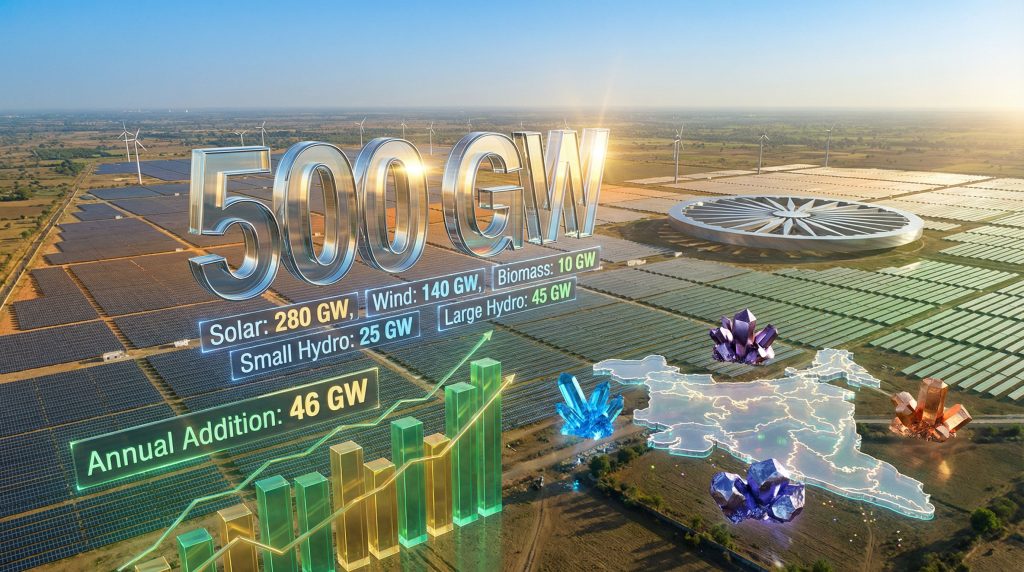
India's commitment to achieve 500 gigawatts of non-fossil fuel capacity by 2030 represents one of the most ambitious energy transition targets globally. This comprehensive framework encompasses 280 GW of solar capacity, 140 GW of wind energy, 45 GW of large hydro, 25 GW of small hydro, and 10 GW of biomass and waste-to-energy installations.
Current progress indicates approximately 271-272 GW of non-fossil fuel capacity has been achieved as of early 2026, according to Central Electricity Authority data. This baseline requires an acceleration to 46 GW of annual additions through 2030, representing a significant increase from the 16-18 GW added annually in recent years.
The strategic context extends beyond capacity targets to encompass India's broader climate commitments. The Panchamrit framework, announced at COP26 Glasgow, established five core pledges including 50% renewable energy by 2030 and net-zero emissions by 2070. Consequently, these commitments were subsequently integrated into India's updated Nationally Determined Contribution, creating binding policy frameworks for sectoral implementation.
Regional Implementation Strategies
State-level progress demonstrates varied approaches to renewable deployment:
- Rajasthan: Leading with 18 GW operational solar capacity, targeting 25 GW by 2030
- Gujarat: Operating 11 GW solar capacity, expanding through the ambitious Khavda Solar Park project
- Tamil Nadu: Maintaining 13 GW operational wind capacity with coastal development focus
- Andhra Pradesh: Implementing comprehensive renewable policies targeting 15 GW by 2030
International Context and Benchmarking
Comparative analysis reveals the magnitude of India's challenge. China achieved annual renewable additions exceeding 200 GW in 2024, while the European Union installed approximately 75 GW annually. Meanwhile, the United States maintains 300+ GW of renewable capacity with 25-30 GW annual additions.
India's trajectory requires sustained policy continuity and accelerated deployment mechanisms. The economic implications include potential job creation of 330,000-540,000 positions across manufacturing, installation, and operations. Moreover, cost savings through avoided fuel imports could reach ₹4-5 lakh crore by 2030, according to India's ambitious renewable energy targets outlined by government assessments.
When big ASX news breaks, our subscribers know first
Critical Mineral Dependencies Create Strategic Vulnerabilities
The transition to renewable energy creates unprecedented demand for specific minerals essential to clean energy technologies. India faces substantial import dependencies across key materials, creating potential supply chain vulnerabilities that could constrain renewable deployment timelines.
Import Dependency Analysis
Current mineral import patterns reveal significant strategic exposure:
| Mineral | Import Dependency | Primary Sources | 2025-2030 Demand Growth |
|---|---|---|---|
| Lithium | 100% | Australia (45%), Chile (30%), Argentina (20%) | 450-500% increase |
| Cobalt | 85-90% | Democratic Republic of Congo (70%), Zambia (15%) | 300-350% increase |
| Nickel | 70% | Indonesia (30%), Philippines (20%), Russia (15%) | 350-400% increase |
| Rare Earth Elements | 95% | China (60%), Myanmar (20%) | 250-300% increase |
| Copper | 50% | Chile (40%), Peru (25%) | 150-200% increase |
Global lithium demand projections indicate growth from 1.3 million tonnes lithium carbonate equivalent in 2025 to 3.5-4.0 million tonnes by 2030. India's projected requirement of 180,000-250,000 tonnes LCE represents a substantial portion of this global expansion.
Processing and Refining Bottlenecks
Beyond raw material access, processing capacity represents a critical constraint. China controls approximately 70% of global lithium processing and 80-90% of rare earth element refining. This concentration creates vulnerability points where geopolitical tensions could disrupt supply chains regardless of raw material availability.
Analysis from the Centre for Science and Environment emphasises that processing and refining capabilities represent more immediate constraints than mining access. India's domestic processing capacity currently handles less than 2% of regional demand, necessitating substantial infrastructure investment, particularly when considering the lithium refinery in India development requirements.
Technical requirements for lithium processing illustrate the complexity. Spodumene ore refining yields approximately 65-70 kg lithium carbonate per tonne of ore, while brine extraction through direct lithium extraction technologies remains at 30-40% technical maturity with 3-5 year development timelines.
Supply Chain Concentration Risks
The Democratic Republic of Congo's dominance in cobalt supply exemplifies concentration risks. Approximately 70% of global cobalt originates from DRC operations, with 40-50% from artisanal mining that raises ethical sourcing and quality consistency concerns. Cobalt pricing volatility in the $20-40 per pound range creates additional cost uncertainty for battery manufacturers.
Rare earth element processing presents technical complexities requiring specialised separation technologies for 17 distinct elements. China's dominance stems from decades of investment in rare earth separation science, while environmental remediation costs typically consume 40-60% of refining economics.
Geopolitical Dynamics Reshape Energy Transition Urgency
Middle East tensions and global supply chain disruptions have accelerated India's renewable energy deployment rationale beyond climate considerations to encompass energy security imperatives. Oil price volatility in the $85-105 per barrel range creates economic incentives for renewable investment as a hedge against fossil fuel cost fluctuations.
Strategic Petroleum Vulnerabilities
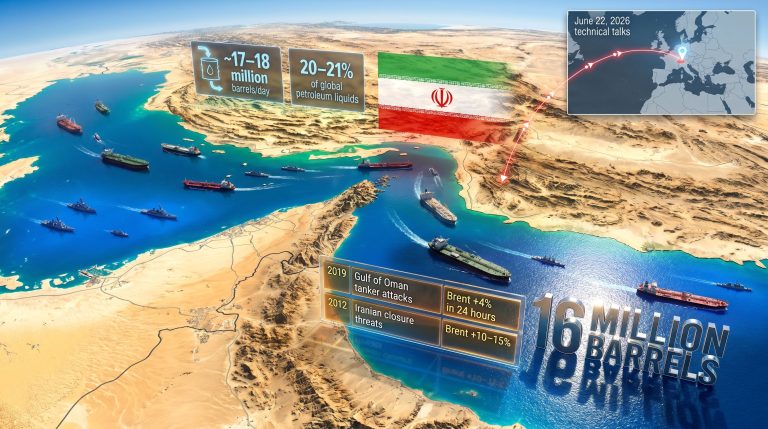
India's strategic petroleum reserve capacity of 5.33 million tonnes provides approximately 18-20 days of consumption coverage, significantly below the International Energy Agency's 90-day recommendation. This limited strategic buffer amplifies vulnerability to supply disruptions, particularly given that 40% of India's oil imports transit through the Strait of Hormuz.
The economic impact of oil import dependency reaches $120-150 billion annually at current prices. Supply route vulnerabilities through critical chokepoints create scenarios where 15-20% price spikes could occur within 48 hours of supply interruption, according to International Energy Agency assessments.
Resource Nationalism Trends
Mineral-producing countries increasingly implement local processing requirements that complicate Indian supply chains. Ghana and the Democratic Republic of Congo mandate domestic value addition for mineral exports, while Bolivia and Chile pursue lithium resource nationalisation strategies.
These trends necessitate diversified sourcing strategies and potential investment in overseas processing facilities. Australia's critical minerals partnerships through Quad cooperation frameworks offer alternative supply chain configurations that reduce dependence on Chinese processing capacity.
Domestic Mineral Production Capabilities and Limitations
India maintains production capacity across several critical materials but faces scale and processing constraints that limit self-sufficiency potential. Current domestic production includes 30,000-40,000 tonnes of graphite annually from Odisha, Jharkhand, and Tamil Nadu operations.
Existing Production Strengths
Aluminium sector leadership positions India as the world's fifth-largest producer with 4.1 million tonnes annual capacity. Major players including Hindalco, Vedanta, and NALCO operate integrated smelting operations that could support expanded downstream applications in renewable energy components.
Copper production reaches approximately 850,000 tonnes annually, though this remains insufficient for renewable energy infrastructure requirements. Vedanta's Sukinda operations represent India's largest copper mine, with expansion projects facing environmental clearance challenges but offering potential capacity growth.
India holds 9-12% of global graphite reserves, primarily in Odisha and Tamil Nadu. Natural graphite deposits could potentially substitute 40-50% of imported graphite for battery applications, reducing import dependency to manageable levels.
National Critical Mineral Mission Progress
The government's National Critical Mineral Mission allocates ₹4,000 crore for geological surveys and exploration activities. Mining lease auction reforms aim to streamline critical mineral block allocation, while research institution partnerships with IITs focus on developing domestic extraction technologies.
Progress remains constrained by project delays and financing gaps. Institute for Energy Economics and Financial Analysis research identifies three critical barriers: limited long-term capital availability for infrastructure-heavy projects, absence of proprietary processing technologies, and insufficient offtake agreements to guarantee market demand for processed materials.
Financing Mechanisms for Large-Scale Renewable Deployment
Meeting India's 500 GW clean energy goal requires approximately $385 billion in total investment, encompassing generation capacity, grid infrastructure, and energy storage systems. Current financing mechanisms must expand significantly to address this capital requirement within the 2030 timeline.
Capital Requirements Breakdown
Grid infrastructure upgrades alone require ₹2.44 lakh crore for transmission line development under the Green Energy Corridors initiative. Battery energy storage systems necessitate approximately $15 billion investment to manage variable renewable generation and ensure grid stability.
The 51,000 circuit kilometres of transmission infrastructure represents a fundamental requirement for renewable energy evacuation from resource-rich regions to demand centres. Central Electricity Authority projections indicate 35-50 GWh of energy storage capacity will be essential for maintaining grid reliability with high renewable penetration.
Innovative Financing Approaches
Green bond market development targets ₹50,000 crore annual issuance, though current market capacity remains below required levels. Sovereign wealth fund partnerships with UAE and Saudi Arabia entities provide alternative capital sources, particularly for large-scale solar and wind projects.
Development finance institution support through World Bank and Asian Development Bank lending programs offers concessional financing for infrastructure development. Corporate investment strategies demonstrate varied approaches to meeting renewable targets.
Corporate Investment Strategies
Tata Power pursues an integrated approach targeting 70% clean capacity through combined solar, wind, hydro, and battery installations. Adani Green Energy scales toward a 45 GW renewable portfolio by 2030, while NTPC expands clean energy capacity by 60 GW through its renewable subsidiary.
These corporate strategies illustrate different models for achieving scale while managing execution risks. Integrated approaches that combine multiple technologies offer portfolio diversification benefits, though they require broader technical capabilities across renewable energy segments.
Circular Economy Solutions for Mineral Security
Recycling and circular economy approaches offer potential pathways to reduce import dependencies while managing growing mineral demand. India's position as the third-largest producer of electronic waste globally creates opportunities for critical mineral recovery through improved waste processing systems.
E-Waste Recovery Potential
Annual e-waste generation of 5.2 million tonnes contains significant quantities of lithium, cobalt, and rare earth elements currently lost to informal recycling sectors. Formal recovery systems could achieve 80% collection rates compared to current 20% levels, substantially increasing domestic mineral availability.
Lithium-ion battery waste projections reach 95,000 tonnes by 2030 from electric vehicle adoption alone. Hydrometallurgical processing technologies can recover 95% of lithium, cobalt, and nickel from spent batteries, though infrastructure investment and regulatory frameworks require development, particularly in the battery recycling process implementation.
Recycling Infrastructure Requirements
Establishing formal recycling capabilities requires extended producer responsibility regulations that incentivise manufacturers to design products for recyclability and fund end-of-life processing. Current informal recycling sectors lack environmental controls and safety standards necessary for critical mineral recovery.
Technical processing methods for battery recycling involve complex hydrometallurgical procedures that require specialised facilities and trained workforce development. Investment requirements for recycling infrastructure represent a fraction of primary extraction costs while providing more predictable supply chains.
The next major ASX story will hit our subscribers first
Regional Manufacturing Hub Development
Creating domestic manufacturing ecosystems requires coordinated development of industrial parks, supply chains, and skilled workforce capabilities. Production-linked incentive schemes allocate ₹4,500 crore for solar PV manufacturing, though comprehensive manufacturing strategies must address multiple technology segments.
Solar Manufacturing Ecosystem Development
Integrated solar parks in Rajasthan, Gujarat, and Andhra Pradesh provide platforms for co-locating manufacturing with large-scale installations. Domestic content requirements targeting 60% local sourcing create market incentives for manufacturing investment while reducing import dependencies.
Supply chain localisation encompasses multiple manufacturing stages from polysilicon production through module assembly. Each stage requires specific technical capabilities and capital investment, necessitating phased development approaches that build manufacturing complexity over time.
Wind Energy Manufacturing Clusters
Offshore wind potential along India's 7,600 km coastline offers 70 GW of development capacity, requiring specialised manufacturing capabilities for marine-grade components. Turbine nacelles, blades, and towers require substantial manufacturing facilities with proximity to installation sites.
Port infrastructure development for wind component handling represents a critical enabler for offshore wind deployment. Specialised vessels and installation equipment must be developed domestically or secured through international partnerships to support large-scale offshore projects.
Grid Integration Challenges and Solutions
Achieving 500 GW of renewable capacity requires fundamental changes to grid architecture and operation procedures. Variable generation from solar and wind resources necessitates enhanced forecasting, storage, and demand response capabilities to maintain system reliability.
Transmission Infrastructure Expansion
The Green Energy Corridors initiative encompasses 51,000 circuit kilometres of new transmission lines designed to evacuate renewable energy from resource-rich regions to demand centres. Renewable energy management centres provide centralised control systems for managing variable generation across multiple states.
Interstate connectivity improvements enable renewable energy trading between surplus and deficit regions, optimising resource utilisation across India's diverse renewable energy resource base. Grid stability solutions include pumped hydro storage and grid-scale battery installations strategically located to provide rapid response capabilities.
Demand-Supply Balancing Mechanisms
Time-of-use tariff structures encourage electricity consumption during peak renewable generation periods while reducing demand during low renewable output times. Industrial consumers, particularly aluminium smelters and steel plants, can provide demand flexibility through modified production schedules aligned with renewable availability.
Agricultural pump electrification through solar irrigation systems reduces grid load during peak agricultural demand periods while providing farmers with reliable water pumping capabilities. These distributed solar installations contribute to overall renewable capacity while addressing rural energy access challenges.
International Partnership Strategies
Technology transfer agreements and mineral security partnerships provide pathways to accelerate India's clean energy transition while building domestic capabilities. Strategic alliances offer access to advanced technologies and supply chain diversification opportunities essential for meeting ambitious renewable energy targets.
Technology Transfer and Cooperation Frameworks
The US-India Clean Energy Finance initiative provides $8 billion in Development Finance Corporation commitments for renewable energy and storage projects. German renewable energy cooperation focuses on solar technology advancement and grid integration expertise through bilateral technical programs.
Japanese partnerships emphasise advanced battery manufacturing and energy storage technologies through joint venture arrangements that combine Japanese technical capabilities with Indian manufacturing scale. These collaborations provide technology access while building domestic manufacturing capabilities, supporting India's aspirations for green metals leadership in the region.
Mineral Security Alliance Development
The Quad Critical Minerals Partnership between Australia, India, Japan, and the United States creates framework agreements for supply chain cooperation and joint investment in critical mineral projects. Australia's mineral resources combined with Indian processing capabilities offer alternatives to Chinese supply chain dominance.
International Solar Alliance membership of 121 countries facilitates technology sharing and coordinated procurement strategies that reduce individual country dependencies on specific suppliers. Indo-Pacific Economic Framework initiatives address supply chain resilience through regional cooperation mechanisms.
Scenario Analysis for 2030 Target Achievement
Multiple pathway scenarios illustrate different potential outcomes for India's 500 GW clean energy goal based on varying assumptions about policy continuity, technology costs, and supply chain development.
Optimistic Trajectory Assessment
Sustained deployment rates of 46+ GW annually combined with continued technology cost declines could enable target achievement by 2030. Solar plus storage reaching grid parity by 2027 would accelerate deployment through improved economics without requiring subsidies.
Policy continuity through 2030 provides investment certainty that encourages private sector participation and long-term capital commitment. Stable regulatory frameworks reduce project development risks and enable efficient capital allocation across the renewable energy sector, particularly when supported by adequate green transition materials availability.
Base Case Projections
Achievement of 480-520 GW represents a realistic outcome accounting for typical project delays and grid integration constraints. Large hydro projects face extended environmental clearance timelines that could result in capacity shortfalls offset by accelerated solar and wind deployment.
Partial mineral security achievement through 40% domestic processing by 2030 reduces import vulnerabilities while maintaining international supply chain dependencies for advanced materials and technologies.
Risk Scenario Considerations
Capacity achievement in the 400-450 GW range could result from land acquisition challenges, financing constraints, or critical mineral supply disruptions. Grid instability issues without adequate storage and transmission infrastructure could limit renewable energy integration regardless of generation capacity.
Geopolitical tensions affecting critical mineral imports present downside risks that require mitigation through diversified supply chains and accelerated domestic processing capability development. According to critical mineral research, these vulnerabilities could significantly impact deployment timelines.
Implementation Success Factors
Achieving India's 500 GW clean energy goal requires coordinated execution across policy frameworks, technology deployment, and investment climate optimisation. Success factors encompass regulatory efficiency, technological innovation, and market mechanism development.
Policy Framework Optimisation
Streamlined environmental clearance processes through single-window approval mechanisms could significantly reduce project development timelines. Grid code modifications to accommodate higher renewable energy integration standards provide technical frameworks for system operation.
Carbon pricing mechanisms that accurately reflect environmental costs would shift economic incentives toward renewable energy while maintaining competitive electricity markets. These policy instruments create market-based solutions for accelerating clean energy adoption.
Technology Deployment Priorities
Floating solar expansion utilises water bodies for renewable energy generation without competing for agricultural land. Agri-voltaics systems enable dual land use for farming and solar generation, maximising land productivity while supporting rural incomes.
Green hydrogen integration provides pathways for industrial decarbonisation through renewable electricity utilisation in steel, cement, and chemical manufacturing processes. These applications create additional demand for renewable energy beyond electricity sector requirements, as highlighted in renewable energy transition roadmaps.
Investment Climate Enhancement
Risk mitigation instruments including payment security mechanisms protect renewable energy developers from counterparty risks while encouraging private investment. Local manufacturing incentives through customs duty protection support domestic equipment production while building industrial capabilities.
Skills development programs for clean energy sector workforce development ensure adequate human resources for installation, operation, and maintenance of renewable energy systems. Technical education partnerships with industry provide practical training aligned with deployment requirements.
Investment decisions should consider multiple risk factors including regulatory changes, technology developments, and market conditions. This analysis represents current information and projections that may change based on evolving circumstances in India's energy sector.
Looking to Capitalise on India's Renewable Energy Boom?
Discovery Alert's proprietary Discovery IQ model delivers real-time alerts on significant mineral discoveries across Australia, providing immediate insights into critical minerals essential for India's 500 GW clean energy transition. With India's unprecedented demand for lithium, cobalt, and rare earth elements creating substantial opportunities for investors, begin your 14-day free trial today to position yourself ahead of the market in this rapidly expanding sector.