June 26, 2026
India's LPG Market: Understanding the Supply Architecture Before the Shock
To appreciate the scale of disruption India absorbed, it helps to understand how the country's LPG supply system was structured before the crisis. India restores industrial LPG supply as imports rise is a headline that only makes sense against a backdrop of profound vulnerability. India consumes liquefied petroleum gas across three broad segments: residential, commercial, and industrial. Of these, industrial demand accounts for approximately 2.9 million tonnes per year, representing roughly 9% of total national LPG consumption.
Sectors reliant on this supply include hospitality, food processing, agriculture, pharmaceuticals, healthcare, ceramics manufacturing, and education institutions.
LPG itself exists in two distinct delivery formats that carry very different supply chain characteristics:
- Packed LPG is distributed via cylinders, predominantly serving residential and small commercial users. Supply chains are relatively fragmented and logistics-intensive but recoverable quickly when volumes increase.
- Bulk LPG is delivered by tanker truck to industrial facilities, where it is stored on-site in large pressurised vessels. It serves continuous-process manufacturing operations, meaning any supply interruption translates almost immediately into production stoppages. Annualised bulk demand in India runs at approximately 1.1 million tonnes per year, or around 3% of national LPG demand.
This distinction is not merely logistical. When crisis-era restrictions were designed, they hit bulk LPG users with disproportionate severity because on-site storage capacity does not buffer supply shortfalls in the same way that cylinder distribution networks can be managed through allocation rationing.
Furthermore, India's import dependency adds another layer of structural vulnerability. The country relies on imports for roughly 60% of its LPG requirements, and prior to the 2026 conflict, approximately 90% of those imports transited the Strait of Hormuz. That single-route concentration effectively meant that any disruption to the strait was, by extension, a direct disruption to India's industrial fuel supply. For context on how LPG pricing benchmarks factor into these procurement decisions, the relationship between supply volume and contract price is inseparable.
When big ASX news breaks, our subscribers know first
How the Strait of Hormuz Disruption Reshaped India's Energy Priorities
When the US-Iran conflict triggered closure of the Strait of Hormuz, India's LPG procurement model collapsed almost overnight. The government's emergency response unfolded across several simultaneous levers:
- Mandatory diversion of C3 and C4 refinery streams away from petrochemical feedstock use and into LPG production blending pools, forcing domestic refiners to maximise LPG output at the direct expense of polypropylene and polyethylene production.
- Sectoral supply restrictions for industrial and commercial consumers, with bulk LPG supplies effectively suspended at the onset of the crisis and packed non-domestic supplies severely curtailed.
- Emergency procurement diversification, redirecting import purchasing toward US LPG cargoes on both term and spot contract bases, a structural shift that gathered pace over a two-month procurement window.
The speed and severity of this response reflects a critical and under-appreciated dynamic in LPG markets. Because LPG is simultaneously a household fuel, an industrial energy source, and a petrochemical feedstock, supply shocks generate cascading conflicts between end-use priorities that do not exist in simpler commodity markets. India's government faced the politically difficult choice of protecting household supply while industrial users absorbed the full weight of shortage. Indeed, as analysts noted when examining global trade disruption, single-corridor dependency amplifies risk exponentially.
The US LPG Pivot: A Structural Supply Realignment, Not a Temporary Fix
Perhaps the most consequential market development to emerge from this crisis is the degree to which the United States displaced Gulf suppliers as India's primary LPG source. The numbers are striking:
| Supply Origin | Pre-Crisis Baseline (Feb 2026) | May 2026 | June 2026 (Projected) |
|---|---|---|---|
| United States | Lower share | ~630,000 t | |
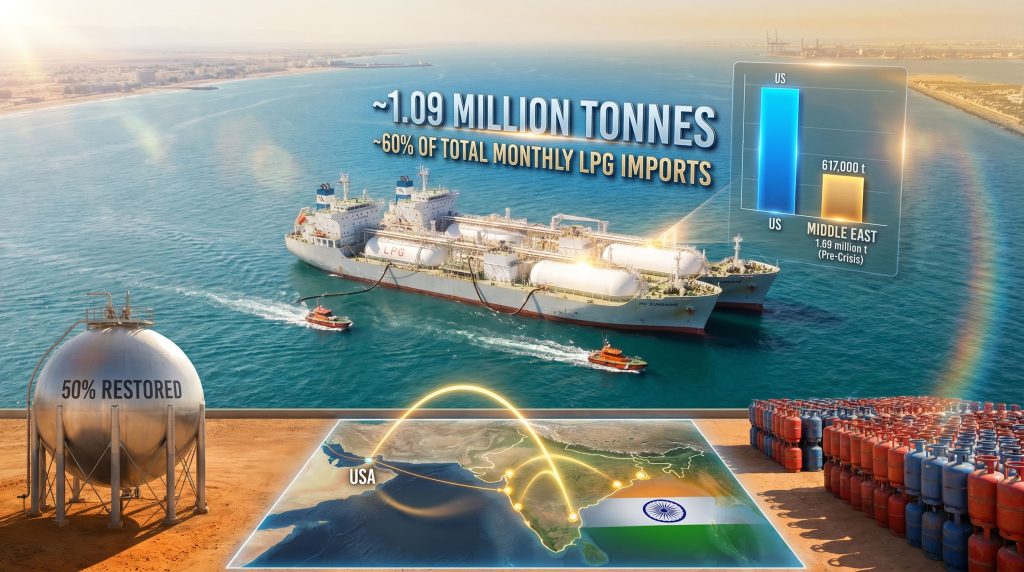
| Middle East (combined) | ~1.69 million t | ~381,000 t | ~617,000 t |
| UAE (standalone) | Higher share | Lower | ~224,000 t |
The June 2026 projected US volume of approximately 1.09 million tonnes represents a historically unprecedented share of India's monthly LPG import mix. Critically, this volume reflects both term contracts and spot cargoes accumulated over the preceding two months, suggesting a procurement posture that extends well beyond opportunistic short-term purchasing.
What makes this shift structurally significant is the routing advantage US LPG carries: it does not transit the Strait of Hormuz. Cargoes move from US Gulf Coast and Marcus Hook terminals aboard Very Large Gas Carriers (VLGCs) on Atlantic and Pacific routing, completely bypassing the Persian Gulf chokepoint. Consequently, for India's procurement planners, this is not merely a price or volume consideration — it is a geopolitical risk hedge embedded directly into the import portfolio.
The Oman Transshipment Innovation: How Middle East LPG Still Reaches India
Even as US volumes surged, Middle East suppliers adapted rather than disappeared. The most operationally interesting development has been the UAE's use of a shuttle vessel model to work around the constraints of direct Hormuz transit. The logistics chain works as follows:
- Smaller shuttle vessels lift LPG cargoes from ADNOC's Ruwais terminal inside the Persian Gulf.
- Product is moved to Sohar in Oman, which sits on the Gulf of Oman side of the Hormuz chokepoint.
- At Sohar, cargo is transferred ship-to-ship onto larger VLGCs for onward delivery to India.
This model was evidenced by the VLGC NV Sunshine, which carried over 44,000 tonnes of LPG for Indian Oil Corporation (IOC), completing a ship-to-ship transfer at Sohar on 16 June 2026 before delivering to Dahej on 28 June. Similar transfer operations are also occurring near the Gulf of Kutch off India's western coast. This logistics innovation has allowed UAE volumes to reach approximately 224,000 tonnes in June 2026, making it the second-largest LPG supplier to India, behind only the US.
What India Restores Industrially and What Remains Constrained
On 25 June 2026, the Indian government issued a notification that formally restored non-domestic packed LPG supplies to pre-crisis levels and reversed the mandate requiring refiners to divert C3/C4 streams into LPG production. The policy change was described as being underpinned by the recovery in import volumes, particularly from the US. However, the restoration picture is more nuanced than headlines suggest:
| Supply Category | Pre-Crisis | Crisis Period | Post-Restoration (June 2026) |
|---|---|---|---|
| Non-domestic packed LPG | Fully available | Severely restricted | Fully restored |
| Bulk LPG | Fully available | Effectively suspended | Restored to 50% of pre-crisis levels |
| C3/C4 stream diversion to LPG | Not mandated | Mandatory | Reversed, streams returned to petrochemical use |
| Domestic LPG production floor | No formal floor | Maximised | Minimum 40,000 t/d mandated |
The continued restriction on bulk LPG at only 50% of pre-war levels carries real operational consequences for heavy industrial users. In May 2026, bulk LPG supplies totalled just 10,800 tonnes, representing an 83% year-on-year decline and a further 9% fall from April. Industrial sectors most severely affected by the persistent bulk LPG constraint include:
- Ceramics manufacturers in Morbi, Gujarat, one of the world's largest ceramic tile production clusters
- Stainless steel processing operations
- Glass manufacturing facilities
- Large-scale food processing plants
For these industries, a restoration to 50% of prior supply levels does not simply mean operating at half capacity. Many require continuous heat processes where partial supply creates quality inconsistencies and equipment stress, effectively making partial LPG availability nearly as operationally damaging as no supply.
Despite these ongoing constraints, total industrial LPG consumption in May 2026 reached 195,100 tonnes, a month-on-month improvement of 4%, even while remaining 12.6% below the same month in 2025. This sequential recovery trajectory confirms that the restoration process is underway, but the destination remains some distance away. According to S&P Global, India's decision to sharply boost domestic LPG output during the Middle East disruption was instrumental in preventing a more severe supply collapse.
Domestic LPG production has also contributed meaningfully to the supply recovery. Output rose from approximately 50,000 t/d in April 2026 to around 52,000 t/d in May 2026, against a post-June minimum floor mandate of 40,000 t/d. This floor is designed to prevent refiners from withdrawing entirely from LPG output as they redirect C3/C4 streams back to petrochemical feedstock, a balancing act that highlights the inherent tension between India's energy security requirements and its downstream industrial needs.
The Petrochemical Ripple Effect: Polypropylene, Feedstock Scarcity, and Duty Dynamics
The C3/C4 diversion mandate was not simply an energy sector policy — it functioned as a direct tax on India's petrochemical industry. By redirecting propane and butane streams into LPG blending, refiners starved polypropylene plants of the feedstock they require. Estimates suggest approximately 80% of India's PP output was affected by feedstock supply restrictions during the crisis period.
The downstream consequences were significant: Indian buyers turned to Chinese and Southeast Asian exporters to fill packaging material shortfalls, and several major plants including Mangalore Refinery and Petrochemicals (MRPL) were forced to idle their PP units pending feedstock normalisation. In addition, the India import tax structure played a pivotal role in shaping how these substitute imports were absorbed by domestic processors during the shortage window.
The reversal of the C3/C4 mandate should enable these units to restart, but the market should not expect an immediate return to pre-crisis output levels. Supply chains take time to refill, and purchasing patterns disrupted over months do not snap back in days.
On the pricing side, the crisis-peak premium has already partially unwound:
| Product | Crisis Peak (10 April 2026) | Week of 19 June 2026 | Price Decline |
|---|---|---|---|
| PP Raffia (cfr India) | $1,350-1,430/t | $1,180-1,270/t | Down ~$170/t |
| LLDPE (cfr India) | $1,430-1,500/t | $1,210-1,270/t | Down ~$230/t |
These price declines reflect both the expectation of improved domestic feedstock availability and the market impact of substitute imports from China and Southeast Asia that arrived during the shortage. However, the policy environment adds a further complication. In April 2026, India waived customs duties on 40 petrochemical products including PE, PVC, and PP to offset cost pressures on domestic industries. With Asian petrochemical prices retreating and domestic production gradually recovering, market participants broadly expect the government to consider reinstating these tariffs, potentially before the end of June 2026 or shortly after.
The potential reinstatement of duties creates a compressed window for Chinese and Southeast Asian exporters who benefited from the waiver period. If tariffs return before the domestic supply recovery is complete, Indian processors could face a period where both import costs rise and domestic volumes remain below baseline, an uncomfortable position for downstream manufacturers.
Buying activity in Gujarat's industrial clusters at Morbi and Rajkot has already slowed as an immediate market response to the restoration announcement, reflecting the expectation that domestic PP supply will progressively improve.
Geopolitical Overhang: Iran's Hormuz Claim and What It Means for Long-Term Supply Security
The US-Iran interim agreement signed on 18 June 2026, followed by the OFAC sanctions waiver effective 22 June, has allowed Iranian crude and product exports to partially resume. Middle East LPG flows into India have responded, rising from approximately 381,000 tonnes in May to around 617,000 tonnes projected for June. However, this remains dramatically below the pre-war February 2026 baseline of approximately 1.69 million tonnes per month.
The more consequential longer-term question involves Iran's stance on Hormuz governance. Iran has established the Persian Gulf Strait Authority (PGSA) and asserted that permanent administrative control of the strait will remain with Tehran. An Oman-Iran joint working group has been formed to formalise a new navigation framework, but the legal and operational parameters remain contested.
Under the UN Convention on the Law of the Sea, specifically Articles 38 and 42, all vessels carry the right of transit passage through international straits, a right that cannot be impeded by bordering states. Any toll or fee structure imposed by the PGSA would therefore exist in direct tension with established international maritime law, creating commercial and legal uncertainty for every cargo that transits the waterway.
For India's LPG procurement strategy, this geopolitical overhang reinforces the logic of sustained US supply diversification. These energy export challenges are not unique to LPG — they reflect a broader pattern of commodity supply vulnerability that resource-dependent economies must now plan around. Senior Indian government officials had previously indicated that full supply chain restoration could take three to four years, reflecting both the scale of infrastructure and contractual disruption and the new political complexity of Hormuz navigation.
The crisis has permanently altered India's LPG import geography. Pre-2026, the US was a marginal LPG supplier to India. At the crisis peak, it became the dominant source at roughly 60% of monthly import volume. Even as Middle East flows recover, the procurement diversification infrastructure built over the past two months — including term contracts, VLGC chartering commitments, and shipping route logistics — creates path dependency that will sustain elevated US market share well into the medium term.
How Do Oil Price Movements Factor In?
The oil price movements during this period have complicated India's LPG cost calculus considerably. As crude benchmarks fluctuated under the dual pressure of conflict-related supply uncertainty and demand concerns, LPG contract pricing mechanisms tied to propane and butane indexes moved with notable volatility. Procurement desks across Indian oil marketing companies were simultaneously managing volume security and price exposure, a dual challenge without recent precedent.
The next major ASX story will hit our subscribers first
Key Takeaways for Market Participants
The trajectory of how India restores industrial LPG supply as imports rise represents is not a simple return to the status quo. Several structural shifts are now embedded in the market:
- The US has become a structurally elevated LPG supplier to India, with June 2026 volumes of approximately 1.09 million tonnes representing around 60% of total monthly imports, a share without historical precedent.
- Bulk LPG restoration remains partial, with supplies at only 50% of pre-crisis levels and highly process-dependent industries still operating well below capacity.
- Domestic production floors are now formalised, with a minimum 40,000 t/d mandate signalling that India will not allow refinery LPG output to fall below critical thresholds, regardless of C3/C4 economics.
- Petrochemical prices have corrected meaningfully from April crisis peaks, with PP and LLDPE cfr India prices falling by approximately $170 to $230 per tonne, but the duty environment adds near-term policy uncertainty for importers.
- Hormuz governance remains structurally unresolved, and Iran's PGSA framework introduces a persistent uncertainty premium for Gulf-origin commodity flows that may take years to fully quantify or price.
Disclaimer: This article contains forward-looking statements, market projections, and analyses based on data available as of late June 2026. Commodity prices, supply volumes, and policy parameters are subject to rapid change. Nothing in this article constitutes financial or investment advice. Readers should conduct independent due diligence before making any commercial or investment decisions based on the information presented.
Want to Stay Ahead of the Next Major Commodity Supply Shock?
Discovery Alert's proprietary Discovery IQ model delivers real-time alerts on significant ASX mineral discoveries, transforming complex commodity data into actionable investment insights — explore historic discoveries and their returns to understand the scale of opportunity, then begin your 14-day free trial at Discovery Alert to position yourself ahead of the broader market.