June 26, 2026
When Headline Prices Lie: Decoding the Iron Ore Market in 2026
Commodity markets have a long history of generating misleading signals during periods of structural transition. Price recoveries that look bullish on the surface often conceal deeply fragile foundations, particularly when the forces driving them originate on the cost side of the ledger rather than the demand side. The iron ore market in 2026 is a textbook example of this phenomenon, and understanding why requires looking beneath the benchmark numbers that dominate trading screens and industry headlines.
The central challenge facing miners, procurement teams, and commodity analysts today is not simply one of price volatility. It is one of price misinterpretation. When iron ore freight costs and weak China demand are simultaneously present in the same market, the resulting price signal is neither reliable nor directionally meaningful without careful decomposition. This analysis unpacks that complexity across four intersecting dimensions: freight market disruption, structural demand weakness in China, global supply dynamics, and the shifting grade preferences reshaping mill procurement behaviour.
When big ASX news breaks, our subscribers know first
The Cost-Push Illusion Driving Benchmark Iron Ore Prices
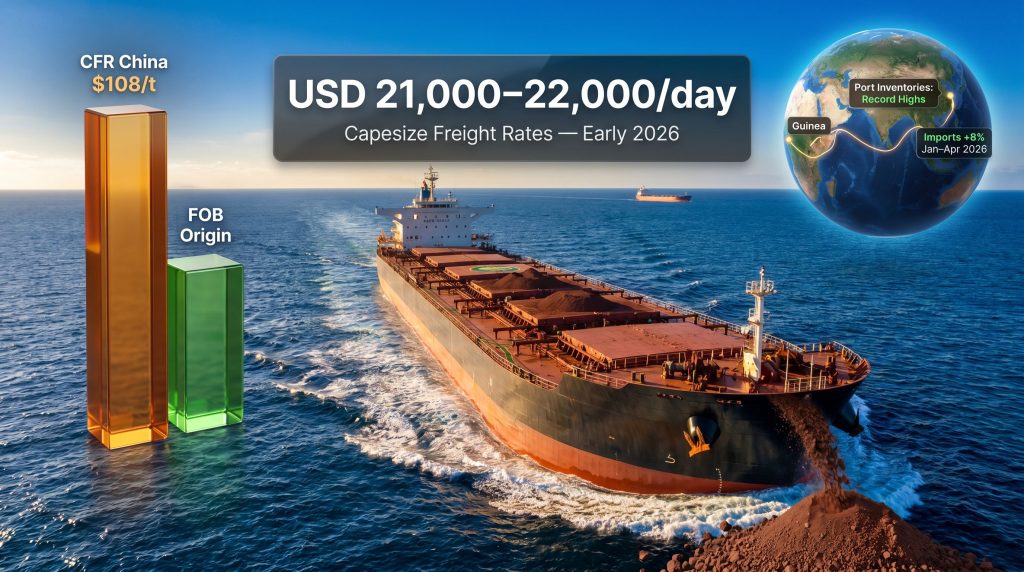
Benchmark 61% Fe fines prices recovered above $108 per tonne CFR China in April 2026, climbing back from sub-$100 levels seen earlier in the year. A similar trajectory was observed across higher-grade categories including 65% Fe fines. On face value, this looks like a recovering market.
It is not.
The recovery is almost entirely freight-driven. Logistics costs across major bulk commodity shipping routes have surged in response to geopolitical escalation linked to the Iran conflict and the effective disruption of the Strait of Hormuz, one of the world's most critical maritime chokepoints. The result is a category of price movement that economists describe as cost-push inflation: prices rising not because buyers want more material, but because it costs more to deliver the material they were already buying.
This distinction carries enormous practical consequences:
- A demand-pull price recovery signals genuine consumption growth and supports investment in production expansion
- A cost-push price recovery signals supply chain stress and compresses realised margins for producers who cannot fully pass on cost increases
- Misreading one for the other leads to misallocated capital, mispriced contracts, and flawed throughput planning
"Critical Framing: The iron ore price strength observed in early 2026 is functioning as an artificial floor, not a ceiling breakthrough. It reflects the cost of delivering iron ore to China, not what Chinese steelmakers are willing to pay for it based on their own profitability."
How Freight Became the Dominant Iron Ore Pricing Variable
Capesize Rates and the Strait of Hormuz Effect
The freight market shock underpinning 2026 iron ore pricing is rooted in geopolitics. Escalating tensions involving Iran have disrupted shipping economics across long-haul bulk commodity routes, with fuel costs rising sharply and vessel routing becoming more complex. Capesize freight rates, the benchmark vessel class for iron ore, rebounded to approximately USD 21,000 to 22,000 per day in early 2026, a level reflecting acute market volatility rather than normalised demand for shipping capacity.
Capesize vessels typically carry between 150,000 and 400,000 tonnes of iron ore per voyage. At these freight rate levels, the cost impact on a per-tonne basis is meaningful, particularly on long-haul routes where total voyage distances amplify fuel consumption. The Brazil-to-Asia route, which serves as the primary delivery corridor for Vale's seaborne iron ore exports, carries disproportionate freight cost exposure relative to shorter Australian routes. Furthermore, as iron ore trade impacts continue to evolve, these freight dynamics are becoming increasingly central to how the market is priced and interpreted.
The CFR-FOB Divergence: What It Reveals About Realised Margins
The most analytically revealing metric in the current market is not the CFR benchmark itself, but the widening spread between CFR and FOB prices. CFR (cost and freight) prices reflect the landed cost in China inclusive of shipping. FOB (free on board) prices reflect what a buyer pays at the port of origin, excluding freight. When freight costs surge, CFR prices rise faster than FOB prices, and the spread widens.
| Price Metric | What It Captures | 2026 Signal |
|---|---|---|
| CFR China (62% Fe) | Landed cost including freight | Elevated, freight-inflated |
| FOB Australia/Brazil | Realised price at port of origin | Softer, demand-constrained |
| Netback to Miner | CFR minus freight, royalties, costs | Compressed for high-cost producers |
For low-cost, short-haul Australian producers including BHP and Rio Tinto, the freight increase elevates CFR benchmarks while leaving netbacks relatively intact. For higher-cost, long-haul producers, the same dynamic compresses realised margins even as headline prices appear firm. Freight volatility is therefore not a neutral market force: it redistributes margin across the supply chain in ways that benchmark numbers alone will never reveal. According to recent analysis of iron ore market disruption, this dynamic has become one of the defining features of the 2026 pricing environment.
China's Import Surge Is Not What It Appears
Volume Growth Without Consumption Growth
China's iron ore imports surged approximately 8% in the first four months of 2026 compared to the prior year period. For any analyst relying solely on import volume data as a demand proxy, this figure looks constructive. The reality is considerably more nuanced.
The import surge is being driven primarily by inventory restocking and pre-emptive procurement ahead of anticipated supply disruption, not by a measurable increase in steel output or downstream consumption. Consequently, portside iron ore inventories in China reached record highs in early 2026, creating a structural overhang that suppresses price upside regardless of how high import volumes climb. Elevated port inventories reduce the urgency for mills to replenish aggressively, dampening the restocking-driven demand cycle before it can gain momentum. The iron ore demand outlook therefore remains considerably weaker than headline import figures suggest.
Three Structural Forces Capping Chinese Steel Demand
The absence of genuine demand recovery in China is not accidental or temporary. Three interlocking structural forces are actively suppressing iron ore consumption, and the China steel market challenges are well documented across the sector:
-
Property sector contraction. Real estate activity in China remains significantly below historical norms. Construction-linked steel demand, which historically represents the single largest end-use category for Chinese steel output, is deeply depressed. Forward indicators including cement production volumes offer little evidence of meaningful recovery through the remainder of 2026.
-
Government-mandated output curbs. Chinese steelmakers were required to reduce production during the annual parliamentary session to meet air quality targets. These policy-driven restrictions directly reduced near-term feedstock consumption and are expected to remain a recurring feature of Chinese industrial management.
-
Declining domestic iron ore output. China's domestic iron ore production fell approximately 1% year-on-year in early 2026. Declining ore grades at domestic mines are increasing reliance on seaborne imports, but this substitution effect supports import volumes without reflecting any underlying demand growth. It is a supply-origin shift, not a consumption expansion.
What Mill Behaviour Reveals About Real Market Conditions
Margins for hot-rolled coil and rebar have turned positive across most Chinese regions in 2026, but the improvement is marginal rather than transformational. Steel mills are responding with operational conservatism rather than output enthusiasm. However, the broader China iron ore outlook suggests this cautious posture is likely to persist well into the second half of the year. Mills are currently:
- Adjusting burden mixes to minimise marginal input costs per tonne of steel produced
- Avoiding aggressive feedstock restocking to preserve working capital and limit cash flow exposure
- Substituting between iron ore grades based on cost efficiency rather than productivity optimisation
"Key Insight: China's iron ore import surge in 2026 is a procurement strategy response to anticipated supply disruption and price volatility. Elevated port inventories confirm that consumption has not kept pace with material arrivals. This is restocking behaviour, not demand recovery."
In addition, the China surplus pressures from prior years have not dissipated — they have instead embedded themselves into the structural supply-demand equation that now defines the market.
The Global Supply Picture: Availability, Not Constraint
Australian and Brazilian Output in a Structurally Long Market
Seasonal production patterns are reinforcing supply availability in 2026. Output from both Australia and Brazil typically increases through the second quarter as wet season disruptions ease, and this normalisation is re-emerging on schedule. Despite rising energy, diesel, and logistics costs, export prices remain comfortably above production costs for major miners, eliminating any economic incentive for voluntary supply curtailment.
The structural condition of the market is therefore one of oversupply relative to genuine consumption requirements. Supply-side discipline, the kind that historically rebalances commodity markets, is effectively absent among the major producers. Furthermore, reports tracking weak China demand pressures on iron ore confirm that this imbalance is widely recognised across the shipping and commodities sectors.
Simandou: A Future Supply Shock in Formation
The single most consequential supply-side development on the medium-term horizon is Guinea's Simandou iron ore project, one of the largest undeveloped high-grade iron ore deposits in the world. Simandou is expected to deliver approximately 40 million tonnes of production in 2026, adding a significant new supply vector into an already oversupplied market.
Simandou's geographic position introduces additional freight complexity. Sailing distances from West Africa to Asian markets are materially longer than from Australia, adding a structural freight cost component that will influence Atlantic-to-Pacific route dynamics and grade competition going forward. The project's long-term implications include:
- Pressure on long-run price ceilings as additional high-grade supply enters the seaborne market
- Increased competition across the quality spectrum, particularly in the 65% Fe segment
- Higher average freight cost inputs into CFR pricing as Atlantic-origin volumes grow
Supply-Demand Scenario Modelling: Three Pathways Through 2026
| Scenario | Demand Driver | Supply Response | Price Outcome |
|---|---|---|---|
| Base Case | Weak China demand, restocking imports | Steady Australian/Brazilian output plus Simandou ramp | Range-bound, freight-supported, $95–$115/t CFR |
| Upside Case | Stimulus-driven construction recovery | Supply discipline from majors | Modest demand-pull recovery above $115/t CFR |
| Downside Case | Inventory destocking plus port overhang | Simandou adds 40Mt, freight normalises | Price correction toward $85–$90/t CFR |
Grade Differentials: How Mill Procurement Strategies Are Reshaping the Quality Spectrum
Why Lump Ore Is Outperforming in a Margin-Compressed Environment
One of the less-discussed but commercially significant dynamics of 2026 is the outperformance of lump ore relative to other iron ore product categories. The driver is operational rather than speculative: lump ore can be charged directly into blast furnaces without requiring the sintering step that fines material demands.
Sintering is an energy-intensive pre-processing stage that consumes significant quantities of coke breeze and solid fuel. In a market environment where mills are actively minimising every component of input cost, eliminating sintering fuel consumption for a portion of the burden mix delivers a tangible cost saving per tonne of steel produced. For margin-compressed mills, this is not a minor operational tweak. It is a meaningful lever in the procurement toolkit.
Premium Grades Losing Traction: The Pellet and Concentrate Dynamic
Higher-grade products including pellets and iron ore concentrate have struggled to gain pricing traction in 2026 despite supply disruptions affecting certain origins. Pellet premiums have remained largely flat, a telling signal about the appetite for cost in a thin-margin environment. The economic logic is straightforward: when steel margins are compressed, the incremental productivity gain from premium feedstock does not justify the additional input cost.
This represents a meaningful shift in procurement philosophy across the Chinese steel sector, moving from efficiency maximisation during high-margin periods to cost minimisation as the dominant operational priority.
The Strategic Significance of 61% Fe Fines
The growing market focus on 61% Fe fines as a benchmark and trading grade reflects a broader evolution in how the market is segmenting. Mid-grade material is gaining strategic relevance in mill procurement decisions precisely because it occupies a cost-efficient position between lower-grade fines and premium grades. In a low-margin environment, mid-grade ore can offer the best risk-adjusted value proposition across the burden mix.
The spread between grades is also becoming increasingly volatile, driven by freight differentials between origins, substitution dynamics across the quality spectrum, and shifting burden strategies at the mill level.
| Iron Ore Product | 2026 Demand Signal | Key Driver |
|---|---|---|
| 62% Fe fines (benchmark) | Stable, pricing anchor | Broad availability, reference standard |
| 65% Fe fines / concentrate | Soft | High cost in thin-margin environment |
| Pellets | Flat | Supply disruption offset by weak demand appetite |
| Lump ore | Outperforming | Direct-charge advantage, sintering cost savings |
| 61% Fe fines | Growing strategic relevance | Mid-grade cost optimisation |
The next major ASX story will hit our subscribers first
Four Compounding Pressures Reshaping Upstream Mining Economics
The convergence of iron ore freight costs and weak China demand is creating a set of compounding operational and strategic pressures for miners and upstream processors that benchmark price tracking alone cannot adequately navigate.
-
Margin compression from cost-side inflation. Rising diesel, explosives, and freight costs are eroding operating margins at a time when price support is freight-driven rather than demand-driven. The two effects are not offsetting.
-
Distorted price signals. CFR benchmarks no longer function as reliable proxies for realised returns at the mine gate. A miner pricing contracts against headline CFR figures without integrating freight data into netback modelling is systematically overestimating revenue.
-
Product strategy as competitive differentiation. Grade mix decisions, beneficiation investment choices, and product positioning carry greater commercial weight when mill procurement preferences are actively shifting. Producers of lump ore and mid-grade material hold structural advantages in the current environment.
-
Planning horizon uncertainty. Geopolitical risks around Strait of Hormuz disruption, policy risks from Chinese output management, and structural supply additions from Simandou create compounding uncertainty across both short- and medium-term planning horizons.
Frequently Asked Questions: Iron Ore Freight Costs and Weak China Demand in 2026
Why are iron ore prices rising if China's demand is weak?
Price strength in early 2026 reflects rising freight costs driven by geopolitical disruption to key shipping routes, not an improvement in Chinese steel consumption. Freight inflation lifts CFR landed prices in China without any corresponding increase in downstream demand or mill profitability.
What is causing Capesize freight rates to surge in 2026?
Geopolitical escalation linked to the Iran conflict and the disruption of the Strait of Hormuz have driven fuel costs higher and complicated shipping routes across major bulk commodity corridors. Capesize rates rebounded to approximately USD 21,000 to 22,000 per day in early 2026 as a direct consequence.
How significant is China's iron ore port inventory overhang?
Portside iron ore inventories in China reached record highs in 2026, driven by an approximately 8% surge in imports during the first four months of the year. This inventory overhang is a key structural factor suppressing price upside, even as import volume data appears superficially bullish.
What is the Simandou project and why does it matter for iron ore markets?
Simandou is a large-scale high-grade iron ore project in Guinea expected to contribute approximately 40 million tonnes of production in 2026. Its market entry adds significant new supply to an already structurally long market, extends average sailing distances to Asian buyers, and introduces additional freight cost complexity — all of which have implications for long-run price ceilings and grade competition dynamics.
Which iron ore grades are performing best in the current environment?
Lump ore is outperforming other grades due to its direct-charge capability, which eliminates sintering costs and delivers tangible savings for margin-focused mills. Mid-grade 61% Fe fines are also gaining strategic procurement relevance as a cost-optimisation tool sitting between lower and higher grade alternatives.
Disclaimer: This article contains forward-looking analysis, scenario projections, and market commentary intended for informational purposes only. It does not constitute financial advice or a recommendation to buy or sell any financial instrument or commodity. All forecasts and projections involve inherent uncertainty and may not reflect actual market outcomes. Readers should conduct their own independent analysis before making commercial or investment decisions.
Want to Position Yourself Ahead of the Next Major Mineral Discovery on the ASX?
While iron ore markets grapple with freight distortions and structural demand shifts, Discovery Alert's proprietary Discovery IQ model cuts through the noise by delivering real-time alerts on significant ASX mineral discoveries — explore historic discovery returns that demonstrate just how transformative early positioning can be, and begin your 14-day free trial at Discovery Alert to ensure you never miss a market-moving announcement.