May 13, 2026
The Quiet Revolution in Mineral Diplomacy: Why Non-Western Supply Chains Are Gaining Momentum
The architecture of global critical mineral supply chains has never been more contested. Across three continents, governments are racing to secure access to the materials that underpin electric vehicles, renewable energy infrastructure, and advanced defence systems. Yet for most of the past decade, two poles have dominated this landscape: Chinese-controlled processing networks and Western-aligned procurement blocs. A third pathway is now taking shape, quietly but with increasing strategic intent.
The India Russia critical minerals pact, currently in advanced negotiation stages as of mid-2026, represents one of the most structurally significant bilateral frameworks to emerge outside either dominant axis. Understanding why requires examining not just the deal itself, but the deeper supply chain logic that makes such a partnership both necessary and complicated.
When big ASX news breaks, our subscribers know first
How Does China's Dominance Over Critical Minerals Drive India's Diversification Strategy?
The Structural Vulnerability at the Core of India's Industrial Ambitions
India's ambitions across electric mobility, clean power generation, and advanced manufacturing all share a single material dependency: a reliance on mineral supply chains overwhelmingly controlled by China. Beijing's dominance is not simply a matter of owning mining assets; it extends deep into refining, processing, and the production of refined intermediates that feed directly into battery cells, permanent magnets, and industrial chemicals.
For India, this creates a structural vulnerability that sits at the intersection of economic planning and national sovereignty. The Indian government formally acknowledged this challenge in 2023, when it identified more than 20 minerals as critical for its energy transition and rising industrial and infrastructure demands, according to Reuters reporting. That classification moved critical minerals energy security from a background concern to an explicit policy priority.
India's response has been diplomatic activity on multiple fronts. As confirmed by Reuters, New Delhi has signed critical minerals agreements with:
- Argentina (lithium exploration and mining, five blocks signed in 2024)
- Australia (bilateral cooperation on key transition minerals)
- Japan (technology and supply collaboration)
- Germany, Brazil, and Canada (technology access and partnership agreements signed in 2025 and 2026)
Beyond these signed agreements, India is in active talks with Peru and Chile on broader bilateral frameworks that also cover critical minerals, Reuters reports.
India's Existing Critical Minerals Partnerships: A Comparative Snapshot
| Partner Country | Agreement Type | Key Minerals Targeted | Status |
|---|---|---|---|
| Argentina | Exploration & Mining | Lithium (5 blocks) | Active, signed 2024 |
| Australia | Bilateral MoU | Lithium, Cobalt, REEs | Active |
| Japan | Technology & Supply | REEs, Nickel | Active |
| Germany | Technology & Partnerships | Broad critical minerals | Active, 2025-2026 |
| Brazil | Technology & Partnerships | Broad critical minerals | Active, 2025-2026 |
| Canada | Technology & Partnerships | Broad critical minerals | Active, 2025-2026 |
| Peru | Broader Bilateral | Copper, Lithium | In Talks |
| Chile | Broader Bilateral | Lithium, Copper | In Talks |
| Russia | Preliminary Pact | Lithium, Rare Earths | Advanced Negotiations |
The gap between India's agreement-signing velocity and its operational project track record is the defining challenge of its critical minerals strategy. Despite a growing diplomatic portfolio, Reuters confirms that only a single lithium exploration and mining project has progressed to active status: the five-block Argentina deal from 2024.
Furthermore, India's lithium supply strategy illustrates just how urgently New Delhi is seeking to close the gap between diplomatic intent and operational reality. This divergence between diplomatic output and operational delivery is more than an administrative footnote. It signals that the structural bottleneck India faces is not a shortage of willing international partners, but rather the sustained capital, technical capacity, and institutional follow-through required to convert frameworks into functioning supply relationships.
What Is the India-Russia Critical Minerals Pact and What Does It Cover?
Scope, Structure, and Timeline of the Proposed Agreement
According to two sources familiar with the matter, as reported by Reuters, India and Russia are in advanced talks to sign a preliminary agreement covering three interconnected domains: mineral exploration, downstream processing, and technological collaboration. The deal is expected to focus primarily on lithium and rare earths, with both governments also set to facilitate corporate investments between the two countries.
The agreement is described as a foundational document rather than a final operational contract. Its purpose is to establish the institutional and legal scaffolding that enables deeper, commercially actionable collaboration to follow. This distinction matters for investors and analysts tracking the pact's near-term significance: the signing of a preliminary framework is a meaningful milestone, but it is not equivalent to a producing asset or an operating joint venture.
Key structural elements of the framework, as reported by Reuters, include:
- Exploration cooperation across mineral-rich territories with access and licensing frameworks
- Processing and technology collaboration to help India develop domestic refining capability for lithium and rare earth elements
- Corporate investment facilitation with both governments creating mechanisms to enable private sector engagement under diplomatic cover
The timeline is concrete: the agreement could be signed within approximately two months of the reporting date (mid-May 2026), placing the expected signing window in July or August 2026. India's Ministry of Mines is leading the negotiation process on the Indian side. One source told Reuters directly: a draft of the proposed agreement has already been shared with Russian counterparts, indicating the pact has moved well beyond exploratory discussion into formal document exchange.
Why the Processing Component Is the Most Strategically Significant Element
Of the three pillars in the proposed framework, processing and technology transfer carries the greatest long-term weight. India's vulnerability in critical minerals is not confined to raw material access. It extends to the refining and separation technologies required to transform ore concentrates into battery-grade intermediates. China's advantage in this domain is built on decades of industrial investment and proprietary processing know-how.
Russia's state nuclear corporation Rosatom has been identified in prior Reuters reporting as an entity with active involvement in international mineral exploration, including a lithium project in Mali from which India temporarily withdrew in early 2026 due to security concerns. The potential for technology transfer from Rosatom-linked institutions represents a qualitatively different form of value compared to simply accessing mineral reserves through exploration agreements.
What Strategic Value Does Russia Bring to India's Critical Minerals Agenda?
Assessing Russia's Mineral Endowment and Geopolitical Positioning
Russia's mineral resource base extends well beyond its established profile as a major nickel and palladium producer. Its rare earth and lithium deposits remain largely underdeveloped relative to their estimated scale, and Western sanctions imposed following 2022 have progressively isolated Russian mineral producers from their traditional European and North American customer base. This creates a structural condition: large mineral resources seeking alternative buyers, intersecting with a large emerging economy seeking alternative suppliers.
From India's standpoint, Russia offers two forms of value that most Western partners cannot easily replicate:
- Reserve scale: Access to mineral deposits that have not yet been drawn into existing Western-aligned supply chains
- Processing technology: Advanced metallurgical and rare earth processing capabilities developed through state industrial institutions, including Rosatom subsidiaries
From Russia's standpoint, India represents a high-growth, strategically neutral demand partner. India is not a signatory to the primary Western sanctions regimes targeting Russia, giving Indian entities more operational latitude when engaging with Russian counterparts than European or American firms would have.
The Rosatom Dimension: A Case Study in the Mali Lithium Project
Reuters reporting provides a concrete illustration of the Russia-India mineral collaboration potential through the Mali lithium project. Rosatom had established a lithium exploration presence in Mali, and India was involved as a partner before withdrawing in early 2026 due to security concerns related to the political instability in that West African nation.
Critically, Reuters reports that one source indicated India could revisit Rosatom's Mali lithium project if political conditions in Mali stabilise. This signals that India's withdrawal was circumstantial rather than a strategic rejection of Rosatom as a partner. It also suggests the Mali project remains a potential future touchpoint for Russia-India mineral collaboration, contingent on geopolitical conditions outside both countries' direct control.
This episode illustrates a broader pattern in India's critical minerals diplomacy: willingness to engage with unconventional partners and geographically challenging jurisdictions when the strategic calculus justifies it, combined with pragmatic risk management when security thresholds are crossed.
What Are the Structural Risks That Could Undermine the Pact?
Three Critical Fault Lines in the India-Russia Minerals Framework
1. The Implementation Gap: India's Operational Track Record
Reuters is explicit on this point: India has had limited success in securing overseas critical minerals assets, despite signing multiple bilateral agreements. The Argentina lithium deal (five blocks, 2024) stands as the sole example of a critical minerals agreement progressing to an active project stage. This is not a commentary on diplomatic capability. India has demonstrated a consistent ability to negotiate and sign frameworks with a diverse range of partners across multiple continents.
The challenge is operational: translating signed frameworks into funded exploration programmes, producing assets, and functioning supply relationships requires sustained institutional capacity and capital commitment that has proved difficult to maintain. The India Russia critical minerals pact enters this context with the same structural headwinds.
2. Western Sanctions Exposure for Indian Corporate Entities
Any Indian company entering into commercial agreements with Russian entities subject to U.S. or EU sanctions faces potential secondary sanctions exposure. While India has not adopted the primary Western sanctions regimes targeting Russia, Indian firms operating in U.S. dollar-denominated financial systems or maintaining business relationships with Western counterparties carry real legal risk when engaging with sanctioned Russian entities.
This risk is asymmetric across different types of Indian corporate actors. State-owned enterprises operating under government-to-government frameworks may be better positioned to absorb this exposure than private sector firms that are more deeply integrated into international financial markets. However, state enterprise involvement typically trades commercial efficiency for political insulation, potentially affecting the speed and flexibility of project development.
3. Geopolitical Triangulation Pressures
India's deepening engagement with Russia on strategic resources occurs simultaneously with its active participation in Western-aligned frameworks and its agreements with countries including Argentina, Australia, Japan, Germany, Brazil, and Canada. Managing these parallel relationships requires careful calibration. Any future tightening of Western sanctions regimes, or an escalation in U.S.-Russia tensions, could create situations where India's engagement on both tracks becomes harder to sustain without explicit prioritisation.
The commercial viability of the India-Russia critical minerals pact ultimately depends not on the strength of diplomatic goodwill between the two countries, but on whether Indian and Russian entities can structure joint ventures that are financeable, legally defensible, and operationally executable within a complex geopolitical environment.
What Minerals Are at the Centre of the India-Russia Agreement?
Lithium and Rare Earths: The Anchor Commodities
Reuters confirms that the proposed pact is expected to focus primarily on lithium and rare earth elements. These two commodity categories represent the most strategically sensitive gaps in India's domestic supply chain. The broader critical minerals demand surge driven by clean energy adoption only intensifies the urgency with which India is pursuing these resources.
Lithium is the foundational material for lithium-ion batteries used across electric vehicles and grid-scale energy storage. India has no commercially producing domestic lithium assets and depends entirely on imports to supply its growing battery manufacturing and electric vehicle sectors. The five Argentine lithium blocks represent India's first and so far only active lithium exploration commitment overseas, making additional supply sources a high priority.
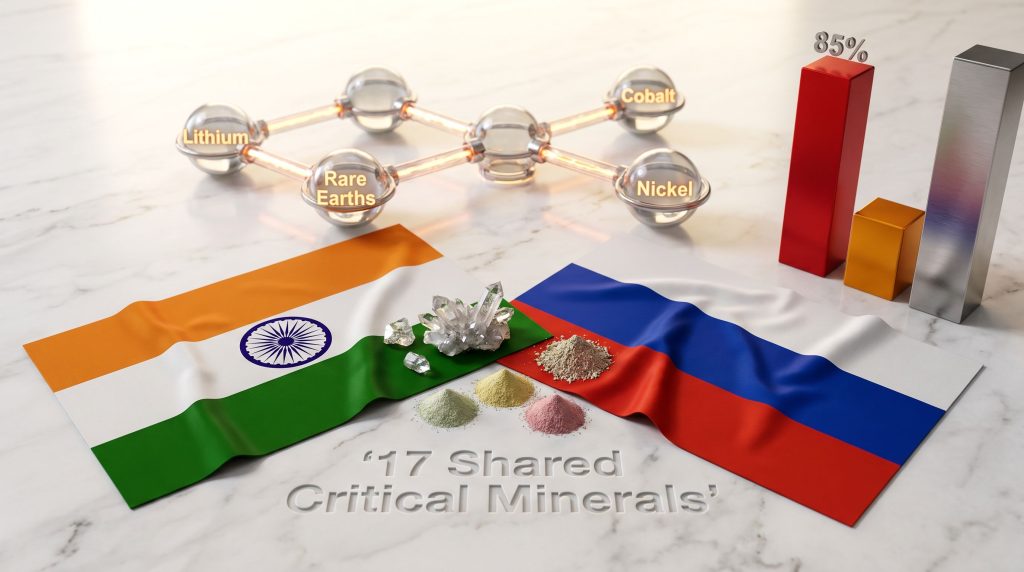
Rare earth elements (REEs) encompass a group of 17 metallic elements critical for the permanent magnets used in EV motors, wind turbine generators, and a range of defence electronics. China's rare earth strategy of vertical integration across the value chain represents a significant structural dependency for any economy pursuing an independent clean energy transition. Access to non-Chinese REE processing technology and supply chains consequently carries high strategic value for India.
The framework's scope, while anchored in lithium and rare earths, is designed with flexibility for broader transition metal coverage. The facilitation of corporate investment mechanisms within the agreement suggests commercial actors from both countries will have pathways to extend collaboration into cobalt, nickel, and other battery-relevant materials over time.
The next major ASX story will hit our subscribers first
How Does This Pact Fit Within the Broader Global Race for Critical Minerals?
A Third Supply Chain Axis Takes Shape
The global competition for transition-era mineral resources has increasingly taken on the characteristics of strategic industrial statecraft. Nations with dominant positions in critical mineral mining or processing have leveraged that control as economic and diplomatic instruments. China's vertical integration across the critical minerals value chain, from mining and concentration through refining and downstream manufacturing, has prompted coordinated responses from the United States, the European Union, Japan, Australia, and now India.
The India Russia critical minerals pact introduces a genuinely distinct dynamic into this landscape. If the preliminary agreement matures into functioning joint ventures with technology transfer components, the partnership would establish a supply chain pathway that operates outside both Chinese-dominated networks and Western-aligned procurement blocs. This is not merely theoretical diversification. It represents a structural change in how critical mineral supply chains are organised globally.
India's dual engagement strategy, maintaining active partnerships with Western-aligned mineral powers while simultaneously pursuing frameworks with non-aligned counterparts like Russia, reflects a strategic autonomy doctrine that prioritises supply security over geopolitical alignment. This approach is consistent with India's broader foreign policy posture, but it carries inherent tension as geopolitical pressures on both sides of the divide intensify. In addition, the minerals deal strategic implications playing out elsewhere further complicate the environment in which India must operate.
Where India Sits in the Global Critical Minerals Architecture
India's portfolio of critical minerals agreements, as confirmed by Reuters, now spans multiple continents and includes partnerships with Western allies, Latin American resource exporters, and now a major non-Western mineral power in Russia. The addition of a Russian framework adds a qualitatively different dimension to India's supply security strategy: access to both large-scale unexploited reserves and advanced processing capabilities that most Western partners are not positioned to offer.
Near-term progress will be measured not by the signing of the preliminary agreement itself, but by subsequent milestones: the establishment of joint venture structures, the initiation of concrete exploration programmes, and evidence of actual technology transfer rather than paper commitments. For supply chain analysts and investors tracking India's critical minerals ambitions, these operational indicators will ultimately determine whether the India Russia critical minerals pact delivers meaningful supply security or remains another entry in India's growing portfolio of well-intentioned but operationally stalled bilateral frameworks.
Frequently Asked Questions: India-Russia Critical Minerals Pact
What is the India-Russia critical minerals pact?
It is a proposed preliminary bilateral agreement between India and Russia covering joint exploration, mineral processing, and technological collaboration, with a primary focus on lithium and rare earth elements. The framework also includes mechanisms to facilitate corporate investment between the two countries, according to Reuters reporting from May 2026.
When is the India-Russia critical minerals agreement expected to be signed?
Based on Reuters reporting from mid-May 2026, the agreement was expected to be finalised within approximately two months, placing the expected signing timeline in July or August 2026.
Why is India pursuing a critical minerals deal with Russia?
India seeks to reduce its dependence on China for critical minerals essential to its clean energy transition, electric vehicle manufacturing, and broader industrial development. Russia offers access to large mineral reserves and advanced processing technology that most Western partners are not positioned to provide. Analysts at Rare Earth Exchanges have further noted that China's shadow continues to loom over the entire arrangement, adding yet another layer of strategic complexity.
What minerals does the India-Russia pact cover?
The agreement is expected to focus primarily on lithium and rare earth elements, with broader mechanisms facilitating corporate investment across additional transition metals, based on Reuters reporting citing two sources familiar with the negotiations.
What are the main risks of the India-Russia critical minerals deal?
The primary risks include potential Western secondary sanctions exposure for Indian companies engaging with sanctioned Russian entities, limited international financing availability for joint ventures, and India's historically limited track record of converting critical minerals agreements into operational projects, as documented by Reuters.
How does the India-Russia pact relate to the Mali lithium project?
India previously withdrew from a Rosatom-led lithium exploration project in Mali due to security concerns in early 2026, as reported by Reuters. However, one source indicated India may revisit participation if the political and security situation in Mali stabilises.
Disclaimer: This article is intended for informational purposes only and does not constitute financial, investment, or legal advice. All forward-looking statements involve uncertainty and actual outcomes may differ materially from those described. Readers should conduct their own due diligence before making any investment decisions related to critical mineral markets, mining equities, or related sectors.
Want To Be First When The Next Major Mineral Discovery Hits The ASX?
Discovery Alert's proprietary Discovery IQ model delivers real-time alerts on significant ASX mineral discoveries across lithium, rare earths, and more than 30 other commodities — turning complex mineral data into actionable investment insights the moment announcements hit the exchange. Explore historic discoveries and their returns, then start your 14-day free trial at Discovery Alert to position yourself ahead of the broader market.