
May 13, 2026
The Hidden Economics of Fuel Shock: Why Tax Cuts Can't Outrun a Geopolitical Crisis
Every few years, when gasoline prices spike and household budgets tighten, a familiar political reflex emerges in Washington: the gas tax holiday. It is a proposal with intuitive appeal, straightforward mechanics, and a long track record of going nowhere. Yet in May 2026, with the national average pump price sitting at $4.52 per gallon and consumer confidence collapsing to its lowest point since 1952, the Trump federal gas tax holiday proposal is back at the centre of the energy policy debate.
The question worth asking before examining the legislative mechanics is a more fundamental one: can any domestic tax adjustment meaningfully counteract a supply shock rooted thousands of miles away in one of the world's most strategically sensitive waterways?
The evidence suggests the answer is almost certainly no. But the politics are considerably more complicated.
When big ASX news breaks, our subscribers know first
What Is Driving the Current Fuel Price Crisis?
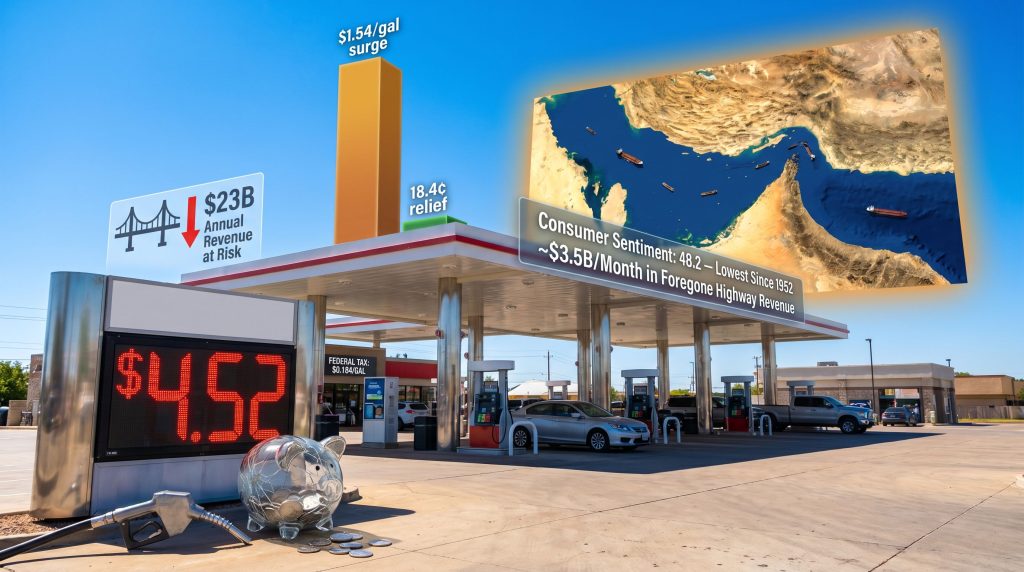
The sharp rise in U.S. gasoline prices since late February 2026 has a single, dominant cause: the effective disruption of the Strait of Hormuz following the escalation of the U.S.-Israel-Iran conflict. In the roughly three months since hostilities began, the national average price at the pump has risen by approximately $1.54 per gallon, representing a ~50% increase in retail fuel costs across a remarkably compressed timeframe.
To understand why that figure is so difficult to address through domestic policy, consider the Strait's role in global energy markets. The waterway is responsible for approximately one-fifth of all globally traded petroleum and energy commodities, including a substantial share of liquefied natural gas bound for Japan, South Korea, and European importers. When that corridor is disrupted, the knock-on effects cascade through every downstream fuel market simultaneously.
According to analysts at Morgan Stanley, global oil supply buffers risk being exhausted before the Strait reopens to unrestricted tanker traffic. Furthermore, a Reuters survey has confirmed that OPEC influence on oil markets has been severely tested, with output falling to a 26-year low as the Iran war disruption continues to suppress production from key member states. These are upstream, structural supply-side forces. No tax adjustment at the American retail pump addresses either of them.
The human impact of this supply shock is being measured in more than just pump prices. The University of Michigan's Index of Consumer Sentiment dropped to 48.2 in May 2026, surpassing even the June 2022 low of 50.2 to become the weakest reading recorded since surveys began in the early 1950s. Joanne Hsu, Director of Surveys at the University of Michigan, noted that approximately one-third of consumers spontaneously identified gasoline prices as their central financial concern, while around 30% pointed to tariffs, underscoring the dual cost-pressure dynamic bearing down on American households simultaneously.
Understanding the Trump Federal Gas Tax Holiday Proposal
The Trump federal gas tax holiday proposal centres on a temporary suspension of the federal excise taxes applied to motor fuels. These rates, established under the Internal Revenue Code (26 U.S.C. § 4081-4083), are:
| Fuel Type | Federal Excise Tax Rate |
|---|---|
| Gasoline | $0.184 per gallon (18.4 cents) |
| Diesel | $0.244 per gallon (24.4 cents) |
What makes these figures particularly notable is their age. The federal gasoline tax rate has not been adjusted since August 10, 1993, when it was raised from 14 cents to 18.4 cents per gallon under the Omnibus Budget Reconciliation Act of that year. In real, inflation-adjusted terms, the federal fuel tax is worth considerably less today than it was three decades ago, meaning the Highway Trust Fund, which receives this revenue under 23 U.S.C. § 9503, has been gradually underfunded in purchasing power terms for years.
Revenue collected through these excise taxes flows into two accounts within the Highway Trust Fund:
- The Highway Account (approximately 80% of receipts), funding interstate construction, maintenance, and road safety programs
- The Mass Transit Account (approximately 20% of receipts), supporting public transit and rail infrastructure
The fund generates roughly $40 billion annually in gross fuel tax receipts, with net transfers to infrastructure programs averaging $23 to $26 billion after administrative adjustments.
What Drivers Would Actually Save
The arithmetic of the Trump federal gas tax holiday is straightforward, and that clarity is part of what makes it politically vulnerable to scrutiny:
| Fill-Up Scenario | Estimated Savings |
|---|---|
| 10-gallon gasoline fill-up | ~$1.84 |
| Average monthly driver savings | $5 to $10 (mileage dependent) |
| National monthly revenue loss | ~$3.5 billion |
At a pump price of $4.52 per gallon, suspending the 18.4-cent federal tax represents a price reduction of approximately 4%. Against a war-driven price surge of $1.54 per gallon, the relief is arithmetically modest. The Brookings Institution documented during the 2022 Russia-Ukraine energy crisis that crude oil price trends account for approximately 80 to 85% of retail gasoline price changes, while federal tax policy contributes less than 5%. That ratio has not improved under the current Hormuz disruption.
Who Is Pushing for a Gas Tax Holiday in Congress?
Despite the economic constraints, legislative momentum is building on multiple fronts. Republican lawmakers have moved beyond rhetoric, with several introducing formal bills:
- Senator Josh Hawley (R-MO): Introduced legislation proposing a 90-day federal gas tax suspension, extendable through presidential order
- Representative Jeff Van Drew (R-NJ): Proposed an 18-month phase-out of the federal gas tax entirely
- Representative Anna Paulina Luna (R-FL): Announced forthcoming House legislation aligned with the President's public statements, framing the effort as delivering a direct win for American families
Bipartisan interest has also emerged, with Senators Mark Kelly (D-AZ), Richard Blumenthal (D-CT), and Representative Chris Pappas (D-NH) jointly introducing a suspension bill targeting relief through October 1, 2026, a timeline that aligns strategically with the November midterm elections.
The opposition is equally distributed across party lines:
| Opponent | Role | Core Objection |
|---|---|---|
| Senator James Lankford (R-OK) | Senate Republican | Federal debt and deficit impact |
| Senate Majority Leader John Thune (R-SD) | Senate Leadership | Skepticism of fiscal trade-offs |
| Representative Sam Graves (R-MO) | House Transportation Chair | Highway Trust Fund revenue dependency |
| Senator Chuck Schumer (D-NY) | Senate Minority Leader | Insufficient against a $1.50/gallon war-driven spike |
A critical constitutional detail often overlooked in public debate: suspension of the federal excise tax cannot be implemented through executive order. It requires an Act of Congress. The President can advocate for the policy, but cannot unilaterally deliver it.
Has a Federal Gas Tax Holiday Ever Been Successfully Enacted?
The historical record is unambiguous. Despite recurring proposals stretching back decades, no federal gas tax suspension has ever been successfully enacted since the tax was first introduced in 1932. During the 2022 Russia-Ukraine energy crisis, the Biden administration explored similar measures, but Congress rejected the proposal before it could progress to a vote.
The 2008 presidential primary season produced comparable proposals from both John McCain and Hillary Clinton, both of which were widely criticised by economists as ineffective political gestures rather than substantive consumer relief.
State-level gas tax holidays implemented in 2022 (notably in Georgia, Maryland, and Connecticut) offer the most relevant empirical evidence of what happens when fuel taxes are temporarily suspended. The findings are instructive:
- Pass-through rates to consumers were incomplete in most markets, with retailers and distributors absorbing portions of the tax reduction rather than fully transmitting savings to the pump
- Pre-holiday inventory drawdowns in anticipation of the suspension partially offset consumer gains in some regions
- Relief was most effective in high-competition retail fuel markets with strong price elasticity, suggesting geographic variation in consumer benefit
The American Enterprise Institute has concluded that upstream commodity price shocks overwhelm downstream tax policy intervention in determining what consumers ultimately pay at the pump, a finding consistent with both the 2022 state-level data and the broader academic literature on fuel price dynamics.
The Fiscal Mathematics: What a Gas Tax Suspension Actually Costs
The Committee for a Responsible Federal Budget has projected the following revenue losses under various suspension scenarios:
| Suspension Duration | Estimated Federal Revenue Loss |
|---|---|
| 1 month | ~$3.5 billion |
| 6 months | ~$21 billion |
| 3 years | ~$124 billion |
These figures represent foregone Highway Trust Fund revenue with no identified replacement mechanism. For budget hawks in both parties, that fiscal gap is deeply uncomfortable, particularly given that lawmakers are already debating long-term structural alternatives to fuel tax revenue, including fees on electric and hybrid vehicles, that remain years away from generating equivalent receipts.
The Highway Trust Fund's near-total dependency on excise tax revenue means any multi-month suspension without alternative funding effectively defers infrastructure spending rather than eliminating it. The cost eventually surfaces, either as debt or deferred maintenance.
The next major ASX story will hit our subscribers first
Why the Supply-Side Reality Makes the Tax Holiday Largely Symbolic
Three structural factors consistently undermine gas tax holiday effectiveness, even under more favourable conditions than currently exist. The hidden cost of a gas tax holiday is felt most acutely through these dynamics:
- The price shock is upstream, not downstream. Crude oil futures, not retail tax policy, set the dominant price signal. The geopolitical risk premium embedded in WTI and Brent pricing reflects Hormuz disruption, not U.S. tax structures.
- Incomplete pass-through risk. Historical evidence from 2022 state-level experiments shows retailers do not always transmit the full tax savings to pump prices, particularly in markets with lower competition density.
- Demand elasticity at elevated price levels. At $4.52 per gallon, consumer driving behaviour has already begun adjusting organically. The marginal demand impact of an 18-cent reduction is limited when behavioural adaptation is already underway.
What Would Actually Move the Needle on Gas Prices?
A comparative assessment of available policy mechanisms illustrates just how constrained the domestic toolkit actually is:
| Mechanism | Estimated Timeframe | Effectiveness |
|---|---|---|
| Strait of Hormuz resolution or ceasefire | Immediate upon resolution | High — removes core supply premium |
| Strategic Petroleum Reserve releases | Days to weeks | Moderate — temporary supply buffer |
| OPEC+ emergency output increases | Weeks to months | Moderate — geopolitically complex |
| Federal gas tax suspension | Immediate if passed | Low — addresses ~4% of current surge |
| Increased domestic drilling output | 6 to 18 months | Limited in near-term due to structural constraints |
The U.S. Strategic Petroleum Reserve held approximately 406 million barrels as of early 2024, providing a meaningful but finite buffer. SPR releases address inventory tightness temporarily but do not resolve the fundamental supply chain disruption caused by Hormuz closure.
Domestic drilling capacity faces its own constraints. The US shale drilling slowdown means that producers operate on capital discipline cycles, and ramping output meaningfully takes a minimum of six to eighteen months even under favourable conditions. The Permian Basin, Eagle Ford, and Bakken formations cannot replenish global supply deficits generated by one of the world's critical maritime chokepoints going offline.
The Electoral Dimension: Midterms and the Politics of Visible Relief
Consumer sentiment at a 74-year low creates a direct electoral liability for incumbents of both parties heading into November 2026 midterms. The political incentive to be seen acting on fuel prices is as powerful as any genuine policy rationale, and the history of gas tax holiday proposals reflects this dynamic clearly.
The Democratic suspension bill targeting October 1, 2026 as its endpoint is explicitly structured to deliver visible relief in the final weeks before voters go to the polls. Republican framing emphasises delivering a tangible win for working Americans. Both narratives are crafted as campaign messaging as much as energy policy.
The pattern of gas tax holiday proposals correlating with election cycles and geopolitical energy disruptions is consistent across multiple decades. The proposal functions as a political signalling mechanism in environments where the actual levers of price relief remain beyond domestic legislative reach.
This does not make the proposal insincere. However, it does mean voters and analysts should evaluate it within a dual framework: part consumer relief measure, part electoral positioning. The trade war impact on oil prices compounds this complexity further, with tariffs and consumer prices already squeezing household budgets from a second direction.
The honest answer to the question of whether the Trump federal gas tax holiday would help American families is that it would help marginally, but that the forces driving pump prices to $4.52 per gallon are operating at a geopolitical scale that no domestic tax adjustment can meaningfully offset.
Until tanker traffic through the Strait of Hormuz normalises and the geopolitical risk premium embedded in crude oil futures begins to unwind, the fundamental price pressure facing American drivers will persist regardless of what happens in Washington. The gas tax holiday debate is a real policy conversation, but the solution it proposes is operating at the wrong level of the problem.
Disclaimer: This article is intended for informational purposes only and does not constitute financial, investment, or tax advice. Energy price forecasts and geopolitical scenarios involve inherent uncertainty. Readers should consult qualified professionals before making any investment or financial decisions based on energy market conditions.
Want to Stay Ahead of the Commodity Shifts Driving Today's Market Volatility?
While geopolitical forces continue to reshape global energy markets, significant mineral discoveries on the ASX are still creating substantial opportunities for informed investors — and Discovery Alert's proprietary Discovery IQ model delivers real-time alerts the moment those discoveries are announced, turning complex data across more than 30 commodities into clear, actionable insights. Explore what historic discoveries have returned for early investors on Discovery Alert's dedicated discoveries page, and begin a 14-day free trial to ensure you're positioned ahead of the broader market.