August 14, 2026
Global metals markets continue experiencing unprecedented volatility as traditional supply chains face mounting disruption from geopolitical tensions and environmental regulations. The accelerating transition toward sustainable manufacturing processes has created complex interdependencies between raw material sourcing, production economics, and regulatory compliance across major industrial economies. Furthermore, iron ore price trends and geopolitical developments continue shaping industry dynamics worldwide.
Understanding India's Raw Material Dependencies
India's stainless steel manufacturing sector faces critical vulnerabilities stemming from its overwhelming reliance on imported raw materials. The country sources approximately 85% of its nickel requirements from international suppliers, creating significant exposure to supply chain disruptions and price volatility.
Indonesia and the Philippines dominate global nickel production, with Indonesia accounting for roughly 34% of worldwide mine output and the Philippines contributing an additional 10%, according to the U.S. Geological Survey's latest mineral commodity summary. This geographic concentration means that policy changes, mining restrictions, or natural disasters in these regions directly impact Indian manufacturers' input costs and material availability.
The cost implications are substantial, with raw material expenses representing 60-70% of total production costs for stainless steel manufacturers. This high dependency ratio leaves Indian producers vulnerable to international price fluctuations and supply disruptions that can significantly affect profitability and production planning.
Chromium Resource Dynamics
While India possesses substantial chromite reserves estimated at 4.6 million tonnes of contained chromium, the country's approach to chromium utilisation presents strategic challenges. India ranks among the world's top three chromite producers by quantity, with domestic production reaching approximately 3.1 million tonnes in FY 2022-23, according to the Indian Bureau of Mines.
Despite these significant reserves, India exports considerable quantities of raw chromite ore rather than processing it domestically for stainless steel production. This approach limits value addition and creates dependencies on processed chromium imports for certain specialised applications.
Supply Chain Risk Assessment
The 2020 Indonesian export ban on nickel ore demonstrated the acute vulnerability of global stainless steel supply chains. When Indonesia restricted raw material exports to promote domestic processing capabilities, international prices surged and manufacturers worldwide, including those in India, faced immediate cost pressures.
Key risk factors affecting India's raw material security include:
- Geopolitical tensions affecting traditional supplier relationships
- Environmental regulations in source countries restricting mining operations
- Transportation route dependencies creating logistical vulnerabilities
- Currency fluctuations impacting import cost calculations
When big ASX news breaks, our subscribers know first
Budget 2026-27 Manufacturing Incentives
India's Union Budget for FY 2026-27 introduces targeted measures designed to strengthen domestic stainless steel manufacturing capabilities. The Production-Linked Incentive (PLI) Scheme 2.0 for specialty steel offers incentive rates ranging from 4-12% on incremental sales of qualifying products, creating opportunities for manufacturers to offset raw material cost pressures.
The budget's infrastructure spending allocation, channelled through the National Infrastructure Pipeline (NIP), creates demand multipliers for stainless steel consumption across railways, ports, and highway construction projects. Government capital expenditure in these sectors directly correlates with increased stainless steel requirements for structural applications.
Policy Framework Implications
Import duty rationalisation represents a critical balancing act between protecting domestic manufacturers and ensuring competitive raw material access. However, the tariffs economic implications continue affecting global trade dynamics. The budget addresses this tension by:
| Policy Area | Current Approach | Expected Impact |
|---|---|---|
| Raw Material Duties | Reduced rates on key inputs | Lower production costs |
| Finished Product Protection | Maintained strategic tariffs | Domestic industry support |
| Specialty Grade Incentives | Enhanced PLI coverage | Innovation promotion |
| Environmental Compliance | Technology upgrade subsidies | Sustainable transition |
The Bureau of Indian Standards (BIS) certification requirements create both opportunities and challenges. While mandatory quality standards improve product credibility in international markets, they require manufacturers to invest in testing infrastructure and process upgrades.
Strategic Raw Material Security Initiatives
Indian stainless steel manufacturers are implementing comprehensive diversification strategies to reduce traditional supply dependencies. Alternative supplier mapping focuses on African nickel deposits and South American chromium sources, though these developments require multi-year investment timelines.
Moreover, developing critical minerals energy security has become essential for long-term sustainability.
Recycling Infrastructure Expansion
The industry targets 40% scrap utilisation rates by 2030, compared to current levels of approximately 25%. Stainless steel recycling offers substantial economic advantages, with secondary production costs typically 30-40% lower than primary manufacturing.
The European Stainless Steel Federation reports that stainless steel achieves recycling rates exceeding 85% in developed economies, demonstrating the technical feasibility of high-volume scrap processing. Indian manufacturers are investing in:
- Scrap sorting technologies for grade separation and contamination reduction
- Electric arc furnace upgrades optimised for secondary material processing
- Supply chain integration with scrap dealers and collection networks
- Quality control systems ensuring recycled material meets specification requirements
Domestic Mining Acceleration
Fast-tracking indigenous chromite and manganese extraction represents a strategic priority for reducing import dependencies. India's chromite reserves provide opportunities for vertical integration, though environmental approvals and infrastructure development create implementation timelines extending beyond immediate production requirements.
Strategic partnership formations with international mining companies offer pathways to secure long-term supply agreements while accessing advanced extraction technologies. These joint ventures typically involve:
- Technology transfer agreements for modern mining methods
- Infrastructure development including transportation and processing facilities
- Environmental compliance systems meeting international sustainability standards
- Risk sharing mechanisms addressing geopolitical and operational uncertainties
Additionally, proper mining project feasibility assessment remains crucial for successful implementation.
EU Trade Agreement Market Access
The ongoing EU-India Free Trade Agreement negotiations present significant opportunities for Indian stainless steel manufacturers, despite the extended timeline since negotiations began in 2007. Potential tariff eliminations on stainless steel products could enhance price competitiveness in European markets.
Current EU tariff rates on stainless steel products range from 0% to 15% depending on product classification, according to the European Commission's TARIC database. Negotiated reductions could increase Indian export volumes to EU markets by an estimated 15-20% based on price elasticity models.
Carbon Border Adjustment Mechanism Challenges
The EU Carbon Border Adjustment Mechanism (CBAM), which entered its definitive phase in January 2026, creates new compliance requirements for Indian exporters. While stainless steel products are not explicitly included in CBAM Phase 1, constituent materials may trigger reporting obligations.
Emission intensity documentation requirements force Indian manufacturers to:
Implement carbon footprint tracking systems across production processes, invest in low-carbon technologies to reduce emission intensities, establish third-party verification protocols for EU market compliance, and develop sustainability reporting frameworks meeting European standards.
Competitive Positioning Analysis
Indian stainless steel manufacturers possess inherent cost advantages through lower labour costs and domestic chromite availability. However, European quality premiums in specialty applications require sustained investment in:
- EN standard compliance for construction and pressure equipment applications
- CE marking capabilities demonstrating European regulatory conformity
- Technical service support for European customers and distributors
- Traceability systems meeting European material certification requirements
US Market Tariff Navigation
Section 232 steel tariffs imposed by the United States continue affecting Indian stainless steel export competitiveness. Initial tariffs of 25% on steel imports were implemented in March 2018, with India receiving periodic temporary exemptions subject to ongoing review.
Antidumping duties on specific stainless steel products create additional market access challenges. The U.S. International Trade Commission maintains active investigations on stainless steel bar from India, with company-specific duty rates varying based on individual determinations. The broader US–China trade war impact continues influencing global market dynamics.
Market Redirection Strategies
Indian manufacturers are adapting to US tariff barriers through:
Specialty grade focus: Super-duplex stainless steels and aerospace-grade materials command 20-30% price premiums over standard 304/316 grades, providing sufficient margins to absorb tariff costs while maintaining competitiveness.
Alternative market development: Southeast Asia and Middle East regions offer growth opportunities with fewer trade barriers. India's geographical proximity to these markets creates logistics advantages over Chinese and European competitors.
Value-added processing: Downstream fabrication and finishing operations shift tariff calculations from raw material to processed product categories, potentially reducing per-unit duty impacts.
Competitive Landscape Analysis
Chinese stainless steel production capacity exceeds 25 million tonnes annually from global production of approximately 40 million tonnes. However, Chinese producers face US antidumping duties of 30-50%+ in certain product categories, creating comparative advantages for Indian manufacturers in non-restricted segments.
Quality differentiation emerges as a strategic response to tariff pressures. Premium product segments demonstrate reduced price sensitivity, allowing manufacturers to maintain market share through technical superiority rather than cost competition alone.
Industry Development Association Priorities
The Indian Stainless Steel Development Association (ISSDA) coordinates sector-wide initiatives addressing structural challenges and growth opportunities. India stainless steel ISSDA president insights emphasise application diversification beyond traditional kitchenware into architecture, transportation, and infrastructure applications.
Sustainability Leadership Framework
Circular economy implementation represents a core strategic priority, with closed-loop recycling system development targeting 40% scrap utilisation rates. This transition requires:
- Collection network optimisation improving scrap availability and quality
- Processing technology upgrades handling mixed-grade scrap efficiently
- Quality assurance protocols ensuring recycled material performance
- Economic incentive structures making recycling financially attractive
Green hydrogen readiness positions the industry for future production method transitions. While hydrogen-based steel production remains experimental, early preparation through research partnerships and pilot projects creates competitive advantages as technology matures.
Skills Development Programs
Technical training initiatives address specialised stainless steel fabrication requirements across various applications. Collaborative innovation projects with academic institutions focus on:
- Advanced welding techniques for high-performance applications
- Corrosion resistance optimisation through alloy development
- Surface treatment technologies enhancing product durability
- Digital manufacturing integration improving production efficiency
The next major ASX story will hit our subscribers first
Long-Term Growth Projections
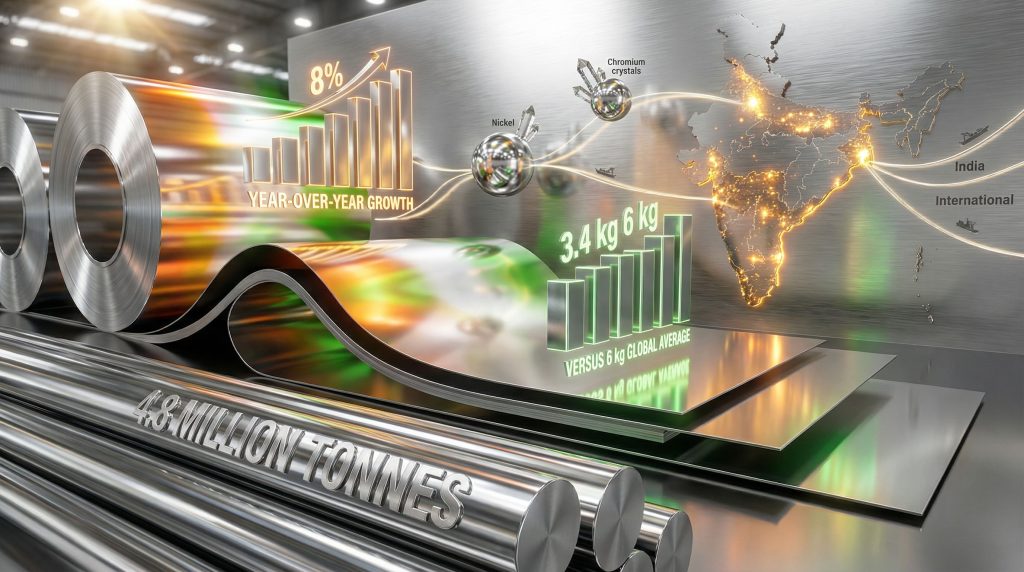
India's stainless steel sector demonstrates significant expansion potential, with annual consumption projected to increase from 4.8 million tonnes to approximately 6.2 million tonnes by 2027. This 7-8% annual growth aligns with broader economic expansion and infrastructure development programmes.
Per capita consumption currently stands at 3.4 kg compared to the global average exceeding 6 kg, indicating substantial market penetration opportunities. Regional demand distribution shows southern and western states driving 60% of total consumption, reflecting industrial concentration and economic development patterns.
Notably, industry experts expect India's stainless steel demand to grow significantly as infrastructure projects accelerate.
Sectoral Demand Analysis
| Application Sector | Current Share | Growth Driver | Market Potential |
|---|---|---|---|
| Infrastructure | 35% | Government spending | High expansion |
| Consumer Goods | 40% | Rising income levels | Steady growth |
| Automotive | 25% | Electric vehicle transition | Moderate increase |
Export potential assessment targets 25% of production for international markets by 2030, compared to current export shares of approximately 15%. This expansion requires sustained investment in quality improvement, international certification, and market development initiatives.
Technology Adoption Roadmap
Digitalisation integration through IoT sensors and AI-driven quality control systems creates opportunities for operational optimisation and cost reduction. Process optimisation technologies focusing on energy-efficient melting and refining techniques address both cost pressures and environmental compliance requirements.
Advanced alloy development for aerospace and medical applications represents high-value market segments with substantial growth potential. These specialised grades require significant research and development investment but offer premium pricing and reduced competition.
Automation implementation in hazardous operations improves safety while reducing labour dependencies. Robotic systems for material handling and processing create consistency improvements and operational efficiency gains.
Risk Mitigation Framework
Geopolitical risk management requires multi-source procurement protocols and alternative logistics route planning. Emergency inventory maintenance systems provide buffer capacity against supply disruptions, though carrying costs must be balanced against security benefits.
Market volatility response mechanisms include flexible pricing arrangements with customers and financial hedging instruments for raw material purchases. Production capacity optimisation allows manufacturers to adjust output levels based on market conditions and input cost fluctuations.
Regulatory Compliance Strategy
Proactive policy engagement through industry associations ensures manufacturers maintain awareness of developing regulations and participate in policy formation processes. International standards alignment creates export opportunities while domestic market protection.
Sustainability reporting systems addressing environmental compliance requirements and stakeholder expectations. Carbon footprint documentation, waste management protocols, and energy efficiency metrics become competitive differentiators in increasingly environmentally conscious markets.
In conclusion, the india stainless steel ISSDA president insights reveal a sector positioned for substantial growth despite facing complex challenges from raw material dependencies and international trade tensions. The india stainless steel ISSDA president insights emphasise that strategic planning, technological advancement, and policy support will determine the industry's ability to capitalise on emerging opportunities.
This analysis is based on publicly available information and industry research. Investment decisions should consider individual circumstances and risk tolerance. Raw material price projections and trade policy developments involve inherent uncertainties that may affect actual outcomes differently than anticipated.
Ready to Capitalise on India's Stainless Steel Growth?
Discovery Alert's proprietary Discovery IQ model delivers instant notifications on significant ASX mineral discoveries, including those related to nickel, chromium, and other critical materials essential to India's expanding stainless steel sector. Stay ahead of market movements by exploring Discovery Alert's dedicated discoveries page to understand why major mineral discoveries can generate substantial returns, then begin your 14-day free trial today to position yourself advantageously in this dynamic market.