July 7, 2026
The Invisible Bottleneck Slowing India's Green Steel Ambition
Across the global steel industry, a quiet but consequential divergence is taking shape. While steelmakers in Europe, Japan, and South Korea navigate declining or stabilising demand alongside aggressive decarbonisation mandates, India finds itself in an entirely different position: a rapidly expanding producer facing the dual pressure of feeding surging domestic demand and meeting intensifying climate expectations. This collision between growth imperatives and emissions accountability is not a future problem. It is already unfolding in blast furnace control rooms, boardrooms, and capital allocation committees across the country.
Understanding India steel sector decarbonisation requires looking past headline net-zero targets and examining what is actually happening at the operational and financial level. The findings, when examined in full, reveal a sector that has embraced ambition on paper while struggling to translate it into measurable progress on the ground.
When big ASX news breaks, our subscribers know first
Why India's Steel Sector Sits at the Centre of the Global Emissions Debate
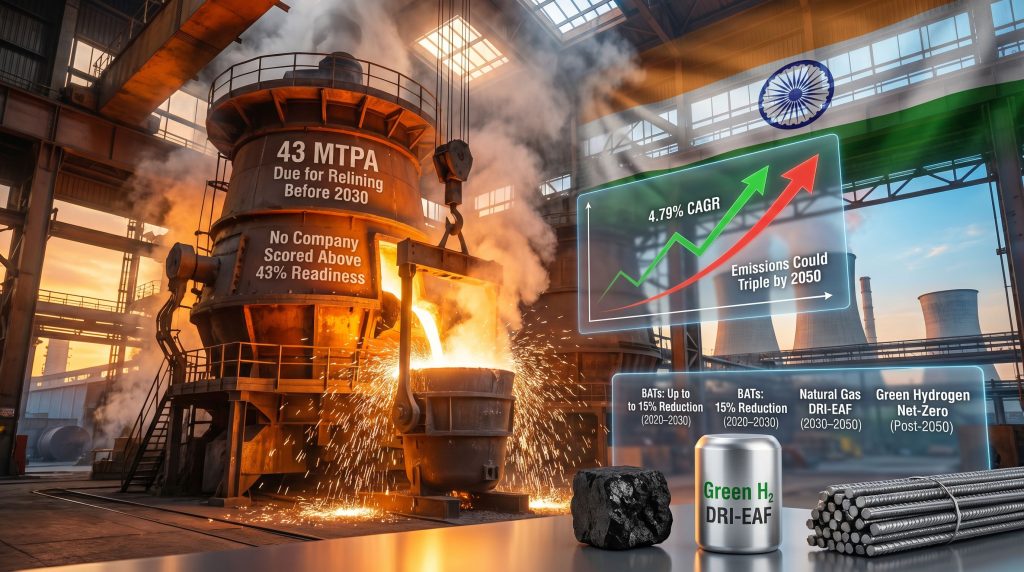
India is the world's second-largest steel producer, a position confirmed consistently by the World Steel Association, and its trajectory shows no sign of moderating. Domestic steel demand is expanding at a 4.79% compound annual growth rate, driven by infrastructure investment, urbanisation, and an automotive sector in structural growth. This contrasts sharply with plateauing or declining demand patterns across other major steel-producing economies, making India an outlier in the global picture.
The emissions consequence of this growth trajectory is significant. Steel production accounts for an estimated 10 to 12% of India's total carbon emissions, placing it among the highest-priority industrial sectors for climate transition planning, alongside cement, chemicals, and heavy transport. Without structural intervention, projections suggest sector emissions could triple by 2050 as capacity expands to meet rising consumption. Furthermore, the China steel and iron ore market faces similarly complex decarbonisation pressures, illustrating that this is a challenge shared across Asia's largest producers.
What makes this particularly challenging is the nature of steel production itself. Unlike consumer industries or power generation, steel decarbonisation is constrained by several compounding factors:
- Long-lived capital assets with operational lives of 15 to 20 years per relining cycle
- Extremely high capital intensity for technology transitions
- Commodity market pricing that compresses margins and discourages premium investment in low-carbon processes
- A dominant production route (Blast Furnace–Basic Oxygen Furnace, or BF-BOF) that is structurally dependent on metallurgical coal
The table below contextualises India's position against global benchmarks:
| Indicator | India | Global Peers |
|---|---|---|
| Share of national emissions | 10–12% | Varies by economy |
| Primary production route | BF-BOF (coal-intensive) | Mix of BF-BOF and EAF |
| Demand trajectory | Steep growth (4.79% CAGR) | Plateauing or declining |
| Net-zero target (national) | 2070 | 2050 (EU, Japan, South Korea) |
| Emissions intensity trend (3 years) | Worsening for most producers | Improving among global peers |
India's steel sector is not just large. It is actively expanding at a moment when global peers are contracting or stabilising. This structural divergence makes decarbonisation both more urgent and more economically complex than in any comparable economy.
The Readiness Gap: Ambition Declared, Progress Absent
A detailed assessment of seven major Indian steel producers published by the Institute for Energy Economics and Financial Analysis (IEEFA) in 2026 reveals a striking paradox. Five of the seven companies studied have adopted net-zero targets aligned to 2050, demonstrating broad strategic intent across the private and public sector alike. Yet not a single company scored above 43% on overall decarbonisation readiness, exposing a systemic gap between declared ambition and operational preparedness.
The producers assessed included JSW Steel, Tata Steel, Steel Authority of India Limited (SAIL), Jindal Steel, Rashtriya Ispat Nigam Limited (RINL), Jindal Stainless, and Godawari Power and Ispat. These were evaluated alongside three international benchmark companies, providing a comparative framework that situates India's performance within the global peer group. According to IEEFA's decarbonisation readiness report, the depth of preparation required across all producers remains substantially underdeveloped.
The readiness assessment examined three core dimensions:
- Capital allocation — whether financial commitments are explicitly linked to decarbonisation milestones
- Technology deployment — evidence of actual low-carbon technology implementation, not just planning documents
- Operational readiness — organisational capacity and infrastructure to execute transition strategies at scale
Critically, the assessment found that emissions intensity has worsened over the past three years for most Indian producers, even as international peers have achieved measurable reductions. This is not a minor statistical anomaly. It is a directional signal that existing climate commitments are not being matched by operational change. As noted by Soni Tiwari, Energy Finance Analyst at IEEFA, companies have advanced their target-setting and technology planning, but the movement of capital required to bring those plans to life has not materialised at the necessary scale or pace. (IEEFA, 2026, as reported in ET Energy World, 28 April 2026.)
Carbon Lock-In: The 2030 Decision Window That Will Define Decades
Perhaps the most underappreciated risk in India steel sector decarbonisation is not what is being built, but what is being continued. Approximately 43 million tonnes per annum (MTPA) of existing blast furnace capacity is due for relining before 2030. Each relining decision extends the operational life of that furnace by 15 to 20 years, meaning that choices made in the next few years will structurally determine emissions trajectories well into the 2040s and 2050s.
This is the carbon lock-in problem in its most concrete form. A blast furnace relining is not a discretionary upgrade. It is a scheduled maintenance necessity. What is discretionary is the technology selected during that relining process. Conventional refurbishment leaves existing coal-intensive processes unchanged. Technology-integrated relining, by contrast, can incorporate infrastructure for pulverised coal injection, future hydrogen DRI compatibility, and enhanced energy recovery systems that progressively reduce emissions intensity over the furnace's extended life.
When the relining risk is combined with planned new capacity, the scale of the challenge becomes even clearer. According to the IEEFA analysis, more than two-thirds of India's planned steel capacity additions, estimated at roughly 195 MTPA in the pipeline, are expected to utilise conventional BF-BOF technology. This combination of unreformed relining decisions and high-carbon new capacity represents the structural foundation of a mid-century emissions problem that is currently being cemented before 2030.
The convergence of blast furnace relining decisions and conventional capacity additions before 2030 is the most critical near-term window for intervention. Proceeding with conventional technology during this window is not a neutral decision. It is a generational commitment to carbon-intensive infrastructure.
Three Technology Phases: A Roadmap From Efficiency to Net-Zero
The decarbonisation pathway for India's steel sector is not a single technological leap. It is a phased transition spanning several decades, with each phase building the economic and infrastructural conditions for the next.
Phase 1: Near-Term Efficiency Capture (Now to 2030)
The most immediately accessible decarbonisation lever sits within existing infrastructure. Deployment of Best Available Technologies (BATs) within BF-BOF plants can deliver emissions reductions of up to 15%, often at negative abatement cost, meaning they simultaneously reduce emissions and operating expenses.
Key BAT interventions include:
- Pulverised Coal Injection (PCI): Substitutes a proportion of metallurgical coke with pulverised coal, reducing coke consumption and its associated carbon footprint by up to 20 to 30% of coke demand
- Coke Dry Quenching (CDQ): Recovers waste heat from hot coke exiting the oven, improving energy efficiency by approximately 10 to 15% in coke oven operations
- Top Pressure Recovery Turbines (TRT): Captures energy from blast furnace gas to generate on-site power, typically yielding 20 to 40 kWh per tonne of hot metal produced
Parallel enablers during this phase include expanding scrap recycling under the Steel Scrap Recycling Policy 2019, improving industrial energy efficiency through the Perform, Achieve and Trade (PAT) scheme, and integrating renewable electricity into auxiliary plant operations.
Phase 2: Technology Transition (2030 to 2050)
The middle phase of the transition involves a gradual shift away from primary coal-based steelmaking toward lower-carbon production routes. In addition, advances in hydrogen iron ore reduction are progressively improving the commercial viability of hydrogen-based steelmaking pathways globally, which will inform India's own transition options.
- Scaling Direct Reduced Iron (DRI) production using natural gas as a bridging fuel, with hydrogen substitution rising from approximately 25 to 30% initially, progressing toward 80% by 2050
- Expanding scrap-based Electric Arc Furnace (EAF) production, which carries 50 to 70% lower emissions intensity than conventional BF-BOF steelmaking and can be powered by renewable electricity
- Deploying Carbon Capture, Utilisation and Storage (CCUS) for process emissions that cannot be eliminated through fuel or technology substitution
- Progressively phasing out coal-based DRI through policy disincentivisation, steering the sector toward lower-carbon feedstock alternatives
Phase 3: Deep Decarbonisation (Post-2050 to 2070)
The final phase involves full transition to green hydrogen DRI-EAF as the dominant production route, enabling near-zero emissions steelmaking aligned with India's national 2070 net-zero commitment. This phase is contingent on green hydrogen costs reaching commercial viability, which most industry modelling places as meaningful scale deployment from approximately 2035 onward, with accelerating penetration through the 2040s and 2050s.
| Phase | Primary Technologies | Timeline | Projected Emissions Impact |
|---|---|---|---|
| Near-Term Efficiency | BATs (PCI, CDQ, TRT), renewables, scrap | Now to 2030 | Up to 15% reduction |
| Technology Transition | Natural gas DRI, EAF expansion, CCUS | 2030 to 2050 | 25 to 80% hydrogen substitution |
| Deep Decarbonisation | Green hydrogen DRI-EAF | Post-2050 | Net-zero by 2070 |
Capital Allocation: The Defining Failure Point
If there is a single diagnosis that cuts across all seven companies assessed and frames the central problem of India steel sector decarbonisation, it is this: the money has not moved. Target-setting has been relatively straightforward. Technology roadmaps have been drafted by leading producers. Policy frameworks are increasingly visible. But the explicit linkage between capital expenditure plans and decarbonisation milestones remains largely absent across the sector.
This distinction matters enormously. A net-zero target without aligned capital deployment is not a transition plan. It is a statement of intent. For targets to become operational realities, several conditions must be present simultaneously:
- Capex plans explicitly tied to emissions milestones, not general capacity expansion goals
- Debt financing structures that incorporate decarbonisation performance conditions, including sustainability-linked bonds and transition loans
- Investment timelines aligned with technology availability curves, ensuring capital is deployed ahead of infrastructure requirements rather than in reaction to regulatory pressure
Transition finance instruments available to the sector include sustainability-linked bonds and loans tied to emissions intensity milestones, blended finance structures that de-risk early-stage green technology deployment, and targeted capital for BAT integration in existing plants as well as greenfield low-carbon capacity. The availability of these instruments is not the constraint. The constraint is the willingness to structure corporate balance sheets around climate commitments in a sector where near-term commodity economics often dominate investment decision-making. However, green steel pricing dynamics are gradually shifting in ways that may improve the financial case for early movers.
Without explicit capital alignment, net-zero targets remain aspirational rather than operational. The gap between roadmap documents and on-the-ground investment is where most decarbonisation credibility is lost.
The next major ASX story will hit our subscribers first
India's Policy Architecture: Substantial Framework, Implementation Gaps
India has assembled a meaningful policy architecture to support the sector's transition, and the framework is more substantive than many international observers recognise. Key components include:
- National Green Hydrogen Mission (NGHM): Allocates ₹14.66 billion specifically for steel sector pilot projects targeting green hydrogen integration into DRI processes
- Ministry of Steel — 13 Dedicated Task Forces: Covering technology, finance, infrastructure, and supply chain dimensions of the transition
- 2024 Greening the Steel Sector Roadmap: A formal government framework establishing sector-level decarbonisation pathways and milestones
- Green Steel Taxonomy: Provides definitional clarity for green finance instruments, enabling capital markets to direct investment toward qualifying low-carbon production
- Vision 2047 Framework: Positions steel sector modernisation within India's broader industrialisation and development strategy
However, significant gaps remain between framework design and implementation reality:
- Carbon pricing remains underdeveloped relative to the scale of transition required, limiting the financial incentive for producers to accelerate technology substitution voluntarily
- MSME steel producers face disproportionate funding barriers, with limited access to transition finance instruments designed predominantly for large-cap producers
- Green public procurement standards, which would create guaranteed demand for low-carbon steel and fundamentally shift market economics, have not been implemented at meaningful scale
- Cross-ministry coordination between the Ministry of Steel, Ministry of New and Renewable Energy, and financial regulators requires strengthening to prevent policy incoherence across the transition framework
External Pressures Compressing the Timeline
For Indian steelmakers inclined to treat decarbonisation as a long-term strategic consideration, a set of near-term external pressures is rapidly compressing the practical timeline for action. Consequently, the window for measured, incremental responses is narrowing faster than many producers have anticipated.
The most concrete mechanism is the European Union's Carbon Border Adjustment Mechanism (CBAM), which places a direct financial cost on carbon-intensive imports into the EU, including steel. Indian producers exporting to European markets will face escalating cost penalties as CBAM tariffs increase unless emissions intensity improves materially. This is not a theoretical future risk. It is a scheduled financial exposure that grows with each year of inaction.
Beyond CBAM, three additional external pressure vectors are intensifying simultaneously:
- Green procurement standards from major global manufacturers and construction companies are increasingly embedding low-carbon steel specifications into supply chain contracts, creating market access risks for high-emission producers regardless of geographic market
- International capital markets are tightening climate-related disclosure and transition planning requirements. Indian steelmakers seeking foreign capital will face growing scrutiny over the credibility of their decarbonisation roadmaps, and insufficient progress will translate directly into higher borrowing costs or restricted access to international finance
- Competitiveness erosion as global peers reduce emissions intensity creates a structural disadvantage for Indian producers in export markets and premium product segments over time
The convergence of these pressures creates a compounding risk scenario: a producer that fails to reduce emissions intensity by 2030 may simultaneously face CBAM levies on EU exports, exclusion from green procurement supply chains, restricted access to international capital, and growing investor pressure over transition plan credibility. Furthermore, rising critical minerals demand linked to the broader energy transition is reshaping global supply chains in ways that will increasingly intersect with India's steel production ambitions.
The Scrap and DRI Shortcut: Near-Term Pathways That Don't Require Hydrogen Infrastructure
One of the less widely discussed aspects of India's decarbonisation pathway is the significant near-term opportunity available through secondary steelmaking expansion, which does not require the hydrogen infrastructure that dominates long-term transition narratives.
Scrap-based Electric Arc Furnace (EAF) production carries substantially lower emissions intensity than primary BF-BOF steelmaking and offers a practical near-term pathway for capacity expansion with a reduced carbon footprint. India's domestic scrap availability is growing as the national steel stock matures, a structural tailwind that improves the economics of EAF investment over time. Where EAF facilities can be powered by renewable electricity, the emissions intensity approaches near-zero without requiring any hydrogen supply chain development.
The Steel Scrap Recycling Policy 2019 provides a regulatory foundation for formalising India's scrap collection and processing infrastructure, though the policy's potential has not yet been fully realised at scale.
Separately, Direct Reduced Iron (DRI) using natural gas as a transitional fuel represents a strategically important bridge technology. India already operates a significant DRI production base, much of it currently using coal as feedstock. This infrastructure can be progressively converted to natural gas and, ultimately, to green hydrogen as costs decline, without requiring entirely new plant construction. The critical policy task is progressively disincentivising coal-based DRI to prevent the sector from defaulting to a sub-optimal transition pathway that extends coal dependency beyond the point at which alternatives become commercially viable. A comparable approach is being explored through international steel decarbonisation partnerships that combine technology transfer with financing structures, offering useful precedents for India's own transition architecture.
What a Credible Transition Plan Actually Requires
Given the combination of readiness deficits, capital deployment gaps, and compressing external timelines, the question of what constitutes a genuinely credible transition plan for an Indian steel producer is not academic. It has direct implications for investor confidence, export market access, and long-term financial performance. Indeed, the Climate Policy Initiative's analysis of transition finance for India's steel industry reinforces that bankability requires structural financial alignment, not simply ambition statements.
A bankable decarbonisation plan requires five structural components:
- Annual emissions intensity milestones, not just 2050 headline targets, with independent verification of progress against a minimum threshold of 30% process emissions reduction by 2030
- Explicit capex-to-target alignment, linking each year's capital expenditure plan to specific decarbonisation technology deployments, verified independently of management commentary
- Technology substitution commitments for upcoming blast furnace relining decisions, with clear timelines for transitioning to technology-integrated refurbishment rather than defaulting to conventional options
- Supply chain development investment in domestic scrap collection infrastructure and early-stage participation in green hydrogen supply chain development to ensure feedstock availability at commercial scale when costs allow
- Active policy engagement to create the enabling conditions that make transition economics viable, including carbon pricing, green procurement standards, and renewable energy access
| Dimension | Current Status | Required Trajectory |
|---|---|---|
| Net-zero target adoption | 5 of 7 major producers | Sector-wide with verifiable interim milestones |
| Decarbonisation readiness score | Below 43% across all assessed | Progressive improvement toward 70%+ by 2030 |
| Emissions intensity trend | Worsening over 3 years | 30% process emissions reduction by 2030 |
| Blast furnace relining | 43 MTPA due before 2030 | Technology-integrated relining decisions |
| Planned capacity route | Over 66% conventional BF-BOF | Shift toward DRI-EAF and scrap-based routes |
| Capital deployment | Lagging behind stated targets | Explicit capex-to-target financial alignment |
| Green hydrogen readiness | Early-stage pilots | Scaled deployment post-2035 |
Frequently Asked Questions: India Steel Sector Decarbonisation
What is India's national net-zero target for the steel sector?
India's national net-zero commitment is aligned to 2070, later than the 2050 targets adopted by the EU, Japan, and South Korea. At the company level, five of the seven major producers assessed by IEEFA have individually adopted 2050 net-zero targets, though implementation progress remains substantially below what those targets imply.
Why is the blast furnace relining decision critical before 2030?
Approximately 43 MTPA of blast furnace capacity requires relining before 2030. Each relining extends furnace life by 15 to 20 years, meaning decisions made now will determine whether India's steel sector remains structurally carbon-intensive through the 2040s and 2050s, precisely the period when global decarbonisation pressure will be most acute.
What is the highest-impact near-term lever for Indian steel decarbonisation?
Deploying Best Available Technologies within existing BF-BOF infrastructure, including PCI, CDQ, and TRT systems, can deliver emissions reductions of up to 15% at negative abatement cost, making them the most financially rational near-term intervention available to producers.
What role does green hydrogen play in India's steel transition?
Green hydrogen is the long-term cornerstone of deep decarbonisation in steelmaking, enabling near-zero emissions through hydrogen-based DRI-EAF production routes. However, cost barriers mean meaningful scale deployment is not anticipated until post-2035, with full transition extending across the 2050 to 2070 period.
What external risks do Indian producers face if decarbonisation stalls?
Stalled progress exposes producers to EU CBAM levies on exports, exclusion from green procurement supply chains, restricted access to international capital markets, and mounting investor pressure over the credibility of transition plans.
Disclaimer: This article is for informational purposes only and does not constitute financial or investment advice. Projections, forecasts, and transition timelines referenced throughout are drawn from third-party analyses including IEEFA publications and represent analytical scenarios, not guaranteed outcomes. Investors and stakeholders should conduct their own due diligence and consult qualified advisers before making decisions based on information contained herein.
Want to Track the ASX Mineral Discoveries Powering the Green Steel Transition?
As India's steel sector navigates a decades-long decarbonisation pathway, the demand for critical minerals — from iron ore to the inputs underpinning hydrogen and scrap-based steelmaking — will continue reshaping ASX exploration and investment opportunities. Discovery Alert's proprietary Discovery IQ model delivers real-time alerts on significant ASX mineral discoveries the moment they are announced, turning complex geological data into actionable insights; explore historic discoveries and their market returns to understand the scale of opportunity, then begin a 14-day free trial at Discovery Alert to position ahead of the market.