
June 4, 2026
Economic historians often observe that energy security policies emerge from the intersection of geopolitical instability and domestic supply vulnerabilities. When global supply chains face disruption, nations typically respond through strategic interventions designed to prioritize internal consumption over export optimization. This dynamic reflects broader patterns of resource nationalism that have shaped international energy markets for decades, particularly as tariff economic implications demonstrate similar protective measures across various sectors.
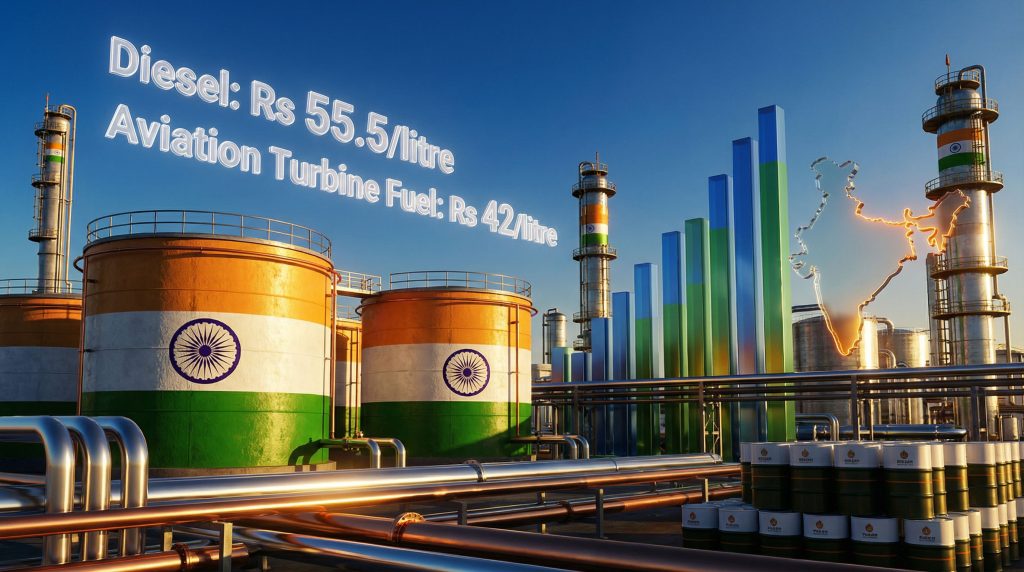
India raises export duties on diesel and aviation turbine fuel as part of a calculated response to evolving global energy dynamics. The country's approach demonstrates how emerging economies navigate the tension between export revenue generation and domestic energy security imperatives during periods of international supply chain stress.
Understanding India's Windfall Tax Mechanism on Fuel Exports
What Are Windfall Taxes and Why Do Governments Impose Them?
Windfall taxes represent government interventions designed to capture extraordinary profits generated during periods of exceptional market conditions. These fiscal instruments typically target sectors experiencing significant price volatility or supply-demand imbalances that create above-normal profit margins.
In energy markets, windfall taxation serves multiple strategic objectives beyond revenue generation. Governments employ these mechanisms to influence domestic supply allocation, moderate price volatility for consumers, and respond to geopolitical supply disruptions. The approach differs fundamentally from standard corporate taxation by targeting specific market conditions rather than baseline business operations.
Historical precedents demonstrate varied implementation approaches across major energy-producing nations. Russia has utilised export duties on crude oil and refined products as both revenue generation tools and geopolitical instruments. The United Kingdom implemented windfall taxes on North Sea oil and gas producers during periods of elevated commodity prices. Norway's petroleum taxation model incorporates progressive elements that effectively function as windfall capture mechanisms during high-price periods.
How India's Latest Export Duty Structure Works
India's refined product export duty framework underwent significant modifications in April 2026, reflecting intensified focus on domestic supply security. The adjustments demonstrate the government's willingness to sacrifice short-term export revenues for enhanced energy security positioning.
Current Export Duty Rates (April 2026):
| Product | Previous Rate (Rs/litre) | Current Rate (Rs/litre) | Percentage Increase |
|---|---|---|---|
| Diesel | 21.5 | 55.5 | 158% |
| Aviation Turbine Fuel | 29.5 | 42.0 | 42% |
| Petrol | Exempt | Exempt | N/A |
The implementation timeline reflects the government's capacity for rapid policy response. Notifications issued on Saturday became effective immediately, demonstrating streamlined decision-making processes during crisis periods. This contrasts with the typically extended policy development timelines characteristic of complex regulatory environments.
Revenue generation projections from these duty increases remain secondary to supply security objectives. The structure effectively creates price disincentives for exporters while maintaining domestic market competitiveness. This dual-purpose design reflects sophisticated policy architecture that balances multiple strategic priorities simultaneously.
Concurrent with export duty increases, the government reduced domestic excise duties on petrol and diesel by Rs 10 per litre ($0.11 USD). This compensatory mechanism partially offsets domestic price pressures while maintaining export restrictions, demonstrating coordinated fiscal policy implementation.
When big ASX news breaks, our subscribers know first
Why Is India Prioritising Domestic Fuel Security Over Export Revenue?
The Strategic Logic Behind Export Restrictions
India's position as the world's third-largest oil importer creates inherent vulnerabilities that influence policy prioritisation. The country's dependence on overseas crude oil supplies, combined with its growing domestic consumption patterns, necessitates strategic interventions during periods of global supply stress.
The geographic concentration of India's crude oil import sources amplifies these vulnerabilities. Approximately 40% of India's crude oil imports transit through the Strait of Hormuz, creating a critical chokepoint dependency. This concentration represents a strategic liability that policy interventions attempt to mitigate through domestic supply optimisation.
Furthermore, the energy export challenges facing resource-dependent economies globally demonstrate the importance of maintaining domestic supply security during volatile periods.
India processes approximately 5 million barrels per day but consumes 4.7 million barrels domestically, creating a narrow margin between refining capacity and internal demand requirements.
This capacity-consumption balance explains the government's sensitivity to export volumes during supply disruption periods. The relatively small surplus available for export means that even modest increases in domestic demand or decreases in refining throughput can create supply shortfalls.
Geopolitical Risk Assessment Framework
Current geopolitical tensions have elevated crude oil prices beyond $100 per barrel, directly attributed to restricted oil flows through the Strait of Hormuz due to the U.S.-Iran conflict. This supply chain disruption creates immediate justification for prioritising domestic fuel security over export optimisation.
Alternative supply route development remains limited despite diversification efforts. India's geographic position and existing infrastructure create path dependencies that maintain vulnerability to Middle Eastern supply disruptions. Strategic petroleum reserve utilisation provides temporary buffer capacity, but insufficient volumes to address extended supply interruptions.
The interconnected nature of global refined product markets means that crude oil supply disruptions in the Middle East create downstream impacts on refined product availability and pricing. India's position as a regional refining hub amplifies these effects, as neighbouring countries also experience supply pressures during crisis periods.
Risk Mitigation Strategies:
• Strategic petroleum reserve expansion and utilisation protocols
• Alternative crude oil supplier relationship development
• Domestic refining capacity optimisation for specific product yields
• Regional cooperation frameworks for emergency supply sharing
• Infrastructure development for alternative supply routes
What Does This Mean for India's Aviation Industry Recovery?
Aviation Fuel Cost Management Strategies
The aviation industry's operational cost structure creates particular sensitivity to fuel price volatility. Jet fuel accounts for up to 40% of an airline's operational expenses, making fuel cost management critical for industry financial sustainability.
India's implementation of a 25% monthly price cap on aviation turbine fuel for domestic airlines represents direct government intervention in industry cost structures. This mechanism protects airlines from extreme price volatility while maintaining export restrictions to ensure adequate domestic supply availability.
Airline Cost Structure Analysis:
| Cost Component | Percentage of Total Operating Expenses |
|---|---|
| Fuel | 40% |
| Labour | 25% |
| Maintenance | 15% |
| Airport Fees | 10% |
| Other Operating | 10% |
The dual policy approach combines supply-side interventions (export duty increases) with demand-side protections (price caps) to create comprehensive industry support during volatile periods. This coordination demonstrates sophisticated understanding of market dynamics and industry vulnerabilities.
Passenger Fare Protection Measures
Government intervention in aviation fuel pricing reflects broader consumer protection priorities during inflationary periods. The 25% monthly price cap prevents extreme fare increases that could damage domestic air travel demand recovery following previous disruptions.
The balance between market mechanisms and government intervention requires careful calibration. Excessive price controls risk creating supply distortions, while insufficient intervention during crisis periods can damage industry recovery trajectories and consumer access to essential transportation services.
Recovery patterns for domestic air travel demand demonstrate sensitivity to fare levels and service reliability. Government intervention aims to maintain service accessibility while supporting industry financial sustainability during external shock periods.
How Will These Duties Impact Global Refined Product Markets?
India's Role as a Regional Refining Hub
India ranks among the top five refining nations globally, with significant export capacity for diesel and aviation fuel to neighbouring markets. The country's strategic geographic position enables efficient supply to Southeast Asian and African markets that have developed dependencies on Indian refined product exports.
India's refined product exports typically serve 15-20% of regional demand in key markets, creating significant supply chain implications when export volumes decrease.
The export duty increases effectively reduce domestic incentives for refined product exports, creating potential supply gaps in dependent regional markets. Southeast Asian countries, in particular, have developed procurement strategies that rely on Indian refinery output for diesel and aviation fuel requirements.
African markets also demonstrate significant dependency on Indian refined product exports, particularly for aviation fuel supplies. These trade relationships reflect India's competitive advantages in refining complex crude oil grades and producing high-quality refined products for international markets.
Price Transmission Effects Across International Markets
Singapore benchmark pricing mechanisms will likely reflect reduced Indian export availability through higher regional product prices. The Singapore market serves as the primary price discovery mechanism for refined products across Asia, making Indian supply changes particularly influential for regional pricing dynamics.
Alternative supplier capacity constraints limit the ability of other refining centres to compensate for reduced Indian exports in the near term. Regional refining utilisation rates already operate at elevated levels, reducing spare capacity available to offset Indian supply restrictions.
Regional Market Dependencies:
• Southeast Asia: 15-20% of diesel demand typically sourced from India
• East Africa: 25-30% of aviation fuel imports from Indian refineries
• Middle East (re-export markets): 10-15% of refined product throughput
• South Asia (neighbouring countries): 30-40% of refined product imports
Long-term contract renegotiation scenarios become necessary as buyers seek alternative supply sources or adjust volume commitments. These contractual adjustments create additional market friction and potentially higher costs for dependent importers.
What Are the Investment Implications for Energy Sector Stakeholders?
Refinery Margin Analysis Under New Tax Structure
Export duties fundamentally alter the economics of refinery operations by creating asymmetric profitability between domestic and export markets. Gross refining margins for exported products compress significantly, while domestic market margins potentially expand due to reduced competition from imports.
Refinery Profitability Impact Scenarios:
| Market Segment | Baseline GRM ($/barrel) | Post-Duty GRM ($/barrel) | Margin Change |
|---|---|---|---|
| Export Markets | 8-12 | 4-7 | -40% to -50% |
| Domestic Sales | 6-9 | 8-12 | +25% to +35% |
| Blended Average | 7-10 | 6-9 | -10% to -20% |
The margin compression for exported products incentivises refineries to optimise production for domestic consumption rather than export maximisation. This strategic shift requires operational adjustments in crude oil procurement, refining configurations, and product yield optimisation.
Strategic Positioning for Energy Companies
Energy companies must reassess capital allocation priorities in response to the altered market dynamics. Investment strategies that previously emphasised export capacity expansion may require reorientation toward domestic market infrastructure and distribution capabilities.
Inventory management becomes increasingly critical as export restrictions create potential storage capacity constraints during periods of reduced export volumes. Companies require enhanced storage infrastructure to maintain operational flexibility during policy-driven market changes.
Investment Priority Adjustments:
• Domestic distribution network expansion
• Storage capacity enhancement projects
• Refinery configuration optimisation for domestic product specifications
• Alternative crude oil sourcing relationship development
• Integration with domestic retail network expansion
Strategic partnerships with domestic distributors and retailers gain increased importance as companies focus on capturing value within India's domestic market rather than through export optimisation.
How Do These Measures Compare to Global Energy Policy Trends?
International Windfall Tax Benchmarking
European Union countries have implemented various approaches to capturing windfall profits from energy companies during periods of exceptional market conditions. These mechanisms typically target electricity generators and oil companies benefiting from elevated commodity prices, though specific implementation details vary significantly across member states.
Norway's petroleum taxation model incorporates progressive elements that effectively function as windfall capture during high-price periods. The Norwegian system combines standard corporate taxation with special petroleum taxes that increase with profitability, creating automatic windfall capture mechanisms.
Moreover, the OPEC production impact on global oil markets has influenced many nations to implement similar protective measures for their domestic energy security.
Comparative Export Duty Approaches:
| Country | Primary Mechanism | Tax Rate/Structure | Implementation Trigger |
|---|---|---|---|
| Russia | Export duties on crude/products | Variable, price-linked | Oil price thresholds |
| Indonesia | Export levies on palm oil | Fixed rate during crisis | Supply shortage periods |
| Argentina | Export taxes on agricultural products | Sliding scale | International price levels |
| India | Export duties on refined products | Fixed rate per litre | Geopolitical supply disruption |
Policy Coordination with International Frameworks
India maintains a non-aligned approach to international energy policy coordination, implementing domestic energy security measures independently of OPEC+ production quotas or International Energy Agency emergency response protocols. This independence enables rapid policy adjustments during crisis periods without requiring multilateral consultation processes.
Strategic petroleum reserve coordination with IEA frameworks remains limited, as India prioritises autonomous decision-making over coordinated international responses. This approach reflects broader foreign policy preferences for strategic independence in critical sectors.
Emergency response protocol development focuses on bilateral relationships rather than multilateral framework participation. India's approach emphasises regional cooperation with neighbouring countries while maintaining independence from global energy governance mechanisms.
The next major ASX story will hit our subscribers first
What Are the Long-Term Strategic Implications?
Energy Independence Acceleration Scenarios
India's renewable energy transition timeline directly influences long-term petroleum import requirements and domestic fuel consumption patterns. Accelerated deployment of renewable energy capacity reduces electricity sector fuel consumption, while electric vehicle adoption impacts transportation fuel demand.
India aims to reduce oil import dependency from 85% to 67% by 2030 through combined renewable energy expansion, biofuel integration, and energy efficiency improvements.
Biofuel blending mandate expansion represents a domestic substitution mechanism that reduces crude oil import requirements while creating alternative markets for agricultural products. Current blending percentages target 20% ethanol in gasoline and 5% biodiesel in diesel by 2030.
Electric vehicle adoption forecasts indicate potential displacement of 15-20% of current petroleum consumption in the transportation sector by 2035. This demand destruction creates structural changes in domestic fuel requirements and export potential.
Additionally, the oil price movements during global trade tensions highlight the importance of energy independence strategies for maintaining economic stability.
Regional Energy Security Architecture
India's participation in Indo-Pacific energy cooperation frameworks focuses on infrastructure development and supply chain diversification rather than coordinated policy implementation. These relationships emphasise bilateral arrangements and project-specific cooperation rather than comprehensive multilateral governance.
Strategic Initiative Timeline:
• 2025-2027: Alternative supply chain development projects
• 2027-2030: Regional storage and distribution infrastructure
• 2030-2035: Integrated renewable energy cooperation frameworks
• 2035-2040: Hydrogen economy development and trade relationships
Alternative supply chain development initiatives include LNG import infrastructure expansion, renewable energy equipment manufacturing capabilities, and hydrogen economy infrastructure development. These investments reduce dependency on traditional petroleum supply chains while creating new economic opportunities.
Battery manufacturing capacity development supports electric vehicle adoption while creating potential export opportunities in energy storage technologies. This industrial development complements petroleum demand reduction objectives with alternative economic value creation.
Frequently Asked Questions
How Often Does India Adjust These Export Duties?
India raises export duties on diesel and aviation turbine fuel based on monthly review cycles according to recent implementation patterns. The government imposed export duties in March 2026 at lower rates, followed by April 2026 increases, suggesting regular policy review and adjustment mechanisms.
Market condition thresholds for policy changes likely include crude oil price levels, domestic supply availability, and geopolitical risk assessments. However, specific trigger mechanisms remain discretionary rather than automatically implemented through predetermined formulas.
Review processes involve coordination between the Ministry of Petroleum and Natural Gas, the Finance Ministry, and the Prime Minister's Office for rapid response capability during crisis periods. This institutional arrangement enables implementation within days of policy decisions.
Which Companies Are Most Affected by These Changes?
Major Indian refinery operators experience the most direct impact from export duty changes, including both state-owned and private companies with significant export operations. Companies with higher export-to-domestic sales ratios face greater margin compression from duty implementation.
International trading companies that source refined products from India for regional distribution networks must adjust procurement strategies and potentially seek alternative suppliers. These adjustments create supply chain complications and potentially higher costs for dependent markets.
Domestic airlines benefit from aviation fuel price caps and improved supply security, while international airlines operating in India may face different fuel cost dynamics depending on their procurement strategies and route structures.
Will These Duties Affect Petrol Prices for Consumers?
Petrol remains exempt from export duties, maintaining current domestic pricing mechanisms without direct policy impact. However, indirect effects through market dynamics and refinery optimisation strategies may influence domestic fuel availability and pricing over time.
Excise duty reductions of Rs 10 per litre on both petrol and diesel partially offset inflationary pressures from global commodity price increases. This compensatory mechanism demonstrates government commitment to moderating domestic fuel price impacts during crisis periods.
The relationship between export duties and domestic prices depends on refinery optimisation strategies and market competition dynamics rather than direct policy transmission. Companies may adjust production configurations to serve domestic markets preferentially, potentially affecting long-term price relationships.
Navigating India's Energy Policy Evolution
Key Takeaways for Market Participants
India's windfall tax strategy reflects sophisticated policy coordination that balances multiple objectives including domestic energy security, consumer protection, and industry sustainability during crisis periods. The approach demonstrates government willingness to sacrifice short-term export revenues for strategic positioning.
Policy predictability requires understanding of India's strategic priorities rather than expecting consistent market-driven decision-making. Energy security considerations consistently outweigh revenue optimisation during periods of geopolitical instability and supply chain stress.
Risk Management Strategies:
• Diversified supply chain development for refined product imports
• Enhanced storage capacity for inventory management during policy changes
• Alternative supplier relationship cultivation for dependent markets
• Domestic market positioning emphasis over export optimisation
Investment thesis adjustments for energy sector exposure should emphasise domestic market growth potential while recognising reduced export profitability during policy restriction periods. Companies with balanced domestic-export portfolios demonstrate greater resilience to policy volatility.
Forward-Looking Policy Trajectory
Integration with broader energy transition goals suggests that windfall taxes and export restrictions represent transitional mechanisms rather than permanent policy features. Long-term trajectories emphasise energy independence through renewable energy development and reduced petroleum dependency.
Regional policy coordination mechanisms may develop through bilateral arrangements rather than comprehensive multilateral frameworks, reflecting India's preference for flexible partnership approaches over rigid institutional commitments.
The evolution toward hydrogen economy infrastructure and battery manufacturing capabilities creates alternative pathways for energy sector value creation beyond traditional petroleum refining and distribution models. These developments reshape long-term investment opportunities and strategic positioning requirements for energy sector participants.
Furthermore, the broader context of US tariffs and inflation demonstrates how trade policies worldwide increasingly prioritise domestic economic security over international market efficiency.
Reuters reports that the export duty increases are part of a broader government strategy to manage domestic fuel supplies during the ongoing geopolitical tensions. The Business World analysis suggests these measures will remain in place until regional supply disruptions stabilise.
This analysis is based on publicly available information and should not be considered as investment advice. Market participants should conduct independent analysis and consult with qualified professionals before making investment decisions. The energy sector involves significant risks including commodity price volatility, regulatory changes, and geopolitical uncertainties.
Looking to Capitalise on Energy Market Volatility?
Discovery Alert's proprietary Discovery IQ model delivers real-time alerts on significant ASX mineral discoveries, instantly empowering subscribers to identify actionable opportunities ahead of the broader market during periods like India's current energy policy shifts. Begin your 14-day free trial today and secure your market-leading advantage whilst major global energy dynamics create new investment landscapes.