
May 12, 2026
When Tax Policy Becomes Trade Policy: India's Gold Import Architecture Under Pressure
Few markets illustrate the intersection of monetary sovereignty and cultural consumption quite like India's gold sector. For decades, successive Indian governments have wrestled with a fundamental tension: gold is a deeply embedded store of value and ceremonial necessity for hundreds of millions of people, yet it also represents one of the country's largest sources of import expenditure and a persistent drag on the current account. The question of how to manage this tension has produced some of the most consequential and occasionally disruptive trade policy decisions in Asia's largest democracy. The events of April and May 2026 represent the latest, and in some ways most instructive, chapter in that ongoing story — and the episode of Indian banks resume bullion imports over 3% levy has since reverberated through global markets.
Understanding what happened requires looking not at the headlines, but at the plumbing beneath them — the institutional architecture that governs how refined gold actually enters India, and why a seemingly routine administrative lapse triggered one of the worst monthly import collapses in nearly three decades.
When big ASX news breaks, our subscribers know first
The Institutional Framework Behind India's Gold Supply Chain
India is the world's second-largest consumer of gold, trailing only China in annual demand volume. This fact alone makes the country's import policy decisions globally significant. But what is less commonly understood is how concentrated the import pipeline actually is. Licensed banks serve as the primary conduit through which refined gold enters the country, handling the dominant share of institutional import volumes. This banking channel is not merely a logistical convenience — it is the structural backbone of India's bullion market, connecting international refineries and trading hubs in London, Dubai, and Singapore directly to domestic jewellers, dealers, and consumers.
The framework also includes nominated agencies and star trading houses, but banks occupy the most critical position in terms of volume and price discovery. When banks stop importing, the entire downstream supply chain feels the effect rapidly. Jewellers face inventory depletion, dealers cannot source physical metal at competitive prices, and consumers either pay elevated premiums or defer purchases.
India's seasonal demand cycle amplifies these vulnerabilities. Gold consumption spikes around wedding seasons, religious festivals including Dhanteras and Akshaya Tritiya, and harvest periods. Furthermore, supply disruptions timed poorly against these seasonal peaks can have outsized economic consequences for hundreds of thousands of jewellery industry workers and traders.
Understanding the 3% IGST and How a Policy Gap Froze the Market
When India unified its indirect tax system under the Integrated Goods and Services Tax framework in 2017, gold-importing banks were granted a specific exemption from the 3% IGST levy that would otherwise apply to their bullion imports. This exemption was not a permanent statutory provision — it required annual renewal through a government authorisation order. That structural design choice, prioritising administrative flexibility over market stability, created a recurring vulnerability at every financial year transition.
Under normal circumstances, the government would issue the renewal order at or around the start of each April financial year, allowing banks to continue importing without the additional levy. The combined effective tax burden on gold imports without the exemption is substantial:
| Tax Component | Rate | Applicability |
|---|---|---|
| Customs import duty | 6% | Applied to all gold imports |
| Integrated Goods and Services Tax | 3% | Applied when bank exemption lapses |
| Sales levy (domestic transactions) | 3% | Applied at point of domestic sale |
| Total burden (exemption absent) | 9% import + 3% sales | Full tax-on-tax chain |
On April 1, 2026, customs authorities began enforcing IGST collection without the standard renewal order having been issued. Banks, unwilling to absorb an unexpected 3% levy on top of existing import duties, halted shipments immediately. What followed was more than a month of institutional paralysis in India's bullion import market.
The government's silence on the exemption renewal was not occurring in a vacuum. Prime Minister Narendra Modi publicly urged citizens to voluntarily avoid gold purchases for one year to help preserve India's foreign exchange reserves, according to Reuters reporting from May 12, 2026. This political messaging, delivered on a Sunday, coincided with customs enforcement and sent a clear signal to market participants about the direction of government intent. With the rupee ranked among Asia's worst-performing currencies in 2026 and current account pressures mounting, the policy logic was transparent even if the mechanism was oblique.
The decision not to renew the IGST exemption at the financial year start was not framed as a formal import restriction — but its practical effect was identical to one. This matters because it avoided the political and diplomatic costs of an explicit tariff hike while achieving a similar outcome.
April 2026: A Near Three-Decade Low in Monthly Gold Imports
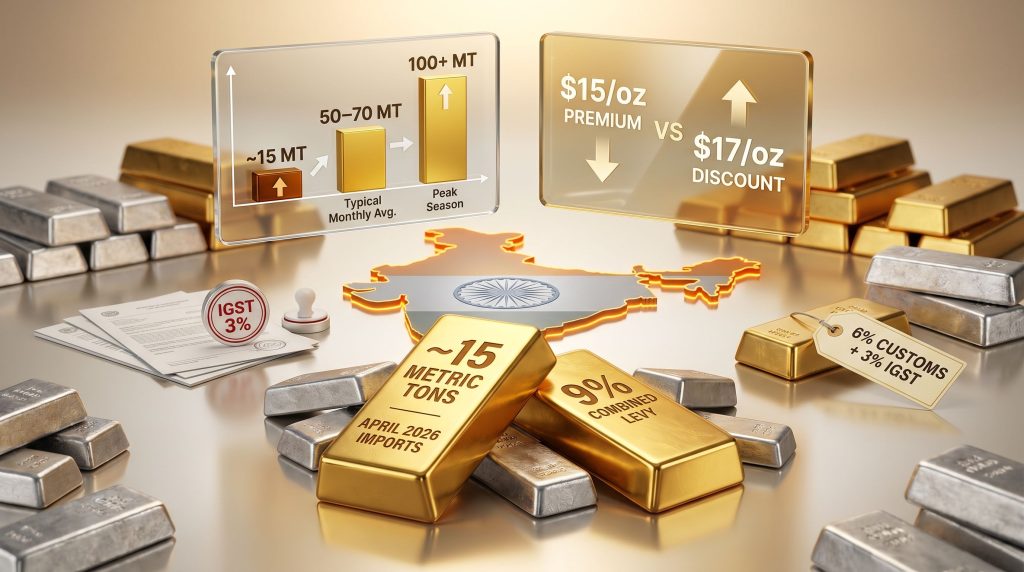
The scale of the supply contraction during the disruption period was severe by any historical measure. India's gold imports in April 2026 fell to approximately 15 metric tons, a figure described by Reuters as a near 30-year low. To contextualise that number:
| Period | Estimated Monthly Gold Imports | Primary Driver |
|---|---|---|
| April 2026 | ~15 metric tons | IGST enforcement halt, bank import suspension |
| Typical monthly average | 50 to 70 metric tons | Normal commercial demand cycle |
| Peak festival or wedding season | 100+ metric tons | Seasonal demand surge |
| Historical crisis comparator (2013) | Sharply reduced | 10% import duty shock |
A reduction of this magnitude — roughly 70 to 78% below normal monthly volumes — does not simply reduce supply. It severs the price discovery mechanism that underpins the entire domestic market. Without regular bank imports providing competitive supply, the pricing relationship between international spot markets and domestic physical gold breaks down.
During the peak disruption period, domestic gold dealers charged premiums of $15 per ounce over official domestic prices, reaching an 11-week high according to Reuters. This premium reflects acute scarcity: when institutional supply is absent, whatever physical inventory exists commands a significant markup. Prior to the import halt, dealers had actually been offering modest discounts of $4 to $6 per ounce, reflecting a well-supplied market with normal competitive dynamics.
Silver imports were equally disrupted by the IGST enforcement action, a dimension that received comparatively little attention given gold's cultural prominence. The industrial demand implications of silver supply disruption in India's manufacturing sector — particularly in electronics, solar panel production, and chemical processing — represent a separate and underappreciated consequence of the policy episode.
Why Banks Stopped Waiting and Started Paying
After more than a month of inaction, India's bullion-importing banks reached a collective commercial determination: the government was not going to issue the exemption order, and continued waiting was more costly than absorbing the levy. The situation where Indian banks resume bullion imports over 3% levy ultimately reflected a threshold being crossed rather than a formal policy resolution.
The head of the bullion desk at a Mumbai-based private bank told Reuters that banks had waited for the government to issue the annual exemption order, but as signals emerged that the government wanted to curb gold imports, banks concluded that formal clarity would not be forthcoming and made the decision to proceed with imports while paying the 3% IGST.
This decision reveals several important dynamics about how Indian bullion markets operate:
-
Institutional threshold behaviour: Banks did not respond linearly to the policy ambiguity. They held their position for over a month before collective action shifted toward resumption, suggesting a threshold-based decision model rather than incremental adjustment.
-
Political signal interpretation: The absence of a formal announcement functioned as an implicit signal. Modi's public messaging provided the interpretive context that transformed administrative silence into perceived policy intent.
-
Cost asymmetry: The 3% IGST, while material, was ultimately less costly than continued supply disruption, customer relationship damage, and the competitive disadvantage of ceding market share to any banks willing to resume earlier.
-
Downstream pressure: Local jewellers operating on depleted inventories, particularly ahead of seasonal demand periods, created customer-facing pressure on bank bullion desks to restore supply regardless of the tax burden.
A government official separately confirmed to Reuters that banks were clearing shipments while the Commerce Ministry worked in parallel toward formally restoring the exemption, indicating that different parts of the government machinery were operating on different timelines and objectives during the crisis.
The India Bullion and Jewellers Association (IBJA) publicly confirmed that the government had expressed commitment to restoring the exemption, providing trade association advocacy as an additional pressure vector on the Commerce Ministry. Industry lobbying of this nature — where trade bodies publicly validate government intent before formal confirmation — is a common mechanism in India's policy ecosystem for managing market uncertainty without committing to hard deadlines.
The Price Reversal: From $15 Premium to $17 Discount
One of the most instructive aspects of the April to May 2026 episode is the speed and magnitude of the domestic price reversal once bank imports resumed. According to Reuters, dealers shifted from charging premiums of $15 per ounce during the disruption to offering discounts of up to $17 per ounce over official domestic prices within weeks of clearances resuming. The discounts were quoted inclusive of the 6% import duty and 3% sales levies.
Chirag Thakkar, Chief Executive of bullion importer Amrapali Group Gujarat, explained the dynamic directly: supply improved due to bank imports resuming, but demand remained weak, causing gold to trade at a discount to official prices.
The swing from a $15 per ounce premium to a $17 per ounce discount within a compressed timeframe illustrates a fundamental characteristic of India's gold market: supply and demand can become drastically desynchronised when institutional import channels are interrupted and then suddenly restored. Traders operating across the Dubai-Singapore-Mumbai corridor regularly encounter this volatility.
This reversal has a straightforward mechanical explanation. Banks clearing accumulated backlog of shipments — approximately 9 metric tons of gold and 34 metric tons of silver cleared in the first weeks of May 2026 per Reuters — injected supply into a market where consumer demand had been subdued both by high prices during the disruption and by the dampening effect of Prime Minister Modi's public messaging. Supply normalised faster than consumer sentiment recovered.
This pattern is not unique to 2026. It mirrors dynamics observed following India's 2013 import duty shock to 10%, where supply restriction created premium spikes, and subsequent easing created discount conditions as inventory flooded back into a demand-constrained market.
The next major ASX story will hit our subscribers first
Macroeconomic Stakes: Gold, the Rupee, and the Current Account
India's gold import policy cannot be separated from its broader macroeconomic context. Gold is consistently one of the top contributors to India's current account deficit, competing with crude oil as the largest import expenditure category in volume-value terms. When the rupee weakens — as it did significantly in 2026 — gold imports become more expensive in rupee terms, amplifying the deficit impact of any given import volume.
Reuters noted that the resumption of bank gold imports is expected to widen the trade deficit and put additional pressure on the rupee. This macroeconomic feedback loop is what drove government behaviour during the disruption period:
| Policy Objective | Mechanism Employed | Short-Term Effect | Structural Risk |
|---|---|---|---|
| Reduce current account deficit pressure | IGST enforcement without exemption renewal | Lower import volumes in April 2026 | Supply scarcity, domestic price spikes |
| Support rupee stability | Reduce gold-related FX outflows | Temporary demand suppression | Sustained consumer sentiment damage |
| Preserve foreign exchange reserves | Political messaging to discourage gold purchases | Short-term demand reduction | Potential informal market growth |
| Restore supply chain function | Commerce Ministry exemption restoration process | Gradual import normalisation | Higher near-term CAD contribution |
The historical precedent for using tax policy to manage gold demand is instructive and cautionary. India's 2013 decision to raise import duties to 10% succeeded in reducing official import volumes but simultaneously stimulated a substantial expansion in gold smuggling networks. Informal import channels, primarily through Nepal, Bangladesh, and sea routes via Myanmar and Sri Lanka, absorbed a meaningful share of demand that official channels could no longer serve competitively. The unintended consequence was that the government lost customs revenue, lost visibility over import flows, and potentially failed to achieve its balance of payments objectives while creating lasting infrastructure for illicit trade.
If the IGST exemption is permanently withdrawn rather than restored, the effective tax burden on bank-imported gold would rise to 9% of import value. At that level, the price differential between official and informal channels widens sufficiently to make smuggling economically attractive for organised networks, potentially triggering a structural shift in India's bullion supply architecture.
Global Price Implications of Indian Demand Contraction
India's role as the world's second-largest gold consumer makes its import volumes a structural support factor for gold price record highs. When Indian institutional buying contracts sharply, it removes a significant demand signal from international markets, particularly affecting the pricing mechanism across the LBMA and COMEX markets and the premium structures in Dubai and Singapore re-export markets.
The transmission mechanism works through several channels:
-
Refinery order flow: Indian banks typically contract with Swiss, South African, and Australian refineries for specific bar formats (primarily 995 fineness kilobars for domestic consumption). A halt in Indian orders reduces refinery throughput utilisation and can create inventory accumulation at the refinery level.
-
Dubai and Singapore re-export dynamics: Both trading hubs serve as intermediaries for gold destined for India. When Indian demand contracts, regional inventory builds in Dubai and Singapore warehouses, creating localised price pressure that can spill over into broader spot market sentiment.
-
Demand substitution limits: While Chinese buyers and central bank gold demand can partially offset Indian demand contraction, the substitution is imperfect. Different bar specifications, purity standards, and delivery logistics mean that supply optimised for Indian consumption cannot always be instantaneously redirected.
In the short term, the supply normalisation following bank resumption has dampened domestic premiums without materially affecting global spot prices. In the medium term, however, if the IGST exemption is formally restored and import volumes rebound sharply, the resulting demand surge could provide upward price support — particularly if it coincides with seasonal festival demand in the second half of the calendar year.
What Market Participants Should Watch
For traders, jewellers, and investors with exposure to Indian bullion markets — including those considering buying physical gold — the April-May 2026 episode surfaces several forward-looking indicators worth monitoring closely:
-
Formal government notification of IGST exemption restoration: Until this is issued, the policy risk of recurring disruption at each financial year transition remains live.
-
Monthly import volume data: May and June 2026 figures will indicate whether the bank resumption has translated into full supply chain normalisation or whether demand weakness is suppressing recovery.
-
Domestic premium or discount spreads: The current discount environment signals oversupply relative to demand. A return to premiums would indicate demand recovery and supply absorption.
-
Rupee performance and foreign exchange reserve data: These remain the macroeconomic drivers of future import policy decisions. Deterioration in either metric could prompt renewed government pressure on gold import volumes.
-
Informal market activity indicators: Seizure data from customs authorities and border security agencies can provide early signals of whether higher effective import costs are stimulating illicit trade channel development.
-
IBJA communications and trade body advocacy: The association's public positioning will provide advance warning of whether formal exemption restoration is imminent or stalled.
The Structural Vulnerability That This Episode Exposed
Perhaps the most consequential insight from the 2026 IGST disruption is not the disruption itself, but the architectural weakness it revealed. India's bullion import framework relies on an annually renewable administrative exemption as a load-bearing structural element. That design creates a recurring policy risk embedded directly into the financial calendar. Furthermore, the episode where Indian banks resume bullion imports over 3% levy demonstrates how swiftly administrative inertia can translate into market-wide paralysis.
A permanent statutory exemption — or alternatively, a clearly defined multi-year authorisation mechanism — would eliminate the annual vulnerability. The absence of such a mechanism means that every April 1 represents a potential repeat of the April 2026 scenario: a policy renewal that fails to arrive, customs enforcement that fills the vacuum, and a market halt that causes disproportionate economic damage relative to whatever macroeconomic objective the government was attempting to achieve.
Consequently, for a country that depends on its jewellery sector as a major employer and export earner, and whose citizens hold an estimated 25,000 tonnes of gold in private hands representing one of the largest concentrations of private gold wealth on earth, this structural fragility carries costs that extend well beyond monthly import statistics. The gold tariff premium dynamics observed internationally offer a useful comparative lens for understanding how tax-driven supply disruptions can distort domestic pricing structures for extended periods.
Readers should note that this article contains forward-looking analysis and market projections that involve inherent uncertainty. All statistics and price data referenced are drawn from Reuters reporting dated May 12, 2026, via Mining Weekly. This article does not constitute financial or investment advice. Past market behaviour during previous Indian gold import disruptions is not necessarily indicative of future outcomes.
Want To Stay Ahead of Commodity Market Disruptions Like India's Gold Import Crisis?
Discovery Alert's proprietary Discovery IQ model delivers real-time alerts on significant ASX mineral discoveries — including gold and silver — instantly translating complex market data into actionable investment insights for traders and investors at every experience level. Explore Discovery Alert's discoveries page to understand how major mineral discoveries have historically generated substantial returns, and begin your 14-day free trial today to secure a market-leading edge.