July 10, 2026
The Structural Logic Behind India's Refining-Export Industrial Model
Most large economies that import the majority of their energy inputs do so at a fundamental disadvantage. They pay international prices for raw commodities and have limited ability to capture value at the processing stage. India has spent decades building an exception to this rule, constructing one of the world's most sophisticated refining infrastructures specifically designed to convert imported crude oil into high-value exportable products. The result is a paradox that is, on closer inspection, a deliberate industrial strategy: a nation that sources more than 90% of its crude oil requirements from abroad yet ranks among the world's leading exporters of refined petroleum products.
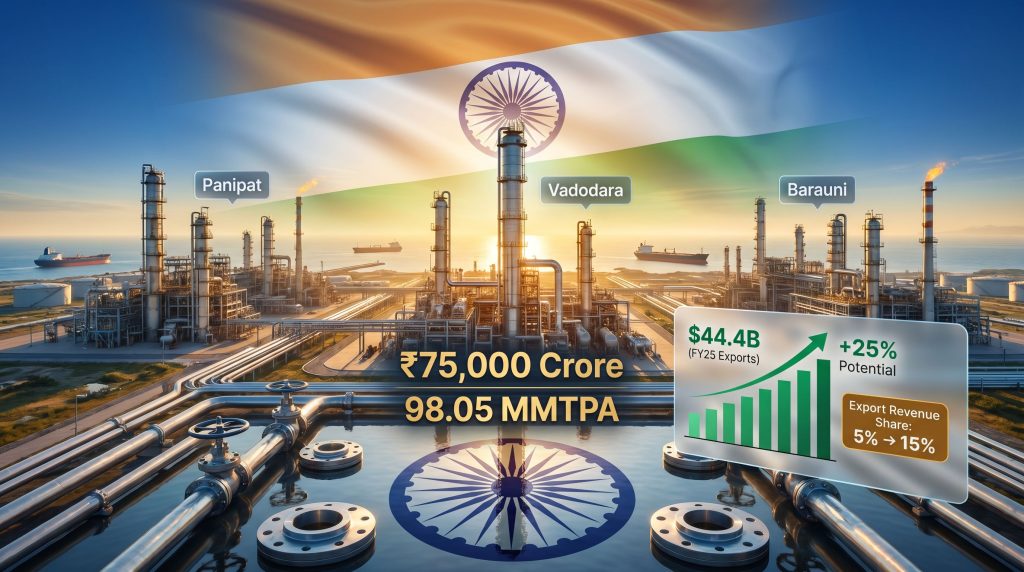
The Indian Oil Corporation refinery expansion programme, valued at ₹75,000 crore and targeting commissioning across three sites by November-December 2026, is not simply a capacity upgrade. It represents the deepening of an economic architecture that has been decades in the making, one where refining complexity and scale serve as the primary mechanism for transforming hydrocarbon trade flows into foreign exchange earnings and industrial output.
When big ASX news breaks, our subscribers know first
India's Refining Sector: An Engineered Surplus
Understanding why the Indian Oil Corporation refinery expansion matters requires first appreciating how deliberately India's refining capacity has been sized relative to domestic consumption. The country's installed national refining capacity currently stands at approximately 258.1 MMTPA, while domestic petroleum product consumption runs at roughly 239 MMTPA. On paper, this looks like a modest surplus. In practice, the picture is significantly different.
Indian refineries routinely operate at 105 to 115% of their nameplate capacity, a reflection of both operational efficiency and commercial incentive. At these utilisation rates, actual annual output approaches 300 million tonnes, creating an exportable surplus of approximately 61.5 million tonnes per year. This is not an accident of industrial planning but a structural feature baked into capacity sizing decisions made over multiple investment cycles.
The logic is straightforward: by building refining capacity that systematically exceeds domestic demand, India converts crude import costs into refined product export revenues at premium valuations. Refining margin — the difference between the cost of crude input and the value of refined output — becomes a foreign exchange generation mechanism at national scale. This is the model that the IOCL expansion programme is designed to extend and intensify. Furthermore, the import tax structure in India plays a meaningful role in shaping how these economics function at the policy level.
What the ₹75,000 Crore Programme Actually Builds
The Indian Oil Corporation refinery expansion touches three geographically distributed sites, each with distinct operational characteristics and integration plans.
| Refinery Location | Current Capacity | Target Capacity | Capacity Addition | Commissioning Target |
|---|---|---|---|---|
| Panipat, Haryana | 15 MMTPA | 25 MMTPA | +10 MMTPA | Nov-Dec 2026 |
| Vadodara (Koyali), Gujarat | 13.7 MMTPA | 18 MMTPA | +4.3 MMTPA | Nov-Dec 2026 |
| Barauni, Bihar | 6 MMTPA | 9 MMTPA | +3 MMTPA | Nov-Dec 2026 |
| Total IOCL System | 80.75 MMTPA | 98.05 MMTPA | +17.3 MMTPA | By December 2026 |
As of mid-2026, more than ₹53,500 crore of the total budget has already been deployed, representing over 71% of committed capital expenditure. The financial execution of this programme has not been without friction. The Panipat refinery project saw its budget revised upward from ₹330 billion to approximately ₹362.25 billion, reflecting both scope additions tied to downstream petrochemical integration and broader cost pressures. The Barauni expansion has similarly registered a cost overrun of approximately 10%, with both escalations attributed to COVID-19 construction disruptions and supply chain pressures arising from the Ukraine conflict.
Site-Specific Dimensions Worth Understanding
Each refinery in the programme carries its own strategic profile beyond the headline capacity numbers:
-
Panipat is linked to the Panipat Refinery and Petrochemical Expansion Project (PRAEP), which incorporates downstream petrochemical integration to capture higher-margin chemical product streams alongside fuel outputs. This transforms Panipat from a pure fuel refinery into a hybrid industrial complex.
-
Vadodara (Koyali) incorporates integration with lubricant and petrochemical production systems. The upgrade requires temporary shutdowns of the hydrocracker and secondary processing units during the transition phase, creating a short-term production gap that operators and planners must manage carefully.
-
Barauni requires a revamp of its gasoline-making unit, with a planned temporary shutdown in the first to second quarters of the relevant fiscal year. Its expansion from 6 to 9 MMTPA represents a 50% capacity increase at a facility serving the strategically important Bihar market.
The Export Revenue Equation: From 5% to 15%
The commercial logic driving the Indian Oil Corporation refinery expansion is anchored in a significant shift in revenue composition. IOCL currently derives approximately 5% of total revenues from petroleum product exports. Following the commissioning of the three expanded sites, the company is targeting an increase to approximately 15% of total revenues from export activity.
This ambition sits against a meaningful baseline. India's resource and energy exports provide a useful comparative lens, as petroleum product exports reached $44.4 billion in FY25, making refined fuels a cornerstone of the country's merchandise export profile. A 25% increase above that baseline, which the incremental refining capacity makes possible in volume terms, would represent a significant uplift to the national current account.
It is important to note a critical caveat that IOCL management has been transparent about: domestic demand fulfilment takes precedence over export volumes in every scenario. Surplus capacity after meeting Indian consumption requirements is what drives export availability. There is no fixed export target, and if domestic petroleum consumption accelerates faster than projected, the anticipated exportable surplus may be substantially absorbed internally.
This creates a genuine demand-side risk that investors and analysts should model carefully. India's petroleum consumption trajectory is influenced by vehicle fleet expansion, industrial activity growth, and the pace of energy transition within the transport sector. If any of these variables shifts materially toward higher domestic consumption, the export revenue uplift from the expanded capacity may prove smaller than headline figures suggest.
The Competitive Landscape: IOCL Within India's Export Ecosystem
| Refining Operator | Key Asset | Capacity | Export Profile |
|---|---|---|---|
| Reliance Industries | Jamnagar (single-site) | 70 MMTPA | ~70% of national refined fuel exports |
| Indian Oil Corporation | Multi-site network (post-expansion) | 98.05 MMTPA | Targeting ~15% of own revenues from exports |
| Other PSU Refiners | Various facilities | Remaining national capacity | Smaller individual shares |
The dominance of Reliance Industries' Jamnagar complex in India's export profile is a structural feature of the market that deserves attention. Jamnagar, the world's largest single-location refinery at 70 MMTPA, currently accounts for roughly 70% of India's refined fuel exports. This level of concentration in a single private-sector asset is unusual for a national export profile of this scale and creates a diversification argument for IOCL's multi-site expansion.
The architectural difference between these two export models matters. Reliance operates through a single integrated mega-complex optimised for export-oriented processing of diverse crude grades. IOCL operates a distributed public sector network with multiple facilities serving both domestic supply obligations and, increasingly, export markets. The two models are complementary in terms of national capacity but structurally different in their operational priorities and strategic flexibility.
Macro Conditions Supporting the Timing of New Indian Capacity
The external environment into which IOCL's new capacity will emerge is, in several respects, favourable for incremental refining output. Global refining capacity additions have remained constrained in the post-pandemic period, with underinvestment in new processing infrastructure across multiple regions reflecting energy transition uncertainty and capital discipline among international oil companies.
Geopolitical disruptions have compounded this tightness. Reduced Russian refinery output following sanctions-related equipment access restrictions and periodic disruptions to Middle Eastern processing capacity have tightened the availability of certain refined product grades on international markets. These conditions structurally support refining margins for facilities with access to diversified crude inputs. Furthermore, an oil price rally driven by geopolitical factors can amplify the margin capture opportunity for well-positioned refiners such as IOCL.
India's geographic positioning further strengthens its export economics. Sitting between major crude-producing regions in the Middle East and growing refined product consumption markets across Asia and Africa, Indian refineries benefit from natural logistical advantages that reduce freight cost disadvantages relative to Atlantic Basin competitors.
The Nelson Complexity Index Advantage
An often-overlooked dimension of India's refining competitiveness is the technical sophistication of its refining infrastructure as measured by the Nelson Complexity Index (NCI). This industry metric quantifies a refinery's ability to process heavier, lower-quality, and typically cheaper crude grades while producing higher-value light product outputs including diesel, jet fuel, and petrochemical feedstocks.
Higher NCI facilities can purchase discounted heavy crudes and still yield premium product slates, which is the core of the refining margin capture strategy. India's major refineries, including IOCL's existing assets and the expanded versions under construction, are configured as high-complexity facilities capable of processing diverse crude inputs. This positions them to benefit from crude grade differentials that exist when heavy or sour crudes trade at significant discounts to Brent benchmarks, a market condition that has been persistent and commercially significant in recent years. Consequently, the commodity price impacts flowing from crude differentials are central to understanding why refining complexity is such a strategic asset.
Execution Risk and the Path to December 2026
The original completion target for the three-refinery expansion was mid-2024. That target shifted to late 2025 before being extended again to the current November-December 2026 commissioning window. Understanding why these delays occurred is important for assessing execution risk in the remaining programme.
The primary factors were:
-
COVID-19 pandemic disruption to construction timelines, contractor mobilisation, and equipment delivery schedules across all three sites.
-
Ukraine conflict supply chain pressures affecting the availability and cost of specialised refinery equipment and engineered materials sourced from European and Russian supply chains.
-
Scope additions at Panipat related to petrochemical integration that increased project complexity beyond the original engineering design.
With over ₹53,500 crore already deployed and the commissioning window now firmly set for the end of 2026, the remaining capital must be executed with precision to avoid further schedule or cost slippage. The temporary shutdowns required at Vadodara and Barauni during transition phases add operational complexity to the final execution stages.
The next major ASX story will hit our subscribers first
The Longer Horizon: India's 450 MMTPA Refining Ambition
The IOCL expansion does not exist in isolation. India has articulated a national refining capacity target of 450 MMTPA by 2030, more than 75% above the current installed base of approximately 258.1 MMTPA. The 17.3 MMTPA being added through the three-refinery programme contributes to this trajectory, but closing the gap to 450 MMTPA requires a substantially broader pipeline of projects.
Several key initiatives form part of this longer-term framework:
-
IOCL is committing over $7 billion to transform its Paradip refinery in Odisha into an integrated refining and petrochemical complex, extending the value chain well beyond fuel products.
-
The proposed Ratnagiri West Coast Refinery, conceived as a greenfield world-scale facility developed with international partners, represents the most ambitious element of India's long-term refining pipeline, though it has faced its own planning and land acquisition complexities over multiple years.
-
Petrochemical integration across the refining network is a consistent theme. By capturing chemical margins alongside fuel margins, refineries reduce their dependence on pure fuel spread economics and generate higher blended returns per barrel of crude processed.
The convergence of scale, complexity, and geographic positioning that defines India's refining sector today is being actively amplified by these investments. In addition, the broader implications for global steel and commodity demand underscore how interconnected refining capacity growth is with the wider industrial commodity cycle. Whether the 450 MMTPA target is met precisely by 2030 or achieved on a slightly extended timeline, the directional commitment to building India into a dominant global refining and petrochemical hub is structurally evident across both public and private sector investment decisions.
Frequently Asked Questions: Indian Oil Corporation Refinery Expansion
What is IOCL's total refining capacity after the expansion?
Following the completion of all three refinery upgrades, IOCL's total refining capacity will reach 98.05 MMTPA, up from 80.75 MMTPA, representing an addition of 17.3 MMTPA and the company's largest-ever single expansion programme.
Which refineries are included in the IOCL expansion?
The programme covers Panipat in Haryana (15 to 25 MMTPA), Vadodara (Koyali) in Gujarat (13.7 to 18 MMTPA), and Barauni in Bihar (6 to 9 MMTPA), with all three targeted for commissioning by November-December 2026.
How much capital has been invested in the programme so far?
The total programme is valued at ₹75,000 crore, with more than ₹53,500 crore already deployed as of mid-2026, representing over 71% of total committed expenditure.
How could the expansion affect India's petroleum product exports?
India's petroleum product exports totalled $44.4 billion in FY25. The new refining capacity has the potential to lift export volumes by approximately 25% over the coming years, with IOCL targeting an increase in its own export revenue share from approximately 5% to 15% of total revenues, subject to domestic demand conditions.
Why has the expansion been delayed?
The original mid-2024 target was pushed back due to COVID-19 construction disruptions and supply chain pressures linked to the Ukraine conflict. The current commissioning window is November-December 2026.
What is India's national refining capacity target?
India is targeting national refining capacity of 450 MMTPA by 2030, compared to approximately 258.1 MMTPA currently installed. IOCL's expansion contributes 17.3 MMTPA toward this goal.
Key Programme Metrics at a Glance
-
Capacity addition: 17.3 MMTPA lifting IOCL to 98.05 MMTPA total
-
Total investment: ₹75,000 crore committed; over ₹53,500 crore deployed
-
Commissioning target: All three sites by November-December 2026
-
Export impact: Potential 25% increase above FY25 levels of $44.4 billion
-
Revenue shift: IOCL export revenue share rising from ~5% to ~15% of total revenues
-
National context: Contributes to India's 450 MMTPA refining capacity target by 2030
-
Market conditions: Constrained global refining additions and geopolitical disruptions in Russia and the Middle East support favourable margins for incoming Indian capacity
This article is intended for informational purposes only and does not constitute financial or investment advice. Forecasts, projections, and export estimates referenced herein are subject to significant variables including domestic demand growth, global refining margin conditions, and project execution timelines. Readers should conduct their own due diligence before making any investment or commercial decisions.
Want to Identify the Next Major Resource Discovery Before the Market Does?
While India's refining expansion reshapes global commodity flows, Discovery Alert's proprietary Discovery IQ model scans ASX announcements in real time, instantly identifying significant mineral discoveries with the potential for substantial returns — explore historic discovery outcomes that demonstrate what early positioning can mean for investors, and begin your 14-day free trial at Discovery Alert to secure your market-leading advantage.