July 10, 2026
The Chokepoint Economics Nobody Is Talking About
Global energy markets have spent decades modelling supply disruption scenarios around a familiar cast of risk factors: OPEC production decisions, U.S. shale output swings, sanctions regimes, and refinery outages. What has received far less systematic attention is the structural vulnerability embedded in the physical geography of international oil trade itself. Strait of Malacca shipping fees, and the broader question of who controls access to critical maritime chokepoints, is now moving from a theoretical geopolitical concern to an active market pricing variable.
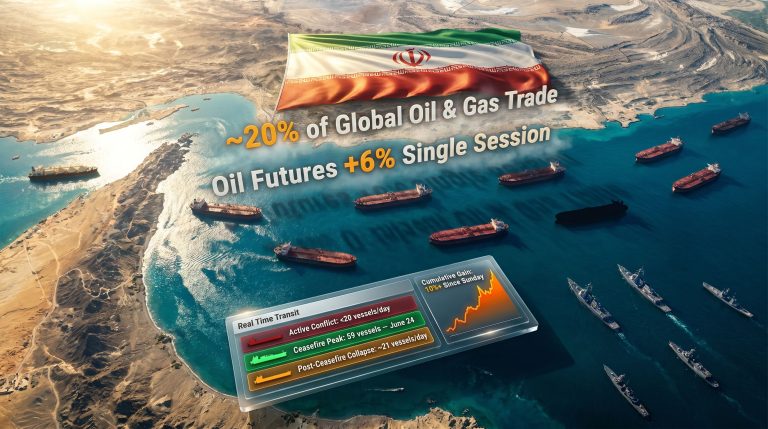
The conversation intensified dramatically in mid-2026 as escalating tensions in the Strait of Hormuz, including Iranian attacks on commercial vessels and renewed U.S. military strikes, pushed global oil prices sharply higher and revived fears about the monetisation of strategic waterways. This oil price shock quickly triggered a parallel anxiety in Southeast Asia: could the same logic that produced Hormuz fee proposals eventually migrate to the Strait of Malacca?
When big ASX news breaks, our subscribers know first
What the Strait of Malacca Actually Represents in Global Trade
Geographic and Strategic Profile
Stretching approximately 900 kilometres between the Malay Peninsula and the Indonesian island of Sumatra, the Strait of Malacca connects the Indian Ocean to the South China Sea and, by extension, to the Pacific. Its three bordering jurisdictions — Indonesia, Malaysia, and Singapore — each hold a stake in its operation, though the legal governance framework sits firmly within the United Nations Convention on the Law of the Sea (UNCLOS).
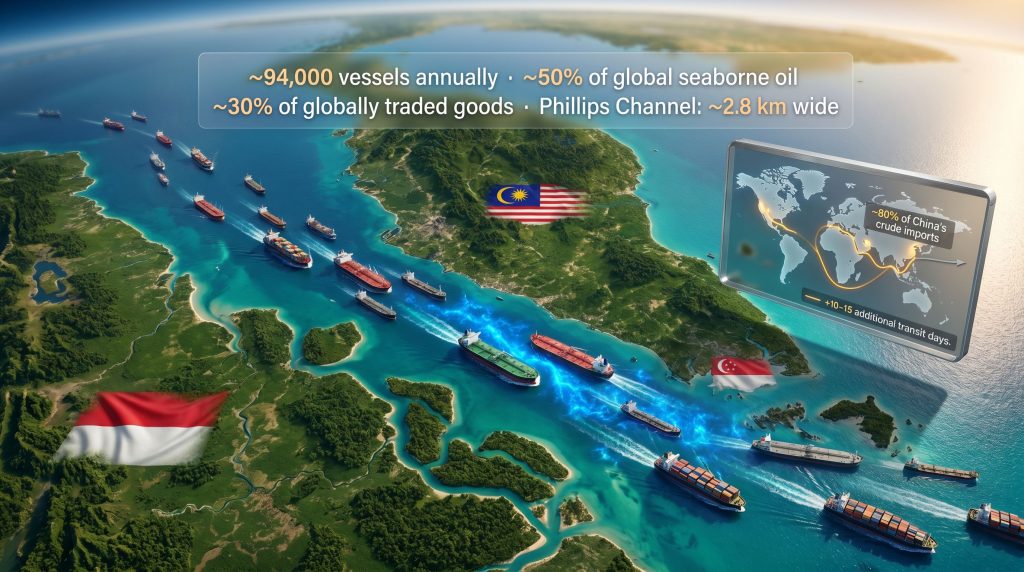
At its southern extreme, where the waterway compresses toward its narrowest point, lies the Phillips Channel adjacent to Singapore, a passage measuring barely 2.8 kilometres across. Singapore itself operates at this geographic fulcrum as the world's largest ship bunkering hub and the premier global container transshipment centre, processing extraordinary volumes of cargo that rely on the strait's unobstructed operation.
The Traffic and Volume Reality
The scale of activity through this waterway is difficult to overstate:
| Metric | Data Point |
|---|---|
| Annual vessel transits | ~94,000+ ships |
| Share of globally traded goods | ~30% |
| Share of global seaborne oil | ~50% |
| Narrowest point | ~2.8 km (Phillips Channel) |
| Detour distance if blocked | +10 to 15 extra transit days via Australia |
| China's crude oil import dependency | ~80% via Malacca |
| Current official transit fee | $0 (none in force) |
The strait serves as the shortest maritime connection between Middle Eastern crude production and East Asian refining capacity, making it the preferred route for tanker traffic bound for China, Japan, and South Korea. No other corridor offers comparable efficiency for this trade flow.
Why Hormuz Created a Malacca Problem
The Fee Precedent That Changed the Calculus
Iran and Oman's joint proposal to introduce administrative charges on vessels transiting the Strait of Hormuz fundamentally shifted the framing of how chokepoint access could be discussed. Tehran characterised its proposed charges as mandatory transit fees applicable to all commercial vessels. Oman took a different position, describing the same framework as voluntary service charges covering navigation assistance, environmental protection, and search-and-rescue coordination.
Omani officials drew an explicit comparison to voluntary service arrangements already operating in the Strait of Malacca, a framing that inadvertently spotlighted Southeast Asia's own exposure. The resulting oil market disruption concerns spread rapidly across Asian trading desks, sharpening focus on what a similar framework might mean for Malacca-dependent economies.
Reports emerging from the shipping industry suggested Iran was contemplating fees as high as $2,000,000 per vessel transiting the Hormuz corridor, a figure that, if applied at scale, would represent a seismic increase in tanker operating costs globally.
"The critical market concern is not necessarily that the Strait of Malacca fee proposals will succeed. It is that the active normalisation of toll discussions in any internationally governed strait creates a template that financially constrained coastal states may seek to replicate elsewhere."
Indonesia's April 2026 Proposal
In April 2026, Indonesia's Finance Minister Purbaya Yudhi Sadewa publicly floated the idea of introducing transit charges on vessels passing through the Strait of Malacca. The stated rationale was straightforward: monetise Indonesia's geographic position to fund domestic expenditure, including national nutrition programmes, without raising taxes on Indonesian citizens.
The minister explicitly cited Iran's Hormuz framework as an inspirational model and outlined a concept involving revenue distribution among Indonesia, Malaysia, and Singapore. The proposal gained brief but significant international attention before the minister subsequently characterised the idea as not a serious policy position. No formal legislative or regulatory process has been initiated, and no fees have been implemented.
The legal barrier is substantial. UNCLOS Article 44 explicitly prohibits coastal states from imposing mandatory transit fees on vessels exercising the right of transit passage through international straits. Both Singapore and Malaysia have reaffirmed their commitment to UNCLOS obligations and their opposition to any toll framework. Legal analysts note that implementing such a mechanism would either require a fundamental renegotiation of international maritime law or a unilateral action that would immediately trigger multilateral legal challenges.
The Legal Architecture Governing Transit Passage
What UNCLOS Article 44 Actually Says
Understanding why Strait of Malacca shipping fees remain legally impermissible requires clarity on a distinction that is often glossed over in public commentary: the difference between transit passage and innocent passage.
- Transit passage applies to international straits used for international navigation. It grants all vessels the right to pass continuously and expeditiously, and it explicitly prohibits coastal states from levying charges on that passage.
- Innocent passage applies to territorial waters more broadly and carries greater restrictions, but even here, fee imposition must meet specific UNCLOS conditions.
- Voluntary service charges, covering pilotage, tug assistance, or environmental response, are legally permissible precisely because they are optional and service-based, not mandatory transit tolls.
The Hormuz debate is actively testing the legal seam between these categories. If Iran successfully frames mandatory fees as voluntary service charges, it would establish a precedent with direct implications for Malacca governance.
Comparison of Legal Frameworks: Hormuz vs. Malacca
| Factor | Strait of Hormuz | Strait of Malacca |
|---|---|---|
| Bordering states | Iran, Oman | Indonesia, Malaysia, Singapore |
| UNCLOS status | Transit passage applies | Transit passage applies |
| Fee status | Proposed; legally contested | No fees; proposal not advanced |
| Legal enforceability of tolls | Highly contested | Prohibited under UNCLOS Article 44 |
| Regional opposition | U.S., EU, Gulf states | Singapore, Malaysia |
| Bypass alternatives | Saudi Red Sea pipeline (proposed) | Australian continent (+10–15 days) |
How Shipping Fees Would Transmit Into Oil Prices
The Cost Cascade Mechanism
Energy markets do not price chokepoint risk in isolation. The mechanism through which Strait of Malacca shipping fees would reach crude oil benchmarks and consumer fuel prices involves several interconnected transmission channels:
- Tanker operating cost increases: Per-voyage fees, even at modest levels, aggregate quickly across 94,000+ annual transits and tens of thousands of tanker-specific voyages.
- Maritime insurance premium escalation: War risk premiums, piracy surcharges, and political risk overlays respond rapidly to regulatory uncertainty, often amplifying underlying cost increases by a significant multiplier.
- Freight rate volatility: Spot freight rates on key tanker routes function as a leading indicator for downstream energy price movements, with disruptions transmitting into crude benchmarks within days.
- Refiner margin compression: Asian refiners processing Middle Eastern crude face direct cost pressure that either compresses margins or passes through to end consumers.
"Scenario Analysis: Applying a hypothetical $500,000 per-voyage toll to the estimated 20,000+ oil tanker transits through Malacca annually would generate an aggregate cost burden exceeding $10 billion per year for global oil supply chains, before accounting for insurance premium escalation or rerouting expenditure."
Furthermore, Goldman Sachs and other major financial institutions have flagged maritime chokepoint disruptions as a key upside risk variable in their global oil price forecasts. The concern is not limited to outright closure scenarios. Even elevated uncertainty, absent any actual fee implementation, is sufficient to generate measurable insurance premium increases and freight rate volatility.
China's Malacca Dilemma: A Structural Vulnerability at Scale
Why Beijing Treats This as an Existential Energy Risk
Approximately 80% of China's crude oil imports transit the Strait of Malacca. For the world's largest energy importer and second-largest economy, this concentration of supply flow through a single 2.8-kilometre bottleneck represents what strategists have long called the Malacca Dilemma: a single-point-of-failure risk embedded at the heart of the country's industrial energy security.
Any state with meaningful influence over the strait's operation, whether through fee structures, regulatory friction, or physical disruption, holds indirect leverage over China's manufacturing and economic output. Compounding this exposure are broader US-China trade tensions, which have heightened Beijing's sensitivity to supply chain vulnerabilities of all kinds. This geopolitical reality has shaped Beijing's infrastructure investment priorities for more than two decades.
China's Belt and Road Bypass Architecture
China has pursued two primary overland alternatives designed to reduce Malacca dependency:
China-Myanmar Economic Corridor (CMEC)
The CMEC is structured as an inverted-Y shaped infrastructure network extending from Yunnan Province through Myanmar toward the Indian Ocean. Its routing is as follows:
- Origin: Kunming, Yunnan Province
- Entry into Myanmar via Muse border crossing
- Through Mandalay as a central hub
- Bifurcating toward Yangon and the deep-sea port of Kyaukpyu in Rakhine State
The China-Myanmar Oil and Gas Pipeline, a central CMEC energy asset operated by CNPC-affiliated entities, carries up to 22 million tonnes of crude oil per year from Kyaukpyu to Yunnan, bypassing Malacca entirely. The pipeline generates approximately $22 million in direct revenue and $13.6 million in annual transit fees for Myanmar. Ongoing civil conflict within Myanmar has required China to significantly increase security investment along the corridor, introducing operational continuity risks that complicate its reliability as a full substitute.
China-Pakistan Economic Corridor (CPEC)
CPEC connects China's western Xinjiang region to Gwadar Port on Pakistan's Arabian Sea coastline, providing an alternative import route that bypasses both Malacca and Hormuz. However, China's overland infrastructure ambitions face consistent headwinds from security conditions and political instability, which remain the primary risk factors constraining CPEC's throughput reliability.
| Route | Capacity | Status | Key Risk |
|---|---|---|---|
| CMEC Myanmar Pipeline | ~22M tonnes/year crude | Operational | Civil conflict |
| CPEC Gwadar Port | Multi-commodity | Partially operational | Security, politics |
| Malacca Strait (primary) | ~50% global seaborne oil | Active | Fee proposals, geopolitical risk |
The next major ASX story will hit our subscribers first
How Asian Importers Beyond China Are Managing Exposure
Diversification Strategies Among Major Energy Consumers
Japan, South Korea, and India have all invested substantially in reducing their Malacca exposure over the past decade:
- Strategic petroleum reserve expansion: Japan, South Korea, and India have each grown their SPR capacity as a buffer against transit disruption events.
- Long-term LNG supply agreements: ADNOC's 15-year LNG supply deal with Japan's Inpex, announced in 2026, exemplifies the multi-decade supply security framework major Asian importers are building to reduce spot market vulnerability.
- Supplier diversification: Reducing dependence on Middle Eastern crude by sourcing from West Africa, Latin America, and the U.S. reduces, though does not eliminate, Malacca transit dependency.
Despite these efforts, no realistic near-term infrastructure alternative can replicate the throughput capacity of the Strait of Malacca. The waterway remains the dominant physical gateway for Asian imported energy, meaning even well-diversified importers would experience price transmission effects from any fee normalisation or access restriction.
Rerouting Scenarios and Their Economic Costs
What Happens If the Strait Is Blocked or Restricted?
Three primary bypass options exist, each with significant cost implications:
| Scenario | Additional Transit Days | Cost Impact | Vessel Class Limitation |
|---|---|---|---|
| Lombok Strait reroute | +2 to 3 days | Moderate | Most vessel classes viable |
| Sunda Strait reroute | +1 to 2 days | Low-moderate | Limited to smaller vessels |
| Australian circumnavigation | +10 to 15 days | High to extreme | All classes, extreme fuel cost |
| Full closure with fee imposition | Variable | Extreme | All classes affected |
The Lombok Strait, running between Bali and Lombok in Indonesia, is the most practical near-term bypass for larger tankers, though it adds meaningful distance and fuel expenditure. The Sunda Strait, between Java and Sumatra, is shallower and restricts larger vessel classes. Full circumnavigation of the Australian continent, while feasible, effectively represents a restructuring of the entire Asian energy import trade, with cost implications that would reverberate across every downstream industry dependent on refined petroleum products.
Frequently Asked Questions: Strait of Malacca Shipping Fees
Are there currently any Strait of Malacca shipping fees in effect?
No. As of mid-2026, no transit fees exist for vessels navigating the Strait of Malacca. The waterway operates as a free-passage corridor under the UNCLOS international maritime law framework.
Did Indonesia formally propose transit fees for the Strait of Malacca?
In April 2026, Indonesia's Finance Minister publicly raised the concept of introducing transit charges, citing the Hormuz framework as a model. The minister subsequently characterised the idea as not a formal policy proposal. No regulatory or legislative action has followed.
Could Strait of Malacca shipping fees be legally imposed?
Not under the current UNCLOS framework. Article 44 explicitly prohibits mandatory transit tolls on vessels exercising transit passage rights through international straits. Any such imposition would face immediate multilateral legal challenge.
How would Malacca shipping fees affect crude oil prices?
Per-voyage fees aggregated across tens of thousands of annual tanker transits would materially increase tanker operating costs and insurance premiums, transmitting upward price pressure into crude benchmarks, particularly for China, Japan, and South Korea.
Why is China disproportionately exposed to Malacca disruption risk?
Approximately 80% of China's crude oil imports transit the Strait of Malacca, creating a structural single-point-of-failure risk. Beijing has invested in pipeline alternatives through Myanmar and Pakistan, but Malacca remains the dominant import corridor.
The Broader Implication: Chokepoint Fee Contagion as a Structural Risk
The question energy market participants should be asking is not whether Strait of Malacca shipping fees will be imposed tomorrow. The current legal architecture makes near-term implementation highly unlikely. The more consequential question is whether the active normalisation of transit fee frameworks in internationally governed waterways represents a structural shift in global shipping economics that markets are not yet adequately pricing.
The legal distinction between voluntary service charges and mandatory transit tolls is being actively litigated in real time through the Hormuz situation. The outcome of that contested framework will set a precedent that coastal states with geographic leverage over other major waterways will observe closely. In addition, the wider backdrop of geopolitical trade risks means that even failed fee proposals can generate sustained uncertainty premiums in freight and insurance markets.
"For crude traders, refinery operators, maritime insurers, and Asian energy importers, chokepoint fee risk should now be treated as a structural variable in long-term supply chain planning, not a peripheral headline risk."
Policy responses capable of containing this risk require multilateral UNCLOS enforcement, investment in legally permissible maritime service infrastructure as an alternative revenue model for coastal states, and coordinated positioning among major Asian energy importers to present a unified response to any fee normalisation effort.
The Strait of Malacca remains open, legally protected, and free to transit today. The risk is not the present reality. It is the trajectory.
Key Statistics: Strait of Malacca at a Glance
| Data Point | Figure |
|---|---|
| Total strait length | ~900 kilometres |
| Annual vessel transits | ~94,000+ |
| Share of global seaborne oil | ~50% |
| Share of globally traded goods | ~30% |
| Narrowest point | ~2.8 km (Phillips Channel) |
| China crude import dependency via Malacca | ~80% |
| CMEC pipeline crude capacity | ~22 million tonnes/year |
| Myanmar pipeline revenue (direct) | ~$22 million/year |
| Myanmar transit fee revenue | ~$13.6 million/year |
| Detour cost if blocked | +10 to 15 transit days via Australia |
| Current official transit fee | $0 (none) |
| Indonesia's proposed fee status | Not implemented; legally impermissible |
This article contains forward-looking scenario analysis and economic modelling based on publicly available data. It does not constitute financial or investment advice. Readers should conduct independent research before making decisions based on any projections contained herein.
Want to Stay Ahead of the Market Moves Driven by Geopolitical Supply Shocks?
Discovery Alert's proprietary Discovery IQ model delivers real-time alerts on significant ASX mineral discoveries, transforming complex market data into actionable insights that help investors capitalise on opportunities before the broader market reacts — explore historic discoveries and their returns to see what early positioning can achieve, then begin your 14-day free trial at Discovery Alert to secure your market-leading edge.