May 20, 2026
Understanding India's Battery Manufacturing Evolution
Battery energy storage systems have emerged as critical infrastructure components across global markets, with manufacturing capacity expansion becoming a key indicator of national energy transition progress. India's energy storage sector reflects this global trend, with domestic manufacturers pursuing aggressive scaling strategies to capture growing demand across utility, mobility, and distributed applications. The establishment of a Waaree Energy Storage Solutions manufacturing facility represents a significant milestone in this evolving landscape.
The Indian battery manufacturing landscape demonstrates significant momentum, driven by policy support, declining technology costs, and expanding renewable energy deployment requirements. Manufacturing facilities capable of producing lithium-ion cells and battery packs at gigawatt-hour scale represent substantial technological and financial commitments that reshape regional supply chain dynamics.
Contemporary battery manufacturing requires sophisticated production processes, quality control systems, and supply chain integration across multiple technology domains. The intersection of renewable energy manufacturing capabilities with battery production creates potential operational synergies and competitive positioning advantages for integrated manufacturers, particularly in the context of critical minerals energy transition initiatives.
When big ASX news breaks, our subscribers know first
Waaree Energy Storage Solutions Manufacturing Facility Development Strategy
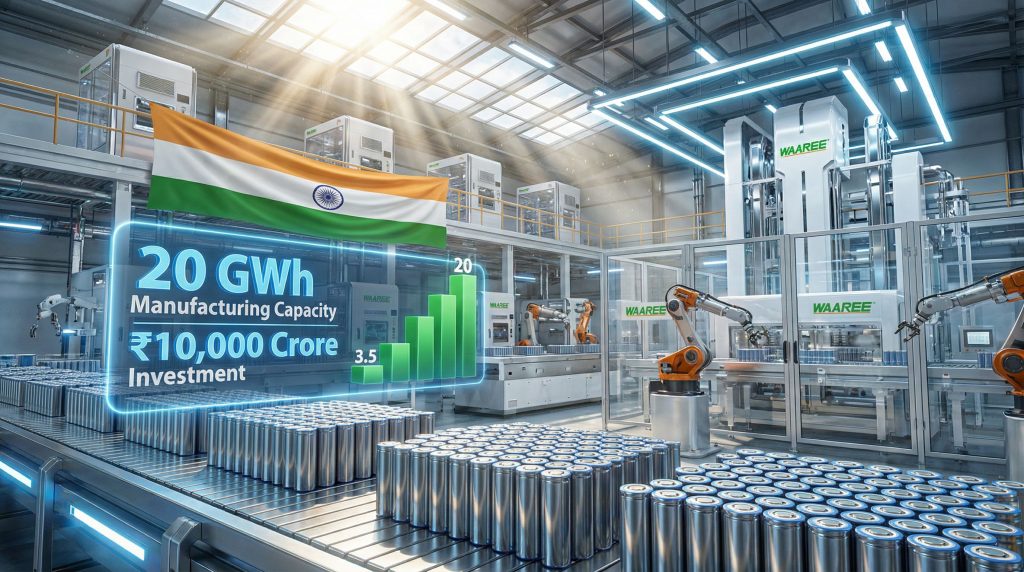
Waaree Energy Storage Solutions has secured INR 1,003 crore (approximately $111 million) in funding to support development of advanced lithium-ion manufacturing capabilities. This initial funding represents approximately 10% of the company's total INR 10,000 crore capital expenditure commitment for battery manufacturing expansion, highlighting the scale of this ambitious project.
The funding round involved multiple investor categories, including strategic institutional investors, family office partnerships, high-net-worth individual participants, and professional fund managers. This diverse investor composition suggests a balanced approach between patient capital and institutional governance standards.
Furthermore, the comprehensive funding structure provides flexibility for long-term manufacturing development whilst maintaining professional management oversight throughout the facility's development phases.
Production Capacity Scaling Framework
The proposed facility targets 20 GWh annual production capacity, representing a 471% increase from Waaree's current 3.5 GWh baseline manufacturing capability. This expansion positions the company among India's largest planned battery manufacturing operations, reflecting the growing importance of lithium industry innovations in the region.
| Capacity Metric | Current Status | Planned Capacity | Growth Multiple |
|---|---|---|---|
| Battery Manufacturing | 3.5 GWh | 20 GWh | 5.7x |
| Electrolyzer Production | 300 MW | 1,000 MW | 3.3x |
| Inverter Manufacturing | Not specified | 4 GW | New capability |
The integrated approach spans multiple clean energy technology domains, creating potential manufacturing synergies and comprehensive project delivery capabilities. Consequently, this positions Waaree as a comprehensive clean energy solutions provider.
Technology Focus and Production Applications
The facility will produce both lithium-ion cells and battery pack assemblies, indicating integrated manufacturing rather than assembly-only operations. The company has demonstrated indigenous lithium iron phosphate (LFP) cell development capabilities, suggesting focus on chemistries optimised for specific application requirements.
Production will target three primary market segments: utility-scale energy storage systems for grid stabilisation and renewable integration, electric mobility applications including commercial vehicles and two-wheeler markets, and distributed energy storage for residential and commercial installations.
According to Saurenergy's analysis, stationary storage became the lowest-cost lithium-ion battery segment in 2025, with pack prices reaching $70/kWh, representing a 45% decrease from 2024 levels.
Global Battery Manufacturing Capacity Comparison
India's battery manufacturing sector remains nascent compared to established Asian production hubs, though domestic capacity expansion demonstrates significant momentum. The global lithium-ion battery manufacturing landscape is dominated by Chinese and South Korean producers, with emerging regional manufacturers pursuing market opportunities in their domestic territories.
International Production Benchmarking
Waaree's planned 20 GWh capacity positions the company as a mid-tier regional manufacturer rather than a global-scale producer. Major international battery manufacturers operate facilities with significantly higher annual capacity: CATL (China) with estimated capacity exceeding 500 GWh annually, LG Energy Solution (South Korea) operating multiple facilities totaling hundreds of GWh, and BYD (China) providing integrated automotive and stationary storage production.
However, regional market focus provides advantages in logistics costs, local supply chain development, and policy support alignment with domestic manufacturing priorities. These factors are particularly relevant when considering innovations in battery recycling breakthrough technologies.
Manufacturing Quality and Standards Framework
Battery manufacturing requires adherence to multiple international standards and certifications: International Electrotechnical Commission (IEC) compliance, Indian Standards (IS) certification requirements, UL safety certifications for specific markets, and quality management system integration (ISO 9001, automotive standards).
Production consistency across large-scale manufacturing batches represents a critical technical challenge requiring advanced process control systems and comprehensive testing protocols. In addition, manufacturers must navigate complex regulatory environments whilst maintaining cost competitiveness.
Market Applications for Domestic Battery Production
India's energy storage applications span multiple sectors experiencing rapid growth, creating diverse demand patterns for battery manufacturers. The country's accelerating renewable energy deployment creates storage requirements across utility-scale, commercial, and residential segments.
Utility-Scale Grid Storage Requirements
Grid-scale battery installations support multiple technical functions essential for renewable energy integration. These include frequency regulation services maintaining grid stability during supply fluctuations, peak demand management reducing electricity costs during high-consumption periods, renewable energy firming providing consistent power output from variable sources, and grid congestion relief optimising transmission infrastructure utilisation.
According to The Hindu Business Line, India's battery energy storage sector is positioned for unprecedented growth, with transformative market development expected by 2029.
Electric Mobility Market Opportunities
India's electric vehicle adoption creates demand for batteries across multiple transportation segments. The growing emphasis on electric vehicles and mining applications demonstrates the expanding scope of battery utilisation.
Two-Wheeler Applications:
- Electric scooters and motorcycles representing the largest EV segment
- Commercial delivery vehicles requiring daily cycling capabilities
- Shared mobility platforms with intensive usage patterns
Commercial Vehicle Electrification:
- Fleet operators seeking operational cost reductions
- Public transportation system modernisation
- Last-mile delivery optimisation requirements
Distributed Energy Storage Growth
Residential and commercial energy storage applications demonstrate increasing adoption driven by grid reliability concerns and electricity cost management objectives. These include home backup systems providing power security during outages, commercial peak shaving reducing demand charges for business operations, and microgrid development supporting community energy independence.
The integration of distributed storage with rooftop solar installations creates bundled value propositions for customers seeking comprehensive energy solutions. Furthermore, this trend aligns with broader sustainability objectives across multiple sectors.
Impact on India's Battery Manufacturing Ecosystem
The Waaree Energy Storage Solutions manufacturing facility represents significant advancement in domestic battery production capabilities, with implications extending beyond the company's direct operations. The facility contributes to broader objectives including import substitution, supply chain localisation, and technology development capacity building.
Supply Chain Localisation Benefits
Domestic battery manufacturing requires development of supporting supplier ecosystems across multiple component categories. These include battery management system (BMS) production for safety and performance optimisation, thermal management components ensuring operational temperature control, structural materials including casings, cooling systems, and electrical connections, and raw material processing particularly lithium compound preparation and cathode materials.
The development of localised supply chains reduces dependence on imported components whilst creating employment opportunities across supporting industries. This approach particularly benefits from advances in battery-grade lithium refinery operations.
Technology Development and Skills Building
Large-scale battery manufacturing facilities require specialised workforce capabilities spanning process engineering expertise for production optimisation and quality control, materials science knowledge for battery chemistry and performance enhancement, automation and control systems for manufacturing efficiency improvement, and safety protocols and environmental management for sustainable operations.
The establishment of domestic manufacturing capability creates foundations for indigenous research and development activities, potentially leading to technology innovations adapted to Indian market requirements. Consequently, this development supports long-term industrial competitiveness.
Competitive Advantages of Integrated Energy Solutions
Waaree's approach integrates battery manufacturing with existing solar module production (19.7 GW capacity) and planned inverter manufacturing (4 GW expansion), creating potential operational synergies and market positioning advantages.
End-to-End Project Delivery Capabilities
Integrated manufacturing across solar modules, inverters, and battery storage enables bundled pricing strategies offering cost advantages to customers, single-vendor accountability simplifying project management and warranty coverage, optimised component compatibility ensuring system performance and reliability, and supply chain coordination reducing lead times and inventory requirements.
Import Substitution and Cost Optimisation
Domestic manufacturing provides potential advantages in transportation cost reduction eliminating international shipping requirements, currency risk mitigation avoiding foreign exchange fluctuations, tariff avoidance benefiting from domestic manufacturing incentives, and technical support proximity enabling faster service response capabilities.
The success of import substitution strategies depends on achieving cost and quality parity with international suppliers whilst maintaining reliable production capacity. However, early indicators suggest positive market reception for domestically manufactured solutions.
The next major ASX story will hit our subscribers first
Funding Structure Supporting Manufacturing Scale-Up
The phased funding approach with INR 1,003 crore initial investment followed by additional tranches totalling INR 10,000 crore reflects risk management practices common in large-scale manufacturing development projects.
Investment Risk Mitigation Strategies
The funding structure incorporates several risk management elements: milestone-based capital deployment linking funding to development achievements, diverse investor participation reducing dependence on single funding sources, phased capacity ramp-up allowing market validation before full-scale production, and technology upgrade flexibility enabling adaptation to evolving battery chemistries.
Family office participation typically indicates patient capital availability with longer investment horizons, suitable for manufacturing projects requiring sustained development periods before achieving full operational capacity. In addition, this investor profile supports sustainable growth strategies.
Capital Allocation Across Technology Domains
The total INR 10,000 crore commitment spans multiple technology areas: battery cell and pack manufacturing (primary allocation), electrolyzer production scaling from 300 MW to 1,000 MW, inverter manufacturing expansion targeting 4 GW capacity, and supporting infrastructure including quality control and testing facilities.
The integrated investment approach creates potential economies of scale across shared infrastructure and management capabilities. Furthermore, this comprehensive allocation demonstrates commitment to technological excellence.
Technical Manufacturing Challenges and Solutions
Scaling battery production from 3.5 GWh to 20 GWh requires addressing multiple technical and operational challenges inherent in precision manufacturing processes.
Production Quality Control Systems
Battery manufacturing demands exceptional consistency across production batches to ensure safety and performance standards. This includes cell voltage uniformity requiring precision electrode preparation and electrolyte management, capacity matching ensuring consistent energy storage performance across production runs, safety validation including thermal runaway prevention and abuse testing protocols, and cycle life verification confirming long-term performance degradation patterns.
Manufacturing Process Optimisation Requirements
Large-scale production requires advanced process control capabilities: environmental controls maintaining precise temperature and humidity conditions, material handling automation minimising contamination and handling damage risks, equipment calibration protocols ensuring consistent manufacturing parameters, and waste management systems addressing sustainable production practices.
The transition from small-scale to large-scale manufacturing often reveals process challenges not apparent at lower production volumes, requiring continuous optimisation and refinement. Consequently, manufacturers must invest significantly in quality assurance systems.
Contributing to India's Clean Energy Transition
The Waaree Energy Storage Solutions manufacturing facility supports broader national objectives for renewable energy deployment and grid modernisation across multiple technical and economic dimensions.
Grid Modernisation and Renewable Integration
Battery storage systems enable higher renewable energy penetration by addressing intermittency challenges. These solutions provide solar and wind power firming delivering consistent output during variable generation periods, grid stability services maintaining frequency and voltage within operational parameters, transmission congestion management optimising power flow across grid infrastructure, and ancillary services provision supporting grid operators with fast-response capabilities.
Industrial Decarbonisation Support
Manufacturing sectors require reliable electricity supply for production processes, creating opportunities for battery storage integration. This includes power quality improvement protecting sensitive equipment from grid disturbances, demand charge optimisation reducing electricity costs through strategic storage utilisation, backup power provision ensuring production continuity during grid outages, and on-site renewable integration maximising clean energy consumption.
Future Technology Development Pathways
The establishment of domestic battery manufacturing capability creates foundations for advanced technology development and market expansion opportunities.
Next-Generation Battery Chemistry Research
Future technology development may include sodium-ion battery systems offering cost advantages for stationary storage applications, solid-state battery development providing enhanced safety and energy density characteristics, battery recycling capabilities supporting circular economy objectives and materials recovery, and advanced battery management systems incorporating artificial intelligence for performance optimisation.
Export Market Development Potential
Domestic manufacturing scale enables potential expansion into regional markets through South Asian market opportunities leveraging geographic proximity and cost advantages, technology transfer partnerships with emerging market manufacturers, component export capabilities supplying other battery assembly operations, and technical service expertise supporting international project development.
Strategic Manufacturing Positioning Assessment
The Waaree Energy Storage Solutions manufacturing facility represents significant advancement in India's battery production capabilities, combining substantial financial investment with integrated energy technology expertise. The facility addresses multiple market segments whilst contributing to domestic supply chain development and technology capacity building.
The success of this manufacturing expansion depends on execution capabilities across production quality, cost competitiveness, and market demand development. The integrated approach spanning solar modules, inverters, and battery storage creates potential competitive advantages through bundled solutions and supply chain coordination.
The facility's development timeline and operational achievements will influence broader industry confidence in domestic battery manufacturing viability. Success could catalyse additional investment in India's battery production ecosystem, supporting energy security objectives and industrial development priorities.
Disclaimer: This analysis is based on publicly available information and industry trends. Investment decisions should consider comprehensive due diligence and professional financial advice. Manufacturing capacity targets and timeline projections are subject to technical, regulatory, and market factors that may affect actual outcomes.
What's Your Strategy for Battery Manufacturing Investment Opportunities?
India's rapid battery manufacturing expansion presents compelling investment possibilities, particularly as companies like Waaree scale production capacity dramatically. Discovery Alert's proprietary Discovery IQ model delivers real-time alerts on significant ASX mineral discoveries, instantly empowering subscribers to identify actionable opportunities in the critical minerals essential for battery production ahead of the broader market. Begin your 30-day free trial today and secure your market-leading advantage.