
August 6, 2026
Understanding Asia's Energy Security Transformation
The global energy landscape has entered a period of unprecedented volatility, with traditional supply-demand dynamics reshaping national energy strategies across emerging markets. While consumption patterns surge in developing economies, domestic production capabilities face mounting pressures from geological constraints, investment shortfalls, and technological gaps. This transformation creates complex macro-economic implications that extend far beyond energy markets, influencing currency stability, trade balances, and long-term economic competitiveness.
Asia's third-largest economy exemplifies this paradox, where robust economic growth drives energy demand whilst India crude oil production decline experiences systematic deterioration. The resulting dependency on imports exposes the nation to external price shocks, supply disruptions, and balance-of-payments pressures that complicate fiscal planning and monetary policy decisions.
When big ASX news breaks, our subscribers know first
Core Structural Forces Driving Production Decline
Geological Depletion Patterns in Legacy Basins
India crude oil production decline reflects the natural lifecycle of mature hydrocarbon reservoirs across its primary producing regions. The country's major oil fields, concentrated in western and eastern offshore basins, have been producing for several decades, leading to inevitable reservoir pressure decline and reduced extraction rates.
The Mumbai High complex, which has historically contributed approximately 40% of India's crude oil output, demonstrates classic depletion characteristics. Reservoir pressure maintenance through water injection and gas recycling has extended field life, but ultimate recovery factors remain constrained by geological limitations and economic thresholds. According to India's crude oil production data, this decline represents an ongoing challenge for the nation's energy security.
Enhanced Oil Recovery (EOR) implementation across Indian fields lags behind international standards, with adoption rates significantly lower than comparable producing regions. Technical analysis indicates that:
- Primary recovery typically extracts 10-15% of original oil in place
- Secondary recovery through water flooding adds another 15-25%
- Tertiary EOR methods could potentially recover an additional 10-20%
However, the economic viability of EOR projects depends on sustained oil prices above $60-70 per barrel, making investment decisions sensitive to the oil price rally impact from global market dynamics.
Investment Allocation Challenges in Upstream Operations
Capital deployment patterns within India's oil sector reveal structural underinvestment in exploration and development activities. Over the past decade, exploration spending has averaged only 12-15% of total upstream capital allocation, significantly below the global industry standard of 20-25%.
Foreign direct investment in India's upstream sector has remained subdued despite policy reforms, with international oil companies preferring established producing regions in Africa, Latin America, and Southeast Asia. This preference stems from:
- Risk-adjusted return calculations that favour proven geological provinces
- Regulatory complexity perception despite recent simplification efforts
- Resource potential assessments that indicate modest compared to global opportunities
The National Geological Data Repository initiative, launched to attract exploration investment, has catalogued extensive seismic and geological datasets. However, translating this information into commercial discoveries requires sustained exploration campaigns that have been limited by capital constraints.
Production Performance in Global Context
| Metric | 2015 | 2020 | 2025 | Trend |
|---|---|---|---|---|
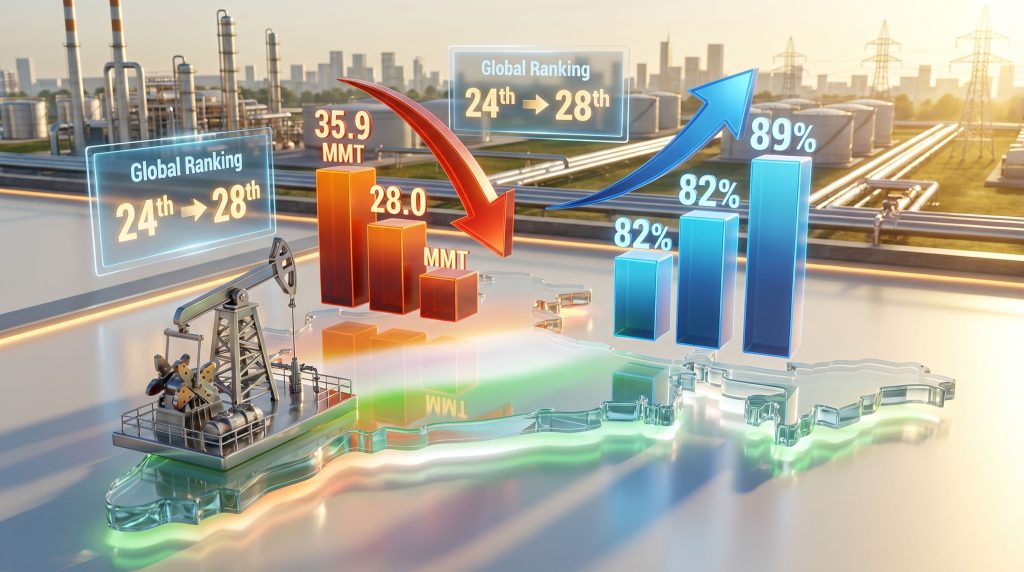
| Crude Production (MMT) | 35.9 | 32.2 | 28.0 | -22% decline |
| Import Dependency (%) | 82% | 85% | 89% | +7 percentage points |
| Natural Gas Output (bcm) | 45.2 | 28.7 | 34.8 | -23% overall |
| Global Production Ranking | 24th | 26th | 28th | Declining position |
Benchmarking Against Regional Energy Producers
India's production efficiency metrics lag behind Southeast Asian peers, particularly in terms of recovery rates per well and discovery success ratios. Regional comparisons reveal significant performance gaps that contribute to India crude oil production decline.
Malaysia's upstream sector maintains production stability through continuous exploration in deep-water provinces, with discovery rates averaging one commercial find per 4-5 exploration wells. India's success ratio approximates one commercial discovery per 8-10 exploration attempts, indicating either inferior geological targeting or suboptimal drilling strategies.
Thailand's natural gas development demonstrates effective resource management through integrated field development and infrastructure sharing. Thai production costs average $8-12 per barrel equivalent, whilst Indian offshore operations typically require $15-20 per barrel to achieve commercial viability.
Technology adoption rates further differentiate regional performance. 3D seismic coverage across India's sedimentary basins remains incomplete, whilst countries like Norway and the UK have achieved comprehensive geological mapping that enables more precise exploration targeting. Furthermore, understanding natural gas price trends provides insight into broader energy market dynamics affecting regional producers.
Economic Consequences of Rising Import Dependency
Balance of Payments Impact Assessment
India crude oil production decline directly correlates with mounting foreign exchange outflows for energy imports. The country's crude oil import bill reached approximately $140 billion in 2025-26, representing nearly 40% of total merchandise imports and creating persistent current account pressures.
Currency volatility exposure intensifies during global oil price shocks, as demonstrated during the Iran conflict in early 2026. Crude oil price spikes to $95-100 per barrel resulted in:
- Additional $15-20 billion in annual import costs
- Rupee depreciation of 8-10% against the dollar
- Inflation pressures through transportation and energy costs
The strategic petroleum reserve capacity of 36.87 million tonnes provides approximately 18 days of consumption coverage, significantly below the International Energy Agency's recommended 90-day strategic reserve threshold. This storage deficit amplifies vulnerability during supply disruptions and limits negotiating power with crude oil suppliers.
Energy Security Risk Quantification
Supply chain vulnerability analysis reveals critical dependencies on specific trade routes and supplier countries. Approximately 85% of India's crude oil imports transit through the Strait of Hormuz, creating concentrated geopolitical risk exposure that commodity hedging strategies cannot fully mitigate. This mirrors global energy exports challenges faced by resource-dependent economies.
Price elasticity studies indicate that India's crude oil demand remains relatively inelastic in the short term, with demand responding minimally to price fluctuations due to:
- Transportation sector dependency on refined petroleum products
- Industrial process requirements for petrochemical feedstocks
- Limited short-term substitution possibilities for liquid fuels
This inelasticity amplifies the economic impact of price volatility and reduces the effectiveness of market-based conservation mechanisms.
How Does Natural Gas Production Decline Impact Energy Security?
Dual Energy Crisis Analysis
Natural gas output decline parallels India crude oil production decline, creating compounded energy security challenges. After reaching peak production of 47.6 billion cubic metres in 2010-11, natural gas output fell to a low of 28.7 bcm in 2020-21 before partially recovering to 34.8 bcm in 2025-26.
The Krishna-Godavari (KG) basin dynamics illustrate the volatility of Indian gas production. Reliance Industries' KG-D6 fields experienced unexpected production decline due to geological complexities, including:
- Water influx issues that reduced hydrocarbon recovery
- Sand production problems that damaged completion equipment
- Reservoir connectivity challenges that limited field development optimisation
New field developments in the same basin have plateaued faster than anticipated, suggesting similar geological constraints affect broader regional production potential. Additionally, evolving LNG market opportunities present alternative pathways for meeting domestic demand.
Industrial Competitiveness Implications
LNG import costs create competitive disadvantages for India's manufacturing sector, particularly in fertiliser production, steel manufacturing, and petrochemicals. Delivered LNG prices averaging $12-15 per million BTU compare unfavourably with domestic gas pricing of $6-8 per million BTU, creating cost structure challenges that affect export competitiveness.
The fertiliser industry's dependency on imported gas and naphtha feedstocks results in production costs that exceed regional competitors, necessitating government subsidies that strain fiscal resources. This dependency cycle illustrates how energy import reliance creates broader economic distortions beyond direct commodity costs.
Policy Intervention Strategies and Economic Viability
Fiscal Incentive Restructuring for Exploration
International best practices in production sharing contracts demonstrate potential pathways for revitalising India's upstream sector. Brazil's pre-salt development model offers valuable insights for deep-water exploration incentives, including:
- Progressive royalty structures that adjust with field profitability
- Technology transfer requirements that build domestic capabilities
- Risk-sharing mechanisms that attract international investment whilst protecting national interests
Norwegian petroleum fiscal regime analysis reveals how transparent, stable taxation frameworks can sustain long-term investment despite high marginal tax rates. The Norwegian Petroleum Fund model demonstrates how resource revenues can be efficiently managed for intergenerational equity whilst maintaining exploration incentives.
Tax regime optimisation for marginal field development requires careful calibration between revenue generation and investment attraction. Economic modelling suggests that reducing royalty rates from 12.5% to 8% for marginal fields could increase cumulative production by 15-20% over field lifetime whilst generating higher net present value for government revenues.
Technological Innovation Pathways
Digital transformation opportunities in upstream operations present significant potential for production optimisation. Artificial intelligence applications in reservoir management can increase recovery factors by 5-10% through:
- Predictive maintenance algorithms that reduce downtime
- Reservoir simulation optimisation that improves drainage patterns
- Real-time monitoring systems that enable dynamic production management
Advanced seismic survey technologies, including ocean-bottom node systems and full waveform inversion, could identify previously undetected hydrocarbon accumulations in mature basins. These technologies have achieved success rates of 60-70% in similar geological environments globally, compared to India's current 20-25% exploration success rate.
Carbon capture, utilisation, and storage (CCUS) integration with enhanced oil recovery presents dual benefits of production enhancement and emissions reduction. CO2-EOR projects could potentially recover an additional 2-3 billion barrels from India's mature oil fields whilst supporting climate commitments.
The next major ASX story will hit our subscribers first
Long-Term Economic Scenarios and Strategic Alternatives
Scenario Modelling: Business-as-Usual vs. Intervention
Economic modelling under current trajectory assumptions projects India crude oil production declining to 22-24 million tonnes by 2030, increasing import dependency to approximately 92-94%. This scenario implies:
- Annual import costs reaching $180-200 billion at current consumption levels
- Current account deficit contributions of 3.5-4% of GDP from energy imports
- Strategic vulnerability during supply disruptions or price shocks
Intervention scenarios incorporating aggressive exploration investment and technology deployment could potentially stabilise production at 30-32 million tonnes through 2030. Break-even analysis indicates that $25-30 billion in cumulative exploration investment could generate:
- Additional production of 40-50 million tonnes over the decade
- Foreign exchange savings of $50-60 billion at average oil prices
- Energy security enhancement through reduced import dependency
Strategic Alternatives Assessment
Offshore exploration potential in India's deep-water blocks remains largely untapped, with less than 20% of prospective areas adequately explored. Geological surveys indicate potential resources of 5-7 billion barrels in ultra-deep water areas beyond 2,000 metres depth, requiring investment of $40-50 billion for comprehensive development.
Coal-to-liquids technology adoption presents an alternative pathway for reducing crude oil import dependency. Economic feasibility analysis suggests that CTL plants could produce synthetic crude at $65-75 per barrel equivalent, competitive with long-term international oil prices whilst utilising India's substantial coal reserves.
Green hydrogen production emergence as an energy security hedge offers long-term strategic value through:
- Industrial application substitution for natural gas in steel and fertiliser production
- Transportation fuel development through synthetic fuel pathways
- Export potential in emerging global hydrogen markets
This transition aligns with broader energy transition challenges faced by resource-dependent economies globally.
The transition from fossil fuel dependency to energy security through diversification requires coordinated policy frameworks that balance short-term import vulnerability with long-term strategic positioning in evolving global energy markets.
Investment Implications and Market Outlook
What Are the Key Sectoral Investment Opportunities?
Upstream technology providers positioned for enhanced oil recovery projects present attractive investment prospects as Indian operators seek production optimisation solutions. Companies specialising in hydraulic fracturing, horizontal drilling, and reservoir stimulation could benefit from increasing adoption of unconventional recovery methods.
Service companies with expertise in mature field optimisation face growing demand as operators extend field life and maximise recovery from aging reservoirs. The digital oilfield services segment offers particular growth potential through data analytics and automated production management systems.
Alternative energy infrastructure investments serve as hedges against continued import dependency growth. LNG terminal capacity expansion, pipeline infrastructure development, and renewable energy integration projects offer diversified exposure to India's evolving energy landscape. According to analysis of India's production patterns, these alternative investments become increasingly crucial.
Risk Assessment for Energy Sector Stakeholders
Regulatory policy stability indicators suggest improving frameworks for long-term investment planning, though implementation consistency remains a critical factor. The Hydrocarbon Exploration and Licensing Policy provides more transparent bidding processes, but execution track record will determine investor confidence levels.
Currency hedging strategies become essential for import-dependent refiners as rupee volatility correlates with global oil price movements. Natural hedging through crude oil futures and currency forwards provides protection against adverse price movements, though hedging costs reduce operational margins.
Supply chain diversification requirements for industrial consumers include developing alternative fuel sources, improving energy efficiency, and implementing demand management systems. Companies with integrated energy strategies demonstrate greater resilience during supply disruptions and price volatility periods.
Investment decisions in India's energy sector require careful consideration of geological constraints, policy frameworks, and global market dynamics. Whilst production decline creates challenges, it also generates opportunities for technology providers, service companies, and alternative energy developers positioned to address the country's evolving energy security requirements.
Disclaimer: This analysis contains forward-looking statements and projections based on current market conditions and available data. Actual outcomes may differ materially due to geological uncertainties, policy changes, technological developments, and global market dynamics. Investment decisions should incorporate comprehensive due diligence and professional financial advice.
Ready to Capitalise on Energy Sector Opportunities?
Discovery Alert's proprietary Discovery IQ model delivers real-time alerts on significant ASX mineral discoveries, instantly empowering subscribers to identify actionable opportunities ahead of the broader market. Begin your 14-day free trial today and secure your market-leading advantage in the evolving energy and resources landscape.