
August 20, 2026
Understanding India's Strategic Position in Global Precious Metals
The global precious metals market operates within complex macroeconomic frameworks where cultural traditions intersect with sophisticated investment strategies. In examining these dynamics, India emerges as a unique case study where traditional wealth preservation mechanisms are rapidly evolving alongside modern financial technologies. Furthermore, the record 2025 gold surge has intensified focus on Indian gold investment trends across all demographic segments.
Market Size and Economic Impact
India's position in global gold markets extends far beyond simple consumption metrics. The nation maintains the world's second-largest consumer market for precious metals, generating approximately $59 billion in annual import values despite experiencing over 20 percent volume reductions throughout 2025. This apparent contradiction reveals sophisticated market dynamics where price appreciation compensates for quantity declines.
For instance, the Odisha gold deposits analysis demonstrates how domestic production capabilities influence national investment strategies. However, import dependence continues driving market behaviour patterns across regional demographics.
The geographic distribution of consumption patterns provides critical insights into investment behavior. Rural regions account for approximately two-thirds of India's total gold demand, indicating that precious metals investment extends well beyond urban financial centers. This demographic spread suggests that gold functions as a distributed wealth storage system rather than merely an investment vehicle for sophisticated investors.
Monthly import tonnage data reveals seasonal fluctuations that reflect both cultural and economic factors. December 2025 imports declined from 48 tonnes in November to an estimated 35-40 tonnes, demonstrating how market participants respond to price signals while maintaining baseline demand levels. These fluctuations provide opportunities for strategic investors to understand cyclical purchasing patterns.
Structural Changes in Indian Gold Demand Architecture
The traditional jewelry-centric consumption model is experiencing fundamental shifts as investment-first approaches gain prominence. Household penetration statistics reveal that 87 percent of Indian families maintain some gold holdings, with particularly notable participation among lower-income demographics where 75 percent of bottom-decile households hold precious metals assets.
This broad-based participation indicates that gold serves multiple functions within Indian household finance. Moreover, India's record-breaking gold investment demand highlights the growing sophistication of investment approaches across economic segments.
Key Functions Include:
• Wealth preservation mechanism during banking system limitations
• Collateral asset for securing financing when traditional credit tightens
• Cultural obligation fulfillment through ceremonial purchases
• Intergenerational transfer vehicle for preserving family wealth
The resilience of this system became evident during COVID-19 economic disruptions, when households utilized gold as collateral for financing after banks tightened credit availability. Subsequently, some participants liquidated holdings entirely to meet consumption needs, demonstrating the asset's dual role as both store of value and emergency liquidity source.
When big ASX news breaks, our subscribers know first
What's Driving the Massive Shift Toward Gold ETFs and Digital Platforms?
Portfolio Diversification Strategies
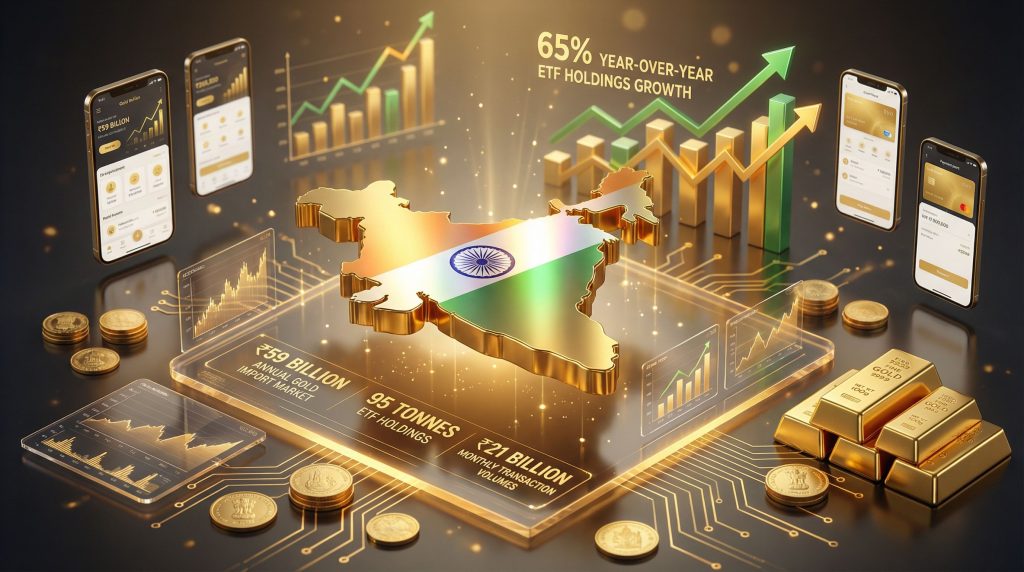
The transformation of Indian gold investment trends reflects sophisticated portfolio construction principles adapted to local market conditions. ETF holdings experienced 65 percent year-over-year growth, reaching 95 tonnes cumulatively by end of 2025. This growth trajectory positions India as the third-largest global market for gold ETF inflows, with $4.4 billion in total inflows.
Furthermore, the best gold investment strategies increasingly incorporate ETF vehicles alongside traditional physical holdings. This diversification approach enables participants to balance convenience with cultural preferences for tangible assets.
December 2025 Record Performance Metrics:
| Metric | Value | Growth Rate |
|---|---|---|
| Monthly ETF Inflows | ₹116 billion | Record high |
| Holdings Increase | 8.6 tonnes | Record monthly addition |
| Consecutive Inflow Months | 8 months | Sustained momentum |
| Total Account Holders | 10.2 million | 60% annual growth |
The sustained eight-month consecutive inflow period indicates that Indian investors view gold as a strategic portfolio diversifier rather than a tactical trading instrument. This behavioral shift suggests that muted equity market performance created rotation effects toward precious metals as portfolio ballast.
Technology-Enabled Investment Channels
Digital payment infrastructure development has democratised precious metals access through innovative technological integration. Unified Payments Interface (UPI) digital gold transactions nearly tripled, rising from ₹8 billion in January 2025 to ₹21 billion in December 2025. This 162.5 percent increase over eleven months demonstrates rapid adoption of frictionless purchase mechanisms.
The UPI integration eliminates traditional barriers to precious metals investment. In addition, this technological advancement supports the ETC investment guide principles by reducing operational complexity for retail participants.
Benefits Include:
• Minimum purchase threshold removal enabling incremental investment approaches
• Real-time settlement reducing transaction costs and processing delays
• Interbank standardisation providing consistent user experience across platforms
• Mobile accessibility expanding participation beyond traditional banking relationships
This technological infrastructure development supports systematic investment plan (SIP) approaches where participants can implement dollar-cost averaging strategies using rupee-denominated gold purchases. The reduction of friction in the purchase-to-ownership journey has expanded participation beyond traditional jewellery retailers and banking channels.
Institutional vs Retail Investment Patterns
The emergence of 10.2 million ETF account holders represents a fundamental shift in Indian investor behaviour. 3.8 million new accounts opened during 2025, indicating accelerating adoption of institutional investment vehicles previously viewed with scepticism among retail participants who traditionally favoured physical possession.
ETF structural mechanics provide transparency through trust company legal frameworks where custodians hold metal on behalf of investors. This structure offers legal separation between investor ownership and counterparty risk inherent in traditional banking relationships, addressing cultural preferences for asset security whilst providing convenience benefits.
Critical Investment Considerations:
ETF investments represent fractional interests in underlying metal holdings rather than direct physical ownership rights. Investors own shares of the ETF, not gold itself, which may not align with traditional Indian preferences for tangible asset possession.
The behavioural adaptation toward paper gold instruments suggests either generational preference shifts or pragmatic recognition of storage and convenience benefits that outweigh traditional tangibility preferences.
Why Are Record-High Prices Strengthening Rather Than Weakening Investment Demand?
Price Elasticity Analysis in Indian Context
Indian gold investment trends demonstrate atypical price elasticity characteristics where record-high prices strengthen investment demand rather than reducing consumption. This phenomenon requires analysis through cultural, behavioural, and economic frameworks that differ from conventional commodity demand models.
However, understanding gold as an inflation hedge becomes crucial when analysing this counter-intuitive behaviour. The perception of gold as protection against currency devaluation drives investment demand even at elevated prices.
Price Response Segmentation Analysis:
| Price Range (INR/10g) | Jewellery Demand | Investment Demand | Cultural Purchases | Market Dynamics |
|---|---|---|---|---|
| Below ₹120,000 | High Volume | Moderate Growth | Stable | Traditional Pattern |
| ₹120,000-₹140,000 | Declining Volume | Accelerating | Maintained | Transition Phase |
| Above ₹140,000 | Lightweight Focus | Dominant Driver | Needs-Based Only | Investment-Led Model |
The bifurcation between jewellery and investment demand reveals that Indians increasingly segment gold consumption into distinct categories. Cultural and ceremonial jewellery obligations exhibit price inelasticity, where wedding and festival demand remains steady despite record-high prices. Conversely, discretionary investment demand shows positive price elasticity, where momentum attracts new participants seeking exposure to price appreciation.
Safe-Haven Premium Calculations
Investment demand acceleration at higher price levels reflects sophisticated risk assessment where Indians calculate safe-haven premiums against alternative investment options. Muted equity market performance creates relative value propositions favouring precious metals as portfolio diversifiers.
The exchange mechanism provides crucial demand support, with over 40 percent of jewellery retailers' sales driven by old jewellery trade-ins. This represents substitution effects where portfolio rebalancing occurs through exchange rather than net new purchases, enabling consumers to maintain gold exposure while minimising incremental cash outlay.
Quality Optimisation Strategies:
• Purity migration from 22-karat to 18-karat and 14-karat alternatives
• Weight reduction through lighter jewellery designs
• Exchange transactions leveraging existing holdings for new purchases
• Festival timing concentrating purchases during culturally significant periods
Wealth Preservation Mechanisms
The persistence of demand despite price increases reflects gold's multiple functions within Indian wealth management strategies. Rural banking system limitations drive precious metals accumulation as alternative savings vehicles, particularly in regions where large numbers operate outside formal tax systems.
Historical precedents demonstrate gold's effectiveness as wealth preservation during economic disruption. COVID-19 lockdown periods revealed both the asset's collateral value for securing financing and its liquidity function when participants sold holdings to meet consumption needs.
How Are Consumer Behaviours Adapting to Sustained High Gold Prices?
Quality and Purity Optimisation Strategies
Consumer adaptation mechanisms reveal sophisticated cost optimisation approaches that maintain cultural significance while managing financial exposure. The migration from traditional 22-karat preferences toward 18-karat and 14-karat alternatives demonstrates quality elasticity responses where participants reduce per-unit costs while preserving precious metals exposure.
Adaptation Mechanisms:
• Purity substitution maintaining gold exposure at lower cost per unit
• Weight optimisation through lighter jewellery designs
• Exchange maximisation leveraging existing holdings for new acquisitions
• Timing strategies concentrating purchases during favourable market conditions
Retailer Revenue Model Evolution
Despite volume declines, listed Indian jewellery retailers reported revenue growth ranging from 37 to 51 percent on an annual basis during Q4 2025. This performance demonstrates successful margin expansion strategies where price appreciation compensates for reduced unit sales.
The exchange market dynamics provide revenue stability through inventory turnover mechanisms. When over 40 percent of sales derive from old jewellery trade-ins, retailers benefit from both margin expansion on new sales and processing fees on exchange transactions.
Regional Consumption Variations
Import tonnage fluctuations from 48 tonnes in November to 35-40 tonnes in December 2025 reflect seasonal demand patterns influenced by festival calendars and wedding seasons. These cyclical variations provide strategic timing opportunities for investors implementing cost averaging approaches.
Furthermore, seasonal gold buying patterns in India demonstrate how cultural events drive demand regardless of price considerations.
Festival and Wedding Demand Seasonality:
The needs-based purchasing category maintains resilience during price volatility, indicating that cultural obligations override pure price optimisation. Wedding seasons and religious festivals create inelastic demand periods where participants prioritise cultural compliance over cost considerations.
What Investment Strategies Are Emerging for Indian Gold Exposure?
Systematic Investment Plan (SIP) Approaches
The integration of gold investment with systematic planning frameworks enables Indian investors to implement sophisticated accumulation strategies. UPI digital gold transaction growth facilitates regular, smaller purchases that reduce timing risk through temporal diversification.
Strategic Implementation Methods:
• Monthly accumulation through automated purchase systems
• Festival timing concentrating investments during seasonal demand peaks
• Price averaging reducing volatility impact through regular investments
• Threshold triggers implementing purchases during price corrections
Portfolio Allocation Frameworks
Professional investment guidance suggests 40-50 percent partial profit-booking at current price levels for participants with substantial accumulated positions. This approach balances continued exposure to potential appreciation against realisation of existing gains.
Risk-Adjusted Allocation Considerations:
| Risk Profile | Gold Allocation | Rebalancing Frequency | Exit Strategy |
|---|---|---|---|
| Conservative | 15-25% | Quarterly | Gradual reduction |
| Moderate | 10-20% | Semi-annually | Tactical profits |
| Aggressive | 5-15% | Annually | Momentum-based |
The correlation analysis with Indian equity and bond markets suggests optimal rebalancing frequencies depend on portfolio construction objectives and risk tolerance levels.
Profit-Taking and Exit Strategies
Current market conditions support strategic profit realisation approaches while maintaining core precious metals exposure. Long-term holding strategies benefit from continued central bank buying patterns and structural demand support, while tactical trading approaches capitalise on price momentum and volatility.
Tax Implications Across Investment Vehicles:
• Physical gold subject to capital gains taxation with holding period considerations
• ETF platforms offering potential tax efficiency through institutional structures
• Digital gold requiring evaluation of classification and treatment protocols
How Do Cultural Factors Influence Modern Investment Decisions?
Wedding and Festival Demand Patterns
Cultural integration with investment strategies creates unique market dynamics where traditional obligations intersect with modern portfolio theory. Wedding and festival seasons maintain steady demand regardless of price levels, providing predictable support during market volatility.
The regional festival calendar influences demand cycles throughout the year, creating opportunities for strategic investors to understand seasonal patterns. Two-thirds of demand originating from non-urban regions indicates that cultural factors operate independently of sophisticated financial market influences.
Socioeconomic Investment Drivers
The penetration of gold ownership across income levels demonstrates the metal's universal appeal within Indian society. 75 percent of bottom-decile households maintain gold holdings, indicating that precious metals investment transcends economic demographics.
Financial Inclusion Mechanisms:
Gold serves as an alternative banking system in regions where traditional financial services remain limited. The asset provides both savings vehicle functionality and collateral mechanisms for securing financing during economic stress periods.
Credit Collateralisation Applications:
The utilisation of gold as collateral during COVID-19 economic disruptions demonstrated the metal's practical financial utility. When banks tightened credit to mitigate default risk, households successfully used precious metals holdings to secure financing for operational needs.
The next major ASX story will hit our subscribers first
What Does the Future Hold for Indian Gold Investment Trends?
Price Forecasting and Market Projections
Professional forecasting indicates continued price appreciation potential with World Gold Council scenarios suggesting 15-30 percent gains over strategic time horizons. J.P. Morgan's $5,055/oz Q4 2026 target implies significant rupee-denominated appreciation for Indian investors maintaining exposure.
Central Bank Buying Support:
International central bank purchasing patterns provide structural demand support that underpins long-term price trajectories. This institutional demand operates independently of retail investment flows, creating baseline support levels that benefit individual investors.
Structural Market Evolution
The transition from physical to paper gold preferences represents fundamental behavioural evolution within Indian investment culture. ETF account growth of 60 percent annually and UPI transaction volume increases of 162.5 percent indicate accelerating adoption of modern investment vehicles.
Consequently, Indian gold investment trends continue evolving toward hybrid models combining traditional cultural obligations with modern investment efficiency. This transformation reflects broader economic development patterns across emerging markets.
Regulatory Environment Development:
Securities and Exchange Board of India (SEBI) frameworks continue evolving to accommodate increased retail participation in precious metals investment vehicles. These regulatory developments enhance investor protection while expanding access to sophisticated investment structures.
Global Supply Chain Implications
India's evolving role in international gold price discovery mechanisms reflects the nation's transition from pure consumer to sophisticated participant in global precious metals markets. Import policy impacts continue influencing domestic investment opportunities while strategic reserve considerations affect national economic security planning.
The integration of Indian demand patterns with global supply chain dynamics creates opportunities for investors who understand both local cultural factors and international market mechanisms. This dual-market fluency becomes increasingly valuable as Indian gold investment trends continue expanding beyond traditional boundaries.
Strategic Investment Considerations:
The analysis presented reflects current market conditions and historical patterns. Precious metals investments carry risks including price volatility, storage costs, and liquidity considerations. Investors should conduct independent research and consider professional guidance before making investment decisions. Past performance does not guarantee future results, and all investment strategies involve potential for both gains and losses.
Ready to Capture the Next Major Precious Metals Opportunity?
Discovery Alert delivers instant notifications on significant ASX mineral discoveries, powered by its proprietary Discovery IQ model, helping investors identify actionable opportunities in precious metals and other commodities ahead of the broader market. Explore Discovery Alert's discoveries page to understand how historic mineral discoveries have generated substantial returns, then begin your 30-day free trial to position yourself strategically in the evolving precious metals landscape.