May 22, 2026
Understanding Indigenous-Led Resource Governance in Modern Mining
Indigenous governance systems are fundamentally reshaping how critical mineral projects advance across Canada's resource landscape. This transformation reflects more than regulatory compliance evolution—it signals the emergence of partnership-driven development models that integrate traditional legal systems with modern permitting frameworks. As global demand for lithium, graphite, and other strategic materials intensifies, companies are pioneering approaches that embed Indigenous participation throughout project lifecycles. Furthermore, the Frontier Lithium First Nation agreements demonstrate how authentic partnerships can accelerate critical mineral development while respecting Indigenous sovereignty.
The shift toward Indigenous-led resource governance emerges from decades of consultation failures and growing recognition of Indigenous sovereignty rights. Modern frameworks acknowledge that sustainable resource development requires authentic partnership rather than token consultation, creating structured mechanisms for shared decision-making that extend from exploration through decommissioning phases.
When big ASX news breaks, our subscribers know first
What Makes Process Agreements Different from Traditional Mining Consultations?
Table: Evolution of Indigenous Engagement in Canadian Mining
| Traditional Consultation Model | Modern Process Agreement Framework |
|---|---|
| Reactive engagement after project design | Proactive co-development from early stages |
| Information sharing focus | Decision-making participation emphasis |
| Provincial regulation priority | Dual governance system integration |
| Economic compensation primary | Cultural protocol recognition central |
| Timeline-driven approvals | Relationship-building foundation |
Process agreements establish fundamentally different engagement models compared to conventional consultation protocols. Rather than seeking Indigenous input on predetermined project designs, these frameworks create formal mechanisms for ongoing participation throughout entire project lifecycles. The Frontier Lithium First Nation agreements demonstrate this evolution, where over a decade of continuous engagement between the company and both Deer Lake First Nation and Sandy Lake First Nation preceded formal process agreement signing.
Key Differentiating Mechanisms:
• Parallel Processing Structure: Indigenous consultation runs concurrently with technical assessments rather than sequentially
• Legal Pluralism Recognition: Formal acknowledgment of Anishinninew laws alongside provincial regulatory requirements
• Information Transparency Protocols: Structured data sharing mechanisms supporting informed community decision-making
• Cultural Protocol Integration: Recognition of traditional laws within formal permitting frameworks
• Long-term Relationship Foundation: Built on established relationships spanning multiple project phases
According to Chief Lenard Mamakeesick of Deer Lake First Nation, these agreements ensure that community concerns about land, water, and future generations receive formal consideration throughout project advancement. This represents a significant departure from consultation models where Indigenous input often occurred after critical project decisions were finalised.
Sandy Lake First Nation emphasised that process agreements create clarity around information sharing while respecting community laws and protocols. In addition, these frameworks establish transparent communication mechanisms rather than one-way information dissemination typical of traditional consultation approaches.
How Does Ontario's One Project, One Process Framework Integrate Indigenous Governance?
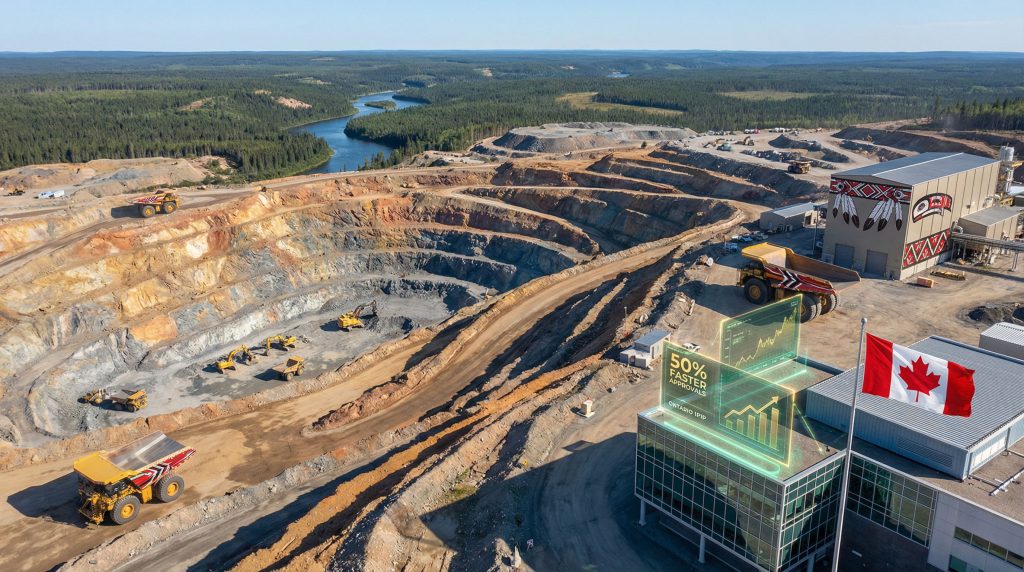
Ontario's One Project, One Process (1P1P) initiative represents Canada's most ambitious attempt to streamline critical mineral approvals while strengthening Indigenous participation. The framework targets 50% reductions in government review timelines through coordinated assessment processes that embed Indigenous consultation within provincial regulatory streams rather than treating them as separate requirements.
1P1P Integration Architecture:
• Coordinated Review Timelines: 24-month target approval periods for qualifying projects through synchronised provincial and Indigenous assessment processes
• Shared Information Systems: Real-time data access for provincial agencies, Indigenous representatives, and project proponents
• Parallel Processing: Indigenous consultation integrated within technical review schedules rather than sequential requirements
• Cultural Protocol Recognition: Formalised acknowledgment of Indigenous legal systems within provincial regulatory architecture
• Transparency Mechanisms: Structured frameworks supporting predictable engagement for all participating parties
The Frontier Lithium PAK project's designation under 1P1P demonstrates how this framework operationalises Indigenous-provincial coordination. Ontario Minister of Energy and Mines Stephen Lecce emphasised that the project's advancement proceeds with speed while maintaining meaningful partnership with both First Nations. Furthermore, the province positions Indigenous engagement as integral to efficient permitting rather than regulatory obstacle.
Technical Implementation Details:
The PAK project's 1P1P designation encompasses mine, mill, all-season road access, and downstream facility permitting across multiple jurisdictions. The framework coordinates review processes for a project with 31-year operational life, $932 million after-tax NPV (at 8% discount rate), and 17.9% after-tax IRR. Consequently, this demonstrates 1P1P capability to handle complex, large-scale developments through integrated assessment processes.
What Economic Models Emerge from Indigenous-Mining Partnerships?
Revenue Participation Structures
Modern Indigenous-mining agreements increasingly feature sophisticated economic participation models that extend beyond traditional royalty arrangements. The evolution reflects growing Indigenous financial capacity and strategic positioning within critical minerals energy transition supply chains essential for global energy transition.
Emerging Partnership Models:
-
Direct Equity Stakes: Indigenous communities acquiring ownership percentages in mining operations
-
Joint Venture Structures: Shared development responsibilities and returns across project phases
-
Impact Benefit Agreements: Comprehensive community development programs linked to project revenues
-
Employment Guarantee Programs: Preferential hiring commitments with associated training investments
-
Indigenous Business Development: Supplier and contractor prioritisation supporting community economic capacity
The Frontier Lithium PAK project, structured as a joint venture between Frontier Lithium (92.5%) and Mitsubishi Corporation (7.5%), demonstrates international investment attraction through Indigenous partnership models. While specific revenue-sharing arrangements remain confidential, the Frontier Lithium First Nation agreements establish frameworks supporting Indigenous economic participation throughout the project's 31-year operational timeline.
Project Economic Scale Supporting Partnership:
• Capital Project Value: $932 million after-tax NPV supporting substantial employment and contracting opportunities
• Operational Timeline: 31-year mine life enabling long-term community economic engagement
• Strategic Mineral Focus: Lithium production addressing global energy transition demand
• Regional Integration: Mine and mill operations in Red Lake area with downstream processing in Thunder Bay
How Do Cultural Protocols Shape Technical Mining Operations?
Indigenous legal systems increasingly influence operational aspects of mining projects, creating hybrid governance models that integrate traditional ecological knowledge with modern engineering practices. The Frontier Lithium First Nation agreements explicitly recognise Anishinninew laws and protocols within project planning and technical assessments. For instance, this establishes formal mechanisms for cultural integration.
Cultural-Technical Integration Areas:
• Environmental Monitoring Integration: Traditional knowledge informing baseline studies and ongoing environmental assessment
• Seasonal Operational Restrictions: Mining activities aligned with cultural calendars and traditional wildlife management practices
• Sacred Site Protection: Project infrastructure design modifications respecting culturally significant landscapes
• Water Stewardship Integration: Traditional watershed management principles guiding water use and protection protocols
• Post-Mining Land Use: Indigenous-led restoration planning incorporating traditional land management approaches
According to Sandy Lake First Nation representatives, the process agreements create clarity around respecting community laws and protocols. However, cultural integration extends beyond symbolic recognition toward operational influence. This approach addresses Indigenous priorities regarding land, water, and intergenerational stewardship that Chief Lenard Mamakeesick emphasised as central community concerns.
Traditional Knowledge Application
The integration of Anishinninew legal systems within technical mining operations represents significant evolution from consultation-based approaches toward genuine legal pluralism. This framework acknowledges that Indigenous communities possess sophisticated governance systems capable of informing complex resource development decisions while maintaining cultural integrity.
What Role Do Frontier Lithium First Nation Agreements Play in Critical Mineral Supply Chain Security?
Strategic Resource Access Through Partnership
The Canada energy transition increasingly depends on Indigenous partnership models to ensure reliable resource access for global supply chains. The Frontier Lithium First Nation agreements demonstrate how collaborative approaches reduce project risk while supporting supply chain security for materials essential to energy transition technologies.
Supply Chain Security Implications:
• Reduced Operational Risk: Partnership-based development models decrease probability of community-related project disruptions
• Accelerated Permitting: 24-month 1P1P timeline compared to traditional multi-year approval processes
• Social Licence Certainty: Community support reducing investor uncertainty and supporting project financing
• ESG Compliance Advantage: Indigenous partnership models attracting responsible investment capital
• Long-term Operational Stability: Relationship-based agreements supporting 31-year project lifecycle planning
The Mitsubishi Corporation's 7.5% joint venture participation in the PAK project indicates international recognition that Indigenous partnership models enhance project viability. This Japanese investment reflects growing global investor preference for mining projects with demonstrated community support and reduced social risk profiles.
Global Competitiveness Factors
Trevor Walker, Frontier Lithium's President and CEO, positioned process agreements as essential best practice for Indigenous engagement in mining. Furthermore, these frameworks provide competitive advantages in attracting international investment and ensuring operational predictability. The integration of Indigenous perspectives with provincial regulatory processes creates investor confidence through reduced uncertainty.
The next major ASX story will hit our subscribers first
How Do These Agreements Address Climate Policy and Energy Transition Goals?
Indigenous communities increasingly position themselves as essential partners in Canada's net-zero transition, leveraging traditional stewardship roles to influence clean energy mineral development. The Frontier Lithium project demonstrates how Indigenous partnerships support climate policy objectives through sustainable resource development approaches.
Climate Policy Integration Mechanisms:
• Traditional Stewardship Recognition: Indigenous land management practices supporting biodiversity conservation and carbon sequestration
• Sustainable Mining Practices: Traditional ecological knowledge informing low-impact extraction methodologies
• Regional Economic Diversification: Mining revenues supporting broader community sustainability initiatives
• Energy Transition Material Supply: Lithium production supporting battery technology and renewable energy infrastructure
• Intergenerational Planning: Indigenous governance emphasising long-term environmental protection aligning with climate objectives
The PAK project's focus on lithium production directly supports global energy transition goals by supplying materials essential for battery technologies and renewable energy storage. The downstream processing facility in Thunder Bay creates value-added production within Canada rather than exporting raw materials. Consequently, this supports domestic clean technology development.
Environmental Protection Integration
Ontario's approach maintains that 1P1P framework advancement remains consistent with objectives of streamlining approvals without weakening environmental protections. This indicates that Indigenous partnership models complement rather than compromise environmental standards, creating dual benefits of community support and environmental stewardship.
What Challenges Remain in Scaling Indigenous-Mining Partnerships?
Capacity and Resource Constraints
Despite growing sophistication in Indigenous-mining agreements, significant challenges persist in scaling these partnership models across Canada's vast resource landscape. The complexity of modern mining industry evolution requires substantial technical and financial capacity that many Indigenous communities are still developing.
Key Implementation Barriers:
• Technical Expertise Development: Limited Indigenous capacity for independent assessment of complex mining technical studies and environmental impact evaluations
• Financial Resource Requirements: Insufficient community funding for independent technical reviews, legal counsel, and ongoing monitoring activities
• Regulatory Complexity Navigation: Overlapping federal, provincial, and Indigenous jurisdictions creating coordination challenges
• Internal Community Consensus: Diverse community perspectives on resource development participation requiring extensive internal consultation
• Market Timeline Pressures: Global commodity demand creating pressure for accelerated development conflicting with relationship-building requirements
Capacity Building Requirements
The over decade-long engagement period between Frontier Lithium and both First Nations illustrates the time investment required for meaningful partnership development. This timeline reflects the complexity of building technical capacity, establishing trust, and developing governance frameworks capable of managing sophisticated mining operations.
How Do International Investors View Indigenous Partnership Models?
ESG Investment Criteria Evolution
Global capital markets increasingly evaluate mining investments through Indigenous relationship quality, creating competitive advantages for projects with demonstrated community partnerships. The Mitsubishi Corporation's participation in the Frontier Lithium joint venture reflects this international investment trend.
Investor Assessment Factors:
• Social Licence Strength: Community support levels and agreement durability reducing operational risk
• Regulatory Risk Mitigation: Partnership models decreasing approval uncertainties and timeline delays
• Operational Continuity: Lower probability of community-related disruptions supporting project financing
• ESG Compliance: Indigenous partnerships supporting corporate sustainability reporting requirements
• Long-term Value Creation: Relationship-based agreements supporting 31-year operational planning and investor confidence
International Recognition Indicators
The Japanese investment in the PAK project through Mitsubishi Corporation indicates international recognition that Indigenous partnership models enhance project investment attractiveness. This participation reflects growing global investor preference for mining projects with enhanced community engagement and reduced social conflict risk.
What Future Trends Will Shape Indigenous-Mining Relationships?
Emerging Governance Models
The next decade will likely witness continued evolution toward Indigenous-led resource governance. However, communities are taking increasingly active roles in project development and ownership rather than remaining passive consultation participants.
Anticipated Developments:
• Indigenous Mining Company Development: Community-owned operations competing directly with traditional mining companies
• Technology Partnership Innovation: Indigenous communities partnering with technology companies on sustainable extraction methodologies
• Regional Coordination Frameworks: Multi-community agreements covering broader resource areas and shared infrastructure
• International Model Influence: Canadian Indigenous-mining approaches influencing global resource development practices
• Financial Innovation: New funding mechanisms supporting Indigenous equity participation and technical capacity development
Policy Integration Expansion
Ontario's 1P1P framework success may influence federal policy development and other provincial approaches to Indigenous-mining coordination. The 50% timeline reduction target demonstrates that Indigenous partnership integration can accelerate rather than delay project advancement when properly structured.
Regulatory Innovation and Legal Framework Development
Constitutional and Legislative Evolution
Indigenous-mining partnerships operate within evolving constitutional frameworks recognising Indigenous rights and governance authority. The integration of Anishinninew laws within provincial regulatory processes represents legal innovation that may influence broader Canadian approaches to Indigenous governance recognition.
Legal Pluralism Implementation:
• Dual Governance Recognition: Formal acknowledgment of Indigenous legal systems alongside provincial regulatory requirements
• Jurisdictional Coordination: Mechanisms for resolving conflicts between different legal frameworks and governance authorities
• Precedent Establishment: Process agreements creating legal precedents for future Indigenous-mining relationships
• Federal-Provincial-Indigenous Coordination: Tri-lateral governance models addressing overlapping jurisdictions
The Frontier Lithium First Nation agreements demonstrate practical implementation of legal pluralism within resource development contexts. Furthermore, these create frameworks that recognise Indigenous governance authority while maintaining provincial regulatory standards. This approach may influence broader constitutional discussions regarding Indigenous self-governance and resource management authority.
Technology and Innovation Integration
Digital Governance Platforms
Modern Indigenous-mining partnerships increasingly leverage technology platforms supporting transparent information sharing, collaborative decision-making, and ongoing monitoring throughout project lifecycles. The digital mining integration enables more sophisticated community participation in complex technical assessments.
Technological Integration Areas:
• Real-time Environmental Monitoring: Digital platforms supporting community access to environmental data and assessment results
• Collaborative Project Planning: Digital tools enabling community input on project design and operational planning
• Cultural Mapping Integration: GIS technologies incorporating traditional knowledge and sacred site documentation
• Economic Modelling Transparency: Financial platforms supporting community understanding of project economics and benefit distribution
The transparency and predictability mechanisms established through Frontier Lithium's process agreements likely incorporate digital platforms supporting ongoing information sharing and collaborative governance throughout the project's development phases.
Conclusion: Toward Collaborative Resource Governance
The transformation of Indigenous-mining relationships in Canada represents fundamental changes in resource governance models that will likely define 21st-century mining practices. The Frontier Lithium First Nation agreements demonstrate how process-based partnerships can accelerate project development while strengthening Indigenous participation in resource management decisions.
As critical mineral demand intensifies globally, jurisdictions with robust Indigenous partnership frameworks will maintain competitive advantages in attracting investment and ensuring operational stability. The 24-month 1P1P permitting timeline achieved through Indigenous-provincial coordination contrasts sharply with traditional consultation approaches that often extended approval processes for years while generating community opposition.
Success in this evolving landscape requires mining companies to view Indigenous engagement as strategic partnership opportunity rather than regulatory compliance cost. Simultaneously, Indigenous communities continue developing capacity to participate meaningfully in complex resource development decisions while maintaining cultural integrity and governance authority.
The $932 million project value and 31-year operational timeline of the PAK project illustrate the economic scale where Indigenous partnerships create mutual benefits supporting community development and sustainable resource extraction. These models provide frameworks for addressing global energy transition material demands while respecting Indigenous governance systems and environmental stewardship priorities.
Disclaimer: This analysis involves forward-looking assessments regarding Indigenous-mining partnership evolution, regulatory framework development, and investment trends. Actual outcomes may differ from projected scenarios based on policy changes, market conditions, and community decisions. Financial projections and timeline estimates are based on current feasibility studies and may change during project development phases.
Ready to Discover the Next Major Mineral Breakthrough?
Discovery Alert's proprietary Discovery IQ model instantly identifies significant ASX mineral discoveries, empowering subscribers to capitalise on critical mineral opportunities like those reshaping Indigenous-mining partnerships across global markets. Explore how historic discoveries have generated substantial returns and begin your 30-day free trial today to position yourself ahead of emerging opportunities in this evolving sector.