May 20, 2026
Resource Nationalism and the Architecture of Control: Understanding Indonesia's Commodity Export Overhaul
Indonesia to route key commodity exports via state firm structures represents one of the most operationally ambitious expressions of resource nationalism seen in Southeast Asia in recent memory. Across the developing world, a quiet but consequential shift has been gathering momentum for more than a decade. Governments that once competed aggressively for foreign capital by offering liberal trade terms are increasingly reasserting sovereignty over commodity wealth. This particular policy turn is distinctive not merely for its ideological commitment to state control, but for the surgical precision with which it targets the mechanism through which revenue has been leaking: the transaction itself.
When big ASX news breaks, our subscribers know first
The Scale of the Problem That Triggered This Policy
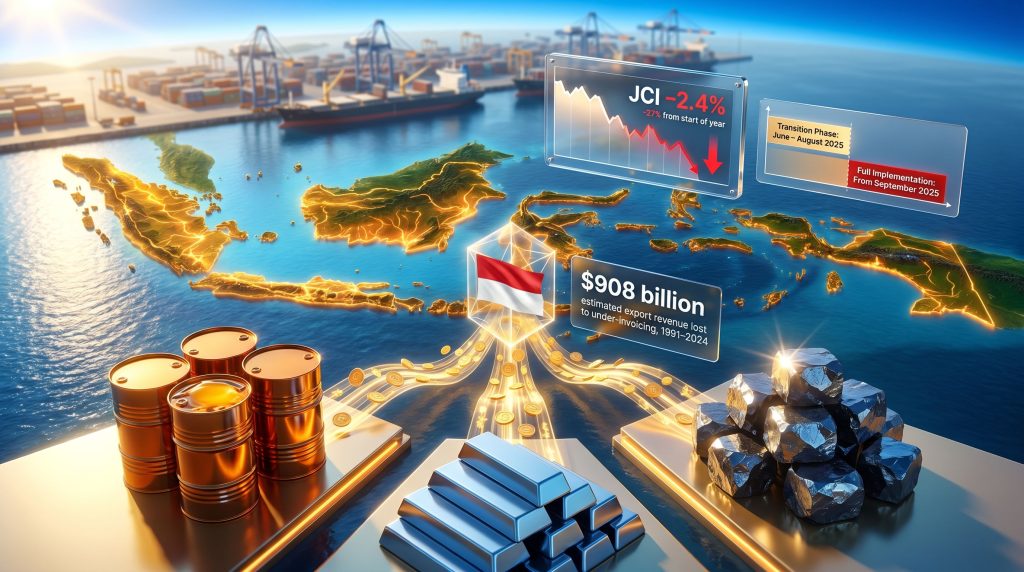
To understand why Indonesia's government moved with such urgency, the numbers speak more clearly than any policy document. President Prabowo Subianto cited a figure that deserves serious attention: an estimated $908 billion in export revenue lost to under-invoicing across the period 1991 to 2024. This represents one of the most extensively documented cases of systematic trade revenue leakage in Southeast Asian economic history.
What Is Under-Invoicing and Why Does It Matter?
Under-invoicing is a practice where exporters deliberately declare a lower value for their shipments than the actual transaction price. The gap between the declared value and the real sale price typically flows to offshore accounts, bypassing both taxation obligations and foreign exchange repatriation requirements. In commodity-intensive economies, this practice is particularly corrosive because it occurs at scale, across thousands of transactions, and is structurally incentivised when price oversight is weak.
The mechanics of transfer pricing abuse in commodity markets are especially difficult to detect in sectors like palm oil and thermal coal, where opaque pricing structures, related-party transactions, and complex trading intermediary chains create multiple points at which declared values can diverge from actual settlement prices.
Indonesia's March 2025 regulation had already moved to address the downstream symptom: exporters of non-oil-and-gas natural resources were required to deposit 100% of foreign currency proceeds into designated national bank accounts for a minimum of 12 months. However, that regulation contained a structural flaw. Without controlling the transaction itself, enforcement depended on voluntary compliance and post-hoc verification. The SOE routing mandate is the logical corrective: if the state controls the sale, the proceeds follow automatically.
Three Commodities, Three Strategic Rationales
Palm Oil: Pricing Opacity at the Heart of an Agricultural Giant
Indonesia holds an extraordinary position in global edible oil markets as the world's largest producer of palm oil, accounting for roughly 60% of global palm oil supply according to the United States Department of Agriculture. The sheer scale of this market position has paradoxically made it fertile ground for transfer pricing manipulation. When a single country dominates supply to this degree, related-party transactions between domestic producers and their offshore trading affiliates become extremely difficult for authorities to benchmark against genuine arm's-length market prices.
Furthermore, the state's interest in palm oil extends beyond revenue capture. Indonesia's long-standing industrial policy ambition is to shift from exporting crude palm oil toward exporting refined, bleached, and deodorised derivatives. Centralised export management through SOEs creates a structural lever to enforce value-addition requirements at the point of sale, something that purely regulatory approaches have consistently struggled to achieve.
Thermal Coal: Maximum Fiscal Extraction Before the Energy Transition Window Closes
Coal occupies a uniquely contradictory position in Indonesia's export portfolio. It generates enormous foreign exchange earnings, with Indonesia consistently ranking among the world's top two thermal coal exporters alongside Australia. At the same time, the country faces growing international pressure regarding its energy transition commitments, creating a time-sensitive fiscal calculus. The global crude steel outlook and shifting energy dynamics add further complexity to this picture.
From the government's perspective, the window for extracting maximum fiscal value from coal reserves is narrowing. The primary buyers, including China, India, South Korea, and Japan, are all managing their own coal dependency timelines to varying degrees. This creates a logic where the state wants to ensure that every dollar of coal export value flows through channels it controls, particularly given that coal's contribution to Indonesian government revenues has historically underperformed relative to export volumes. The China steel market outlook further underscores how regional demand shifts are reshaping Indonesian export priorities.
Ferrous Alloys: The Industrial Policy Frontier
Ferroalloys represent the most forward-looking dimension of the policy. These materials, which include ferronickel, ferromanganese, ferrochrome, and related products, sit at the intersection of Indonesia's raw material wealth and its manufacturing ambitions. Ferronickel in particular has become central to Indonesia's positioning within global battery supply chains, as nickel is a key input for lithium-ion battery cathode chemistries used in electric vehicles.
The inclusion of ferrous alloys in the initial policy scope signals that this framework is not purely a fiscal emergency measure. It reflects a deliberate strategy to use transactional control as an instrument of industrial policy. Consequently, the Indonesian nickel market trends and critical minerals demand will be closely watched as this policy takes shape.
How the SOE Export Routing System Will Work in Practice
The operational architecture of this policy involves a fundamental repositioning of Indonesia's state-owned enterprises from passive participants in commodity trade to the primary interface between domestic producers and international markets.
| Phase | Period | Operational Scope |
|---|---|---|
| Transition Phase | June to August 2025 | Exporters gradually shift contracts, transactions, and payment flows to SOEs while retaining partial operational involvement |
| Full Implementation | From September 2025 | SOEs assume end-to-end transactional authority including contract negotiation, documentation, shipping coordination, and receipt of export proceeds |
Under full implementation, the practical consequences for market participants include:
- Private Indonesian exporters losing direct contractual relationships with international buyers, replaced by SOE intermediation
- SOEs becoming the sole counterparty recognised by overseas purchasers for contract formation, pricing negotiation, and payment settlement
- Export documentation, logistics coordination, and customs processing consolidated under state enterprise management
- Foreign exchange proceeds flowing directly into state-controlled accounts before any distribution to underlying producers
- Private exporters effectively becoming domestic supply contractors to the SOE, rather than autonomous international trade participants
This architecture bears a structural resemblance to the hydrocarbon management models employed by Gulf state national oil companies, where domestic producers engage exclusively with international markets through a mandatory state intermediary. The key distinction is that such models have rarely been applied to agricultural or diversified mining commodities at this operational scale.
Market Response and Investor Concern
Financial markets responded to the announcement with notable negativity. The Jakarta Composite Index (JCI), which tracks 913 listed companies across commodities, energy, financial services, and consumer sectors, declined by as much as 2.4% intraday following the announcement before recovering some losses. This reaction arrived against an already difficult backdrop, with the index having lost approximately 27% of its value from the start of the year prior to this announcement.
The market's response can be decomposed into three distinct investor concerns:
- Margin compression risk: Private commodity exporters face the prospect of losing pricing autonomy and bearing compliance transition costs, with uncertainty about whether the SOE intermediary structure will impose a fee or margin that further erodes net returns for producers
- Contract disruption risk: Long-term supply agreements with international buyers may require renegotiation or structural amendments to accommodate the mandatory SOE counterparty requirement, introducing legal and commercial complexity
- Policy uncertainty risk: The announcement preceded detailed implementation regulations, leaving exporters, buyers, and investors without clarity on compliance mechanics, fee structures, or dispute resolution processes
Global Supply Chain Implications
Disruption to Established Trading Relationships
Indonesian commodity exporters have spent decades building direct, often relationship-intensive commercial ties with buyers across Asia. Coal offtake agreements with Indian utilities, palm oil supply contracts with Chinese refiners, and ferroalloy purchasing arrangements with Japanese steelmakers all reflect accumulated trust, pricing familiarity, and logistical coordination that cannot be easily replicated through a new state intermediary.
The question for international buyers is whether they will accept SOEs as mandatory counterparties or begin diversifying supply sources. For thermal coal buyers, alternatives exist in Australia, Russia, Colombia, and South Africa. For palm oil, Malaysia represents the obvious alternative, though not at the volumes required to fully substitute Indonesian supply. The degree to which buyers tolerate the transition will significantly influence how much pressure the Indonesian government faces to moderate the policy's implementation scope.
Price Discovery and Benchmark Integrity
A less-discussed but potentially significant consequence involves commodity price benchmarking. Global price indices for thermal coal and palm oil rely substantially on Indonesian export transaction data as reference points. If SOE-managed export pricing diverges from market-clearing prices, either through state pricing decisions that prioritise revenue targets or through reduced transparency in transaction reporting, the integrity of benchmark indices could be affected. This matters not only for Indonesian exporters but for any market participant globally whose contracts are indexed to benchmarks incorporating Indonesian trade data.
Risk Assessment Matrix
| Risk Category | Probability | Potential Market Impact |
|---|---|---|
| Supply chain disruption during transition period | Medium-High | Short-term delivery delays and contract renegotiations |
| Pricing opacity affecting benchmark reliability | Medium | Reduced confidence in Indonesian commodity price signals |
| Private exporter margin erosion | High | Reduced investment in Indonesian commodity production capacity |
| Foreign buyer diversification away from Indonesia | Low-Medium | Gradual market share loss in competitive commodity segments |
| Policy extension to additional commodity categories | Medium | Broader reach beyond palm oil, coal, and ferroalloys |
The next major ASX story will hit our subscribers first
Indonesia's Downstreaming Doctrine and Where This Policy Fits
This policy does not exist in isolation. It is the latest expression of Indonesia's multi-year industrial strategy known domestically as hilirisasi, or downstreaming: the systematic push to shift from exporting raw and semi-processed natural resources toward exporting higher-value manufactured and refined products.
The most advanced case study for this approach is Indonesia's nickel sector. The government's 2020 ban on unprocessed nickel ore exports succeeded in attracting substantial investment in domestic smelting and processing capacity. Indonesia now supplies a significant share of global battery-grade nickel intermediates, a position that would have been inconceivable under a raw ore export model. However, the Indonesian nickel industry challenges that have emerged along the way offer important lessons for this broader rollout.
The SOE routing framework extends hilirisasi logic from the production stage to the trade stage. Where ore export bans intervened at the point of extraction, SOE intermediation intervenes at the point of sale. Together, these instruments form a comprehensive architecture of state influence over the full commodity value chain.
Lessons From Comparable Models
Looking at international precedents provides useful context, though no single model maps cleanly onto Indonesia's situation:
- Saudi Arabia's Aramco model: The most mature example of a state enterprise functioning as the mandatory international trade interface for a strategic commodity. Aramco's pricing authority and counterparty status are constitutionally entrenched, giving it structural legitimacy that Indonesian SOEs will need time to establish.
- Bolivia's lithium nationalisation: State control over a strategic mineral yielded mixed results, with investment flowing unevenly and output targets proving difficult to achieve without private sector technical expertise. A cautionary case for commodity-specific nationalisation approaches.
- Malaysia's palm oil regulatory framework: Perhaps the most directly relevant partial analogue, where agencies including the Malaysian Palm Oil Board influence but do not fully control export transactions. Malaysia's model demonstrates that state influence can improve revenue capture without full transactional nationalisation.
Compliance Obligations and Investment Implications
For private Indonesian commodity exporters, the transition window from June through August is operationally demanding. Indonesia's centralised commodity export framework requires exporters to:
- Restructure existing export contracts to route through designated SOEs before September
- Renegotiate payment terms and banking arrangements to reflect the new transactional intermediary
- Manage buyer relationships through a transition period where the counterparty is changing mid-contract
- Absorb transition costs without clarity on whether or how those costs will be recovered through the SOE fee structure
For foreign investors in Indonesian commodity sectors, the policy introduces a new layer of risk assessment. The tension between Indonesia's stated desire to attract foreign capital for downstream processing investment and a policy that materially increases state control over export revenue streams creates a structurally ambiguous investment environment. Investors evaluating exposure to Indonesian coal, palm oil, or metals producers will need to factor potential margin compression and reduced operational autonomy into their return models.
It is important to note that this article contains analysis based on publicly available policy announcements and market data. Forecasts and projections regarding policy outcomes, market responses, and supply chain effects represent analytical assessments and should not be construed as investment advice. Actual outcomes will depend on implementation details not yet publicly confirmed.
Frequently Asked Questions: Indonesia's SOE Commodity Export Routing Policy
What commodities are initially covered by Indonesia's new SOE export routing policy?
The policy initially covers palm oil, coal, and ferrous alloys. These sectors were selected because of their centrality to Indonesia's export earnings and their documented history of under-invoicing and foreign exchange leakage.
When does the new system take full effect?
A phased transition runs from June through August 2025, during which exporters gradually shift to SOE-managed channels. Full implementation, with SOEs holding complete transactional authority, commences from September 2025 onward.
Why is Indonesia implementing this policy now?
The policy responds to fiscal pressure, rupiah depreciation, and an estimated $908 billion in cumulative export revenue lost to under-invoicing between 1991 and 2024. It also reinforces the March 2025 regulation requiring 100% foreign currency export proceeds to be retained in Indonesian bank accounts for at least 12 months, addressing the enforcement gap that existed in that prior framework.
How will this affect international buyers of Indonesian commodities?
International buyers will be required to engage with state-owned enterprises as their primary commercial counterparty rather than private Indonesian exporters. This is likely to require contract renegotiations and may affect pricing terms, delivery scheduling, and long-term supply chain planning.
Could this policy expand beyond the initial three commodity categories?
Given Indonesia's broader hilirisasi strategy and the government's stated objectives around revenue optimisation, extension to additional commodity categories, including nickel, copper, bauxite, and other strategic minerals, represents a plausible medium-term development. The current framework appears designed for phased expansion rather than permanent limitation to three sectors.
What is the relationship between this policy and Indonesia's existing foreign exchange retention rules?
The March 2025 regulation created a retention obligation without a structural enforcement mechanism at the point of sale. Indonesia to route key commodity exports via state firm channels closes this gap by ensuring the state controls the transaction itself, making compliance inherent to the trade structure rather than dependent on exporter self-reporting and post-hoc auditing.
Want to Stay Ahead of Major Commodity and Resource Discoveries on the ASX?
Discovery Alert's proprietary Discovery IQ model delivers real-time alerts on significant ASX mineral discoveries — cutting through market complexity to surface actionable opportunities in commodities like nickel, copper, and critical minerals before the broader market reacts. Explore how historic discoveries have generated substantial returns and begin your 14-day free trial today to position yourself ahead of the next major find.