
May 21, 2026
Resource Nationalism and the Architecture of Sovereign Commodity Control
Few policy interventions reshape global commodity markets as profoundly as the moment a resource-rich nation decides that private export channels are no longer sufficient to serve its national interests. History offers a recurring pattern: a country sitting atop vast natural wealth eventually concludes that the revenue flowing through its borders does not reflect its true share of that wealth. What follows is typically a graduated sequence of policy tightening, from royalty increases to export restrictions, and in the most assertive cases, direct state intermediation of commodity transactions.
Indonesia's Indonesia commodity export plan, announced under President Prabowo Subianto's administration, represents one of the most structurally ambitious iterations of this pattern seen in Southeast Asia in decades. Understanding its mechanics, its risks, and its potential to reshape global supply chains requires looking well beyond the policy headline.
When big ASX news breaks, our subscribers know first
The Revenue Leakage Problem Driving the Policy
At the core of the centralisation framework is a problem that Indonesian fiscal authorities have struggled with for years: systematic under-invoicing of commodity export values. When private exporters declare transaction values below actual market prices, the Indonesian state loses tax revenue, royalty income, and foreign exchange that should flow domestically. This is not unique to Indonesia. The practice is widespread across commodity-exporting developing economies, and it is notoriously difficult to police through conventional customs and tax enforcement mechanisms.
The Prabowo administration's proposed solution is structural rather than incremental. Instead of attempting to verify thousands of individual export transactions after the fact, the framework inserts a state-owned enterprise (BUMN) as the mandatory transaction counterparty for international buyers. In theory, when the state is the seller, it becomes far harder to under-declare the value of what is being sold.
The three commodity categories targeted in the initial phase each carry significant weight in Indonesia's export revenue profile:
- Palm oil: Indonesia is the world's single largest exporter, supplying roughly half of global palm oil trade
- Thermal coal: A critical energy input for power utilities across Japan, South Korea, India, and several Southeast Asian nations
- Ferroalloys: Including nickel-based alloys essential to stainless steel manufacturing and lithium-ion battery production
What Are the Scale and Scope of Indonesia's Exports?
According to Bloomberg's coverage of the plan, the policy represents a fundamental restructuring of how Indonesia routes its most strategically important export revenues. Furthermore, the Indonesian nickel industry has already undergone significant transformation in recent years, making this latest intervention a continuation of a broader sovereign resource strategy rather than an isolated policy event.
A Tightened Foreign Exchange Regime Already in Place
The centralisation announcement did not arrive in a policy vacuum. Since March 2025, Indonesia has required natural resource exporters (excluding oil and gas operators) to deposit 100% of their foreign currency export proceeds into designated domestic bank accounts. Those proceeds must remain within Indonesian financial institutions for a minimum of 12 months before they can be repatriated or otherwise deployed.
This foreign exchange retention requirement was itself a significant escalation. Many exporters had historically parked offshore proceeds in more liquid international banking arrangements, giving them flexibility in currency management and capital allocation. The 12-month lock-in fundamentally altered that calculus.
The centralisation plan now layers an additional structural intervention on top of this already restrictive regime. Private exporters under the new framework face not only retained proceeds but also the removal of their direct contractual relationship with international buyers. This dual constraint represents a compounding operational burden that market participants had not fully anticipated when they adapted to the March 2025 rules.
What the Three-Phase Implementation Timeline Signals
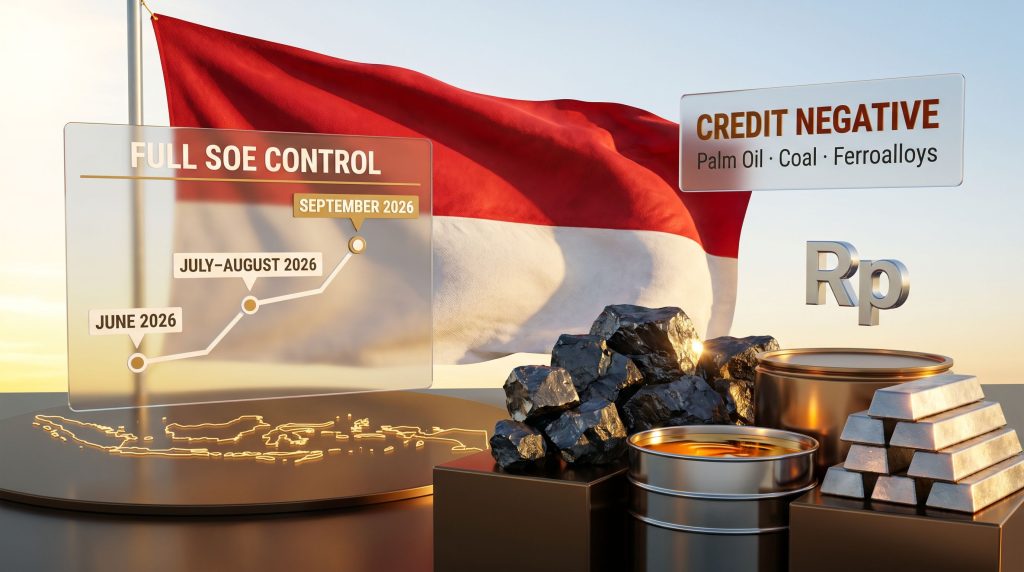
The rollout architecture is notable for its compressed duration:
| Phase | Timeline | Milestone |
|---|---|---|
| Pilot Launch | June 2026 | Initial activation for designated commodities |
| Transition Period | July to August 2026 | Phased compliance obligations begin |
| Full SOE Control | September 2026 | Complete state-intermediated export model |
A three-month window from pilot to full implementation is aggressive by any standard. Building the operational infrastructure for a BUMN entity to function as the primary counterparty across Indonesia's coal, palm oil, and ferroalloy export volumes is a substantial logistical and administrative undertaking. As of the policy announcement, the specific operating rules governing pricing methodology, contract assignment, dispute resolution, and transition treatment of existing long-term supply agreements had not been publicly released.
The absence of detailed operational guidelines at the time of announcement is itself a market signal. It suggests either that implementation details remain genuinely unresolved, or that the government is deliberately maintaining flexibility in how the framework will be applied.
For commodity traders and industrial buyers attempting to plan procurement strategies, this ambiguity is a material risk factor in its own right.
Moody's Credit Negative Assessment: Unpacking the Two-Sided Warning
Moody's Ratings formally classified the Indonesia commodity export plan as credit negative for mining operators with Indonesian exposure. The agency's assessment identified two distinct risk vectors:
- Elevated operational risk for private miners navigating compliance with the new state-intermediated export structure
- Market distortion risk arising from the insertion of a state entity into commodity price formation and transaction execution
Critically, Moody's did not dismiss the policy's potential macroeconomic benefits outright. The agency acknowledged that successful implementation could deliver stronger foreign exchange inflows and provide meaningful support for the Indonesian rupiah. A stronger rupiah would have downstream effects on import costs, inflation dynamics, and the monetary policy settings of Bank Indonesia.
However, the ratings agency flagged that these potential gains come at a significant cost to investor sentiment across the broader policy environment. This is a subtle but important distinction. Moody's is not simply warning about the mechanics of the policy. It is warning that the signal the policy sends about Indonesia's regulatory predictability may itself be as damaging as any operational disruption.
When a sovereign government inserts a state entity as the mandatory intermediary in commodity export transactions, it introduces counterparty risk, pricing opacity, and regulatory unpredictability. These are factors that rating agencies weight heavily when assessing the creditworthiness of private sector operators in that jurisdiction.
Pricing Transparency and the Benchmark Integrity Problem
One of the less-discussed but potentially far-reaching consequences of the centralisation framework involves its effect on commodity price benchmark integrity. Global commodity markets function on the assumption that prices discovered in liquid markets between willing buyers and sellers reflect genuine supply and demand conditions.
When a single state entity becomes the sole seller of Indonesian palm oil, coal, and ferroalloys to international markets, several distortions become possible:
- Prices may be set at levels that maximise fiscal capture for the Indonesian state rather than reflecting competitive market clearing
- Transaction opacity could reduce the information available to benchmark-setting agencies, weakening the reliability of published reference prices
- Long-term contract pricing, which is often indexed to benchmark prices, could become contested if the benchmark itself is distorted by state pricing decisions
For Asian coal benchmark pricing in particular, where Indonesian thermal coal grades serve as important reference points for power utility procurement across Japan, South Korea, and India, any systematic divergence between BUMN-quoted prices and underlying supply-demand conditions would have region-wide consequences. These dynamics are further compounded by shifting steel market dynamics across Asia, which amplify the downstream effects of any disruption to Indonesian ferroalloy flows.
The next major ASX story will hit our subscribers first
Which Commodity Faces the Highest Exposure?
Each of the three covered commodity categories carries distinct risk profiles.
Palm Oil: Food System Vulnerability
Indonesia supplies approximately 50% of global palm oil trade, making it the single most concentrated source of any major globally traded agricultural commodity. Centralised routing of these exports through a state entity would directly affect food manufacturers, biodiesel blenders, and oleochemical producers across Asia, Europe, and North America. Buyers holding long-term supply contracts would face immediate legal uncertainty about whether those agreements remain enforceable under the new intermediated structure.
Thermal Coal: Energy Security at Scale
Indonesian thermal coal supplies a critical share of baseload power generation across multiple Asian economies. Japan and South Korea in particular have limited short-term alternatives at the scale and calorific specifications that Indonesian coal provides. Even a modest disruption to export flows during the transition period could tighten spot market availability precisely when seasonal power demand peaks.
Ferroalloys: Battery Supply Chain Sensitivity
Indonesia's dominance in nickel production has already reshaped global battery supply chains following the 2020 nickel ore export ban. The centralisation of ferroalloy exports extends that leverage further downstream. In addition, the rising critical minerals demand driven by the global energy transition means Indonesian ferroalloys are now embedded in procurement strategies that span electric vehicle manufacturing and grid-scale energy storage. This introduces a new layer of counterparty and supply reliability risk into procurement planning.
Indonesia Within the Global Resource Nationalism Spectrum
Comparing Indonesia's approach to its peers illuminates both what is distinctive and what is familiar about the centralisation model:
| Country | Mechanism | Commodity Focus | Primary Objective |
|---|---|---|---|
| Indonesia | SOE export intermediation | Coal, palm oil, ferroalloys | FX capture, tax compliance |
| Chile | State royalty reform | Copper, lithium | Revenue maximisation |
| DR Congo | Export licensing restrictions | Cobalt, copper | Value-add retention |
| Zimbabwe | Raw material export bans | Lithium, chrome | Downstream processing |
The DR Congo's recent cobalt export suspension illustrates how abrupt state interventions in commodity flows can send shockwaves through global supply chains — a precedent that lends additional weight to concerns about how Indonesia's centralisation plan may unfold in practice. Furthermore, the broader metals geopolitics of 2025 have made resource nationalism a defining feature of the global investment landscape, rather than an isolated policy curiosity.
What makes Indonesia's model distinctive is its use of state enterprise as transaction counterparty rather than simply imposing higher taxes, royalties, or export bans. Most resource nationalism frameworks leave the commercial transaction itself in private hands while capturing a share of proceeds through fiscal instruments. Indonesia's approach repositions the state as an active commercial participant, which is operationally more complex and creates qualitatively different risks for private sector operators and international buyers alike.
According to Reuters, the specific operational details of how this intermediation will function in practice remain to be clarified, adding further uncertainty for international buyers seeking to understand their contractual obligations under the new regime.
Three Scenarios for Policy Trajectory
Scenario 1: Calibrated Implementation
The government releases detailed operational guidelines before the June 2026 launch. The BUMN entity builds sufficient administrative capacity, buyer relationships are maintained, and pricing remains broadly aligned with international benchmarks. Foreign exchange capture improves, and investor sentiment stabilises after an initial uncertainty period.
Scenario 2: Partial Rollback Under Market Pressure
Implementation bottlenecks, buyer resistance, or measurable trade flow disruption prompt a narrowing of commodity coverage or an extension of transition timelines. The policy framework is preserved in principle while being moderated in practice.
Scenario 3: Escalation Toward Deeper Nationalisation
Early implementation emboldens the government to expand the framework to additional commodity categories, potentially including copper concentrates, bauxite, or tin. Indonesia's resource nationalism posture deepens further, and investor risk perceptions across the resource sector undergo a more sustained repricing.
Key Variables for Investors and Market Participants to Track
- Operational guideline release dates: Publication of specific pricing frameworks, compliance rules, and contract transition arrangements ahead of June 2026 will be a critical early indicator of implementation quality
- BUMN capacity signals: Statements from the designated state enterprise about staffing, systems, and counterparty agreements will reveal whether the operational foundation is genuinely in place
- Buyer procurement pivots: Monitor long-term contract renewal patterns among Asian utilities, steel mills, and food processors for early evidence of supply chain rerouting away from Indonesian sources
- Rating agency follow-through: Moody's initial credit-negative classification may be followed by formal rating actions on specific Indonesian mining operators if policy uncertainty persists beyond mid-2026
- Rupiah performance: Currency trajectory will serve as a real-time indicator of whether the foreign exchange capture objectives are being achieved in practice
- Regional policy contagion: Assess whether other resource-rich Southeast Asian economies interpret Indonesia's approach as a replicable template, potentially triggering broader shifts in regional commodity export governance frameworks
The Longer Investment Horizon
For investors with exposure to Indonesian commodity producers, the Moody's warning is a prompt to reassess not just near-term operational risk but the structural investability of the Indonesian resource sector over a multi-year horizon. The policy environment signal matters at least as much as the policy mechanics. Foreign direct investment in resource extraction is inherently long-duration: project cycles span decades, capital commitments are large and illiquid, and regulatory predictability is therefore weighted heavily in project economics and discount rates.
The Indonesia commodity export plan, as currently framed, creates a regulatory environment that is objectively less predictable than it was twelve months ago. Whether that deterioration in predictability is temporary or structural depends entirely on how the June 2026 pilot phase is executed and what regulatory detail emerges in the weeks preceding it. Consequently, market participants would be well advised to monitor both implementation signals and the broader trajectory of Indonesian resource policy closely in the months ahead.
This article is intended for informational purposes only and does not constitute financial or investment advice. Forecasts, scenario analyses, and policy projections involve inherent uncertainty and should not be relied upon as predictions of actual outcomes. Readers should conduct independent research and consult qualified advisers before making investment decisions.
Want to Stay Ahead of ASX Mineral Discoveries Shaped by Global Commodity Shifts?
As resource nationalism reshapes supply chains and redirects capital toward new mineral frontiers, Discovery Alert's proprietary Discovery IQ model instantly identifies significant ASX mineral discoveries — turning complex market signals into actionable investment opportunities before the broader market catches on. Explore how historic mineral discoveries have generated substantial returns and begin your 14-day free trial today to position yourself ahead of the next major find.