June 8, 2026
When a Shipping Chokepoint Becomes a Battery Materials Crisis
The relationship between geopolitical instability and battery supply chain economics is rarely linear. Most disruptions travel through indirect channels, arriving at manufacturing facilities not as sudden shutdowns but as gradual cost escalations that quietly erode the economic logic of production. What is unfolding in Indonesia's nickel processing sector during the first half of 2026 is a textbook illustration of this dynamic, and it carries implications that extend well beyond any single facility or company.
The Indonesia Huafei MHP output cut on sulphur costs represents more than an operational adjustment by one producer. It signals a structural vulnerability embedded within the dominant processing technology underpinning the global EV battery supply chain, one that geopolitical events thousands of kilometres away can trigger with remarkable speed. Furthermore, when considered alongside broader Indonesian nickel industry challenges, the implications for global battery supply become even more pronounced.
When big ASX news breaks, our subscribers know first
The Chemistry That Created the Vulnerability
Why HPAL Is Structurally Dependent on Sulphur
High-pressure acid leaching has emerged as the preferred metallurgical pathway for converting laterite nickel ore into mixed hydroxide precipitate, the intermediate compound that feeds into nickel sulphate production for NMC and NCA battery cathodes. Unlike pyrometallurgical alternatives such as rotary kiln electric furnace processing, HPAL is chemically intensive by design. Its effectiveness depends on sulphuric acid as the primary leaching agent, which either arrives via direct import or is manufactured on-site from elemental sulphur.
This chemical dependency creates an asymmetric exposure that is not always appreciated by upstream or downstream market participants. While nickel ore prices, labour costs, and energy inputs all fluctuate, sulphur occupies a uniquely determinative role in HPAL unit economics because it cannot be easily substituted or reduced without fundamentally altering the processing chemistry. Consequently, shifts in the battery raw materials market can amplify these pressures considerably.
What is Mixed Hydroxide Precipitate (MHP)? MHP is an intermediate nickel-cobalt compound produced through HPAL processing of laterite ore. It serves as the primary feedstock for manufacturing battery-grade nickel sulphate, a critical input for NMC and NCA lithium-ion cathode chemistries. Indonesia has become the world's largest MHP production hub, making its HPAL sector's cost structure directly relevant to global EV battery supply security.
Under historically normal market conditions, sulphur represents approximately 25% of total HPAL operating expenditure, a meaningful but manageable cost share. When sulphur prices escalate sharply, however, the cost structure of HPAL operations deteriorates in a way that cannot be offset by operational efficiency gains alone. The result is a binary operational choice: absorb deteriorating unit economics across the full production base, or rationalise throughput to preserve margins at the core.
The Sulphur Price Shock: Speed, Magnitude, and Origin
From $514 to $948 Per Tonne in Under Eight Weeks
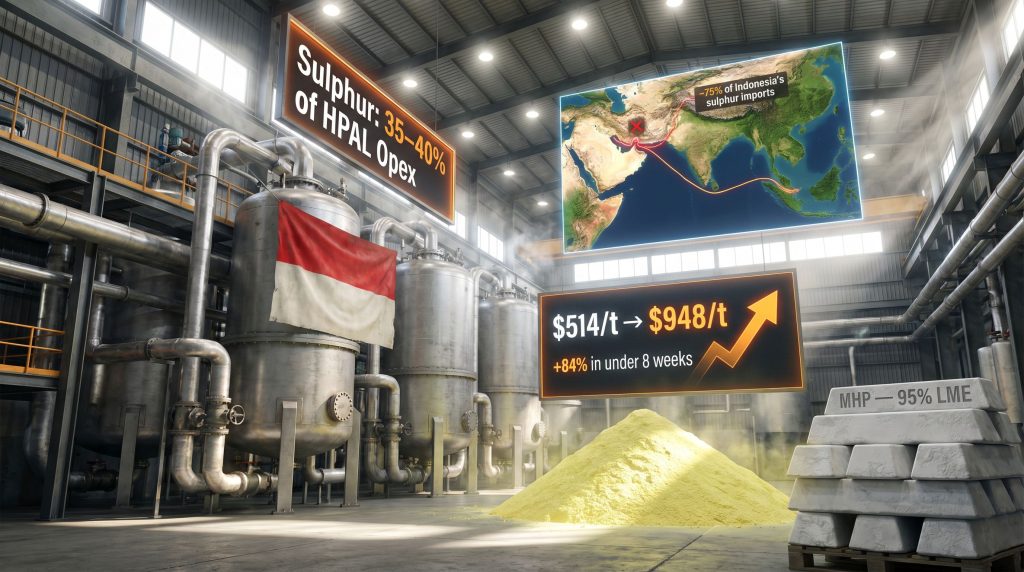
The velocity of the sulphur price move in early 2026 is what distinguishes this event from typical commodity market volatility. According to Argus Media price assessments, granular sulphur delivered to Indonesia was priced at approximately $514 per tonne CFR on 26 February 2026. By 23 April 2026, the same benchmark had reached approximately $948 per tonne on a midpoint basis, representing an increase of $434 per tonne, or 84%, in under eight weeks (Argus Media, 29 April 2026).
Forward market signals have amplified this concern further, with some July delivery indications reported in the $1,100 to $1,200 per tonne range, suggesting traders and buyers do not anticipate near-term relief from current conditions.
| Price Benchmark | Date | CFR Indonesia Price |
|---|---|---|
| Pre-conflict baseline | 26 February 2026 | ~$514/t |
| Post-shock assessment | 23 April 2026 | ~$948/t (midpoint) |
| Forward indications | July 2026 delivery | $1,100–$1,200/t |
| Price change | 8 weeks | +$434/t (+84%) |
Source: Argus Media, 29 April 2026
The Strait of Hormuz: A Single Chokepoint with Outsized Consequences
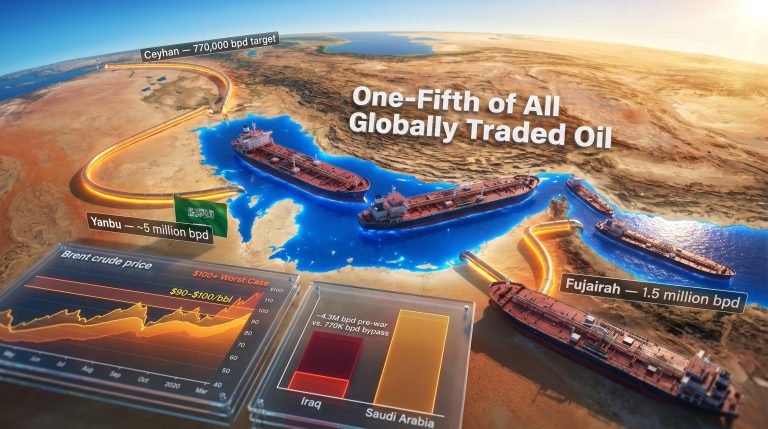
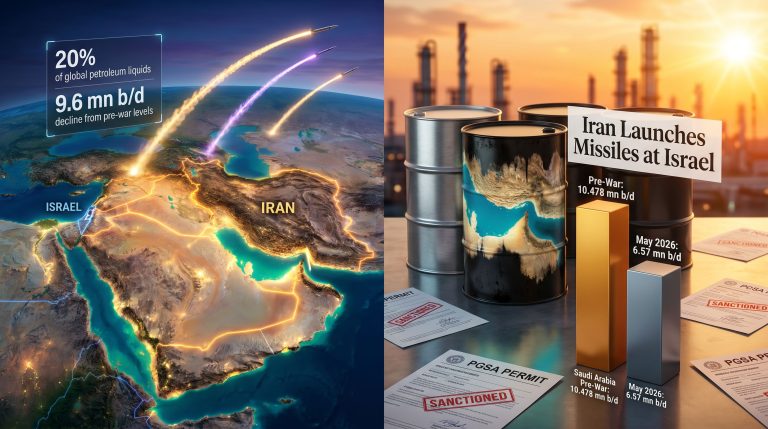
The origin of this shock lies in the disruption of seaborne sulphur trade through the Strait of Hormuz, which handles close to half of global seaborne sulphur traffic. The ongoing US-Iran conflict has severely disrupted shipping through this corridor, generating both supply shortfalls and freight cost escalation that have compounded spot price increases across Asian import markets (Argus Media, 29 April 2026).
Indonesia's exposure to this particular chokepoint is unusually acute for several interconnected reasons:
- Approximately 75% of Indonesia's annual sulphur imports are sourced from Middle Eastern producers
- Total Indonesian sulphur imports in 2025 reached approximately 5.34 million tonnes, meaning the Middle Eastern exposure represents roughly 4 million tonnes of annual supply
- Port infrastructure at processing hubs such as Weda Bay and Morowali has been calibrated around Middle Eastern supply chains, limiting rapid logistical pivots
- Alternative seaborne origins, including North American, Russian, and Central Asian sources, carry longer lead times and currently command significant premiums above already elevated freight-inclusive prices
Source: Argus Media, 29 April 2026
This combination of geographic concentration, infrastructure alignment, and logistics constraints means Indonesia cannot rapidly substitute its way out of a Hormuz-related supply disruption, regardless of how much premium buyers might be willing to pay in the short term.
The Cost Share Transformation
The practical consequence of this price shock has been a fundamental shift in the operating cost profile of Indonesian HPAL facilities. Sulphur's share of HPAL operating costs has escalated from the historical norm of approximately 25% to an estimated 35–40% in the current environment, based on Argus Media's market assessment (Argus Media, 29 April 2026).
| Operating Scenario | Sulphur's Share of HPAL Opex | Operational Implication |
|---|---|---|
| Historical baseline (pre-2026) | ~25% | Full utilisation economically rational |
| Current environment (2026) | 35–40% | Margin compression triggers output reviews |
| Prolonged disruption scenario | >40% | Structural curtailments become likely |
This shift is not merely a financial inconvenience. At the level of HPAL economics, a 40–60% relative increase in sulphur's cost share fundamentally alters the contribution margin of incremental production. Facilities designed for sustained overperformance above nameplate capacity face the sharpest deterioration, because the economic case for producing the marginal tonne collapses first.
Huafei's Output Decision: Context, Scale, and Timing
The Weda Bay Facility and Its Production History
Huafei Nickel Cobalt, the Indonesian subsidiary of Zhejiang Huayou Cobalt, operates an HPAL facility within the Weda Bay Industrial Park in North Maluku province. The facility commenced production in 2023 and carries a nameplate capacity of 120,000 tonnes per year of nickel equivalent in MHP form, making it one of the largest individual HPAL processing installations in Indonesia (Argus Media, 29 April 2026).
Effective 1 May 2026, the company placed approximately half of this capacity into temporary care and maintenance, citing two converging factors: the sharp escalation in sulphur input costs described above, and accumulated maintenance requirements resulting from an extended period of above-nameplate utilisation. The Indonesia Huafei MHP output cut on sulphur costs has, however, drawn significant attention as an indicator of broader sector stress.
Sustained Overperformance and Its Consequences
The maintenance dimension of this decision is particularly instructive from an operational risk perspective. Huayou's combined MHP shipments across its Indonesian facilities reached 236,500 tonnes in 2025, representing 30% year-on-year growth. Total nickel production across all product forms rose 59% year-on-year to 292,500 tonnes of nickel metal equivalent (Argus Media, 29 April 2026).
When measured against the combined nameplate capacity of Huayou's two operational Indonesian MHP facilities, totalling 180,000 tonnes per year across Huayue and Huafei, these 2025 shipment volumes imply sustained operation at approximately 131% of combined nameplate capacity. This level of overperformance, while commercially impressive, creates a predictable maintenance accumulation problem.
Equipment operating continuously above design parameters requires more frequent intervention, and deferred maintenance obligations compound over time until operational windows to address them become necessary rather than optional.
Huayou's Indonesian MHP Portfolio
| Facility | Location | Capacity (Ni Eq.) | Production Start |
|---|---|---|---|
| Huayue | Morowali, Sulawesi | 60,000 t/yr | 2021 |
| Huafei | Weda Bay, North Maluku | 120,000 t/yr | 2023 |
| KNI (JV, under construction) | TBC | 120,000 t/yr | Scheduled December 2026 |
Source: Argus Media, 29 April 2026. Note: The KNI project is a joint venture between Huayou, Vale of Brazil, and Ford of the United States.
A Sector-Wide Rationalisation, Not an Isolated Event
Industry Curtailments Since March 2026
The Huafei decision sits within a broader pattern of throughput rationalisation across the Indonesian HPAL sector that has been building since March 2026. Multiple major producers, including Lygend Resources and Tsingshan, have been scaling back output rates during this period, with aggregate reductions across the sector estimated at more than 10% from peak operating rates as facilities revert toward nameplate capacity levels.
This collective pullback reflects a shared economic reality rather than coincidental timing. When sulphur costs consume a structurally elevated share of operating expenditure, the marginal tonne of MHP output becomes increasingly expensive to produce relative to prevailing market prices. The rational operator response under these conditions is voluntary production discipline, particularly at above-nameplate utilisation rates where the cost profile of incremental output is most unfavourable. In addition, Indonesian nickel price trends have added further complexity to producer decision-making during this period.
Analytical Perspective: HPAL operations in Indonesia were already navigating compressed margins during the 2024 to 2025 nickel price downturn. The near-doubling of sulphur costs onto this already constrained margin structure has compressed the timeline for curtailment decisions that might otherwise have been deferred. This is a case of a second-order shock arriving before the first-order shock (nickel price weakness) had fully resolved.
A Note on Operational Versus Structural Curtailments
An important distinction exists between what is currently unfolding and a structural capacity exit. The Huafei curtailment has been characterised as temporary, with Huayou indicating no expectation of long-term adverse impact from the suspension. The combination of deferred maintenance and cost-driven rationalisation suggests this is a pause to reset operational conditions rather than a signal of permanent capacity reduction.
However, the absence of a disclosed restart timeline introduces genuine uncertainty about when the curtailed capacity will return, and at what sulphur cost environment that return becomes economically justified.
MHP Market Consequences: Price Sentiment and Supply Tightening
The Payable Price Shift
The supply-side signal from the Huafei curtailment has produced measurable movement in MHP spot market pricing dynamics. Offers for MHP rose to approximately 95% of LME nickel prices for nickel payable on 28 April 2026, compared with approximately 91% in March 2026 (Argus Media, 29 April 2026). As of the time of reporting, no transactions had been confirmed at the higher 95% level, suggesting that buyers remain cautious and that the spread compression reflects seller positioning rather than completed market clearing.
This four-percentage-point shift in the payable ratio, while appearing modest in absolute terms, represents a meaningful repositioning of negotiating leverage within MHP spot markets. LME nickel prices had moved toward approximately $19,000 per tonne in the context of these supply developments, and the convergence of tighter physical availability with seller confidence signals a potential inflection in a market that had been characterised by buyer dominance through much of 2024 and 2025.
Why MHP Payable Ratios Matter to Battery Supply Chains
The payable ratio concept in MHP markets is worth understanding clearly. When buyers and sellers negotiate MHP transactions, the nickel price component of the deal is expressed as a percentage of the LME nickel price. A higher payable ratio means sellers are capturing more value per unit of contained nickel, which directly affects the economics of downstream nickel sulphate production and, by extension, battery cathode manufacturing costs.
A sustained move from 91% to 95% payable, if confirmed in actual trades, would represent a roughly 4.4% increase in the nickel component of MHP costs for battery material processors purchasing on a payable basis. At a $19,000 per tonne LME nickel price, this differential equates to approximately $760 per tonne of contained nickel in additional procurement cost, a material figure for operations with tight processing margins.
The next major ASX story will hit our subscribers first
Huayou's Strategic Response to Sulphur Dependency
Immediate Tactical Pivot: Sulphuric Acid Import Permits
As a short-term operational workaround, Huafei secured regulatory approval from Indonesian authorities in April 2026 to import sulphuric acid directly, bypassing the on-site conversion of elemental sulphur (Argus Media, 29 April 2026). This approach accesses acid from supply chains with different geographic exposures than the Middle Eastern sulphur routes currently disrupted by Hormuz shipping conditions. The approved import volumes have not been publicly disclosed, limiting assessment of how materially this measure addresses the cost challenge.
Medium-Term Infrastructure: Pyrite and Phosphogypsum Acid Production
The more structurally significant response involves Huayou's announced plans to construct acid production facilities using pyrite and phosphogypsum as feedstocks, both of which are available domestically within Indonesia and are entirely independent of seaborne sulphur supply chains. These alternative acid production units are targeted for commissioning by end of 2026 (Argus Media, 29 April 2026).
If delivered on schedule, this infrastructure would represent a genuine structural insulation against future Hormuz-related sulphur disruptions. Pyrite-based acid production is an established industrial technology, and phosphogypsum, a byproduct of phosphate fertiliser production, has been used as an acid feedstock in various industrial contexts. The key unknowns at this stage include:
- Which specific Huayou subsidiaries will deploy the technology
- The production capacity of the new acid units relative to total HPAL acid requirements
- The operating cost of domestically produced acid versus imported seaborne alternatives under normalised conditions
- Whether the December 2026 commissioning timeline can be maintained given concurrent operational disruptions
Broader Supply Diversification Initiatives
Beyond the domestic acid production strategy, Huayou has signalled it is actively expanding sulphur procurement across a wider range of supply origins to reduce geographic concentration risk. Specific origins, contracted volumes, and pricing arrangements have not been disclosed publicly, reflecting the commercially sensitive nature of commodity procurement strategy (Argus Media, 29 April 2026).
The Compounding Risk: Ore Quota Uncertainty
Indonesian Nickel Ore Production Quota Discussions
Separate from the sulphur cost crisis, Indonesian regulatory discussions around nickel ore production quotas for 2026 introduce a second layer of input constraint for HPAL operators. Proposed reductions from approximately 370 million tonnes in 2025 to a range of 250 to 260 million tonnes in 2026 could constrain the availability of laterite ore feedstock for HPAL processing facilities.
The Dual Input Squeeze Scenario
Risk Scenario: If both elevated sulphur costs and tighter ore availability persist simultaneously through the second half of 2026, Indonesian HPAL operators would face a dual input squeeze: constrained feedstock supply from the upstream ore side combined with elevated processing costs on the acid side. This scenario places structural downward pressure on MHP output volumes that extends well beyond the temporary curtailments currently being implemented, and warrants close monitoring by battery material procurement teams and EV supply chain strategists.
This intersection of geopolitical disruption, domestic regulatory dynamics, and accumulated operational pressures illustrates the complexity of supply chain risk assessment in the battery materials sector. Individual risk factors that might be manageable in isolation become compounding when they arrive simultaneously across the same production system. Furthermore, the battery metals demand growth trajectory makes supply disruptions of this nature increasingly consequential for the broader energy transition.
FAQ: Indonesia HPAL, Sulphur Costs, and MHP Supply
Why Is Sulphur So Critical to HPAL Nickel Processing?
Sulphur is the primary raw material used to manufacture sulphuric acid, which functions as the leaching reagent in HPAL processing. Without acid at viable cost and volume, HPAL facilities cannot operate at economic throughput levels.
How Large Has the Sulphur Price Increase Been for Indonesian Importers in 2026?
Granular sulphur CFR Indonesia rose approximately 84% between late February and late April 2026, moving from around $514 per tonne to approximately $948 per tonne on a midpoint basis, with forward indications suggesting further upside risk into mid-2026.
What Share of Indonesian Sulphur Comes from the Middle East?
Approximately 75% of Indonesia's sulphur imports, out of a total of around 5.34 million tonnes imported in 2025, are sourced from Middle Eastern producers, the majority of which transit the Strait of Hormuz (Argus Media, 29 April 2026).
What Is the Huafei Facility's Production Capacity and Current Operational Status?
Huafei's HPAL plant at Weda Bay has a nameplate capacity of 120,000 tonnes per year of nickel equivalent in MHP form. Approximately half of this capacity was placed into care and maintenance effective 1 May 2026, citing elevated sulphur costs and deferred maintenance from sustained overperformance (Argus Media, 29 April 2026).
When Will Huafei Resume Full Production?
No specific restart timeline has been disclosed. Huayou characterised the curtailment as temporary and indicated no long-term adverse impact is expected. Medium-term structural solutions targeting alternative acid production are aimed at end of 2026 commissioning.
How Has the MHP Spot Market Responded?
MHP spot offers have risen from approximately 91% to 95% of LME nickel payable prices, though no confirmed transactions at the higher level had been reported as of late April 2026, suggesting buyers remain cautious about accepting the new pricing level (Argus Media, 29 April 2026). For context, the broader global cobalt supply picture has added additional uncertainty to battery material cost forecasting during this period.
Key Takeaways for Battery Materials Market Participants
The developments unfolding across Indonesia's HPAL sector in 2026 offer several critical insights for investors, procurement professionals, and supply chain analysts operating in the battery materials space. The Indonesia Huafei MHP output cut on sulphur costs is, in many respects, a crystallising event that makes visible vulnerabilities that have been building quietly for several years. According to recent industry reporting, this curtailment is part of a wider pattern of Indonesian producers trimming output as the sulphur squeeze intensifies across the sector.
- Sulphur is the hidden systemic risk in HPAL economics. Its cost share can shift rapidly under geopolitical stress, with consequences that cascade through MHP pricing to battery cathode material costs
- Geographic concentration in sulphur supply has created a structural vulnerability for Indonesian HPAL operators that is unlikely to be resolved quickly, even with active procurement diversification efforts
- The Huafei curtailment is a sector indicator, not an isolated event. Multiple major HPAL producers have been rationalising throughput since March 2026, signalling broad-based margin pressure rather than company-specific difficulties
- MHP pricing momentum is building from the supply side, with payable ratios moving in sellers' favour even before confirmed transactions validate the new price levels
- Huayou's medium-term response through domestic pyrite and phosphogypsum acid production, if delivered on schedule, could represent a meaningful structural insulation against future seaborne sulphur disruptions for the world's largest MHP producer
- The compounding effect of potential ore quota reductions alongside persistent sulphur cost elevation represents a scenario that warrants active monitoring and contingency planning across battery material supply chains
Disclaimer: This article contains forward-looking statements, market projections, and scenario analyses derived from publicly available sources, including Argus Media reporting dated 29 April 2026. These forward-looking elements involve inherent uncertainty and should not be construed as investment advice. Commodity prices, regulatory outcomes, and operational decisions referenced herein are subject to change. Readers should conduct independent due diligence before making any investment or procurement decisions based on this content.
Want to Capitalise on the Next Major Battery Materials Discovery Before the Market Moves?
Discovery Alert's proprietary Discovery IQ model scans ASX announcements in real time, delivering instant alerts on significant mineral discoveries across nickel, cobalt, and the full battery materials supply chain — turning complex commodity data into actionable investment insights before the broader market catches on. Explore how historic mineral discoveries have generated substantial returns on Discovery Alert's dedicated discoveries page, and begin your 14-day free trial today to position yourself ahead of the next major find.