August 11, 2026
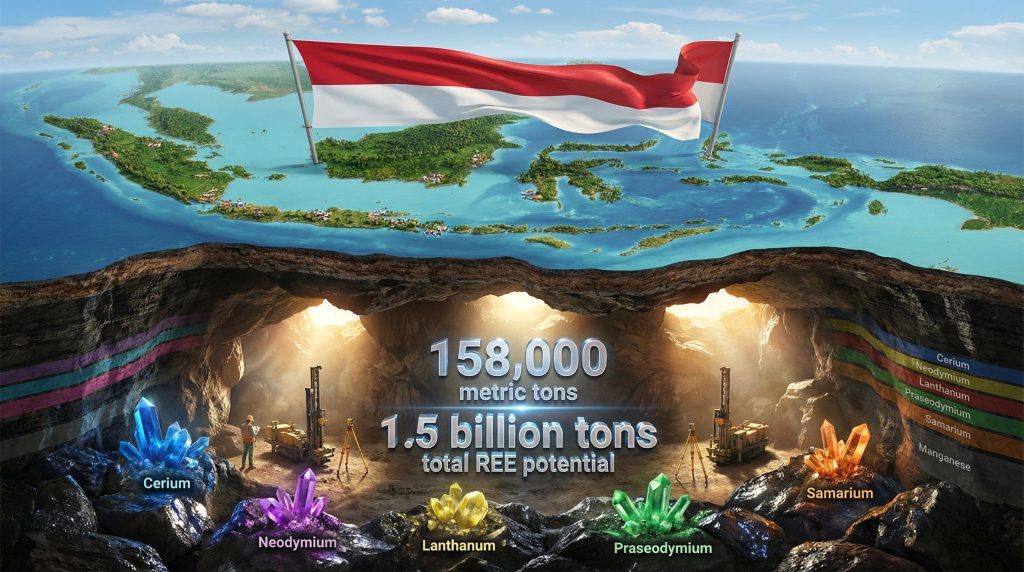
Indonesia's position as a major manganese producer intersects with emerging opportunities in critical minerals energy transition supply chains. Indonesia manganese rare earth elements discoveries represent one of the most significant developments in global resource strategy, where traditional steel industry minerals reveal potential for clean energy applications. The archipelago nation's established manganese framework now hosts valuable rare earth element concentrations, creating dual-purpose mineral systems that extend far beyond metallurgical markets.
Modern geological analysis reveals that many of Indonesia's manganese ore bodies simultaneously host valuable rare earth element concentrations. This discovery transforms how investors, policymakers, and industry analysts must evaluate strategic mineral potential. The geological reality of rare earth element co-occurrence with manganese opens pathways for integrated extraction approaches serving both traditional metallurgy and advanced technology manufacturing.
Recent findings from South Sulawesi demonstrate measurable light rare earth element concentrations within established manganese mining districts. Indonesia's 158,000 metric tons of manganese concentrate production in 2023 represents only one dimension of the country's critical minerals capacity. Furthermore, understanding ore mineralogy and economics becomes crucial for evaluating these complex mineral systems.
Geological Formation Mechanisms of REE-Manganese Systems
The formation of rare earth element-enriched manganese deposits involves complex geological processes where specific environmental conditions create favourable circumstances for both manganese precipitation and rare earth concentration. Indonesia's tropical archipelago setting provides multiple geological environments where these dual mineral systems can develop through distinct formation pathways.
Hydrothermal Circulation Processes
In Indonesia's tectonically active regions, hydrothermal fluids circulating through fractured basement rocks can simultaneously transport dissolved manganese and rare earth elements. As these metal-bearing solutions encounter changes in temperature, pressure, or chemical conditions, sequential precipitation occurs. Manganese typically precipitates as oxide phases in outer zones, while rare earth elements may concentrate in altered country rock or form discrete mineral phases during later-stage fluid evolution.
Marine Chemical Precipitation Systems
Ancient marine environments, particularly those characterised by restricted circulation and oxygen-poor conditions, create ideal settings for manganese-rare earth element co-precipitation. Chemical precipitation in these environments occurs when dissolved metals encounter specific pH and redox conditions that favour simultaneous deposition of both manganese oxides and rare earth-bearing phases.
Tropical Weathering Enhancement
Indonesia's equatorial position subjects exposed ore bodies to intense tropical weathering that can enhance rare earth element concentrations through selective leaching and reconcentration processes. High rainfall and elevated temperatures accelerate chemical weathering of source rocks. Consequently, this creates secondary enrichment zones where both manganese and rare earth elements accumulate in economically interesting grades.
Formation Environment Classification
| Formation Type | Primary Locations | REE Concentration Mechanism | Typical Depth Range |
|---|---|---|---|
| Marine Chemical | East Nusa Tenggara | Anoxic precipitation | 50-200 metres |
| Hydrothermal | South Sulawesi | Fluid circulation | Variable depths |
| Lateritic | Kalimantan | Surface weathering | 5-40 metres |
| Diagenetic | Aceh Province | Groundwater processes | 10-60 metres |
When big ASX news breaks, our subscribers know first
Regional Distribution and Geological Characteristics
Indonesia's vast archipelago encompasses diverse geological terranes that host manganese deposits with varying degrees of rare earth element association. Understanding the regional distribution of these dual-purpose mineral systems requires examination of specific geological settings and their influence on rare earth element concentration mechanisms.
South Sulawesi Breakthrough Discovery
Recent analytical work by researchers from Universitas Muslim Indonesia and Universitas Gadjah Mada has documented significant light rare earth element concentrations in manganese ores from the Anabanua District in Barru Regency, South Sulawesi. This research published in the Journal of Geoscience, Engineering, Environment, and Technology represents the first systematic documentation of rare earth elements in Indonesian manganese deposits.
The study examined three manganese ore samples using integrated analytical techniques including petrographic analysis, X-ray diffraction, and ICP-OES geochemistry. Results identified multiple light rare earth elements including lanthanum, cerium, praseodymium, neodymium, and samarium. Additionally, smaller concentrations of heavy rare earth elements such as dysprosium, terbium, and yttrium were documented.
East Nusa Tenggara Potential
The eastern Indonesian province of East Nusa Tenggara hosts extensive manganese deposits formed through marine sedimentary processes. These deposits, developed in ancient oceanic environments, exhibit geological characteristics consistent with rare earth element co-occurrence patterns. The region's position along convergent tectonic margins provides additional geological complexity that may enhance rare earth element concentration through metamorphic or hydrothermal processes.
Kalimantan Lateritic Systems
The tropical climate of Indonesian Borneo (Kalimantan) creates ideal conditions for lateritic weathering of rare earth-bearing source rocks. Established manganese production areas in South Kalimantan may host significant rare earth element potential through secondary concentration processes. Furthermore, intense tropical weathering selectively concentrates both manganese and rare earth elements in near-surface environments.
Aceh Province Exploration Targets
Geophysical surveys in Aceh Jaya have identified manganese-bearing formations at depths of 5-40 metres, suggesting accessible targets for integrated manganese-rare earth element evaluation. The region's position along the Sumatra fault system indicates potential for hydrothermal enhancement of rare earth element concentrations through fluid circulation and alteration processes.
Advanced Analytical Techniques for REE Characterisation
Accurate assessment of rare earth element content in manganese ores requires sophisticated analytical approaches that can distinguish between different hosting mechanisms. Modern characterisation techniques enable precise determination of rare earth element concentrations, spatial distribution, and mineral hosting relationships.
Integrated Petrographic Analysis
Optical microscopy examination of polished thin sections provides fundamental insights into the physical relationships between manganese minerals and rare earth-bearing phases. This technique reveals whether rare earth elements occur as discrete mineral phases, adsorbed surface coatings, or substitutions within manganese oxide crystal lattices. Understanding these textural relationships guides subsequent processing and extraction strategies.
X-Ray Diffraction Applications
Crystalline phase identification through X-ray diffraction determines the specific mineral hosts for rare earth elements within manganese ore assemblages. This analysis distinguishes between primary rare earth phases such as monazite or bastnasite and secondary phases formed through weathering. XRD results directly influence beneficiation and extraction methodology selection.
Precision Geochemical Quantification
Inductively Coupled Plasma Optical Emission Spectrometry (ICP-OES) provides accurate quantitative analysis of individual rare earth elements across the complete lanthanide series. This technique enables precise determination of light rare earth element concentrations (lanthanum through samarium) and heavy rare earth element levels. Consequently, this establishes the economic potential of dual-purpose extraction operations.
Analytical Methodology Framework
| Analytical Stage | Primary Application | Information Obtained | Processing Implications |
|---|---|---|---|
| Petrography | Textural analysis | Spatial relationships | Mineral liberation requirements |
| XRD Analysis | Phase identification | Host mineral determination | Extraction pathway selection |
| ICP-OES | Elemental quantification | Precise REE concentrations | Economic viability assessment |
| SEM-EDS | Microchemical mapping | Element distribution patterns | Beneficiation optimisation |
Global Context and Competitive Positioning
Indonesia manganese rare earth elements discoveries must be evaluated within the broader context of global rare earth supply chains and established producing regions. Comparative analysis reveals both opportunities and challenges for Indonesian rare earth development relative to existing global suppliers. In addition, understanding rare earth reserves overview provides essential context for strategic positioning.
International Deposit Comparison
Global manganese deposits with documented rare earth element associations provide benchmarks for evaluating Indonesian potential. The Kalahari Manganese Field in South Africa represents the world's largest manganese resource base, with documented but largely unexploited rare earth element associations. Australian deposits, particularly on Groote Eylandt, focus primarily on manganese production with minimal attention to rare earth recovery.
Concentration Level Assessment
Early analytical results from South Sulawesi indicate rare earth element concentrations that compare favourably with several known global deposits. However, specific numerical comparisons require comprehensive grade evaluation across multiple sample locations. The presence of both light and heavy rare earth elements in measurable concentrations suggests potential for balanced rare earth production profiles.
Strategic Geographic Advantages
Indonesia's position within the Asia-Pacific region provides significant logistical advantages for rare earth element marketing compared to more distant suppliers. Proximity to major consuming markets in China, Japan, and South Korea reduces transportation costs and supply chain complexity. Additionally, Indonesia's established relationships with regional trading partners create potential pathways for rare earth element commercialisation.
Comparative Advantage Analysis
• Resource diversity: Indonesia's multiple formation types provide geological diversity compared to single-deposit suppliers
• Infrastructure: Existing manganese operations offer potential platforms for rare earth element recovery
• Market access: Regional proximity to major rare earth consumers reduces logistics complexity
• Policy support: Government commitment to downstream processing development creates enabling environment
Processing and Extraction Challenges
The transition from geological discovery to commercial rare earth element production requires overcoming significant technical and economic challenges specific to manganese-hosted systems. These processing complexities distinguish rare earth extraction from conventional manganese beneficiation and demand specialised approaches.
Hydrometallurgical Complexity
Rare earth element extraction from manganese ores typically requires acid leaching processes that differ substantially from conventional manganese processing. Sulfuric acid or hydrochloric acid dissolution dissolves both manganese and rare earth phases. Therefore, this necessitates sophisticated separation techniques to recover individual rare earth elements while managing manganese-rich process streams.
Selective Recovery Mechanisms
The co-occurrence of manganese and rare earth elements complicates conventional separation technologies. Solvent extraction, ion exchange, and selective precipitation techniques must be optimised for simultaneous management of high manganese concentrations alongside target rare earth recovery. This technical challenge requires specialised expertise and equipment not typically present in conventional manganese operations.
Environmental Management Requirements
Rare earth processing generates significantly more complex waste streams than manganese concentration alone. Radioactive thorium and uranium associations, common in rare earth ores, require specialised handling and disposal protocols. Additionally, acid consumption and neutralisation requirements create substantial environmental management obligations.
Economic Viability Thresholds
Critical Economic Factors:
• Acid consumption: High reagent costs for dissolution and pH control
• Energy requirements: Intensive processing steps for purification and separation
• Capital intensity: Specialised equipment for rare earth separation
• Market volatility: Individual rare earth element pricing fluctuations
• Regulatory compliance: Environmental and safety permitting complexity
China's Processing Dominance and Strategic Implications
China's overwhelming control of global rare earth processing capabilities creates fundamental strategic challenges for any new rare earth element development, including Indonesia manganese rare earth elements. Understanding this processing bottleneck illuminates the distinction between resource discovery and supply chain independence.
Processing Infrastructure Concentration
China currently processes approximately 85-90% of global rare earth elements, regardless of ore origin. This processing monopoly extends beyond Chinese domestic production to include rare earth concentrates exported from Australia, Myanmar, and other producing regions. Even with successful rare earth element extraction from Indonesian manganese deposits, current global infrastructure would likely route these materials through Chinese separation facilities.
Technology Transfer Barriers
Rare earth separation and purification technologies remain closely guarded intellectual property concentrated within Chinese industrial entities. The technical complexity of producing battery-grade or magnet-grade rare earth products requires sophisticated process knowledge. Few non-Chinese entities possess this expertise, representing a more significant constraint than resource availability for most potential rare earth producers.
Economic Integration Dependencies
Indonesia's extensive trade relationship with China creates additional complexity for any strategy targeting rare earth processing independence. Bilateral trade volumes, infrastructure financing arrangements, and industrial cooperation agreements influence policy options. These factors affect the development of competing rare earth processing capabilities.
Strategic Response Options
International cooperation frameworks offer potential pathways for reducing Chinese processing dependence. Joint ventures with Japanese, South Korean, or Western technology providers could enable development of regional rare earth processing capabilities. Additionally, Indonesia's success with nickel export restrictions demonstrates policy tools available for encouraging domestic value-added processing.
The next major ASX story will hit our subscribers first
Integration with Indonesia's Critical Minerals Framework
Indonesia's approach to manganese-hosted rare earth elements must align with broader national strategies for critical minerals development. This builds upon lessons learned from successful nickel industry transformation and ongoing initiatives across multiple mineral commodities. The mining industry evolution provides context for strategic development approaches.
Policy Framework Evolution
Indonesia's implementation of comprehensive state control over rare earth development reflects policy lessons from nickel industry success. The government's establishment of exclusive licensing systems and mandatory domestic processing requirements creates institutional frameworks. These could apply to manganese-hosted rare earth extraction, prioritising downstream value creation over raw material exports.
Diversified Critical Minerals Portfolio
Manganese-hosted rare earth elements complement Indonesia's broader critical minerals potential, including rare earth recovery from tin mining tailings, nickel processing residues, and coal ash streams. This diversified approach reduces dependence on single-source supply and creates multiple pathways for rare earth element production. Furthermore, it operates across different geological and operational contexts.
Infrastructure Synergies
Existing manganese mining operations provide established infrastructure platforms for potential rare earth element recovery. Transportation networks, power supplies, and workforce capabilities developed for manganese production create foundation assets. These reduce capital requirements for rare earth development while providing proximity to ports and established trade routes.
Regulatory Integration Requirements
Policy Development Priorities:
• Dual-purpose mining regulations: Legal frameworks for simultaneous manganese and rare earth extraction
• Environmental standards: Specialised protocols for rare earth processing impacts
• Technology transfer: Incentive structures for foreign processing technology acquisition
• Export controls: Balancing raw material restrictions with processing development goals
• Investment frameworks: Risk mitigation for integrated manganese-rare earth projects
Development Scenario Analysis
The evolution of Indonesia manganese rare earth elements development will likely follow a staged progression reflecting technical complexity, market conditions, and policy implementation. Understanding potential development pathways enables more effective strategic planning and investment decision-making.
Near-Term Exploration Phase (2026-2028)
Systematic rare earth element assessment across Indonesia's established manganese districts represents the logical first development stage. This exploration phase would expand upon South Sulawesi findings to identify the most promising dual-purpose deposits nationwide. Geological mapping, systematic sampling, and comprehensive analytical programmes would establish resource inventories and grade distributions.
Technology Development Stage (2029-2031)
Pilot-scale processing trials would optimise rare earth element extraction from Indonesian manganese ores while addressing specific technical challenges. These include acid consumption, separation efficiency, and waste management concerns. These trials might initially focus on light rare earth element recovery, given higher concentrations and simpler separation requirements compared to heavy rare earth elements.
Commercial Integration Phase (2032+)
Full-scale rare earth element recovery as a co-product of manganese mining represents the ultimate development objective. This phase would require substantial capital investment in processing infrastructure, technical expertise acquisition, and market development. Success would depend heavily on favourable rare earth pricing and resolution of processing technology access.
Development Risk Factors
Technical Risks:
• Processing optimisation: Achieving economic extraction rates from complex ore assemblages
• Quality specifications: Meeting customer requirements for rare earth purity and consistency
• Scale economies: Achieving sufficient production volumes for economic viability
Market Risks:
• Price volatility: Rare earth element pricing fluctuations affecting project economics
• Demand uncertainty: Electric vehicle and renewable energy adoption rates
• Competition: New rare earth projects globally affecting market dynamics
Policy Risks:
• Regulatory changes: Evolving environmental and processing requirements
• International relations: Trade policy impacts on rare earth market access
• Technology access: Availability of specialised processing technologies
Investment and Strategic Implications
The identification of rare earth potential in Indonesian manganese deposits creates new investing strategies overview frameworks where traditional steel industry minerals intersect with clean energy supply chains. This convergence generates distinct opportunities and challenges for multiple stakeholder categories.
Capital Allocation Considerations
Investment in manganese-rare earth element projects requires evaluation frameworks that account for both immediate manganese revenue streams and longer-term rare earth element potential. Traditional manganese project economics focus on steel industry demand cycles. However, rare earth elements exhibit different market dynamics driven by clean energy and technology adoption rates.
Market Opportunity Quantification
The global rare earth element market, valued at approximately $8-10 billion annually, offers significantly higher unit values than manganese markets. Light rare earth elements typically trade at $5-15 per kilogram, while specialty rare earth products command substantially higher prices. This value differential creates strong economic incentives for integrated extraction approaches.
Risk-Return Profile Assessment
Investment Opportunity Framework:
| Investment Category | Risk Level | Potential Return | Development Timeline |
|---|---|---|---|
| Exploration/Assessment | Medium | High discovery value | 2-3 years |
| Pilot Processing | High | Technology validation | 3-5 years |
| Commercial Development | Very High | Full market participation | 7-10 years |
| Infrastructure/Logistics | Medium-High | Regional positioning | 5-8 years |
Stakeholder Strategic Implications
For mining companies, manganese-rare earth element deposits offer diversification opportunities that hedge against steel industry cyclicality while providing exposure to clean energy growth. Technology companies may find partnership opportunities that secure rare earth supply chains whilst contributing processing expertise.
Government entities face decisions about resource development prioritisation, with manganese-rare earth systems offering potential for accelerated critical minerals independence. International development organisations may view Indonesian rare earth capabilities as opportunities for regional supply chain resilience compared to greenfield rare earth projects.
Due Diligence Requirements
Investment evaluation of manganese-rare earth projects demands technical expertise spanning both traditional mining engineering and specialised hydrometallurgy. Environmental assessment must address complex waste streams, water management, and potential radioactive materials handling. In addition, market analysis requires understanding of both steel industry manganese demand and technology sector rare earth requirements.
Investment Consideration: The convergence of manganese and rare earth element potential in Indonesian deposits represents an emerging asset class where traditional mining investment approaches intersect with critical minerals strategy. Success requires integrated technical, market, and policy analysis that accounts for both immediate manganese economics and longer-term rare earth element development potential.
Want to Stay Ahead of Critical Minerals Discoveries?
Discovery Alert's proprietary Discovery IQ model identifies emerging opportunities in critical minerals and rare earth elements across ASX markets, ensuring investors don't miss the next significant breakthrough. Explore our track record of historic discovery alerts and begin your 30-day free trial today to position yourself ahead of major market movements.