May 11, 2026
The Hidden Mechanics Behind Indonesia's Repeated Royalty Deferrals
Resource taxation is rarely straightforward, but it is almost never as structurally complicated as it is in commodity-dependent emerging economies. When governments with large sovereign spending commitments attempt to extract more revenue from industries already under margin pressure, the result is rarely a clean policy announcement followed by orderly implementation.
Instead, what typically emerges is a protracted cycle of proposal, resistance, deferral, and reformulation, each iteration eroding investor confidence while failing to deliver the fiscal outcome originally sought.
Indonesia is currently navigating precisely this dynamic. The country's decision to delay higher mineral royalties and export duties on key commodities, confirmed publicly by Energy and Mineral Resources Minister Bahlil Lahadalia in May 2026, is not an isolated event. It is the visible surface of a much deeper structural tension that has been building since the government began recalibrating its relationship with the mining sector in the years following the COVID-era commodity boom.
When big ASX news breaks, our subscribers know first
Why Indonesia's Fiscal Position Created Pressure on the Mining Sector
Indonesia's government has been searching for durable revenue streams to fund an expanding slate of domestic programmes. The mining sector, as one of the country's largest foreign exchange earners and a significant contributor to national GDP, was a logical target for incremental fiscal extraction. With commodity prices elevated through much of 2022 and 2023, the political window for introducing higher extraction charges seemed open.
The rationale was reinforced by several converging pressures:
- Rising fuel import costs linked to geopolitical instability in the Middle East placed additional strain on the national budget
- Flagship domestic spending initiatives required sustained and predictable funding mechanisms
- The capitalisation of Danantara, Indonesia's sovereign wealth fund, created an institutional expectation of regular commodity revenue streams
- Declining non-commodity tax revenues narrowed the government's fiscal flexibility
The result was a regulatory push that took shape through two government regulations enacted in 2025, establishing a price-linked progressive royalty framework covering the country's most commercially significant minerals.
The Progressive Royalty Architecture: How It Was Designed to Work
The framework introduced under the 2025 government regulations was structurally different from flat-rate royalty systems. Rather than charging a fixed percentage regardless of market conditions, the new system was designed to scale upward automatically as benchmark commodity prices increased. This approach, known in resource economics as a price-contingent or windfall capture mechanism, is theoretically attractive for governments because it allows the state to participate more fully in commodity booms without requiring constant legislative intervention.
The proposed rate structure covered four primary commodity categories:
| Commodity | Progressive Royalty Rate Range |
|---|---|
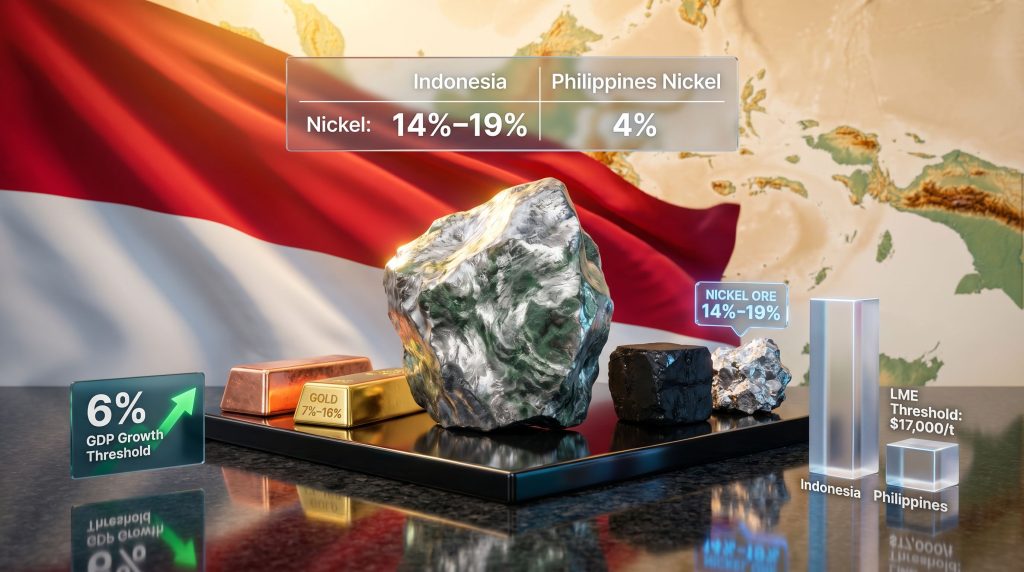
| Nickel Ore | 14% to 19% |
| Copper | 10% to 17% |
| Gold | 7% to 16% |
| Coal | Up to 13.5% |
Alongside this royalty framework, the government also proposed an export duty on mineral shipments, including coal, as a separate revenue instrument. An initial implementation date of April 2025 was identified for the windfall tax component before technical coordination problems between the Ministry of Energy and Mineral Resources and the Ministry of Finance caused the timeline to slip. As Reuters reported, the repeated delays reflect deeper structural tensions within Indonesia's regulatory process.
"The core challenge with price-linked royalties is that their attractiveness depends entirely on commodity price conditions at the time of implementation. A royalty designed to capture windfall profits at $20,000 per tonne nickel becomes a financial burden at $15,000 per tonne."
Indonesia Delays Higher Mineral Royalties and Export Duties: The Industry Response
The confirmation that Indonesia delays higher mineral royalties and export duties came after a sustained period of industry consultation. Minister Bahlil Lahadalia stated publicly that the government would pause implementation in order to develop a policy formulation that is genuinely workable for both the state and mining operators. The ministry indicated it was actively gathering feedback from producers to ensure the eventual policy does not impose unsustainable burdens on the sector.
The industry pushback centred on two interconnected arguments. First, commodity price conditions. Second, sector-level financial health.
On nickel specifically, the Indonesian Nickel Smelters Association (FINI) pressed the government to defer new royalty obligations until London Metal Exchange nickel prices recover to at least $17,000 per metric tonne. At the time the request was made, LME nickel prices were trading at approximately $15,600 per metric tonne, creating a gap of roughly $1,400 per tonne between the market price and the threshold industry considered necessary to absorb additional fiscal charges without triggering operational losses or capital reallocation.
On sector health, the broader context was equally challenging. Furthermore, Indonesia's mining sector experienced a contraction of approximately 2.14% in the first quarter of 2026, pressured by elevated energy input costs and a structural oversupply in the global nickel market. The combination of falling prices and rising costs created exactly the kind of margin compression that makes royalty increases most damaging, and least likely to generate the incremental revenue governments anticipate.
Investors and operators also raised a less visible but equally significant concern: regulatory fatigue. Two major proposed fiscal adjustments within a twelve-month period, neither of which reached formal implementation, created a planning environment where long-cycle capital decisions became difficult to underwrite with confidence. The Indonesian nickel price trends heading into 2025 had already signalled the fragility of industry margins before the royalty debate intensified.
Benchmarking Indonesia Against the Global Royalty Landscape
To understand why Indonesia's proposed rates generated such resistance, it helps to place them in an international comparative context. Resource taxation varies enormously across jurisdictions, reflecting differences in geological endowment, political economy, investment climate priorities, and government revenue needs.
| Country | Commodity | Royalty Model | Rate / Range |
|---|---|---|---|
| Indonesia | Nickel Ore | Price-linked progressive | 14% to 19% |
| Indonesia | Copper | Price-linked progressive | 10% to 17% |
| Australia (WA) | Iron Ore | Ad valorem | ~7.5% |
| Chile | Copper | Progressive, profit-based | Up to ~46% effective rate |
| Philippines | Nickel | Flat excise | 4% |
| Democratic Republic of Congo | Cobalt | Flat royalty | 10% |
The competitive sensitivity is most acute in nickel. Indonesia's proposed progressive nickel ore royalty of 14% to 19% sits dramatically above the Philippines' flat 4% excise rate. Given that both countries compete for the same pool of international mining investment and both sit within the Indo-Pacific's laterite nickel belt, this gap is not academic.
Investment allocation decisions for greenfield exploration projects take explicit account of comparative fiscal regimes, and a 10 to 15 percentage point royalty differential is material enough to shift capital deployment decisions. In addition, the challenges facing Indonesia's nickel industry in 2025 have made this competitive gap even more consequential.
Chile's copper framework offers an instructive parallel. The effective combined government take in Chile can reach approximately 46% under high copper price scenarios, yet Chile continues to attract large-scale mining investment because its fiscal system is perceived as stable, predictable, and consistently applied. The lesson for Indonesia is that the absolute level of the royalty rate matters less than the credibility and consistency of the policy framework.
The Structural Consequences of Repeated Deferrals
Policy deferrals carry costs that compound over time. In the short term, the postponement of higher royalties relieves margin pressure on Indonesian mining operators and prevents an immediate flight of capital. Indonesian mining equities typically react positively to deferral announcements, with sector valuations recovering ground lost during the initial announcement phase.
However, the longer-term consequences are more nuanced and, in several respects, counterproductive to the government's own objectives:
-
Policy credibility erosion: Each deferral cycle reduces the probability that institutional investors will treat subsequent policy announcements as credible. This introduces a policy uncertainty premium into capital allocation decisions, effectively raising the cost of capital for Indonesian mining projects.
-
Danantara revenue impacts: The sovereign wealth fund's projected income streams depend partly on the royalty revenue that higher extraction charges were designed to generate. Deferrals reduce Danantara's near-term deployment capacity, which creates a feedback loop in which fiscal pressure intensifies precisely because the revenue measures designed to relieve it have been delayed.
-
Inter-ministerial credibility damage: The repeated inability to reach a final policy position signals coordination dysfunction between the Ministry of Energy and the Ministry of Finance. This institutional friction has real economic costs because it signals to investors that the regulatory environment remains unresolved at a fundamental governance level.
"The paradox of Indonesian royalty policy is that each deferral, while economically rational in isolation, collectively makes the regulatory environment less stable than a clearly defined, consistently applied higher-rate framework would."
The next major ASX story will hit our subscribers first
Indonesia's Nickel Dominance and the Global Battery Supply Chain Dimension
Any analysis of Indonesia's royalty policy that ignores the country's structural position in global commodity markets is incomplete. Indonesia controls approximately 40% of global nickel reserves and is the world's largest nickel ore producer. This concentration of supply creates a geopolitical dimension to Indonesian mining policy that extends well beyond the bilateral government-industry relationship.
For electric vehicle manufacturers and battery cathode producers, Indonesia's regulatory environment is a material supply chain risk variable. Nickel-rich battery chemistries, particularly nickel manganese cobalt (NMC) formulations used in high energy-density EV batteries, depend on reliable and competitively priced Indonesian nickel inputs. Consequently, the lithium boom driven by battery storage expansion has made Indonesian nickel even more strategically significant to global supply chains.
When Indonesian regulatory uncertainty rises, downstream manufacturers have a commercial incentive to accelerate portfolio diversification, including:
- Increasing procurement from alternative producing jurisdictions such as the Philippines, Papua New Guinea, and emerging African producers
- Investing in alternative battery chemistries, particularly lithium iron phosphate (LFP) formulations that eliminate nickel dependency entirely
- Accelerating development of nickel recycling streams to reduce primary ore requirements
The cumulative effect of sustained Indonesian policy uncertainty could therefore be structural demand destruction for Indonesian nickel, rather than simply a temporary reduction in investment inflows. For instance, battery raw materials market dynamics in 2025 have already demonstrated how quickly procurement strategies can shift when supply certainty falters.
What Would Actually Trigger Full Implementation?
Based on publicly available government statements, three conditions appear necessary for the progressive royalty framework to reach genuine implementation:
-
GDP growth momentum: The Finance Ministry has linked new fiscal measures to macroeconomic performance benchmarks, with a 6% GDP growth threshold cited as the level at which new charges would be introduced without risking economic disruption.
-
Commodity price recovery: LME nickel prices would need to sustain levels above $17,000 per metric tonne, with analogous recovery signals required in copper and coal markets to justify implementation across all commodity categories.
-
Formula finalisation: The inter-ministerial process of developing a "mutually beneficial formulation" must be completed to a standard that satisfies both revenue objectives and industry viability concerns.
All three conditions converging simultaneously is not guaranteed within any near-term window. Under a base case commodity recovery scenario, a modified and phased version of the framework could emerge in late 2026 or 2027, with rates introduced at the lower end of proposed bands. According to Business Times, this ongoing policy uncertainty continues to weigh on the sector's investment outlook.
Strategic Considerations for Investors and Operators
The royalty deferral environment creates distinct risk and opportunity profiles depending on a producer's commodity exposure and operational structure:
-
Short-cycle coal producers face the most immediate exposure, given that export duties on coal were among the first proposed measures. These operators should model royalty cost scenarios across a range of implementation dates and price environments.
-
Nickel smelter operators benefit from the current deferral window but should use this period to stress-test capital structures against both $15,000 per tonne and $17,000 per tonne LME price scenarios, incorporating full progressive royalty charges into the downside case.
-
Copper and gold producers operating under existing Investment Agreements (IUP and IUPK frameworks) may hold contractual protections that limit retroactive royalty application. The enforceability of these protections under new government regulations is a legal question that warrants specialist advice.
-
Downstream processing operators occupy a structurally advantaged position. The progressive royalty system is designed to penalise raw ore exporters more heavily than refined product manufacturers, embedding a structural incentive toward domestic beneficiation that is consistent with Indonesia's longer-term industrial policy direction. However, the significant role of China's investment in Indonesia's nickel sector adds a further layer of complexity to how these downstream advantages are ultimately distributed.
Ultimately, Indonesia delays higher mineral royalties and export duties not simply as a matter of administrative convenience, but as a reflection of genuine structural tensions between fiscal ambition and investment reality. The path to a durable policy framework will require resolving those tensions rather than deferring them indefinitely.
Disclaimer: This article is for informational purposes only and does not constitute financial or investment advice. Readers should conduct independent research and consult qualified financial advisers before making investment decisions. All forecasts and scenarios discussed represent analytical possibilities, not confirmed outcomes, and are subject to significant uncertainty given the evolving nature of Indonesian regulatory policy.
Want To Catch The Next Major ASX Mineral Discovery Before The Market Does?
Discovery Alert's proprietary Discovery IQ model delivers real-time alerts on significant ASX mineral discoveries, transforming complex commodity data into actionable investment insights — ideal for investors navigating volatile regulatory environments like Indonesia's evolving royalty landscape. Explore how historic mineral discoveries have generated substantial returns and start your 14-day free trial at Discovery Alert to position yourself ahead of the market.